SP-5 IFC Radar Maint Chief
A/2/52 (HM-69) 1966-68 (this is from my memories --- any additions / corrections / names of people – please contribute )

FT. BLISS LIVE FIRE:

Proposed Purpose -Try to capture some of the (techie) life and times of the era.
Proposed format:
Also see People Stories
Listed usually most recently arrived at the top (near this point) until a better organization makes itself evident.
Click on high-lighted name to send e-mail to that person.
HIPAR - stories from Bill Shaw- July 2020
|
That huge klystron that was used in the HIPAR was vertically mounted in an oil compartment with a small leaded glass
observation window to prevent x-rays from getting out.
I forget just how many different cabinets were in the HIPAR bldg but every one had at least 1 interlock switch to prevent someone from getting electrocuted. The driver for the big klystron cabinet had better than 300KV in it and current more than a few milliamps. :-))
Here is something I often wondered about. On could stand on the ground 90 ft below the rotating antenna hold a fluorescent bulb up in the air and it would light brightly as the antenna rotated. We did always see several dead birds that got hit from the HIPAR waves.
Ed Thelen says: You can make a parametric amplifier with very low thermal noise - can be great for the first amplifier stage in a receiver! |
Calculated Error :-((
submitted Sept 2016
|
by: Theodore L. (Ted) Swanson
SP-5 IFC Radar Maint Chief A/2/52 (HM-69) 1966-68 (this is from my memories --- any additions / corrections / names of people – please contribute )
FT. BLISS LIVE FIRE:
|
TRR - Help ;-)) from George Wallot - August 6, 2016
|
I spent 6 months in Ordnance Nike tracking radar and associated test equipment at
Redstone Arsenal in 1962. Due to personnel shortages in Anchorage, AK, I did not
get the full training boo hoo. This left me untrained on the TRR and Ord shop 3
but still responsible to maintain them. Needless to say, I was the lead tech
assigned to get them up and running.
I spent a great amount of time with some help from WECO engineers during my 2 years trying to get the TRRs functioning with no luck. I heard many years later that all 4 TRRs were replaced with ones that worked. The original ones were apparently declared FUBAR as we would call them in the Army! I would like to know what problems were fixed with the original TRR that finally got them working? I left the Army in Jan 1964 to go back to college. Anyone have the answers to my questions about the TRR? This is one of the few problems in my life I was not able to fix, but I never gave up on it.
Ed Thelen here - someone (this web site is bigger than my brain) wrote many years ago that part of the TRR antenna RF system that was really tricky - and that he spent his time in Germany traveling about solving that impossible problem.
Any help with the TRR ??
|
Near mishap at Edgewood - July 2014
from Rob Weiman
|
My name is Rob Weiman and I am the son of CW3 John Weiman. My father was the Warrant officer in Anchorage
but we left the day of the earth quake. We were flying from Fairbanks and still in the airplane when the quake hit.
Also, when we lived at Edgewood, Maryland during an inspection they had a rocket fueled and with a live warhead on it that got stuck 1/2 way on and off the elevator. The missile was at about a 30 degree lean and the elevator would not go back up (according to my dad). Dad called some guy he bowled with (don't remember his name) from a nearby base (actually called the base and asked to be connected with him) and said something to the effect of "This is CW3 Weiman from the Nike Hurk battery, Imagine the worst thing you can imagine happening over here, it's happening now. We need your biggest crane and your best operator and we need him ASAP. They sent the crane and the operator. The odd part of the story is that dad was calling for some guy he bowled with that happened to have the exact same name as the base commander, and they put him through to the base CO, who supplied the crane he needed. Rob. |
Tall Tower, Heavy Slip Ring Assembly - Mar 2014
from Bob Belli
|
while spending time at the 166th Ord. Co. at Ft. Wainwright AK.
One of the five sites that the 166th was tasked to maintained, had one of, if not the tallest, TTR antenna to be found anywhere. The local terrain dictated that the antenna was mounted on top of this tower. Some thirty feet off the ground as I recall. Only access was a spiral staircase, enclosed in a walled tube. Something went wrong with the antenna, and the problem was isolated to the SLIP RING assembly. That puppy was, as I recall, about 14" in diameter and about three feet long. And it was heavy!! It took three of us to muscle it up that damn spiral staircase. We could have used more help, but there wasn't room for that many bodies! We did get it up there, and changed out. But what a trip that one was. Maybe that is why my back is so bad today!! |
electrical short - then Battle Short! - Mar 2014
from Bob Belli
via Roger A Babler webmaster for
a-2-562 “Moose Creek Nike”
|
I remember one incident (of many) that happened to me.
I was in the Acquisition trailer, making adjustments on the display for the lo-power acq. radar. The operator complained of something to do with the presentation or sweep time.. I arrived out at site, I'm thinking it was either Bravo or Delta battery (the furthest from Ft. Wainwright), very late one evening. I had the radar console pulled out onto the shelf, changed out the writing gun driver, and was making adjustments. I was sitting on an operators chair with wheels. I was adjusting the -28V power supply through a plastic cover with a pocket screwdriver and pressing the "erase" button on the front panel at the same time with the other hand. Well, I got into contact with the blade of the screwdriver with my one hand and the metal around the erase button with the other hand. The next thing I remember, I was across the trailer thinking that I just got hit by lightening!! Wow, what a rush. While trying to recover from that wake up, all hell broke loose. Sirens all over the place and people running into the IFC area. I never finished adjusting and replacing a console so fast! The battery had been called up to HOT status because of a Russian Flyover!! Around Fairbanks, we had at least one per week. That was an even bigger rush. I stepped back while the operators took over and it's the first time I saw a battery bring up the radars using the BATTLE SHORT startup! We in Ordnance rarely used it. That bypassed the usual warm-ups, but I guess you would know that! Gee, makes the hair on the back of my neck stand up just thinking about it!! Here I was, just about 21 years old and all that was happening right in front of me. At the time, it was a rush, but now that I'm pushing 70, it is even more exciting. To explain it to a layman, just doesn't do it justice. It's one of those "ya just had to be there" moments!
Bob Belli,
Roger A Babler webmaster for a-2-562 “Moose Creek Nike” asked > BATTLE SHORT ??
Ed Thelen responds:
Ah yes - The BATTLE SHORT short circuits protective timers -
Case in point -
Normally there was a 15 minute timer that started at system power up, and when the 15 minutes was up you could start the LOPAR operating (transmitting). OK - but one day the battery commander, Capt. Hill, wanted to know what would happen if he was in a hurry, like the Russians were close -
So he asked us maintenance people what would happen if
he operated the red Battle Short
switch and started transmitting.
We had been told that this switch was for emergency use only.
?? Did it also cheat the safety interlock system ??
Well - he wanted to know what would happen - and so about five minutes after we
powered up the system he operated the
So - he was happy, but the experiment was over and he henceforth
waited the normal 15 minutes - and we in maintenance were relieved. :-))
Ed Thelen
|
Fueling Ajax in New Mexico heat :-(( - June 2012
from BillHinds@aol.com
|
Hi Ed,
Gosh, you sure surprised me. I was boring my wife repeating old 'war stories' and Red Canyon Missile Range came up. I was telling (once again) about the base there and the beautiful chapel Ed says "Yeah - wives have to put up with a lot - mine just spaces out - " when suddenly I thought I would get on the internet and do a search for Red Canyon Missile Range. I never expected to find anything...but you never know. I didn't realize the life of the base was so short. I was just a visitor there, going to fire every year. We had it better than some as we flew civilian as the advanced party doing the missile assembly and check-outs before the second week when the firing crew came in on contracted air transport and made the long trip by bus from Fort Bliss/El Paso Airport to the Canyon. Those contractors who flew the main party deserve mention as they were not very safe. Every body came back to home base after the shoot on those things. One flight the hydraulics were so bad the cargo doors wouldn't stay shut so we couldn't fly over twenty thousand feet as there was no oxygen. Their fix was to string a quarter inch rope across the back 15 feet and told us not to sit beyond the rope. The gap between the doors was wide enough to see the ground below. We didn't know about oxygen deprivation in those days which would explain everyone falling asleep and getting headaches etc. Except for Rosy Hendren who got air-sick even getting near one of those old prop jobs. Things I remember. First I'm fairly certain the Ajax was bigger than 12 inches in diameter as the middle war-head was over 12 inches in Diameter as I recall and weighed 313 lbs. The fuel was Red Fuming Nitric Acid and the Oxidizer I think was later J-4, I've forgotten what was used before that. I know the acid came in a barrel that looked like an over sized beer keg. We were always careful with the stuff, cracking the bung and gradually unscrewing the lid because of a danger of blow-out especially in those hot New Mexico summers. The starting mix was UDMH, Un-Symmetrical Dimethyl Hydrazine, pretty nasty stuff that, supposedly caused something similar to leukemia if exposed to it. All we had to protect us was those old rubberized hooded suits with a face mask, rubber boots and some heavy duty rubber gloves which was always checked for pin holes before we suited up for the fueling portion of the exercise. God, the fueling exercise was a miserable affair. I'll bet it was 140 degrees inside those suits in those New Mexico summers. I remember rolling the hand-truck with the Acid to the prep area, sweat pouring down my face so bad I couldn't see where I was going! Everybody learned quick to tear off a bottom of the T-shirt and wrap it around your head. It wasn't all bad. Actually going to fire was like going to a school or family re-union, we would meet people we had gone to tech school with sometimes even some body from basic training. Guys who were back from every where. |
Have Kit, what Launcher Angle? - Nov 2011
from Enno Dittmar
> ... find a model kit of the NIKE Hercules,
> I finally got lucky and managed to purchase one of the
> original "History Makers" Kits from Revell -
> it dates back as far as 1982, so its 30 years old!

Great, I likely have the same version :-))
 ( Gathering dust, I should cover it with a plastic box  ;-))
I should have saved the attractive box :-|

> There were to my memory two different launcher erection angles,

Oh - I am almost 60 years out of date - and Ajax only also -
With the above limitations :

   - The prelaunch configuration of the computer
         ( to compute the approximate predicted point of impact
             if the missile is launched 'right now' )
         considered the launcher to be vertical.
      I did not notice any difference in that part of the Hercules
         analog computer.
      [ I have no info about the later digital ( 1974? ) computer. ]

   - In our (1953) Ajax training, we were told that :
       a) the angle of the launcher was limited,
           and that it was totally dependent upon the location
           of the Booster Disposal Area.  The idea being
           to drop the boosters into a relatively safe area.

       b) the near vertical angle was adopted to permit the
           Nike site to efficiently attack aircraft from any azimuth.
           ( The longer time to perform the initial dive was
              an engineering compromise for the any_azimuth capability.)
           ( I notice the smaller HAWK and Patriot, and later missiles,
              are aimed at the expected Intercept Point,
              for faster intercept and marginally greater range.)

    - Until your e-mail, I have never heard any other suggestion.

Best Regards,

   Ed Thelen
Dear Ed, I am a German Air Force Officer who started his military career as a BCO in a German NIKE Battery (I served with Delta Battery, SAM Bn 24 in Ristedt, Lower Saxony, Germany), the last one to phase out here in Germany, and one with special warheads, too. Having searched stores, shops and the internet for literally decades now to find a model kit of the NIKE Hercules, I finally got lucky and managed to purchase one of the original "History Makers" Kits from Revell - it dates back as far as 1982, so its 30 years old! The kit is in perfect shape and I have almost finished the assembly. I intend to build a static display inside a glass box on a wooden pedestal with a brass plate stating the name and basic facts of the NIKE Hercules and place it in my office - sort of an altar (not for praying, though). :o) To do so, I need some technical information about the launcher, which I have been unable to find on your fabulous website. Maybe you can help me out. There were to my memory two different launcher erection angles, depending on target azimuth (direct or over shoulder trajectory) and warhead type (we had conventional BHE warheads loaded during normal readiness status). One angle was close to vertical, something around 86.5°. The other one was significantly less, could it be 67.5°? I should like to fix the launcher of the model in a correct elevation for the display. You can find a variety of photos where the launcher is elevated only half way up to make it fit into a photo frame (like the one of my training crew at Fort Bliss attached to this mail, I am the tall bearded guy in the center underneath the booster connection ring). But that's not operationally accurate, and therefore I would like to use one of the correct elevation angles, preferably the lower one to keep the display box smaller. Hopefully you have this information available - judging by the quality of your website you probably know it by heart! Thank you very much in advance. Fondest regards to an old NIKE buddy from Germany, Enno |
SCR-784, a compact version of the 584 & more - May 2011
from Jim Spieth
|
Subject: 1947
See Jim's pre Japan invasion story The articles about radars and anti-aircraft guns I accidentally found while searching for something else brought back a flood of memories of my brief time in the army, fall of '46 to spring of '48. I was trained on radars at Ft.Sill where the SCR-784, a compact version of the 584 was modified to track mortar and artillery shells to plot position and direct our fire. Properly located ourselves we could plot guns plus or minus 10 yards. By stopping the dipole motor and positioning the beam vertical and scanning at ground-level we could spot troop movements on the range scope, too, by the unusual wigglings among the ground clutter. Most fascinating when getting back to Ft, Bliss was the assignment at Ore Grande firing range testing the new, improved 120mm anti-aircraft gun involving a B-29 pulling target sleeves at 30,000 feet since the Soviets now had copies of our B-29 and the 90 couldn't get up that far. Other tests involved B-26 Martin Marauders pulling sleeves over 40mm sites and the problems of spotting and locking onto the much faster new jets just coming on-line. Of special interest was since Oro Grande was just across from White Sands we had to shut down every time Werner VonBraun was going to fire a V2 rocket up showing us how to do it. Watching through a theodolite telescope was like being there in person---got to watch the birth of our missile program! At Sill we also used a portable radar called ANTPQ-3, a 100 mile search unit scaled down to 10,000 yards where the antenna was made out of tubular aluminum covered with chicken-wire---honest---chicken-wire! The frequency was so low chicken-wire could focus the beam and since it couldn't be tilted enough you had to bounce the beam off a hill to get elevation! Ah, the memories! |
Over The Top - from George Peltonen- July 2010
|
Hi Ed,
Reading various articles on the Hercules Capabilities, reminded me of a live fire in 1960 or 1961. I was stationed with the Nike Battery above Eielson AFB in Alaska. We were the host Firing Battery for the Fairbanks Defense. I was a SP5 Acq Operator during a live fire (ASP?). Ed here - what were you shooting at?? I know your question "what were you shooting at??" is rhetorical, but we were shooting at an actual, live manned Air Force Fighter Jet from Eielson AFB. In the Fairbanks area there was a severe shortage of live aircraft in the sky to run tracking tests etc. During live firings we used live, manned Air Force Jets, the radars were off-set 1600 mils and we had two Air Force Officers looking over our shoulders all the time and they had communications at all times with the pilot. Normally they would bring the pilot who was to fly this mission to the Site prior to see first hand how this worked, but for some reason, this pilot had not been briefed because he had no intention of being a target for some Amy Missile Test. The two Air Force Officers in the BC Van had a hard time convincing this pilot he would be safe and he eventually flew the mission. This was a time before the T1 Flight Simulator and no RCATS in Alaska. |
Over Rated Fuse - from Tom Woodbury - July 2010
|
I was attached to the 55th Maintenace Battallion at Camp Humprhreys in the Signal Platoon.
We repaired communciation equip that came from the field. Made approx 5 trips to D Battery
in my 21 month hitch there 1968 through 69 helping to bring the TRC 47s back to life.
Like snapshots in life there are certain memories that always linger.
Recalled getting orders from my Warrant Officer(Billy Southern) that one of the TRC 47 transmitter sections went up in smoke. Grabbed a TRC 47 transmiiter section we had in a illegal can room jammed with all sorts of communciation equipment. Took the 2-3 hour or so up to D Battery and was firmally chewed out by a officer there. Seems I had repaired that same transmitter a short while earlier and overlooked the very large over rated fuse that someone had put in. Power supply shorted and blew out the transformer. Transmitter was full of Tar. Good thing they had some sort of chemical that removed the tar. Installed old transformer and blown cap and all was well again for awhile. Officer there really putting down the 55th Maintenance, but i did remind him that we were there to help. That sort of soothed him down. |
Tracking radar could theoretically be ready to
fire the second missile in 30 seconds total? - Mar 2009
Tracking radar could theoretically be ready to
fire the second missile in 30 seconds total? - Mar 2009
> 2) The guide also said that the tracking radar could theoretically be ready to
> fire the second missile in 30 seconds total. I don't recall it being that fast as well
> as other things have to be done to actually fire. I agree that it is amazingly fast.
Lets assume two or more missiles are ready and "vertical" ;-))
We are dealing with two tracking radars, each with aids to tracking the next
- target
- missile
as fast as practical.
Lets do the Missile Tracking Radar, (MTR)
as there are fewer complexities.
a) behind the MTR operator is a cabinet with the
elevation, azimuth, and range of each launcher preset.
b) after the missile bursts, the MTR operator can command
the radar to slew to the correct elevation and azimuth,
and simultaneously the MTR range servo to slew to lock on
to the next designated missile.
This is actually the easiest, fastest, and most automatic part of the
"get ready to fire another missile" operation.
Target tracking radar(s)
a) there is an electronic aid to help slew the TTR (and slaved TRR)
to the target designated by the Battery Control Officer (BCO)
b) elevation has to be searched for manually by the Elevation Operator.
c) if the new target is not successfully jamming the TTR or the
Acquisition radar (both are needed) the TTR should be able to lock on
to the next target with in 20 seconds of designation.
(say 10 seconds max to get azimuth and range,
and another 10 seconds max to get the elevation and
"Target Tracked"
Actually, if a target is not currently being tracked,
the TTR crew tries to second guess the BCO
about what target is likely to be designated,
and are already tracking it. They can do this because
they see the same Acquisition display the BCO sees,
and they can watch the target designation indicator
move as the BCO moves it - almost a game -
However, there are several procedural consideration, issues, -
that can slow the actual launch of the second or succeeding missiles -
a) after a missile burst at/near the 1st target, the BCO needs some
time to verify the 1st target is disabled enough to go for a second target -
To aid this, there is a target speed indicator for him to look at-
Likely, the target, being badly damaged, will slow dramatically,
of enough to convince the BCO that the target does not
need the attention of another round.
b) If the BCO determines another missile is needed,
- the target is already tracked
- the next missile is likely already tracked.
- the computer is settled
(about 2 seconds after missile tracked and target tracked)
and the next missile is on its way as soon as he hits the fire switch.
(I would guess, in this circumstance, the BCO could send another
missile within 10 seconds after determining the target needs
another missile.)
c) However, if the BCO decides the target is disabled,
and other targets are available, he can with in seconds
move the target designation symbol over the new target
and hit the designate switch.
While the BCO is studying the old target,
the acquisition operator should be aiding this process,
determining Identification Friend of Foe status,
determining if aircraft is in a "safe" flight area,
or other helpful observations.
So, lets say that the BCO could determine that the old target
is no longer a danger (10 seconds?)
and designates another target (5 seconds?)
and the hot TTR crew is hot
and the target is not jamming hard,
they might get "Target Tracked" in say 15 seconds
and the computer and plotting boards settle in 2 seconds
and the BCO is satisfied that the time is right to fire (?5 seconds)
We have an approximate delay between
missile burst and FIRE command to next missile of
say 37 seconds, plus or minus who knows -
I don't know - 40 seconds minus the fudge factor of a friendly docent?
To me, the major uncertainty of over 30 seconds is the time
it takes for the BCO to make a hopefully correct assessment
of the damage inflicted on the target - no trivial task -
The target can play games also :-|
like playing possum, dead, come to life later ;-))
====================
Nike was "Mobile" - well, how "mobile"? - Jan 2009
I was assigned to Charlie section as senior launcher crewman and fire panel opr. I was there
in[C 5/6 Baumholder, Germany] when in 1962
we tested the mobile concept.
S.N.A.F.U of the first order.
David.
As you will soon discover I am not very good at this sort of project. I am trying to recall events that took place almost fifty years ago. I know I will leave out some details and perhaps include some faulty recollections. This project will take a while as I am also dealing with a cataract problem that limits the time I can spend on this infernal machine. I shall press on.
I will begin with a description of C-5/6 Charlie section. C-5/6 was an above ground Nike Herc site. Charlie section consisted of a large concrete pad enclosed by an by eighteen foot high earthen berm on three sides, built into this berm was a firing panel room of concrete protected by three blast proof doors. At one end of this berm was large concrete building called the hangar where the herc rounds where kept prior to loading. This building had two large retractable doors. To load the launchers you opened the front door of the hangar and swung out two movable gates and rolled the round to the launcher. The other end of the berm was open to access the pad by trucks, missile trailers, etc.
Now comes the hard part. The crew of C-section were informed that starting on I believe a Monday morning we would involved in test project to make a Nike Herc launch site mobile. None of the section crew had ever heard of such a program and no one in the battery had either. The operation began with the arrival of the equipment and the tech reps from I believe Ft Bliss. They began to unpack and try to explain the equipment to us.
The first step was to take off the loading rails from the outboard launcher. We then had to support the launcher while the very large and heavy attaching plates were unbolted and removed from the concrete, this took about three hours. The next step was to charge the hydraulic jacks and manhandle them into place on the side of the launcher, as I remember there were six of them. This took about five hours. The jacks weighed about 3-5 hundred pounds apiece.
We then had to manually pump the jacks to raise the launcher high enough to install two sets of wheeled bogey's. The bogey in front had a heavy duty tow bar that connected the launcher to intermediate bogey which was then connected to a trailer hitch on 5 ton tow vehicle. This hook up was a nightmare to drive and almost impossible to back up. This operation took about six hours. After the hooking up was complete the rest of section was loaded, launch firing panel, launch control indicator, cable's etc.
The launcher was now mobile. Elapsed time about fourteen hours. We then moved the mobile unit out of the exclusion area to the limited area to join the rest of the launcher convoy. We then finished loading misc. equipment, tents, personal equip, camouflage nets, etc. The time was around midnight and we were told that move was to begin around seven o'clock the next morning. We had to finish up any personal things and to be ready to reassemble in the launcher area at 0500 hrs. Makeup of the launcher convoy as well as I can remember thru the fog of very little sleep and fifty years of memory loss is as follows: Mp escort jeep, convoy commander and 1st sgt jeep. commo van 3/4 ton truck, Nike Herc missile trl 5ton tk, assy crew with assy equip 5 ton tk, mobile launcher with section pers & equip 5ton tk, 500 gallon water truck, L.C.Trailer and security pers 5 ton tk, generator pers with gen 5 ton tk, launcher plt ldr & plt sgt jeep. I believe 10 vehicles total. I have tried to reconstruct this part of the operation as accurately but I know I am not 100% factual.
Convoy to training area(day two)
The convoy left C-5/6 at approx. 0645 headed for a training area that two this day I am unsure of it's exact location I seem to keep thinking it was around Wetslar Germany. You must remember ever thing I relate is from a very tired P.F.C. not exactly a member of the command staff. The trip to the training area was fairly uneventful except for German civilian's shouting and laughing at the chains we had on the wheels of the trucks. The convoy arrived at the designated area about 1300 hrs. We started to unload pick the spots to set up the launch area. While I am in this section I forgot include a motor pool 5 ton with a fuel trailer attached and mess hall 5 ton with trailer. That would increase the convoy to thirteen for launcher area.
Set up day two.
This part of my knowledge of the events will be interrupted because of four hour stint on K.P. I finished my K.P. duties about 1700 hrs and rejoined the fray at the launch site. I was immediately assigned to finish the checkout of the firing panel circuits. It was now getting dark and growing colder. To help the crews we brought in all of the vehicles and used their headlights to light up the scene. About this time things really started down hill.
I noticed that our battalion ex and our battery CO were engaged in rather heated discussion with three French army officers. I was about forty feet away and did not hear the whole conversation but I heard enough to know it was not good. I will offer a liberal translation. The French officer told our Bn ex that we setting up in a French mortar range impact area and that they intended to fire the next day 0800 hrs. The Bn ex turned to our Bt CO and told him he would have to move the site. Our Bt CO replied in very loud voice "If I move this S.O.B. I will move it back to Baumholder". The Bn ex then replied "you have twelve hours".
And so the disaster continued and in fact intensified. The Bt commander told M/sgt Gjardahl launcher Plt sgt what we had to do. Sgt Gjardahl called the platoon together and gave us the word to start undoing what we done over the past five hours. Sgt Gjardahl stated that he knew we were tired and wet but he had to ask for one more max effort. We had to do in twelve hrs in the semi darkness, what we had accomplished in the previous twenty four +plus hours. We started immediately to try to accomplish this seemingly impossible task with a remarkable lack of complaint.
I think that Baumholder, whose nickname was "the _ _ _hole of the world", began to look like Heaven. The first steps were to remove all cables and equipment from around the launcher so that we could gain access with the wheeled bogeys. While one crew packed up the L.C.I. and the firing panel and their cabling another crew was manhandling the bogey's into place near the launcher. The launcher was then jacked up and the bogey's attached. We then turned our attention to disassembling the rest of the area, ground defense equip, tents, misc vehicles any thing that would be in the way of moving the tow vehicle's into place.
A strange thing happened during this part of the operation. I will relate it as I remember it. I was working to attach one of the bogeys and we needed more light. We called for some one to move a truck so we could light up this area, someone jumped into the truck and started to back it up. This person backed directly over a tripod mounted .50 cal M.G jamming it into the rear tandem wheels. We yelled and the driver stopped, out jumped Sgt Gjardahl and asked who ran over that gun? We replied "you did". His answer was "Not me, I don't have a license for that truck".
This was the way it went all thru the night. As I remember we had the launcher site ready to move by about 0430 hrs in the morning about nine and half hours. The mess Sgt had some how made bisquits and bacon and coffee. We ate, laied down and waited for M.P. road clearance.
Road clearance came about 0630 and we left to return to our site in Baumholder arriving about 1300 Hrs. Upon reaching the site the Bt Co said put the equip in limited area, told the troops go "do what ever you want." "I don't want to see you until tomorrow."
I will send this to you now if you have any questions I will try to answer them. I am having eye surgery Feb 9 so I kinda wanted to get it to you so you could determine if it has any worth. I know I left many things out due a perhaps faulty memory. Maybe some one else can fill in the blanks I hope so. I will sent more info in a separate e-mail as I am over my time on this computer as recommended by my eye doctor.
Jamming Exercises - September 2008
We must have given them some ego problems as about the only times they penetrated us was when we were training a newer crew or they cheated. Often for their last run they would come in under our radar mask and then pop up and overfly the IFC area at about 200 feet. One time they were running a B-52 against us when we suddenly got totally wiped out. In just a few minutes we received a call from ARADCOM asking if we had just received some jamming that had looked like “Telephone Poles” moving across our a-scopes. We replied yes and were told “No you didn’t. Forget anything like that ever happened.” So we figured the B-52 ECM officer cut loose with something the Russians might not know about.
We got a lot of Russian “trawlers” off the coast and whenever they were around we would go into “ELINT” conditions and limit our radars to a 10% frequency shift. We used to joke that if we had a problem that was stumping our maintenance men we could call up the Russian Consulate and they could probably suggest a fix.
We had a T-1 trailer and used it extensively. We never tracked in an automatic mode on the TTR because if you broke lock due to jamming the antennas would slew anywhere. We would set up an “assisted” mode (Did you have that on your TTR?) where the gyros in the Azimuth and Range positions continued to track on the same course as before lock was broken. The Elevation operator would begin an elevation search while the TRR operator tried to find a hole in the jamming.
Our maintenance men, who were running the T-1 training, were seeing our a-scopes and what effect the jamming was having. They would simply reduce the gain on the signal until we were tracking on the ragged edge. I always enjoyed T-1 training even though I knew we ultimately were going to lose. You just can’t track a signal that isn’t there.
Randy
Ed replies -
Our generator operator :-(( - August 13. 2008
The "goat" of our IFC area was easy to identify. He was short, rat faced, sloppy past extreme (even worse than me),
if he had cigarettes - one was in his mouth, and close to "retarded".
You have to give everyone a job, we didn't have spare folks - so Captain Hill appointed him IFC generator operator.
The guys noted that he liked to smoke while filling the 5 foot high 40 KW 400 cycle generators with gasoline - and after some warnings,
they got physical with him to discourage further cigarette smoking while pouring gasoline. He was resentful about this.
(He apparently got out of generator school successfully - maybe the school people strip searched him daily to remove cigarettes?
Maybe all tests were pencil and paper?)
We had two generators, and when we went on red alert, "we" fired up both generators. "We" synchronized and phased to
city power one generator, we went off city power, generating all our power incase our city power went off for some reason.
One night, during a long alert, the on-line generator was getting low on fuel. Normal operation was to synchronize and phase the
off-line generator and transfer the load to the fresh generator - then turn off the used generator, let it cool and refuel it.
Our "goat" apparently decided the above procedure was unnecessary. He stood on a stool and started to pour a 5 gallon can
of gas into the hot, roaring, on-line engine. !!!
Fortunately it was a hot night and the doors of the vans were open and we saw the bright flames just as they started.
Fortunately the required big red fire extinguishers were handy to the generators. Van folks poured out and put out the fires.
Would you believe the "goat" was only slightly burned, and we could repaint and fix up the generator without a report to headquarters.
Our "goat" disappeared - and Woody Woodward showed up and was quietly competent with the generators.
A few months after our "goat" disappeared, "Casey" started sitting on his bed, sharpening his bayonet, a lot. He no longer talked much with folks -
After a few months, he attacked his buddy "Brisco" with the bayonet - for reasons unexplained "Brisco" survived, and "Casey" disappeared.
The gasoline 40 KW generators were OK, but the phase indicators were faulty. The phase indicators were improperly designed and burned out
way too fast. Techies know that the peak AC voltage is about 141 % above the "RMS voltage" or equivalent heating voltage. The phase A of
the generator was connected to phase A of the power source to be phased with. (There were three bulbs, one for each phase pair.) The goal being that there be little voltage between the synchronized
phases when you "cut over" to the generator. The above implies that when the two sources are exactly out of phase, but at about the same frequency,
there will be about 280 % of nominal voltage across the phase lights - for several seconds as you gently try to phase up. The phase lights were
rated for 200 % of nominal voltage - but the 40 % over voltage intervals during phasing caused very short bulb life - there was a retrofit correcting this situation
after about a year on site.
The above sounds more complicated than it really is - give me a pencil and paper, and let me wave my hands, and it will be simple ;-))
Multi-path missile track during launch problem - August 12. 2008
[Referring to the new Multi-path section.]
the section looks fine to me.
This was a very complicated problem with cheating and lying involved.
The U.S. Colonel Wilfred O. Boettiger mentioned in his book "Former
Classified"
(Xlibris Corporation 1-888-7XLIBRIS / www.Xlibris.com / 14741-BOET)
ISBN: 1-4010-5048-4)
that the Nike units competed in everything in the 50`s and early 60`s.
Later things were getting worse because being "good" or "the best" was
related to promotion and whatever....
So, telling the HHQ Commander a problem that nobody could solve
(understand) was bad, very very bad!
Looking at the problem, the worst case was the loss of a NATO assignment.!!!
Losing 2 out of your 4 batteries, what would you as a battalion
commander say/report to HHQ?
"I don`t no why but we cannot acquire a (some) missile."!? And no solutions!
Radar theory and problems were not part of the IFC maintenance course!
One fine day I met my first BCO on site in Wiesmoor. At the time he was
"Regiment Commander" (He left the Air Force as General).
We talked about the problem and I told him my (emergency) version of
solving the problem during war time. (Remember the trucks in the line
of site.?)
He told me that another battery (24th battalion) had the same problem
and solved it by building up a fence between the IFC and LA.
WOW, I told him that this measure would not solve the problem
constantly. "Well, they reported to me that the problem is solved!"
(In short.) "Yes Sir".
Some time later I talked to a friend of mine who was "Chief" at the time
at the mentioned site. His comment: "Bullshit"!
Nothing was solved. The large folder with all the orders, complains,
plans and ... was untraceable and removed from the safe!!!!
It´s not good to have a (Nike) problem that couldn't be solved.
To shorten the story. There was a lawsuit between the landowner and the
Federal Republic. Finally, a fence was build (expensive)
at the point were the MTR antenna was pointing at (wrong).
The mesh or wire netting was not blocking the reflection instead the
fence only attenuated the reflection because of the mesh design. So the
aiming point moved a bit.
During a Tactical Evaluation the problem did not show up and everything
was in fine order!
Many good (NATO) comments/points and "Ready for Promotion." The winner
was/is? The liar!
By looking at the Nike site locations in northern Germany I assume that
quiet a few sites suffered from multipath effects.
However, before the system was digitized the problem was played down
(dail slack etc.) I guess.
All the best!
Rolf
Wrong kind of spit and polish ;-)) July 25, 2008
Transferred in to our unit [was] a career S.F.C. with no nike training, but his rank put him in charge of a pit.
Old army says keep the troops busy so he told the boys to find some car wax so they could make the white coat
[of the Nike missiles] shine.
I got a hurried call from our trained former pit boss telling me the above story. Quickly I called our warrant officer and field sarg. Four legs could be seen running to the pits where "spit and polish" was told waxing the nike could cause wax in the fin gear causing malfunctions,
Two weeks later Old Sarg was transferred out.
Nike Hercules HAPOT Program April 4, 2008
I was one of a few persons who worked on this "NEW" Innovation of putting complete Hercules Sets together, [ except for the IFC and Launch Area cabling which remained as a consistent part of the system testing ], to be issued to the using Missile Batteries as a complete and tested system, and, there were "NO" malfunctions of the system, so it saved lead time in putting the systems in the field... I left the facility when we were at system No. 80 on Oct.1, 1958 and went to the Douglas Thor Missile, Test Firing Facility at Sacramento, CA.
As we tested the different components of the launch area, if we found any latent malfunction,or re-occurring malfunctions, we would repair same, and write a written report to the headquarters of the Field Service Engineering Section in Lawndale, CA. Myself and a Keith Johnson developed a Missile Simulator, using the Transponder to receive shaping signals from the IFC area [ Western Electric Co. the prime contractor ] the simulator, an interface, remained on the ground and we lifted the Transponder on the end of the Missile Launcher so that the IFC area could see us from about 3300 feet, as the Transponder was up in the air quite a ways. There was the Supervisor Richard Mansfield, and Al Nell, Keith Johnson, Scott ( I can't remember the last name ) and an ex Lt. Thomas, who was stationed at Fort Baker, in Marin County CA. and my self.
Hercules Tracking Antennas development & details - May 11,2007
As a part of that work, I and two other non-Bell Labs consultant microwave theoreticians
were awarded the patent for the Cassegrain twist reflector arrangement;
and I did the mechanical physical design of the reflectors and their assembly.
So I welcome and appreciate the compliments in your text about the twist reflector Cassegrain antenna,
and your recognition of our concerns about other possible inaccuracies in the system caused by solar heating of parts of the
radar tracking antenna assemblies and the effects of wind and the benefits of the little bubble radome which was considered
essential from the start.; The sixty foot tall boresight tower was also my design responsibility.
In the reflectors, placing and holding the hundreds of feet of embedded fine diameter wire, all within the necessary tolerances, was a large concern but as you recognized, use of radome technology, with fiberglass honeycomb sandwich for the mechanical structure, was the ideal solution. While close control of the wire positioning in the honeycomb skins, and control of the dielectric of the resin and glass construction was a manufacturing challenge, it all worked out better than we ever could have hoped for.
One problem we discovered quite early in the design of the precision tracking antennas, you might find of interest. The elevation axis is supported by the two vertical yoke arms cast integrally with the azimuth-turntable. The elevation servo motors which drive the elevation axis supporting the RF electronics & reflector assembly are mounted to the inside metal wall of only one of the yoke arms. Whenever the tracking radars were powered (whether driving the structure or not), the servomotors would generate and dissipate heat. This heat soaking into the metal of that one yoke arm was enough to cause that side of the yoke to slowly grow vertically. If the antenna sits powered long enough, this heating of course temporarily tilts the elevation axis making it no longer parallel to the leveled azimuth plane. This non parallelizm of the elevation axis to the leveled azimuth plane affects the azimuth tracking accuracy when the antenna tracks an object at higher and higher elevation tracking angles (becoming worst when pointed nearly straight upward).
My solution was to attach an equivalent wattage of heating strips inside the metal yoke structure supporting the elevation axis on the side opposite from the servo motors; which strips would be powered - and heating that side of the yoke anytime the servo motors were "on" - whether driving the elevation structure or not - and which heat and resultant vertical metal growth would match that of the side with the servo motors, and keep the plane of the elevating radar beam truly perpendicular to the leveled azimuth plane at all
elevation angles. Tests on early models proved that this correction worked will.
Later I was the lead mechanical engineer on the first large experimental Nike Zeus target tracking antenna which was massive enough to require use of hydraulic servo motors. If you could direct me to any internet site which discusses that early Zeus three axis tracking antenna, I would certainly appreciate it. And needless to say I'd love to hear from any of my old Nike friends.
A method of angle jamming mono-pulse radars
I joined the "Society of Old Crows" when their informative radar presentations via video were no longer available for free.
April Fool, any day ;-)
One of the devices had many contacts. I inserted a thin
clear plastic tab between the contacts and then had the students
troubleshoot the system. Even when they narrowed the malfunction to
the appropriate device, it was still a puzzle. Nothing seemed to be
wrong.
Roy
BIRDiE Techie July 2006
"Harold" - hld41 at bellsouth dot net - received July 4th, 2006
An interesting point is that the equipment vans were air mobile but the airconditioning trucks were not!
The units used discrete component logic and each digital card had a 50-ohm resister from +5 vdc to ground
as a voltage stabilizer and noise reducing factor. That generated a lot of heat.
[200 cards dumped 100 wats with these resistors]
The PPI crt's had four banks of six each beam power tubes of very large size -
it used electromagnetic deflection with symbology [such as circles denoting a target]
placed on the deflection coils as a high frequency rf riding on the deflection ramp current.
Much heat- required three semis to haul the A/C and generator. The tubes were beam tetrodes
about 1.5 inches diameter and 5 inches high.
In the 5, there was a van with two consoles and an electronics van containing digital logic
and analog display circuitry. The second van could have a third console.
The 6 did not have a computer and had one console in the single van.
The computer was a 16-bit serial processor with a bit time of 7.6 microsecond and required 16 clock bit times
to move one word through the cp/u. Main memory was a ferrite coated drum running [about 12,000 RPM] rpm
with about 40 tracks of 1024 bits each divided into 32 16-bit words each.
Data read/write heads were a quarter-inch dia. These were manually adjusted to a
few mils off the drum . It used an air pressure sensor to adjust the spacing while it was running.
A little too much and a big gouge was made on the drum.
It was in a temperature controlled oven so thermal expansion would not mess it up.
The computer was dispersed in several cabinets and used combined
( lo or hi either could be true or false) hi/lo logic.
It was a five-function calculator with a diode-pegboard fixed program and a very simple fixed routine:
convert polar radar data to a Cartesian coordinate reference frame
and increment each target symbol (friend, foe, no ID) each sweep on the PPI.
Increment with each radar sweep. The symbol would jump to a new calculated position and the console operator would manually move the track over the blip. This would give new velocity data for the next sweep update. If the target kept the same heading and speed the computer would do all tracking. Any change required operator intervention
Timing signals were generated to transfer data to the missile batteries.
According to stories from the field, protocol prohibited action based on computer-encoded commands as to firing.
There was capability to hook on to SAGE and NORAD data.
I remember a great deal about the electronics. The course intro described the mission and the tie-in with Nike sites.
I would be happy to try to answer any of your questions,
but please remember a hell of a lot of water has been under the bridge since then.
[Any books? stories? ...]
No books - those were locked in a safe each night. Student schematics went with the students to field assignment.
We were told by some students coming back for retraining that the Martin reps did all maintenance,
so after 11 months of training they pulled KP and policed the grounds. One man was busted down to E-1
for doing a little hands-on maintenance.
RTL IC's were used to update a prototype in 1965 and eliminated the huge power load on the logic curcuits.
Martin wanted to convert all units but the Pentagon has their eye on a Hughes system.
Martin could not provide a mean time between failure becvause in six months testing it
did not fail. That was enough to turn down the Martin proposal. The only thing tat operated
on the Hughes system when I got out was a binary counter arranged in octal pattern. Impressed the brass in a dog and pony show.
There was a feeling among the artillery vets that all this electronics was gilding the lily,
and the missile batteries could do fine with a field radio and on-site radar.
The signal corps folks who were transferred from Monmouth to Blissand put under artillery command
were much irritated at being in the real army. They were retiring left and right,
and the boomlet in Vietnam incouraged even more to get out.
The BIRDiE was a PR effort and was a level of redundancy at the battery level..
It was a good practical exercise in appliacation of high tech, and maybe prepared the military
to accept such new hardware. Mainly it was peacetime and they had to spend money somewhere.
Army Air Defense Board
Some background:
In June, 1955, I completed basic training with the Army and was sent to the Army
Air Defense Board (Board 4) at Ft. Bliss, Texas. My role there was as an
enlisted Electronics Engineer with the Board's Support Division. I served in
that capacity, rising to the rank of Sergeant E5 until my discharge in June,
1977, at which time I took the position of Chief of the Board's Electronics
Laboratory as a Civil Service employee. I remained with the Board in that
capacity until November, 1962, when I left Ft. Bliss for employment in the
civilian sector in California.
During my time at Ft. Bliss, the Board was conducting service tests of missile
systems including the Nike Ajax and Hercules. My role was in the Support
division, however that did not dampen my natural curiosity. I began to wonder
whether the local L-Band radars - I believe they were TPS-!D's - could somehow
be integrated into the Nike Systems to provide some measure of electronic
countermeasure. To this end, I came up with the concept of displaying the
L-Band acquisition radar signal on the PPI console of the Nike Acquisition
Radar. I scrounged the necessary parts to convert the rotational information
from the TPS-1D to a format usable by the Nike System, and built a video
adaptor to provide a compatible video signal from the TPS-1D to the Nike System.
From what I have read, this concept eventually was developed into something
called a HIPAR as part of an upgrade to the Nike Hercules System.
Don Minow
Hey - that is neat - instead of just bitching and moaning - you did something.
Old Herc Radars didn't die, they just worked somewhere else -
from Richard "Max" Vickroy November 2005
The point of all this is that I think they have retired those radars
and still may have them on site (if the Navy hasn't scarfed them up). The
Navy uses the trunions for some type of ship borne radar. Evidently, no one
has produced a radar trunion as stable as the NIKE-HERC's. Anyway, when I
left there in '80 they were still using them but I heard thru the grapevine
that they couldn't find parts for them anymore so they deactivated them.
Someone who was interested could probably pick up the radars and their
control consoles for a song, if they still have them. I also heard that the
Bureau of Land Management was always interested in old NIKE equipment. They
use them to track insects, of all things.
This is turning into a manuscript but when I left Alaska I was
assigned to WSMR in New Mexico with this same ASL outfit. We had six old
NIKE systems used for the same purpose. I found enough repair parts to fill
five old RC vans full to the brim. This included four or five complete
MonoPulse Duplexors. I also picked up the Panama Met Teams two radars when
ASL closed their site there. They were pretty much junk as they had set on
the dock in Panama for a year unprotected and were full of water and mold. I
even had two radar trailers for road marching the radars. All of this
equipment has since been deactivated but could still be at WSMR or Ft.
Bliss. It was all functional when deactivated. It could be in the WSMR junk
yard or, again, could have been picked up by BLM.
Well, I thought someone might be interested in all this, thought it
might help the people trying to set up the old sites. I hate to see part of
my life slip into obscurity.
NIKE Vs Tac Ftrs 1963
from Kevin Gilroy - October 2005
A bit on current HARM (missiles)
from Dave Mason - April 2005
You can't actually take advantage of the ALARM's lower weight to load more weapons - both weapons take up a weapons station and there are only so many of those per jet. Although the Brits have released photos of Tornados carrying 7 ALARMs, like photos of
F-4s decked out with 24 Mk-82 500 lb bombs, it ain't gonna happen in wartime. In Desert Storm 2 ALARMs per jet was the standard load after the first few days of ALARM ops. Likewise F-4Gs carried 2 HARMs most of the time, although a max load of 4 was possible. But notice the range difference, HARM has twice the legs and it's faster.
Yeah - in the mid-1950s I used to worry a lot about what are now called HARM missiles.
We tended to call the idea "beam riders", riding our beam down to us :-((
I even had a proposed scheme - assuming that you could put a reasonably directional X band
antenna in the nose of say a 6 or 8 inch in diameter rocket ( the maximum size I figured
the Soviets would likely tote over the North Pole. It would be gyro stabilized, and know
which way was down. It would tend to fly looking down at the illuminating radar at an
angle of say 10 degrees to avoid ground reflections and drifting into the earth. As the
missile got closer to the radar, the down angle would tend to increase rapidly so some
compensation had to be designed to prevent overshoot as the missile got really close
and couldn't dive fast enough to keep the 10 degrees down - probably go to a 0 degree down
mode of flight.
I thought such missiles well within the technical capabilities of the U.S. and Soviets in the mid 1950s, when I was at a Nike radar site :-| Not a fun thought!
Dave responded with:
In case you're wondering how I know this, I dug up stuff on these weapons for my book. The Iraqis had Kh-28s, probably had KS-11s and were widely believed to have the other two weapons, but didn't.
And how cold does it get in Fairbanks, Alaska?
from George Wallot - June 2004
Ans: Only a dedicated troop like me can answer
that one. CCCCCOOOOOLLLLLLDDDD. Chill factor was
about 80 below zero.
Things like the position pots in the tracking
antennas had to be operated dry in the winter at
Fairbanks because the insulating oil got too thick
at -60F to allow them to turn without damage.
Note that the -60F is thermometer temperature, not windchill temperature
which is an approximation of equivalent temperature due to
increased heat loss from bare skin due to breeze or wind.
Another Accuracy Check
from Rick Eldridge - January 2004
It was an annual event to remove all of the "pots" from the antennas and
send them off to the support shop for checkout. If your TTR was on a 75ft
tower, it was tough to carry the the things down the ladder. Another monster
that needed to be changed and was quite large was the slip ring assembly.
I
can relate several stories of changing sliprings in a snow storm, but that's
for another day.
We were "down" for several weeks until we got a replacement pot back. :-))
I would like to post your story - what URL was the "pipe" at?
Thanks much
In the old "Gun Artillery" and some naval systems (3.50 and 5 inchers for
example), when a round receives the "firing impulse" - call it what you
will, depending on the systems, that means a firing system has been
activated and reached the round in chamber, and in some cases the round
fails to fire and misfire/hangfire procedures go into effect.
When a Nike battery , let`s go with the Herc, the procedures are about the
same for Ajax, has a round on the launcher, say at SNAP - Short Notice
Annual Service Practice - which means if you are Germany you get your butts
on an airplane and go to White Sands - RCRC - build a missile from the
crates to launch configuration, check out the IFC and prepare to fire - 2 or
three rounds - maybe one - depends of what era we speak.
Now if all goes well, the round launches, dives down range and gets a kill.
BUT if the fire (launch command) is sent and the round just sits there and
percolates in the hot Texas sun, that is indicative of a major problem -
which MUST and WILL be solved. As I recall the procedure there are one or
two more fire commands sent then if the round still doesn`t launch the
Assembly Chief gets to solve the problem.
The problem, at this point, is that approximately 5000 pounds of solid
booster propellent (we`re talking controlled explosive here) has just been
hit with 120 volts to the firing squibs and nothing happened. The booster
has been socked at least once more with 120 volts and the propellent failed
to ignite. Amazing because although we hit it with 120 volts it takes only a
few volts to get the job done.
At this point ( or a little later, depends if you let it "cook" or not) the
Assembly Chief (at least in my unit I got to do it - popular ballot I guess)
starts a long walk - and I do mean a looooooong walk to the launcher.
Depending upon the setup it could be several hundred yards - The mission is
merely to walk down to the launcher and unhook the squibs to render the
missile safe.(On our firing site we had nobody closer to the missile than
the Launch Control Trailer - crews were all back at the trailer not "down
below" in the bunker).
The first few feet of the long walk aren`t too bad but things change as you
proceed and the missile gets larger and larger. That is 10 000 pounds of
missile and booster and a lot of it is explosive in one form or another and
there is obviously something wrong which could get right very quickly and
you would get a very close look at a Nike Hercules launch - VIP box seat, if
you will.
As you get closer and closer to the launcher your thoughts become more and
more profound like "what in hell am I doing here?"
When you finally arrive at the missile, suck it up, and shakily unhook the
squibs, which theoretically at least renders the missile safe, and because
you are a brave Nike man you stick and help run a firing command voltage
check (which indicates zilch in my one and only case -- the 120 volts isn`t
coming down the line) and all at once you are back in charge of your destiny
and the sun starts shining again and it looks as if you may see some more
good times.
A couple of hours later after some straight ahead trouble shooting - you
fire again - all is well - you get your kill- and get ready to fly back to
the easy life of 12-16 hour days on a German Nike site (Hontheim was mine -
very early sixties I guess - moved there from Kaiserslautern - first ones in
Hontheim as I recall- we lived in Spangdahlem). And that`s my story of the
loooooooooooong walk. Perhaps others have experienced the same - not easy to
forget.
I was sworn into the Army by a Naval officer on an Air Force base (Albrook AFB,
Canal Zone). ... Ft. Bliss for training in the Fire Unit Integration Facility (FUIF).
... [at Ft. McArthur] Our barracks was right on the water ... We sometimes referred
to ourselves as the 69th Surfboard Assault Group. ...
There were four or five of us FUIF men in LA and our duties were to go to
each of the Nike sites surrounding the LA area and perform maintenance. We were
subject to 24 hour call out if one of the sites went down.
When I first arrived in May of 63, there were a lot of Nike Ajax sites (seems
to me there were about 25 of them. They were in the process of converting to
Nike Hercules and by the time I left, 2 years later, many of the sites had
been closed, and those that remained were all Hercules. If I remember right
(and I probably don't), there were about 12 if them.
Although I was a Fuif man, I actually spent most of my time working in the
shop at the Missile Master. There we performed repairs on all the electronic
"packages" sent to us by the techs who worked on the various equipment in the
Equipment Room and the Blue Room. Everything in the entire system was duplexed
(there were two of them so when something went down they switched to another).
The only exception was FUIF. There was only one of them at each site.
When I had about a year to go, I switched over to Signal Supply, because
there was no possibility of picking up an E-4 in the FUIF MOS. In Supply I made
E-4 almost immediately and got a private room in the Barracks. Most of those
who stayed in Electronics either ended their 3 year tours as an E-3 or were
promoted to E-4 just before they separated. I could never understand why the
Army spent all, the money to train these folks and then couldn't give them the
few extra bucks they would make as an E-4. I don't think the Army ever figured
out why so few of them ever reenlisted.
Anyway, being assigned to the Los Angeles Missile Master was probably some of
the best duty available anywhere and I thoroughly enjoyed my tour there.
The Missile Master was located at Site C-80. This site in 1961 was also
the Hq. for the 45th Brigade, Chicago Area Air Defense. We had a crew
on duty 24 hours a day. The usual crew had a Captain in charge and 4 to
6 Lieutenants.
We worked in the "Blue Room", so named since we had blue
lights so that we could see our screens. This was a joint Army/Air
Force operation. The Air Force boys (we didn't) have any women at that
time controlled the interceptor aircraft in the vicinity. Our screens
did not show raw radar data, but did show aircraft in the entire area.
We were connected to the SAGE (Semi-Automatic Ground Environment),
located near Madison, Wisc.
In the event of an attack, it would be our
job to direct the various Nike sites as to what plane to shoot down.
I came to the Missile Master after a tour with a Field Artillery unit
in Munsan-i Korea. I was originally scheduled to be discharged within 5
months and since I came from Chicago, the Army put me close to home.
When the Berlin Wall went up, the 1st & 2nd Lts. were extended for an
additional year.
We worked three shifts. You would be on duty for three nine hour day
shifts. You would then be off for 24 hours and work three 15 hour night
shifts. If we were on a stand by status, there would be two officers on
duty at all times, but the other four could be sleeping. After this
three day shift, we would get 72 hours off and then come back on the day
shift.
To be sure everything was working properly, we would have several FUIF
(Fire Unit Integration Facility) checks with the sites that were on a 15
minute status. The Missile Master officer would choose an aircraft on
his screen, and then have the Nike site lock on to the aircraft with its
radar. We could tell if they locked on the right target.
I was only at the Missile Master a short time, when I was transferred to
Wheeler, IN. as Battery Exec. Officer. We had four officers at each
site, plus 4 Warrant officers, (2 with the FDC and 2 in the launcher
area.).
Following up on Don Bender's message from 27 Feb 99/2235,
here's some additional information I've dug up on the Navy's
radar picket ships.
DDR's - the DDR's were first developed following the
Navy's experience with kamikazes off Okinawa, late in World
War II. The service started fitting tin cans with SC, SG,
SP and SR radars early in the war, and latter added a YE
beacon. By 1944 several of the destroyers were being
stationed well in advance of task forces for both early
warning and interceptor control purposes. Needless to say,
they drew their own share of interest from the kamikazes,
resulting in many ships getting sunk; several, however,
survived incredible hits and remained afloat.
The class chosen for the postwar modification was the
Gearing (DD-710), a stretched modification of the Allen M.
Sumner (DD-692) class. A total of 152 Gearings were ordered
during the course of the war, with 93 completed before
combat ended. As delivered, the ships were equipped with
three twin 5"38 dual-purpose (ASUW/AAW) guns, twelve 40mm's,
11 20mm's, depth charges, and ten 21-in torpedoes in
quintuple mounts.
A total of 35 were converted to DDR's, with other units
modified into escort (DDE) and hunter-killer (DDE)
destroyers. For conversion to DDR's, the torpedoes were
removed and an AN/SPS-8 height finder mounted on the after
deck house (couldn't be placed on a mast due to weight
considerations). In addition, the ships were fitted with
TACAN and typically had an SG-6 or AN/SPS-4 surface search
radar and AN/SPS-6B air search radar.
Most of the DDR's were converted under the FRAM (Fleet
Rehabilitation & Modernization) program during the early
1960's, gaining an emphasis on the ASW mission and reverting
to "straight" DD's. The number of ships in commission fell
drastically following the end of the Vietnam War, with the
last few tired units being retained into the early 1980's as
Naval Reserve training vessels. Several continue to see
service with several allied Navy's.
In general, the DDR's were assigned to carrier task
forces for fleet air defense and early warning duties, and
did not regularly participate in the continental air defense
mission.
DER's - Destroyer Escorts underwent a similar
modification to radar picket ships late in the war; unlike
the DDR's, postwar they were a major component of US Naval
Forces-CONAD.
The class selected for the conversion was the FMR (for
Fairbanks-Morse Reduction, ie, diesel-powered). As
developed, the ships were scheduled to receive two AN/SPS-6B
air search radars (one each fore and aft), two AN/SPS-8's,
and a single AN/SPS-4 surface search. Due to equipment
limitations, most went to sea with only one SPS-6B. The
first two conversions were USS Harveson (DER-316) and USS
Joyce (DER-317).
Later mods brought a radar suite of a single SPS-6 on
the after deckhouse, an AN/SPS-12 air search radar no the
mast, and an AN/SPS-10 surface search radar. The last of 36
conversions - which included two WGT/steam geared-turbine
escorts, USS Wagner (DER-539) and USS Vandiver (DER-540) -
were completed in 1957.
Small, slow and single-screwed, the ships were cramped
but had the legs for extended picket duty off the Atlantic
and Pacific coasts. Notably, their air defense armament was
limited to a pair of single 3"50's, with one gun each fore
and aft. According to Norman Friedman in US Destroyers: An
Illustrated Design History (Annapolis: Naval Institute
Press, 1982), everyone knew they were undergunned vis a vis
AAW, but, "There would be little point in wasting part of a
strategic attack force on a DER - which would provide first
warning by its disappearance" (oh BOY!).
The ships turned out to be highly effective (if boring,
I'd presume, and they probably didn't ride too well with all
that heavy metal hanging up high). Most started going into
mothballs or the reserves during the mid-1960's when the
Navy cut back it's radar picket program, although several
ships saw extensive service off Vietnam as part of Operation
Market Time, performing coastal surveillance and
interdiction. One of the DER's ended up with the Tunisian
Navy, while another went to the South Vietnamese Navy. It
escaped in 1975 and later served with the Philippine Navy.
If you've seen "Tora! Tora! Tora!", the ship that played
USS Ward - the destroyer which depth charged a Japanese
mini-sub inside Pear Harbor before the main attack - is a
DER. Best I can tell, the only surviving ship of the class
is USS Stewart (DE-238), encased in concrete and on display
at Seawolf Park in Galveston. She was never converted to a
DER, but is of the same class and would give you an idea
what the ship's looked like.
AGR's - The AGR's (Radar Picket Ship) were 16 EC-2 type
Liberty ships, modified under an FY55 program as an augment
to the DER's. As Don indicated, they were initially
designated YAGR but later dropped the "Y."
The ship names were appropriate for the mission; AGR's
1-16 were USS Guardian, Lookout, Sky Watcher, Searcher,
Scanner, Locator, Picket, Interceptor, Investigator,
Outpost, Protector, Vigil, Interdictor, Interpreter, Tracer
and Watchman. I don't have any information on the radar
suite, but from looking at photos of USS Interdictor
(AGR-13), these ships had a large air search radar mounted
on a mast forward, a large height finder on a tripod mast
aft (it kind of looks like an AN/FPS-6), and one big honking
search radar on a third mast abaft the superstructure.
With the DER's, the ships were assigned to Radar Picket
Squadrons, one each under Atlantic and Pacific Fleet. The
squadrons disestablished in the summer of 1965 and the AGR's
went into mothballs.
All except one were scrapped; according to the Naval
Vessels Register (www.nvr.navymil/nvrships/s_AGR.htm) the
former USS Protector (AGR-11) is still in the James River
(VA) Reserve Fleet.
from - USAF-RadarStationVeterans@yahoogroups.com
The NORAD Radar Picket Ships were in service from 1955-1965. In the late fall of 1964
the Navy had some concerns with the AGR WW2 Liberty ships that provided the platform.
A Naval testing company wired all kind of sensors thought out the hull and had the ships
lay to in the ocean. A buoy was attached to the vessel and as the ship was bouncing
around the Northern Picket Station 300 miles East of Massachusetts, the buoy was measuring
50-60 foot waves......as one might think, it was a rough ride, the ships (both East and
West coast) were all decommissioned by July 1965 due to structural conditions and land based
Radar improvements.....the Hull Stress test lasted three days, the bunks had straps to keep
one from being bounced out of bed...
Ted RD2 USN/ Sgt-SSgt 273/274x0
SSR's - Finally, the navy also studied submarine picket
ships following the Okinawa campaign, the idea being they
could submerge if they came under attack.
Several fleet boats of the Gato, Balao and Tench classes
were modified to SSR status after World War II under Project
Migraine, receiving a collapsible air-search radar in a
housing aft of the sail. An initial group of seven
conversions grew to 12 by the mid-1950's, and these were
followed by two post-war boats built specifically for the
mission, USS Sailfish (SSR-572) and USS Salmon (SSR-573);
these were the two largest non-nuclear powered submarines
built by the Navy since the 1930's.
Once converted, they were assigned duties as radar pickets
for carrier and surface task forces, and also provided
mid-course guidance for the SSM-N-8 Regulus.
The surviving units had their radar and CIC equipment
remove were redesignated as SS's on 1 March 1961. By 1965,
the seven surviving fleet boat SSR's - USS Rasher (SS-269),
Raton (SS-270), Redfin (SS-272), Tigrone (SS-419), Requin
(SS-481) and Spinax (SS-489) - were reclassified as AGSS's.
When it decommissioned on 30 June 1975, USS Tigrone
(AGSS-419) was the last World War II fleet boat in active
Naval service. USS Salmon and Sailfish decommissioned
shortly afterwards.
Notably, Sailfish was supposed to go to the Iranian Navy,
but the transfer was canceled after the Shah's fall in
1979. The old sub still sits at Puget Sound Naval
Shipyard. The other surviving SSR is USS Requin, which is
now a memorial on the Ohio River in Pittsburgh of all
places. It's parked at the Carnegie Science Center in
downtown PBG.
With nuclear power coming on line, the Navy further
ordered USS Triton (SSRN-586) in October 1955. At the time
of her construction she was the largest submarine of any
type, measuring 447-ft in length, displacing 6,670-tons
submerged, and powered by two S4G reactors. The sub had a
lengthy sail containing a retractable AN/SPS-26 and a
substantial Combat Information Center in the hull; the
intent was for Triton to operate in advance of carrier task
forces.
Triton was commissioned on 10 November 1959. From 16
February to 10 May 1960, she made an around-the-world
submerged cruise, covering 41,500 miles. On 1 March 1961 she
too was redesignated an SSN, but was never successful as an
attack boat. After some consideration as a submarine C3
platform (SSCN?), USS Triton decommissioned on 3 May 1969.
She was the first US nuke to be retired.
As for the airborne component of the Navy's continental
air defense mission, a couple of sites you might want to
check out are the AEW Association's www.aewa.org, which has
some material on EC-12 operations, and www2.wi.net/~thelid,
aka "The Lid's Lair," which is a salute to Air Barrier
Squadron, Pacific (AIRBARRONPAC) operations. It includes a
page on the DER's assigned to the barrier, with tactical
call signs.
s/ MK, USS McKean (DDR/DD-784), 1975.
Les mentioned that he had worked on SAGE. He did some
general coding and then the BOMARC guidance code.
(It was coded 100% in assembly language)
Les said that "SAGE was a fraud", that it would work only against cooperating bombers.
I was shocked and asked him to clarify.
Les said that SAGE had no provision to work against jamming, either chaff or active.
He said that if the bombers dropped chaff or did active jamming,
SAGE could not track them, and could not guide BOMARC missiles to them.
He said "Thank God the Russians did not attack."
For a fuller story, see Stories about SAGE
The B52 crews were dead serious about this training
due to the fact they were being deployed to N. Viet Nam
and if you check the figures we lost a number of bombers.
The bomber may have flown all day from different parts
of the country, declare I.P. and start a bombing run on
a known "target" on the ground.
This target exact range and location was known and when
the aircraft dropped it's ordinance a "bomb tone" sounded
over a special radio which ment the bomb was in flight.
When the tone stopped this was the point of impact.
I would life the plotting pen and the distance
would be measured and a score determined.
Also the bomber had to make a 180 degree turn
or be considered destroyed by it's own 'blast effect'.
Again we were safe in the van, these guys were turning,
diving and a bunch of other maneuvers all in an
eight engine bomber.
Let me know if you need anymore details, but in the later days
of the Herc system I belive this mission was serious
and is little known to the people who lived around the sites
that a smoke stack or center span of a bridge was a target
at 0300 Dark!!
I cannot verfy this but around 1970 or so,
a B52 crashed into Lake Michigan,east of Chicago,
on such a RBS mission.
Added information from J.P.Moore
c) what started and stopped the "bomb tone"?
The RBS people knew the aircraft heading and altitude from their plotting
boards, and by consulting some ballistics charts, knew the ballistics of that
type weapon, how the wind vectors would effect it, etc. When the tone
stopped, (at weapon release), it was simply a matter of ballistics as to where
the weapon would have hit. The RBS team would plot the point of impact ( for
Nukes only: or air burst, whichever was selected), measure the miss distance
from the target relative to true north, encrypt that number, and radio it up
to the acft. Example: Simulated weapon impacted 350 feet away at 135 degree
from the target. The number 350135 would be encrypted and called to aircrew.
If the miss sounded excessive to the crew, they could call for a re-plot,
which almost always came back the same as the original. The entire 12 hour
mission would have to be re-flown another day. Also, a very serious black
mark against entire crew.
d) what computed the impact point?
Following my 3 year army tour w/Nike Ajax, I joined the USAF. Later,
as an inflight Bomb/Nav system tech, I was lucky enough to experience a few
RBS runs made by B-47E bombers. We "bombed" the RBS Express, an M-33 radar
van mounted on a railroad flatbed car, parked on a siding near Miles City,
Montana. I am sure using a Nike site as RBS worked the same way. Basically,
an RBS site needed a tracking radar and plotting boards.
Rarely was the actual target placed under the radar X-hairs as an aim point.
Rather, an Offset Aim Point (OAP) was used. SAC mission planners knew from
U-2 photo reconnaissance and other means that many targets were camouflaged or
otherwise concealed from both optical and radar view. The Soviets had taken
elaborate steps to make positive ID of targets difficult if not impossible.
Missile silos and other underground structures were particularly difficult to
detect.
SAC's mission planners would locate, nearby the target, a prominent and
permanent geographic feature, such as a point of land extending into a body
of water. Lakes, oceans, rivers, etc., appear as pitch black areas on
airborne radar, no reflected signal. Anything jutting out into the water is
an ideal OAP, as are sharp bends in rivers. The OAP had to be relatively near
(within several miles of) the actual target.
Every target (both RBS and actual) had at least one OAP assigned to it. Using
mission planning info, the bombardier would dial the distance and direction
(N/S & E/W) of the OAP from the target into a panel on his right, and place
his radar X-hairs directly over the OAP. The analog bombing computer,
synchronized to the radar X-hairs, subtracted that distance and direction from
the position of the X-hairs, and computed the weapon release on the actual
target. In other words, "I can't see the target, but I know it is exactly
3,000 yards due east of that point of land in the lake." The aircraft radar
was looking at one thing in order to hit another. Worked great. Every RBS
run I flew on used this procedure, it was SOP.
NOTE: I believe all RBS runs at that time were simulated nuke weapon releases.
If SAC wanted to practice dropping iron bombs, there was a bombing range on
Matagordo Island in the Gulf of Mexico and probably others where actual iron
bombs with spotting charges were dropped. This policy may have changed during
the Viet Nam war, though. I was transferred from bombers to ICBMs in 1963.
Now you know "the rest of the story." :-)
Story from John J Federico, Jr.
The picture shows seven armed ROK soldiers placing camouflage netting
over the four crushed JATO units of what was once a M42 Rocket Motor
Cluster.
While serving in Europe during the mid-80s', the nuclear operations folks
in the Pentagon directed a study that focused on "Deliberate Unauthorized
Launch" or DUL of a Nike missile. They were not too concerned about the
nuclear side of the system, but they wanted to understand what it would
take for a disgruntled soldier to fire a round with an HE warhead mated
to it. The section chief would wear the "crew safety" keys around his
neck and insert them somewhere on the Section Control Indicator (SCI) at
a certain point during the crew drill to complete the SCI board with
green ready-to-fire lights. Besides performing a stray voltage check,
connecting the booster squib cable and elevating the missile, the crew
safety keys were all that was needed for a lone individual to launch an
HE-tipped missile. (An if you were mad because you've been pulling more
than your share of guard duty and KP, you might skip the stray voltage
check!)
Well, you better believe that after that study was completed those keys
were put under serious lock and key. There also was a time during the
early 60s' when CONUS fire units kept the Arm Plugs for the W31 in an
unlocked glass case mounted on the wall of underground magazine. To the
best of my knowledge, the European units always had the Arm Plugs locked
up. Even though there was a "Two-Man Rule" in place, the "insider
threat" was also a concern because you could very easily have two
perfectly authorized but disgruntled soldiers. So besides having the
plugs under positive control, the Permissive Action Link or PAL system
was employed, which was either electrical, electro-mechanical or
mechanical. Herc used a mechanical PAL device which was another lock
that secured the connector the Arm Plug mated to.
Tell that Colonel whose is your resident nuke expert that there is
nothing even remotely sensitive about the above in this day and time.
Story from Bill Shaw
The biggest danger of going up that ladder was right at the top. The trap
door that opened up into the antenna area had 2 interlock switches at the
top. One to stop the antenna from rotating and the other to shut down the
xmtr if it was transmitting. I can't remember what the switching
arrangement was right there but they had the MALE part of the switch plug
all exposed when the door was opened.. We had quite a number of guys lay
their hands on the edges of the door to kinda boost themselves up into the
antenna area and get knocked silly, the switch plugs being right there
exposed. After submitting a few requests for a work order to have the
female part and male part switched the problem was solved.
Hope this helps with your "ladder warmer". That was ours anyway... That
particular ladder brings back a memory of a BIG brass going up to see the
view from 90 ft up out the small windows of the bubble and we had to carry
him down. Poor guy got skiddish about coming down. (grin) bill.....
Story from John J Federico, Jr.
-
I was assigned to 2nd Bn 44th Arty (Herc) with further duty at D Btry
in Yeoju. CW4 Everett Harmon, the Bn WO, would be checking on me not
only because I was young and newly appointed, but because I would be the
sole warrant officer in the Launching Area for awhile. I would replace a
much older, really bitter CW3 who almost died on the table in the Btry
Aid station due to an allergic reaction to penicillin. For obvious
reasons, he shall remain nameless! He left Delta Btry the day after I
arrived, and all he told me was which the direction was downrange and to
watch out for the IFC warrants.
I came to find out that this WO didn't
spend too much time downrange because he had so many additional admin
duties i.e. Btry Fire Marshall, Btry Safety Officer, Mess Officer, Motor
Officer, VD Control Officer (that's another story unto itself), and
Postal Officer. Now I always noticed a bit of friction between the IFC
and launcher folks, but sort of stayed out of the fray, so "watch out for
the IFC warrants" didn't have any significance to me - until later on!!!.
We were told in school that IFC people looked upon the downrange folks
as a sub-human species who had trouble marching in formation because
their knuckles dragged the ground. I was new, untested, alone and needed
to get along with everybody, more so because we lived together in one
hooch.
My first day downrange was horrific. No one in the A&S section knew
how "Chief" kept track of scheduled maint and by the looks of the
equipment it was clear that a lot of "paper maint" was being performed.
My E6 Assy Sgt and E7 Elec Maint Chief had also just reported in from
Bliss. Now these two soldiers were suppose to be the enlisted technical
strength in the launching area and A&S section, however, the E6 had been
in charge of the post auto hobby shop during most of his 4 years at Bliss
and the E7 had been writing SAM-D (later Patriot) tech manuals for the
last 30 months. Fortunately they were super NCOs and got up to speed by
the time their mid-tour leave requests came across my desk. We ended our
tour together with a "zero point" loss in the launching area during our
ASP firing down at Sea Range (B Btry) and routinely passed all our
inspections. The rest of my crew and some firing section personnel were
married to Korean gals and had been in the unit for years.
The only launchers that would elevate were in Charlie section which was
the Nuke" section. The launching set was a semi-mobile emplacement and
most of the outrigger jacks were sunk in the mud and out of level. Equip
in the HE sections were awaiting parts for the longest time with no
recent follow up. My SP4 PLL clerk said the priority was Vietnam,
Europe, and what was left over (if any) came to Korea. That was new to
me because we got everything we needed and a lot of things we didn't need
during my time on site in Conus but never the less that was the reality
in Korea. Looking through the missile log books, however, I noticed that
many of the missiles were past due their biennial and quadrennial
services.
I called the DS/GS Msl shop in Pyongtek and arranged a site
visit for them to change out missile actuators. In the mean time, I told
the downrange section and A&S folks that we were gonna dejoin a missile
first thing in the morning. The troops gave me a thousand yard stare
that I can still see today. I was told that the old "Chief" said that if
the missiles "pitched and yawed" during weeklys there was no reason to
take them apart. This would be the longest 12 months of my life! It
turned out we had to remove part of the berm in Alfa section because the
nose of the forward body section hit it before it cleared the booster to
allow us to set it on the missile dolly. It was apparent to me that
missiles were not demated in quite awhile at that site.
However, my initial "interface" with my IFC brothers was over AGs! One
of the magical things that happened over the inter-area cable was the
transmission of AGs, which the IFC sent to the launching area during
weekly checks or maybe it was during monthly checks. CW3 Dick Asbell,
the senior IFC warrant called our new West Point 2LT Launcher Platoon
Leader and told him to report to the IFC area and bring back down a
bucket of AGs". So he got the red fire bucket from the warhead bldg and
with jeep and driver heads off to the IFC or "OZ" as my Platoon Sgt
called it!. We all had a good laugh at breakfast the next morning, but
really had AG checks scheduled for that day. I believe that AGs when
sent from the IFC had to be received and read at the Section Control
Indicator (SCI) within 100 mils of what they send.
The dial on the SCI
was way off and could not be brought into tolerance. Manual AGs were
OK, but to assume status, you had to be able to do automatic AGs. (Now I
may be mistaken and if so I would be glad to get the right poop from whom
ever might read this.) Concurrent with the automatic AG problem, we
found that when the IFC brought us to Yellow status, the Launching
Control Trailer (LCT) and section panels received a Blue status light. If
they brought us to Red, we got White lights, and White saw the launching
area in continuous Yellow status whenever we powered up. The 2LT was
still reeling from the bucket of AGs and thought this was another IFC
"test", so he proceeded to tear into Chief Asbell. I'm sure that Asbell
probably had underwear older than our West Pointer, so it was immediately
obvious that locking horns with the Chief was the wrong thing to do. It
also caused "Blazing Skies" at the BOQ that evening at Officers Call.
At
the end of each day, the battery officers would gather in the BOQ and
over a cold beer report to the Battery Commander on the status of their
respective areas of responsibility. Asbell shared with the group that
there's a serious tech problem in the Launching Area that will prevent
Delta from assuming hot battery in a few days. The BC figured out real
quickly how that would reflect on him and he was very clear as to how it
would reflect on me if I didn't get it fixed ASAP. Asbell also passed on
that his maint folks checked over their equip and the problem was
definitely not in the IFC. I would spend the rest of that evening and
the next two days downrange eating from mermite cans and drinking kool
aid while troubleshooting the problem.
I had a good relationship with my civilian DS/GS Missile shop folks out
of Ft. Devens during my tour at D-3-5. A WECO-trained tech named Paul
Parrot would bring us fruit and vegetables from his garden, but what I
coveted most was his "M1 Pocket Missile", which was a set of wire leads
that consisted of some alligator clips and a set of pins like the
launcher P1X/P72A quick disconnects. He did most if not all of his
troubleshooting with his M1. He would apply external grounds with the M1
and get relays to chattering and launchers to elevating, and lights to
flashing. I followed him around like a puppy whenever he came to my site
and I learned more from him than from anyone else I would come across in
the Nike field. But no matter how many time I asked, he wouldn't make me
my own M1 and I never got close enough to it to see exactly how it was
made. Anyhow, my duty at D-3-5 had come to an end and I was clearing my
quarters getting ready to report to Bliss, when Mr. Parrot stopped by to
drop off some apples from his orchard. He wished me luck and then left.
When I opened the bag of apples I saw a small box and upon opening it
found my very own M1 Pocket Rocket, although this one was the newly
modified M1A1 model.
I'm the first to admit that electrical expertise is somewhat narrow in
scope although heavy in theory in the launching area because all we
really had to work with was the TS-352/U multimeter and a set of
schematics. Now the IFC - they had "stuff" and the techs would tell you
in a NY minute that they were the real electrical wizards of Nike and I
would agree. But they didn't have the M1A1 Pocket Missile. The first
thing I did at the LCT was to drop the inter-area cables. Mr. Parrot use
to tell me that the telephone company designed the Nike system and the
principle was all components always had a "hot" present on one side and
just sat there waiting for a ground to show up. The "big TM" (as my E6
called it) showed which pins brought the ground to each side of the
status lights on the LCT console. I used the M1A1 to apply ground the
appropriate grounds and the lights lit like they were supposed to and the
troops acted as though I parted the Hahn River! I called Asbell and told
him that the problem was either in the inter-area cable or in his
equipment. Well, as a new WO1, I committed blasphemy telling HIM, the
all knowing, all seeing wizard (now I know why the Plt Sgt called IFC
"OZ") first what I thought and second that the problem could be in his
area. The BC wanted us down to the BOQ ASAP. We reviewed the bidding
and I'm back downrange troubleshooting while Asbell is in the BOQ
drinking a cold one and listening to AFN radio!.
I dug more into the LCT and found a lot of scary things. Behind the
door that allows access to crab locks and other electrical components, I
found indications that there might have been a small electrical fire or a
lightning strike. (This also was the battery that accidently fired a
round into the Hahn River in the early 60s. The report I found in the
files stated "After standing down to white status at the conclusion of a
crew drill, missiles were in the process of being lowered when premature
red status was received in the firing section and one missile was
vertically launched.) But everything checked out. Being careful how I
approached Chief Asbell, I told him what I had done and was confident
that the problem was not in the Launching Area. He admitted that all he
knew about my area was that it was on the other side of the Admin area,
but if I didn't mind, he wanted to come down and see what I had done. I
showed him the checks I had made and he had a fit over my pocket missile
saying it was unauthorized and I would eventually burn something up
(which I did). He brought a huge "O" scope with him and we confirmed
that "total trash" - his words - was coming down on the inter-area
cable.
He convinced the BC, based on the scope check, that the
inter-area cable was bad. I arranged for our supporting signal company
to come out and "meg" the entire cable run. They even replaced reels of
cable that were marginal but still serviceable. After 4 days on the
poles and changing out cables rushed from stateside depots, which took an
act of congress, the problem still persisted. I was sent back downrange
to again look at my equipment. By this time I'm at the end of my rope.
I called Chief Harmon at battalion and he came out and watched us
troubleshoot. He met with the CO of the signal company who said it would
take at least a Colonel or above to tell him to put his linemen back up
on the poles. Then Harmon suggested we call the two civilian tech reps
from Osan AB. I didn't even know such people were in country. The
arrived the next morning and observed what I've been doing pretty
routinely for all the visitors that have showed up to "help" me. They
smiled when they saw the pocket missile. One tech took a piece of equip
out of the van and the other tech headed to the IFC area. After making
some checks they pronounced the inter-area cable serviceable, which is
what the signal folks have been telling us for days! Now the other tech
heads for the IFC area and a few hours later they leave. The IFC maint
sgt passed to my E6 three defective components that were nearly burned in
two that the tech reps found in one of the fire control van computer
coffins. My E6 placed them on the bar in the BOQ for discussion during
the next Officers Call".
Question from Bill Shaw
One day a guy from Western Electric called him up and said,
"Hi Robie we need a special receiver for some reduction of noise
generated by the bad guys from Russia."
Robie said, "Hey man, no problem, I`ve got one already."
And the Army said,"Thank you, awfully nice.
(Instead of paying a lot of money.) We will name the circuitry
-Dicke Fix Receiver-". Robert D. was delighted.
The receiver was made CONFIDENTIAL (for better selling)
and build into the LOPAR.
The DF receiver was military standard in every US military radar
for a long,long time....
Nice story.....hahahahaha. Some is true... ;-))
"Another CFAR technique is the hard limiter, sometimes called the
Dicke Fix. This consists of a broadband IF filter followed by a
hard limiter and a narrow-band matched filter.
The hard limiter is set low enough to insure that receiver noise
is limited. Thus the output is uneffected by the level of noise.
A signal,however, causes the output of the matched filter to
increase by a factor of M, equal to the ratio of the bandwidth of
the broadband filter to the bandwidth of the narrow-band
(matched) filter.
This form of CFAR (Constant False Alarm Rate) may not be desirable with MTI since hard
limiting reduces the improvement factor or the clutter
attenuation. Hard limiting also introduces an additional loss."
I had a discussion with the GE people about this facts in
1975 because the performance of the DF was really p. poor in the
HIPAR. But DF was US military standard....
"Impulsive noise, that can shock-excite the "narrow-band" radar
receiver cause it to ring, can be reduced with the Lamp
noise-silencing circuit, or Dicke fix."
I/we used the DF at the LOPAR against noise ECM.
Some times it helped a bit.
Aux-Antenna
had a sensitivity like (almost) the main antenna side lobes.
So, the JS circuit compared signals from the main- and
aux-channel. If the (jam) signal from the main channel
was stronger a Jam Strobe (JS) was generated and presented
on the PPI.
A stronger signal in the main channel ment that the
main antenna was pointing at the jammer or jamming source.
Up to a certain power level of the jamming signal
the circuit worked quite well.
Best Regards Rolf Dieter
From R. H. Bridgman
Channel 2 is 54 to 60 MHz, 60 MHz is the IF (Intermediate Frequency) of the tracking
radars, (TTR, TRR, MTR) and apparently was strong enough to leak in and cause interference
- Ed Thelen
I've had the same experience - Being a techie, I kept volunteering to
"fix" the various neighbors flaky TV sets. I finally went to changing
only 3 or 4 at a time. {I always made a chart, and marked it,
because the tube types were often not marked on the chassis. Then verify
that things did not get worse before proceeding.)
> During my time at C/4/562 there was a program
that came around where every vacuum tube in the Hipar was replaced. And
the radar still worked.
My best guess - tighter specks, quality control, burn-in, and final inspection
of military tubes worked. We had a similar episode with our Nike analog
computer. One day the "COMPUTER-SETTLED" light would not stop blinking.
(It normally blinked for a few seconds after turn-on and after
selection of a new target.) There was a good method of localizing
the trouble to a few chassis - and we found most of the high gain
twin triodes (8???, the military "equivalent" of the 12AT7) sub marginal or worse.
At first we assumed we had set up the tube tester incorrectly, but
new tubes tested way up in the green "GOOD" of the tester.
(?15?) were so bad they were about 1/2 way up the red "BAD" in the tube tester.
We only had about 5 spares of that particular tube.
We informed the officers, who phoned ??GROUP??, and the site was set "down" for repairs.
We quickly phone ordered about 50 of those tubes "BLUE STREAK" and started a massive
tube testing campaign through the IFC and Launching area. A few of the
other tubes were yellow "MARGINAL" and ordered regular speed.
(But really, the
vacuum tubes were much more reliable than those in service in the customer TVs,
maybe more conservative circuit design and ratings.
The mercury thyratrons in the power supplies were a different matter. In cold weather,
they frequently failed to start functioning correctly. We would watch the power supplies
start, and replace those thyratons that started slowly [flickered longer than average].)
After about 7 days, the 50 "BLUE STREAK" tubes arrived from the
local depot (?Great Lakes?). (We could drive there in two hours.)
We tested all of the new tubes (all tested good!) replaced all of the
marginal tubes in the computer. We turned the computer on and it
settled quickly (worked correctly) on all the tests. The down side of
this is that we had to go back to work - "HOT STATUS".
But the view-point or directing point was not the reflection point, instead it
was the sum of the direct and indirect RF energy from the MSL.
The "reflection point" was changing with season and daytime and sometimes gone at all.
It was a really interesting case and I learned a lot. I was engaged (again) in that
"secret" story. That case was really hot and sensitive.
This matter is discussed in some radar books.
The wartime solution! Moving trucks between the MTR and MSL, it worked!
If you have comments or suggestions, Send e-mail
to Ed Thelen
Return to Home,
Updated April, 2022
> Ed:
> I am a former USAF type but vaguely familiar with N/H from my NORAD experience.
> I toured the site in the Everglades National Park and have a couple of questions.
A little background about "mobile" Nike. by Ed Thelen
I asked for more fun details ;-)) and David responded :-))
> 1st site: S-13 Redmond, WA
> started 1st site: 8/66
> left 1st site: 11/70
> 1st site comments: IFC MTR & TTR operator. In '69 they ran an SR-71 from Anchorage, AK to San Diego, CA. He gave us
position updates every 30 secs. We locked on at 202K inbound. We broke lock at 200K when he started jamming. We
didn't even get a smell until he quit jamming at 198K outbound. The computer said the missile couldn't catch him. I
said, "I'd better find another job!" I took the test for Border Patrol and started there 11/70. They closed down our site
while I was in the BP academy. I retired from the USBP 11/90.
Ed Thelen responded
Sure sounds scarry to me -
     I was in Chicago in 1955 - never saw jamming, not even in training   :-((
    I didn't like that one bit - jamming doesn't seem that hard to do -
          Since we had a constant pulse repetition frequency,
              spoofing us wouldn't have been very hard either
                  We could have been in big trouble and not even known it.  :-((
      I was sure that there were techniques to try to fight it -
         but could only guess - the operators had no clue -

   I had read about radar and jamming/spoofing in WWII !!
      Jamming/spoofing works all to well - I was very worried and irritated !!

Did you get any jamming training using the T-1 trailer?
   Was it realistic?

Your listing is on the web site now  :-))
          http://www.ed-thelen.org/ppl-w.html#S-13

Best Regards
    Ed Thelen
Randy replied
We got a lot of training with jamming and we thought we were very good at it. Of course we didn’t know what the Russians had so I have no idea if what we were seeing was anywhere near realistic. We used to get a lot of “cross training” missions. There was an AFNG unit flying B-57 Canberras out of either McChord AF base or Fairchild AF base, I don’t remember which that used to run penetration missions against us.
I am moderately convinced that every group of say more than 20 people has a "black sheep" or "goat" - the kind of person
who will certainly step into an open pail of paint if available -
What a neat solution!! Simple, inexpensive, reliable, almost no design time, understandable by the "rest of us", no side effects, ...
There was a recent (Sept 2018) presentation about "Cross Eyed Jamming" that in principle
would cause the TTR to track the target offset in angle to its actual position - which would not similarly effect the MTR.
The technique is very difficult to apply, and currently (probably) not yet practical at the ranges were Nike is/was effective.
Laboratory demos seem limited to a few hundred yards.
from Roy Mize April 3, 2007
From June 1963 until June 1966 I was at the Air Defense School at Ft Bliss,
first as a student and second as an instructor in these systems.
from Don Minow Jan 2006
... I came across your web site and it
brought back memories of my involvement with the Air Defense Board at Ft. Bliss
from mid-1955 through November, 1962.
In recognition of this early attempt, I received a Commendation and cash award
from the Department of the Army. I am attaching a copy of the Commendation
certificate for your information and addition to your collection of Nike
history.
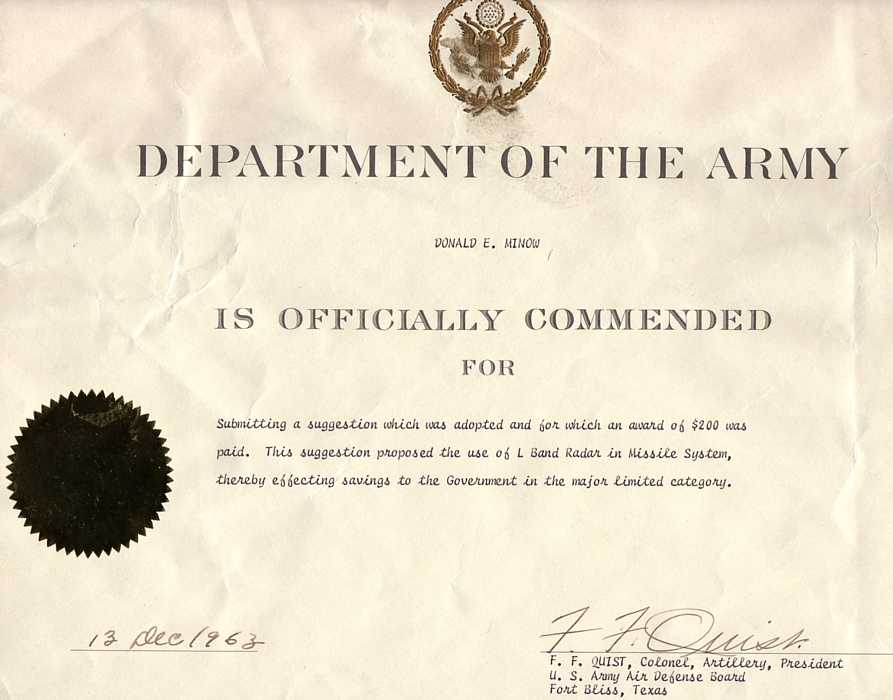
Mr. Thelen,
> Ed, I came across your Nike web page and thought you might be able to
> help me. I am a retired USAF Colonel, who flew Wild Weasel missions in
> Vietnam, and am writing what is to be Volume 1 of the US anti-SAM
> operations.

WOW !!

> I have a good friend retired Lt Gen Phil Gast who has told
> me of a General Palmer who mentioned (bragged) to Gen Sweeny USAF
> TAC/CC that the Army Nikes were shooting down TAC fighters in every
> joint exercise.

The stories I heard were about bombers vs. Nike systems.

> The result was a test done in December of 1963 of
> fighters from George AFB in Victorville, Ca against the USMC Hawk
> Battalion at 29 Palms.

A quick point of reference -
   Nike systems,
      Ajax
   and its second generation
      Hercules
   were designed to defend against high altitude bombers
   such as potential flights from over the North Pole.
   It had longer range missiles, and pulse radar.

   HAWK systems were designed for a different purpose.
   It used a radar of different principle
      a form of Doppler, chirp, CW, FM, ...
   that was good at low level targets in a lot of clutter
   with shorter range missiles

   Unfortunately I know very little more about HAWK  :-((
     and don't know any HAWK or ECM techie web sites :-((

> The Air Force used ELINT aircraft to locate the
> sites as well as electronic warfare A/C to jam the sites, followed up
> by fighters doing attack runs. The Air Force called it Operation
> Rabbits Foot.  According to Phil Gast the fighters won the first
> engagements, followed by a halt in the exercise for Raytheon to "peak"
> the radars. Following that, the Hawks won hands down.  The results were
> briefed up the AF Chain of Command with recommendations for self
> protection jammers for the fighters as well as the recommendation for a
> designated anti-SAM fighter. It appears that all the copies of the
> exercise report were destroyed and that no action was taken on the
> recommendations. I am trying to see if any reference to that exercise
> exists in either the Army of Marine Corps historical documents. Have
> you heard at all about this exercise or can you point me in the right
> direction.

I have heard urban legends of Air Force vs. Nike
    - one where the Air Force came lower than anyone's
        effective radar range, (curvature of the earth)
           toss bombed,
            (a relatively new technique at the time)
        and claimed victory over Nike.
There are of course various forms of interservice rivalries
   - guys bragging in a bar
   - battles for bigger pieces of congressional budgets
   and the fog of various confusions over real and/or imagined
   events,  Individual viewpoints ...
   Third to fifteenth hand distortions, ...
   And I have no clue what is relatively correct.

   :-((

Of course I have heard various silliness from the Nike side,
   "Which engine do you want the missile to go through, sir?"

And of course there is operational security.
   Why inform the other side
      Air Force or Soviet or ...
   of your strengths and weaknesses -
   and the opposition is reluctant to expose their best tricks
        prematurely -

I would love to provide definitive answers to such interesting
questions - but can't  -((

And worse, I have never seen jamming.
By the time I left the military (early 1957), to the best of
my knowledge, Nike had never faced jamming, ECM, ...

  - and our operators would have been facing an interesting
     challenge for the first time.

  - the T-1 trailer, to provide jamming and interesting simulated
      problems, was being developed in that time frame.

In any case I was very concerned about
   - jamming
   - incoming anti-radar missiles
        (a small pointed incoming missile,
           - is a difficult radar target even without jamming
           - is out of the center of the operators focus
           - ...
and our total unpreparedness for such at the time.

In my view, at the time, we (Nike) had world class equipment,
   and totally inadequate ECM (Electronic Counter Measures)
   knowledge and training.

I am CCing some folks who might have later unclassified knowledge
  and a wider perspective.

Good fortune, and if you hear some good Nike or ECM stuff,
   please let me know.

Best Regards
   Ed Thelen

P.S. Of course there is rather accurate info about
     one of Israel's wars.
     Israel's aircraft
        - with jammers designed to confuse pulse radar
        - with warning receivers listening for pulses
     vs a new Soviet AA system using Doppler radar
        - which was ignored by the Israeli aircraft
        - which was very good at blowing unprepared
           Israeli aircraft out of the air at the time.
I bet the ECM folks worked 24/7 for a while after that surprise.


>
> Thanks,  Mike Gilroy
>
>
Reference Anti-Radiation Missiles: I was a Wild Weasel at one time, so I think I have some insight into this. The ALARM is a nice little missile with some nice features, but when people are shooting SAMs at you, the HARM is the missile you want on your side. There is NOTHING as capable as a HARM fired off an F-4G - unfortunately for the troops today, that includes a HARM fired from an F-16CJ with the "Weasel in a can" ASQ-213 HARM Targeting System. But I digress. Using Jane's data:
System Weight Range
ALARM 584 lb 24
HARM 796 lb 43
... and questions on Ft. Richardson, Alaska like:
"Just how cold does it get while making adjustments
on the TTR antenna of site Summit in winter with
clam shells down?"
Ed,
A bit of background:
INTERESTING !! You guys were serious!!
The Long Walk - (the boosters didn't ignite!)
More Missile Master & Naval officer "swears-in" Army recruit
- from French, Jay
From Ed Thelen - It is my understanding that military pay is
set by the U.S. Congress - and I suppose there is an appropriations cap
on expenses.
Missile Master
from Gerald Schloetter
Also see "US Army Air Defense Digest, 1966"-
MISSILE MASTER (AN/FSG-1)
Radar Picket Ships
WX in Winter North Atlantic
Wed Mar 4, 2015 7:18 pm (PST) - by: "Ted Wilming" ted.wilming
Info from Les Earnest
to Ed ThelenSAGE was a fraud
Story from Harry Mc Clure who was at
C-32 (Porter/Chesterton, Indiana) at the time.
Scoring Bomb "Hits"
Radar Bomb Scoring, a joint operation with I.F.C.
and the Air Force. As an Acq. Op. I was ECM trained at
Kessler A.F.B. and we would spend long hours in the wee hrs.
working with B52s ,SR 71s and B58s.
b) What is "I.P."?
did they try to compensate for wind, air density, ... etc.
A little known fact about radar bombing RE: B-47E RBS runs in the 50's and
early 60's.
Missile Launch accident prevention
"Missile Wreckage... Southern Korean soldiers cover the wreckage of an
anti-aircraft missile at a park in Inchon today. Officials say the
missile exploded 500 feet above the ground after it accidently launched.
It was unclear whether a soldier fired the missile or a malfunction
caused the launch. Three people were injured by debris from the
exploding Nike-Hercules missile."
ladder warmers
Life in the Launcher Area
{Editorial input - I believe that the "AGs" mentioned below is the
signal to set from the IFC to position the missile gyro in the direction
of the predicted intercept point. (This is actually used so that
the missile knows which directions are "down" and "right".)
For further detail see Missile Steering.}
Answer from Rolf Dieter Görigk
E-mail from J. P. Moore
E-mail between Peter Wurzbach and me (Ed)
from Rolf Dieter Görigk
commenting about the after effects of improvements made to the Nike system
after 1974 in Germany -
Return to beginning of Nike Technical Stories