Return to home page, Goto Next Section
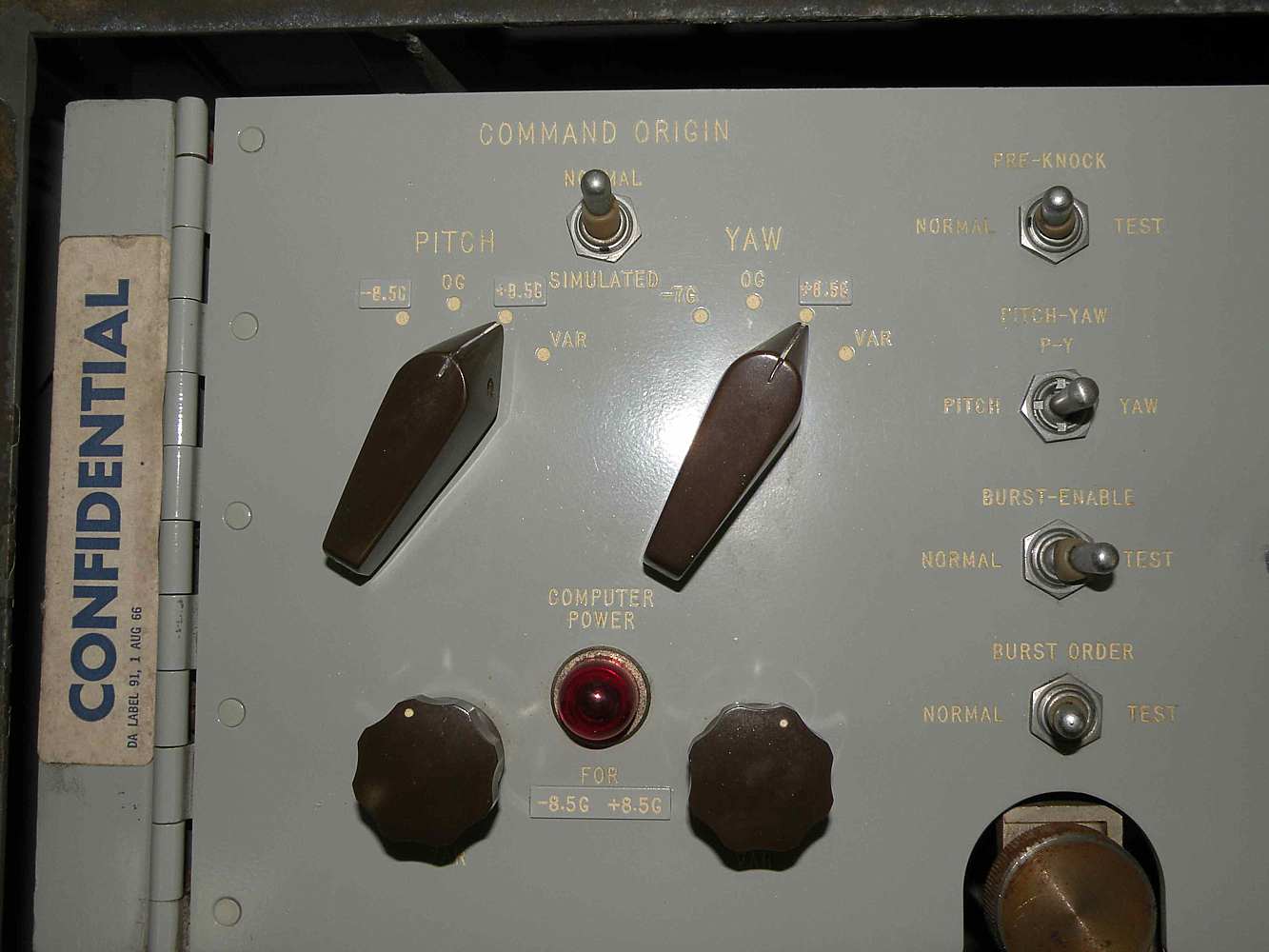
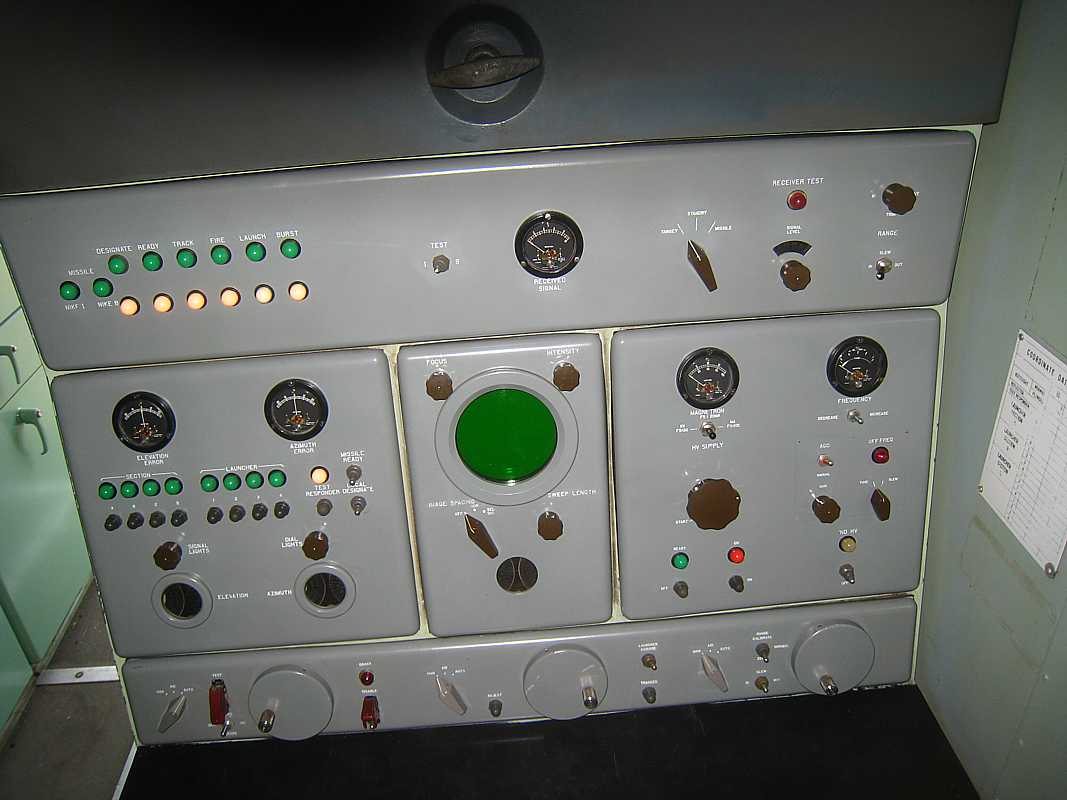
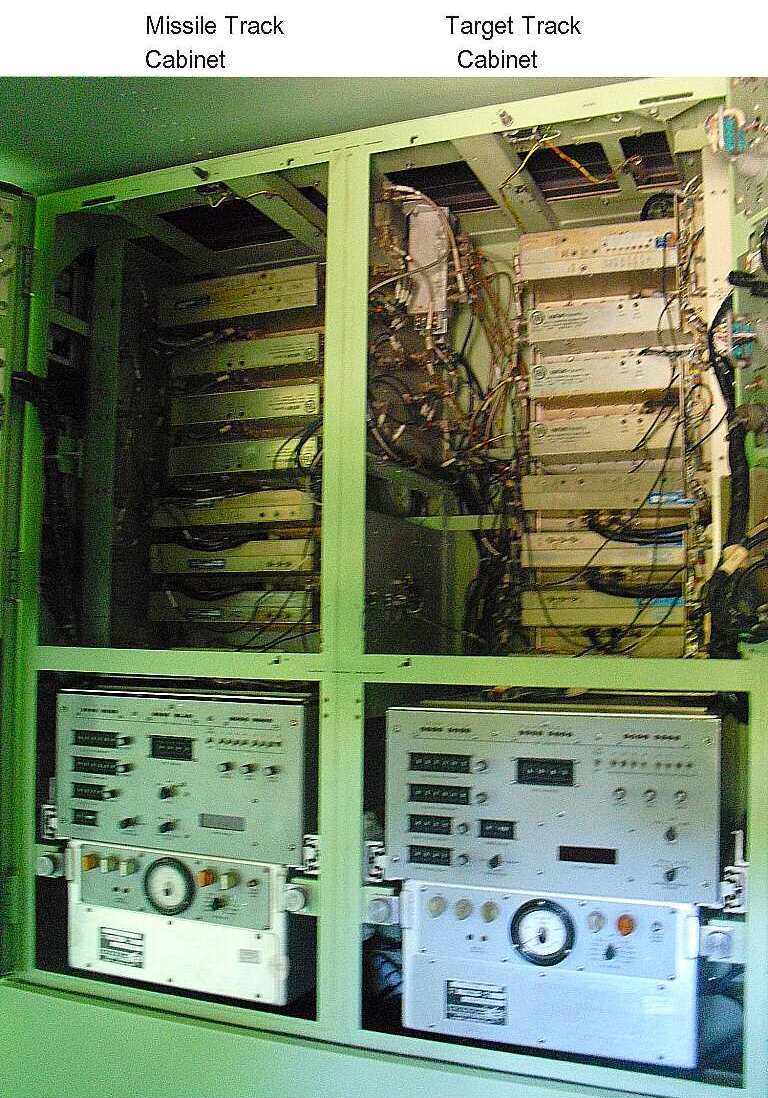
The controls for these radars were housed in the Radar Control Van, which was located very near the Battery Control Van and the same size. John Porter, manager of SF-88, reports that "The Battery Control Van is 20.5 ft long, 8 ft wide, 7 ft high, with a 6.5 ft tongue."
This information is grouped into the following sections:
Also, TM9-5000-18 "NIKE I SYSTEMS - TTR TRANSMITTER AND RECEIVER CIRCUITRY" is available for another (more detailed) view of some of this material. (The Nike 1 [Ajax] was the predecessor of the Nike Hercules, but the same principles apply.)
Beam width - A rough (somewhat optimistic) formula for the beam width is:
The earlier Nike Ajax tracking radar had an effective range of about 50 miles.
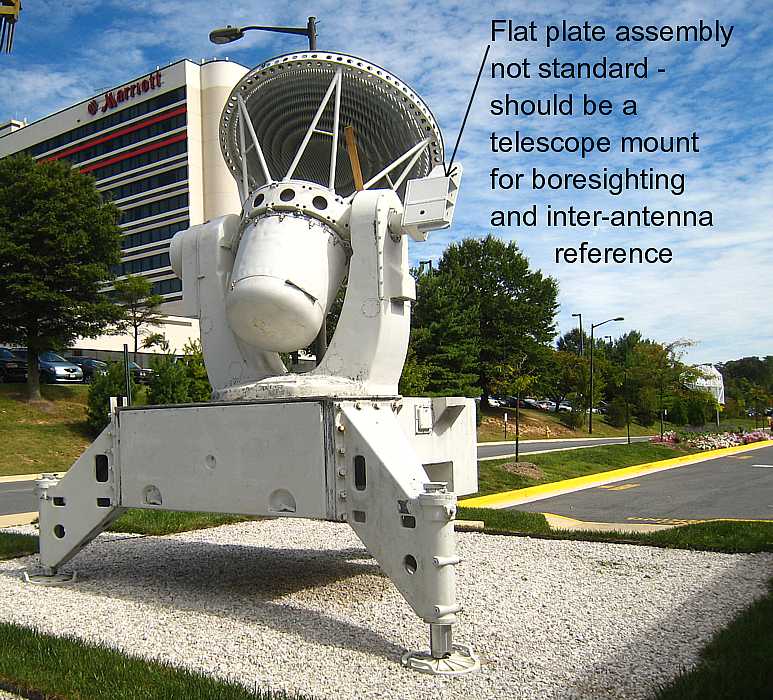
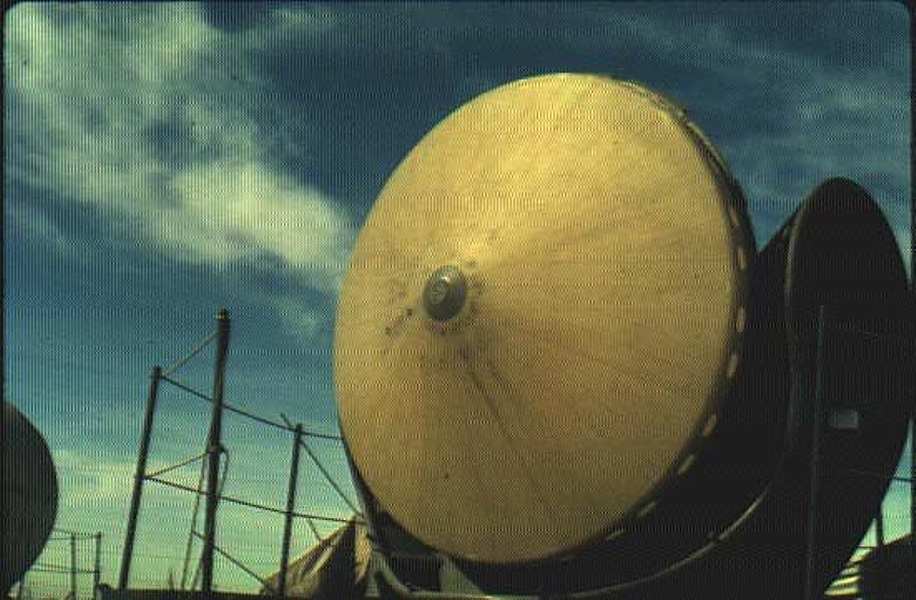
Overview This antenna (next four pictures) is at the Historical Electronics Museum near Ft. Meade, MD. A great place to visit! :-)) ![]()
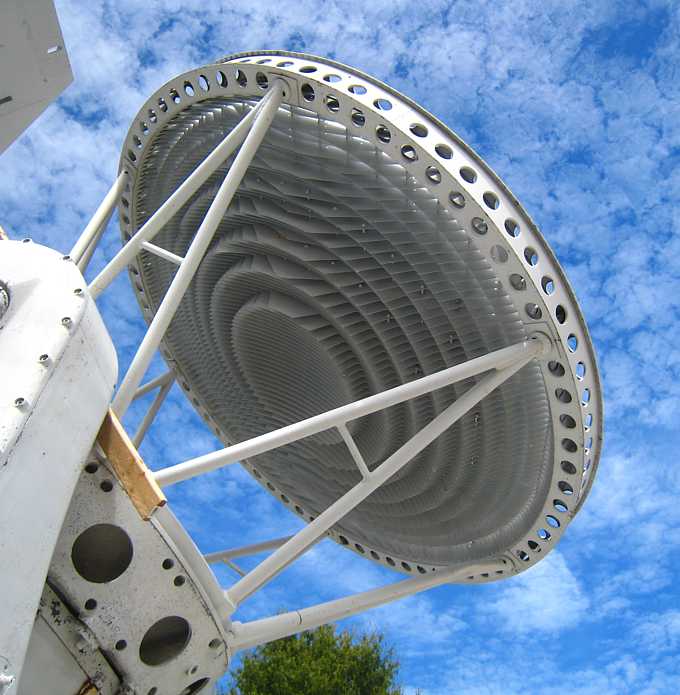
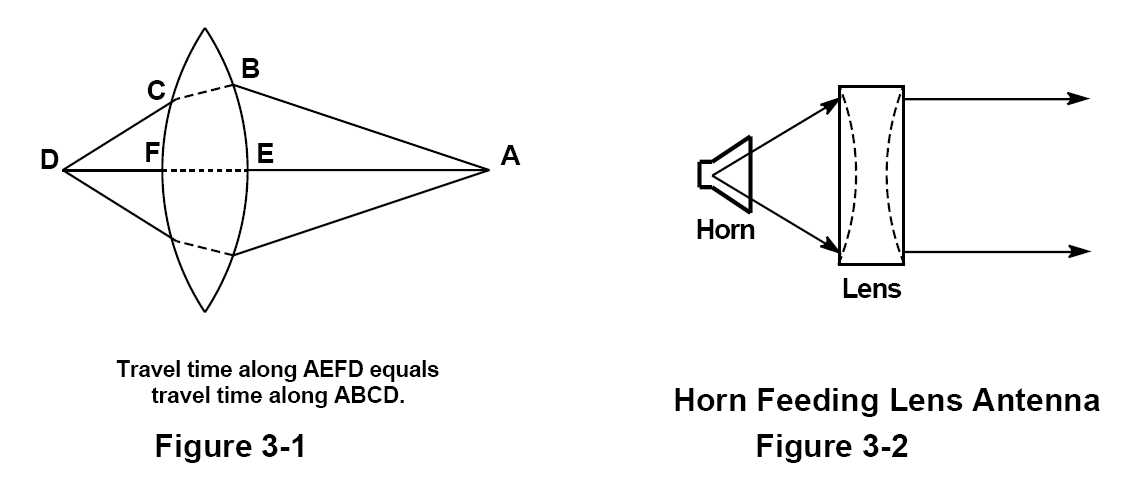
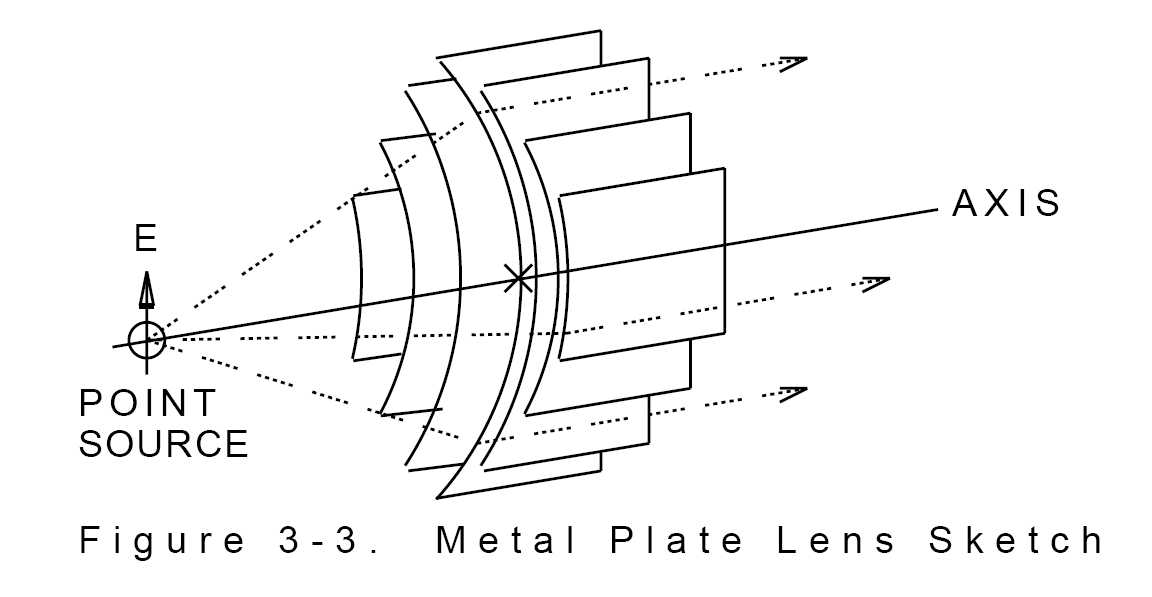
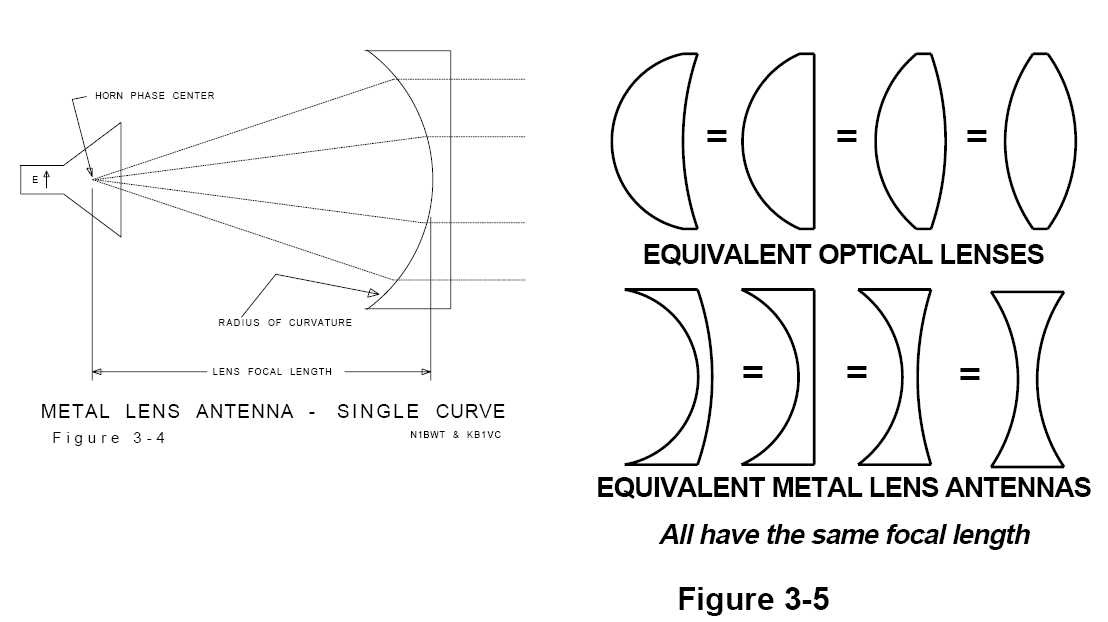
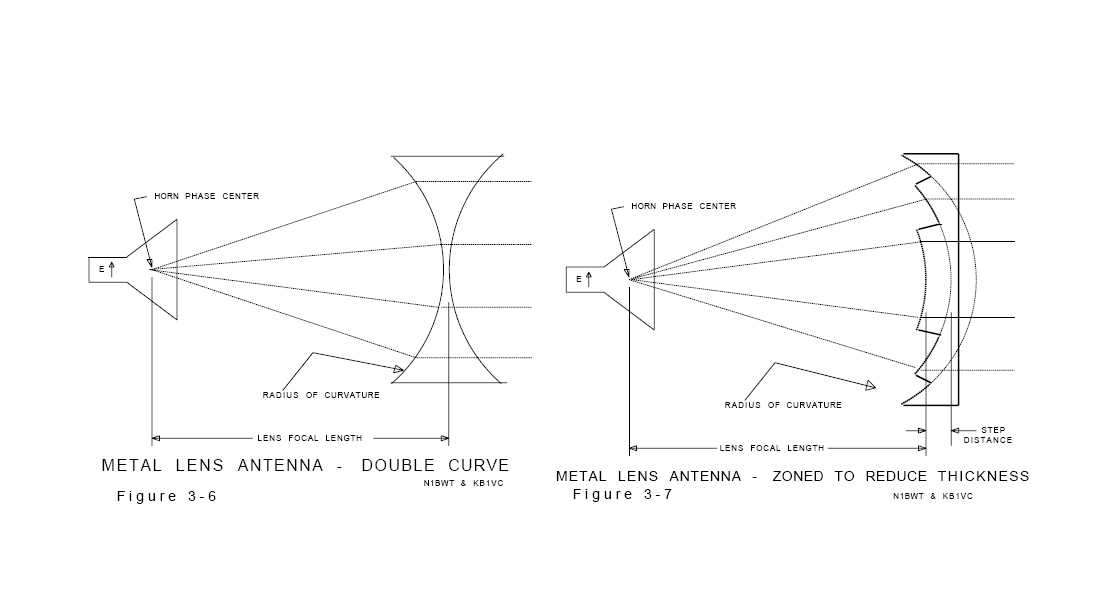
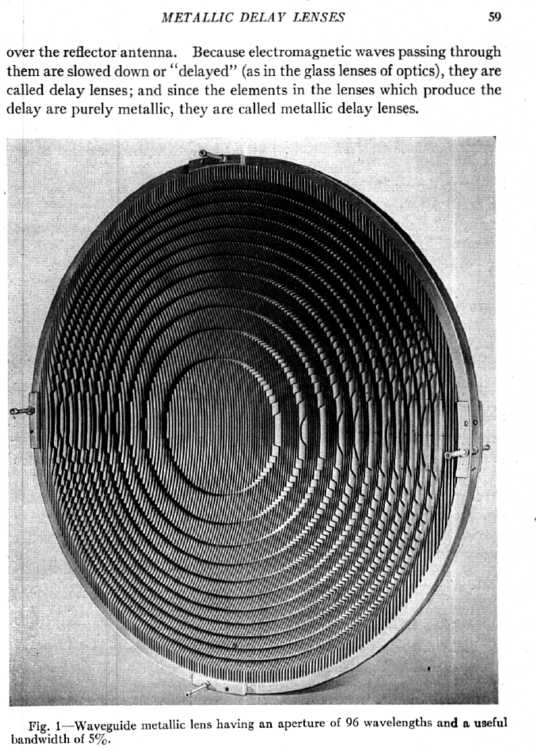
It used a Fresnel lens type of focusing like this. Boresighting was identical with the later Hercules Tracking antennas. ![]()
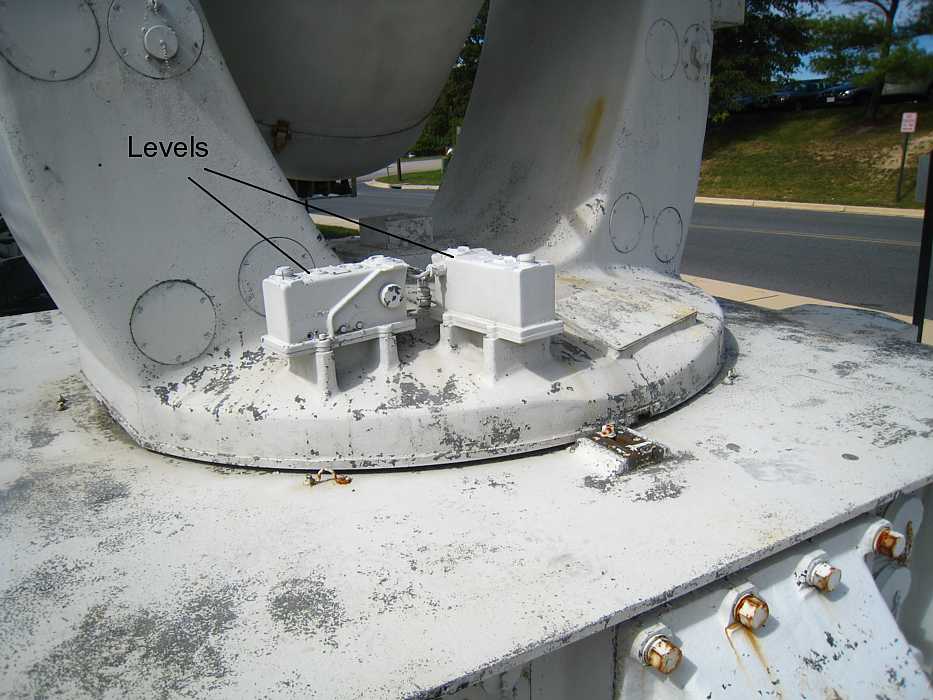
Leveling was of course a big deal. The Target Tracking and Missile Tracking radars MUST have a common vertical reference. Two levels at right angles are used for convenience. ![]()
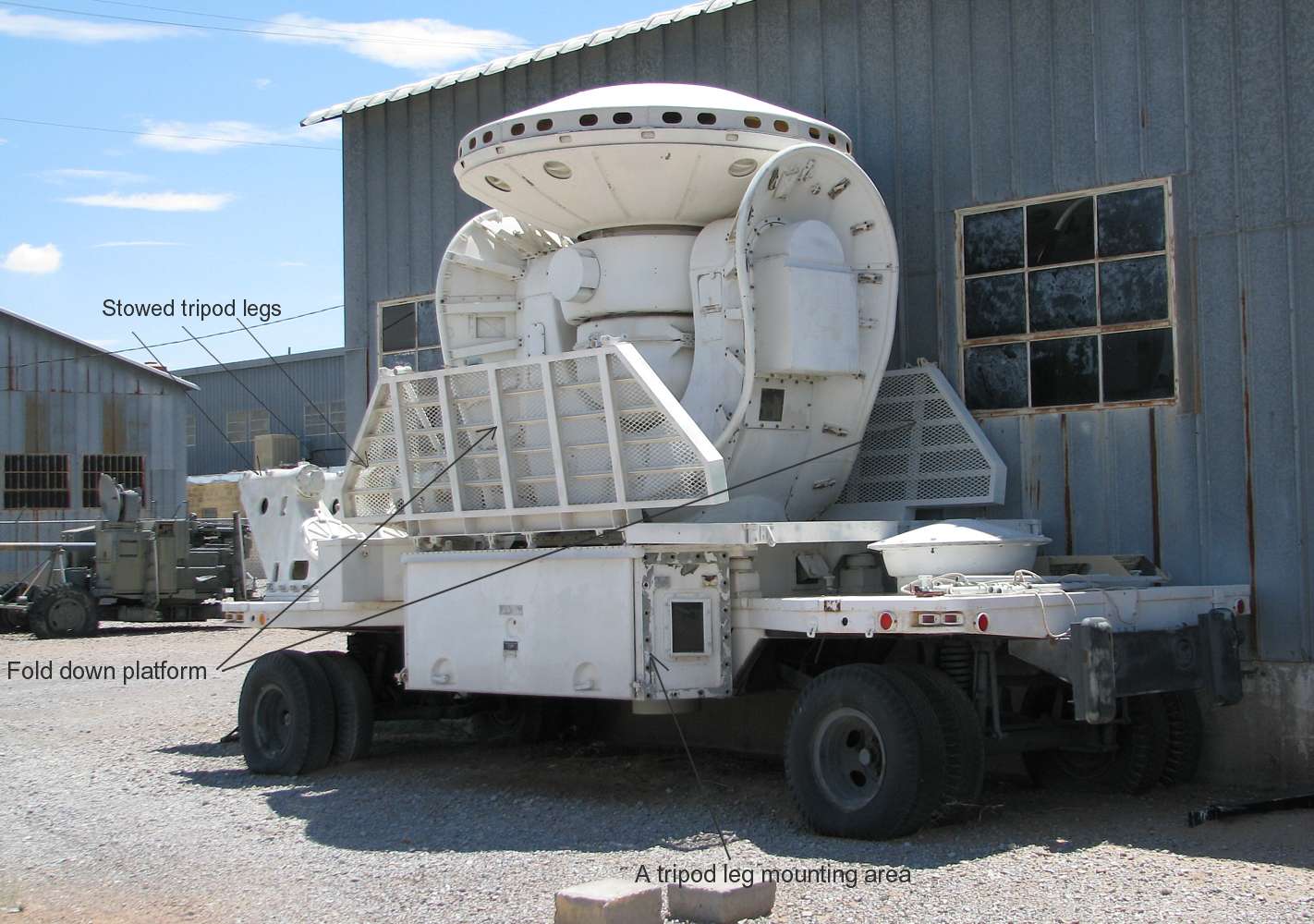
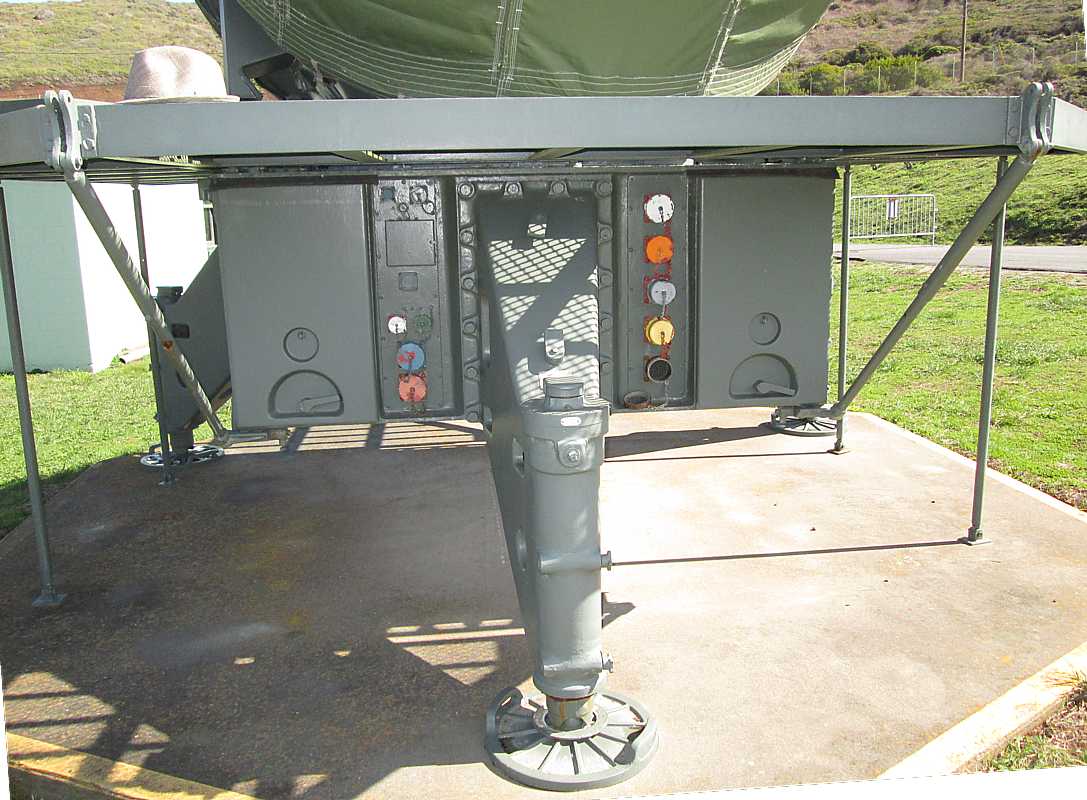
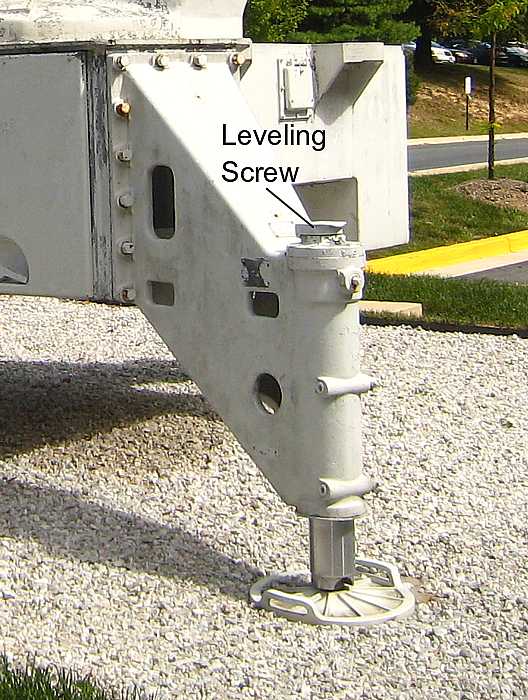
This was one leg of the tripod support of a tracking antenna. The cap covers a 1 inch hex bolt head to be turned to level the antenna. ![]()
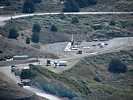
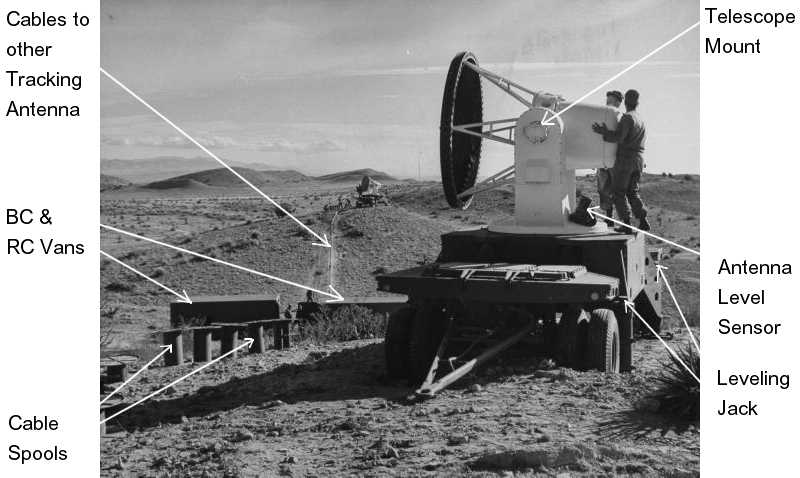
A Life Magazine photo - at Red Canyon - possibly troops firing their Nike Ajax equipment before taking it to some site at some city. An other possibility is troops back for annual re-fire shooting from resident equipment. ![]()
The Nike Hercules Tracking Radars had a maximum range of 200,000 yards, a little over 110 miles. (This was a hard limit as the tracking displays and computer scaling had that limit.) For an interesting comparison with the earlier (WWII) SCR-584, click here.
The Nike Hercules systems had two Target Tracking Radars that were externally similar. Internal differences included using different frequency bands. The two radars were used instead of the usual one radar to help fight enemy jamming. A variety of strategies made the life of enemy jammers extremely difficult. (The Nike Ajax systems had one target tracking radar).
![]()
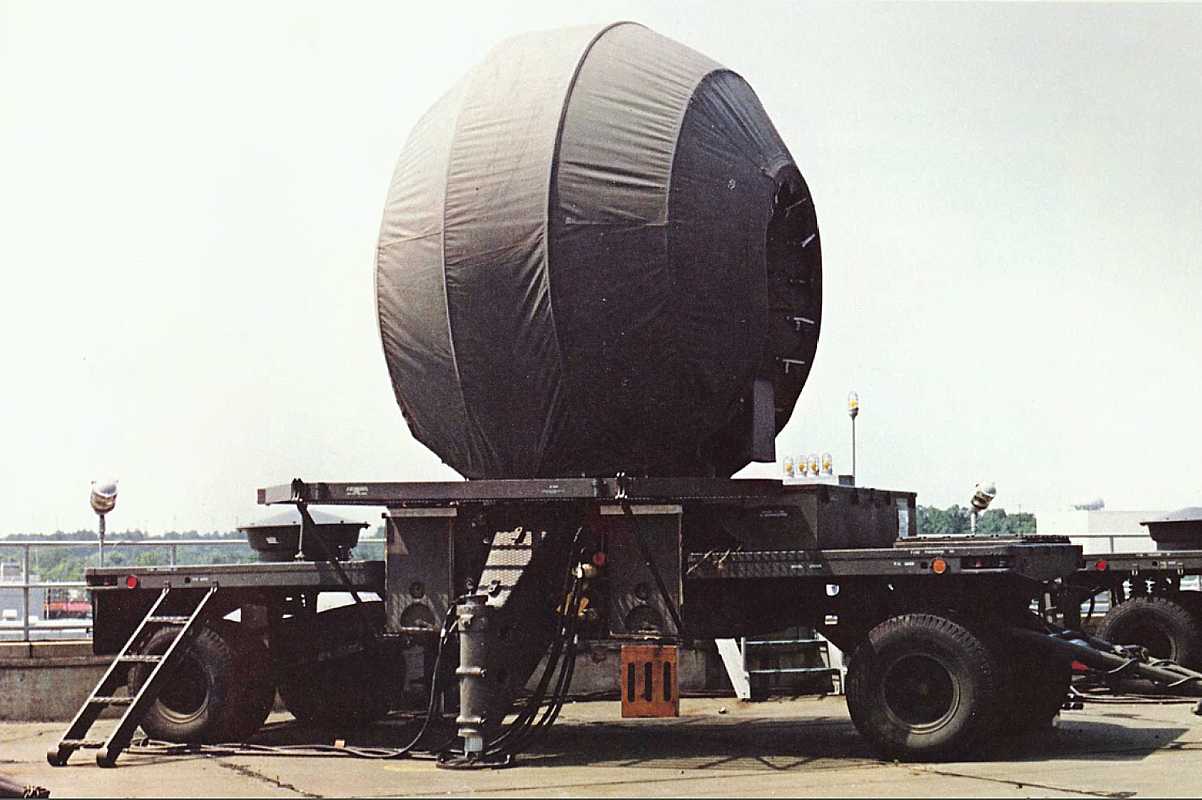
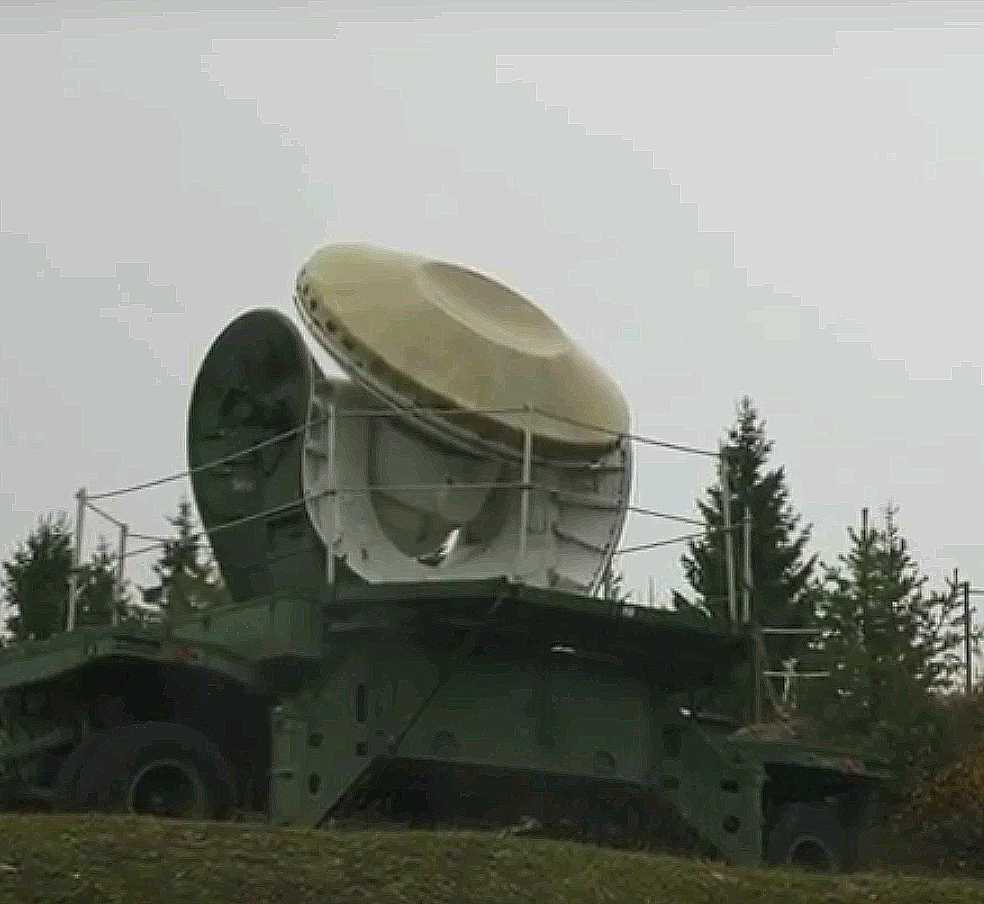
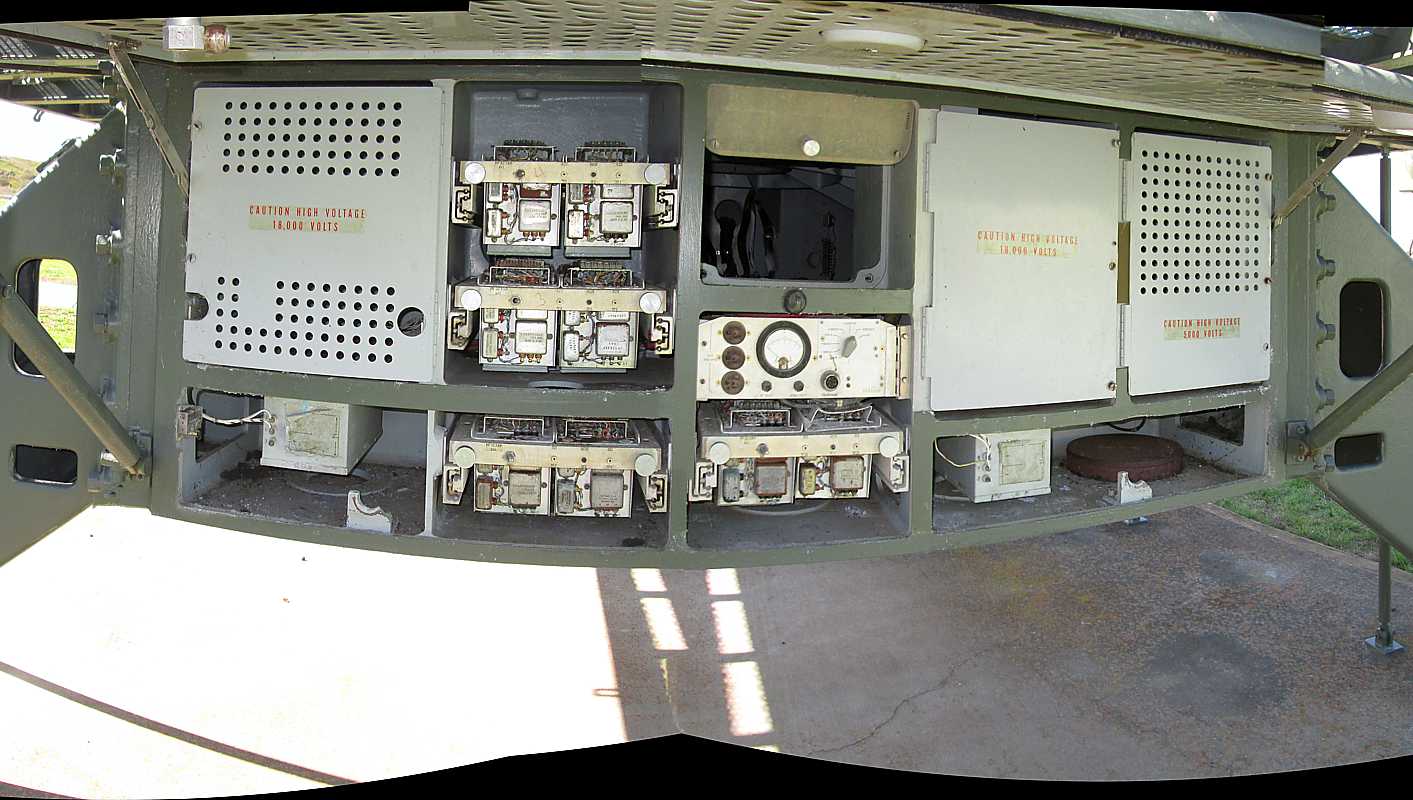
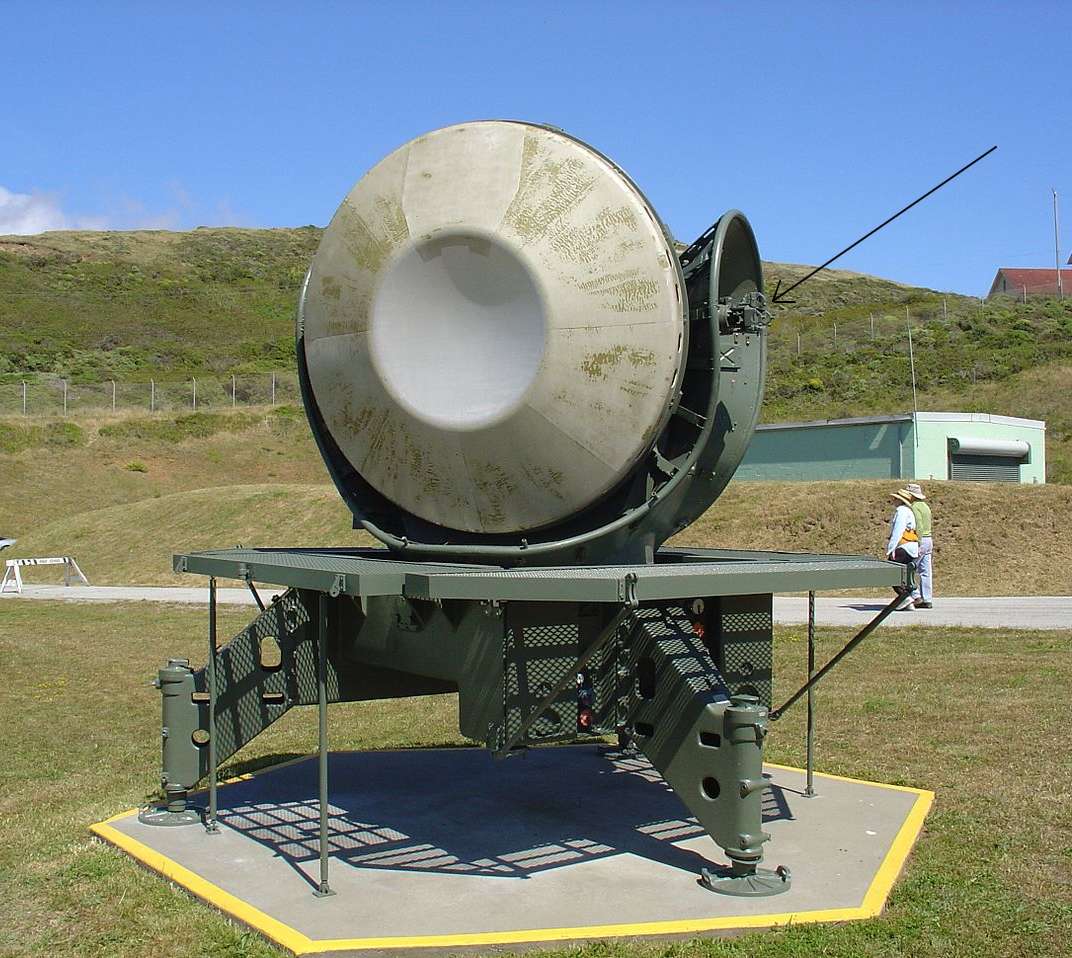
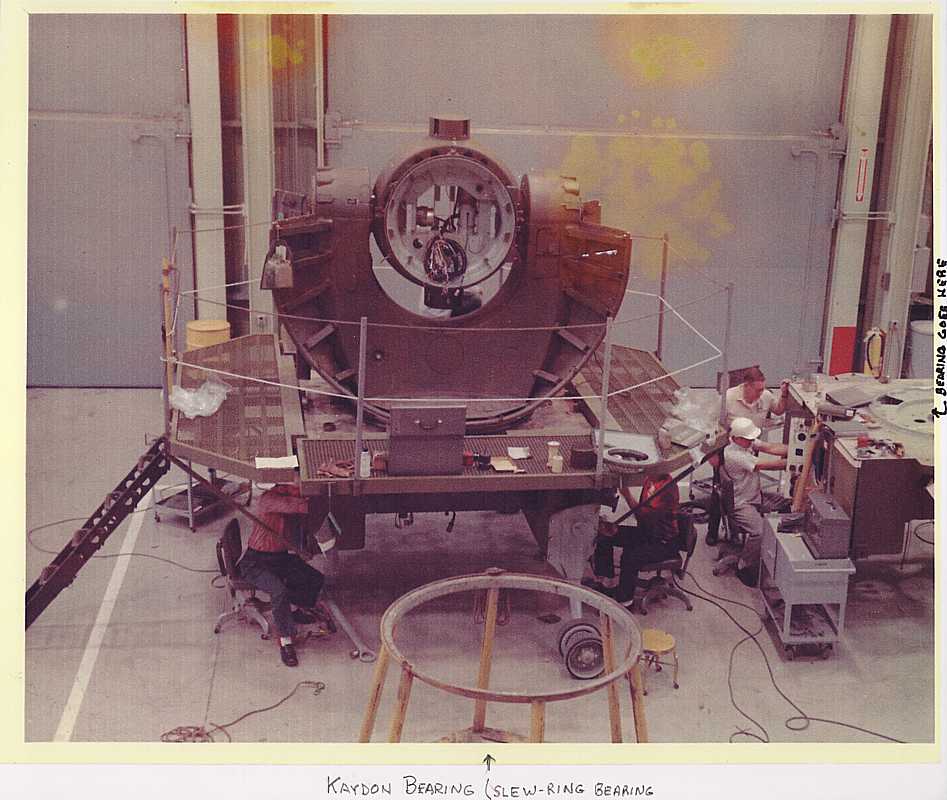
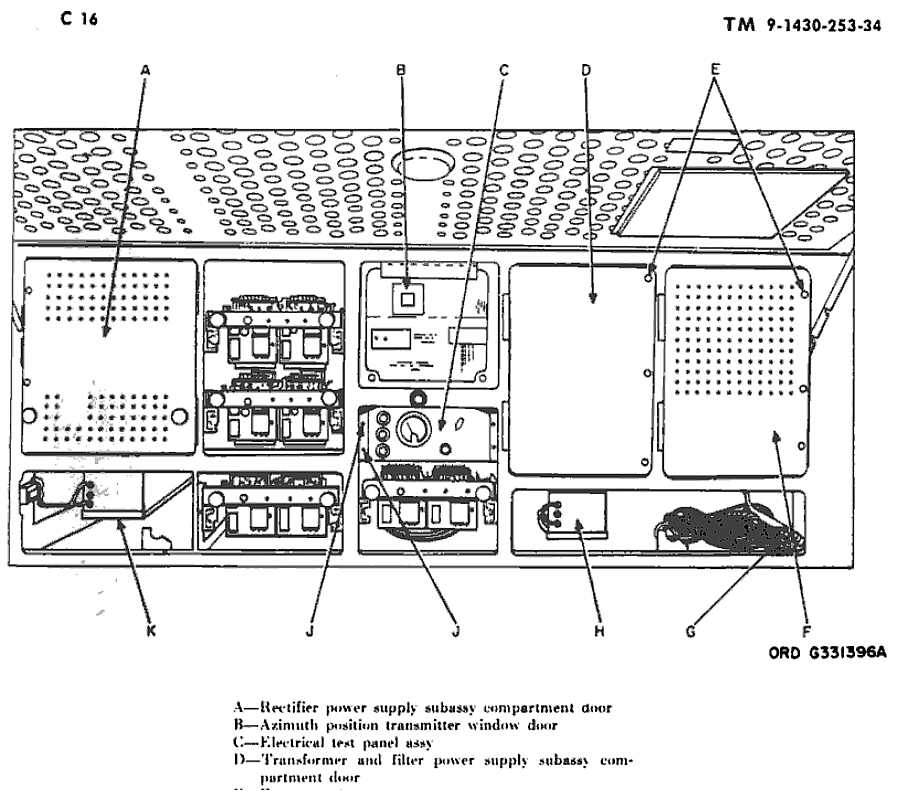
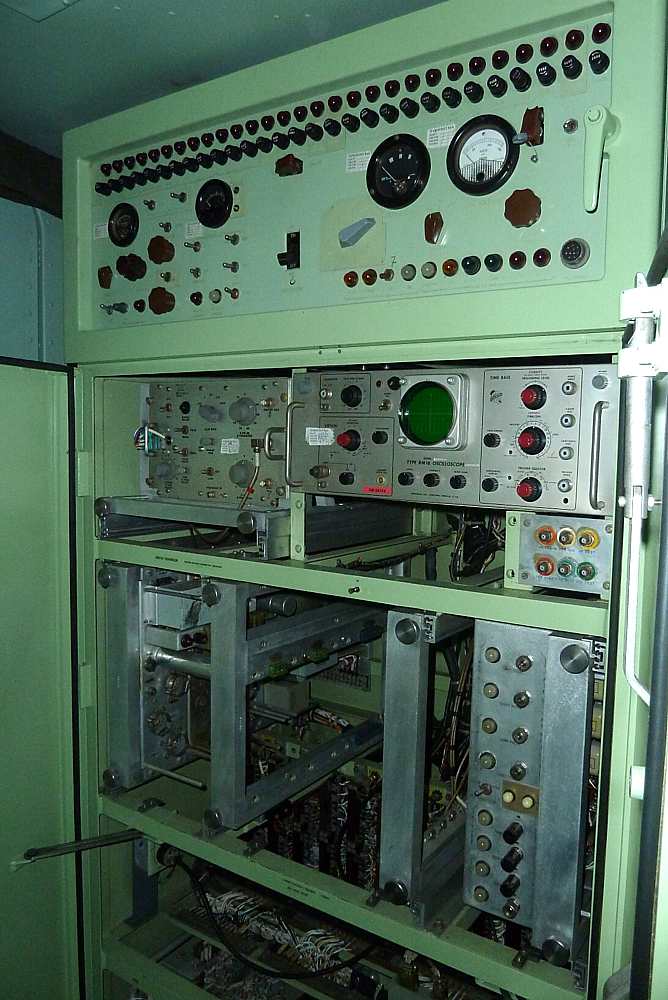
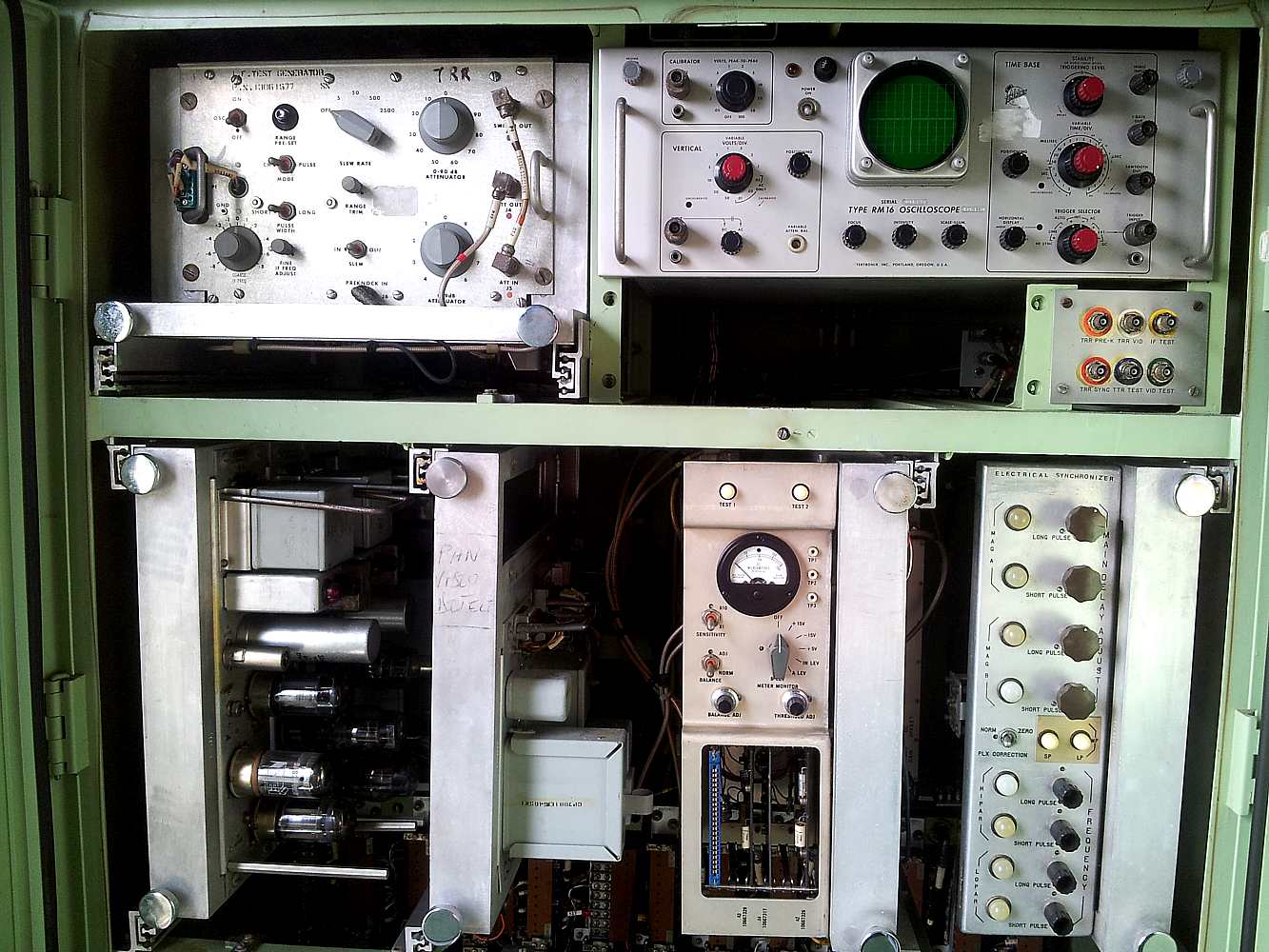
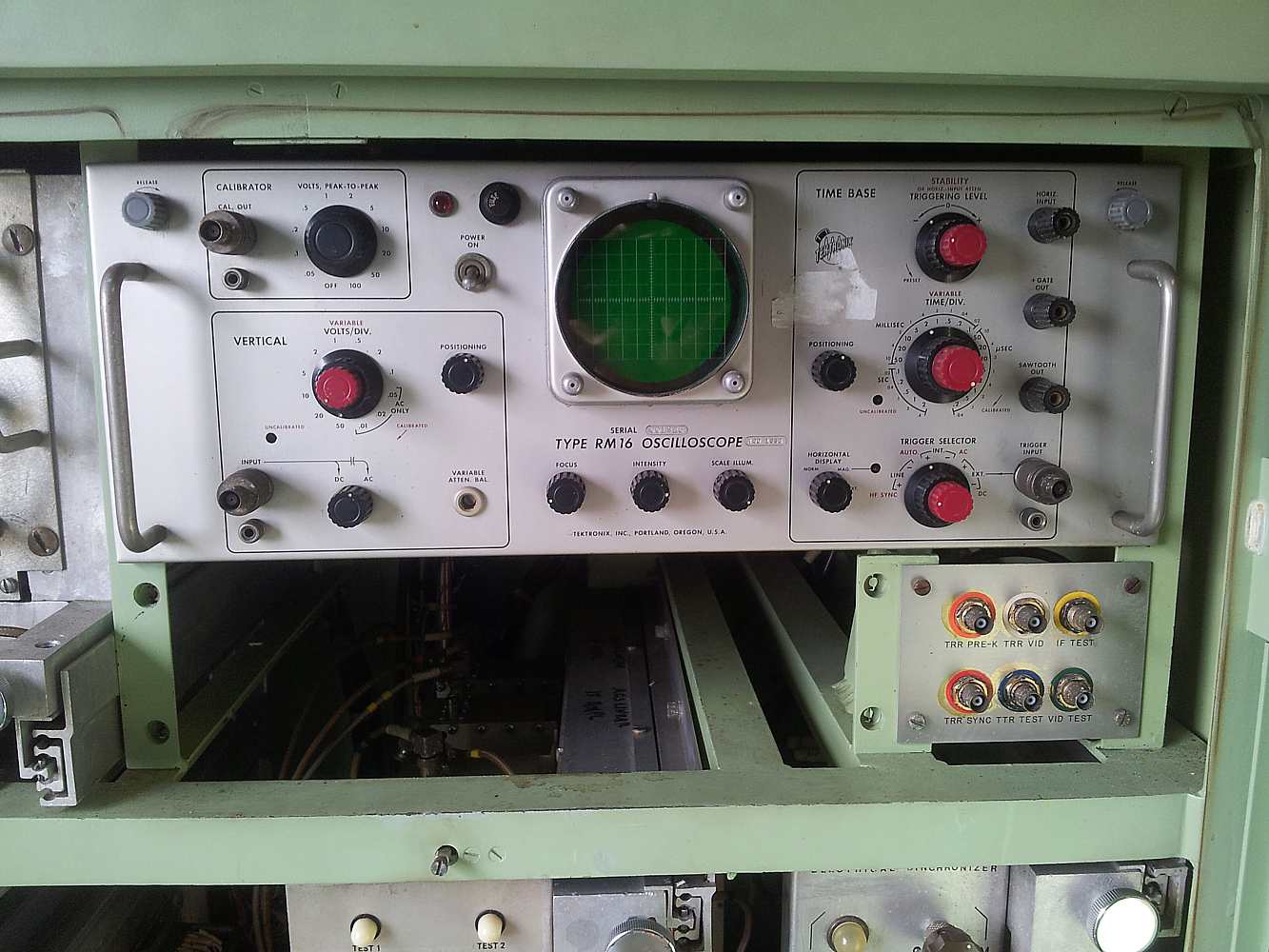
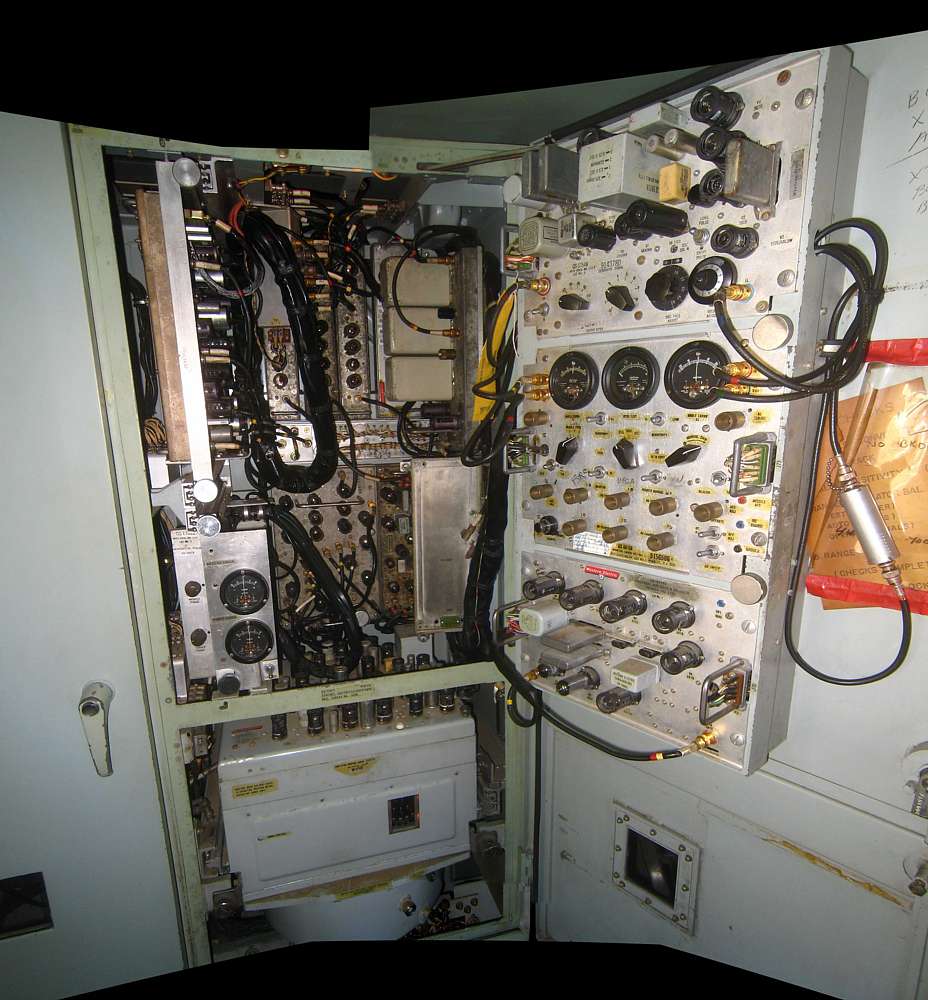
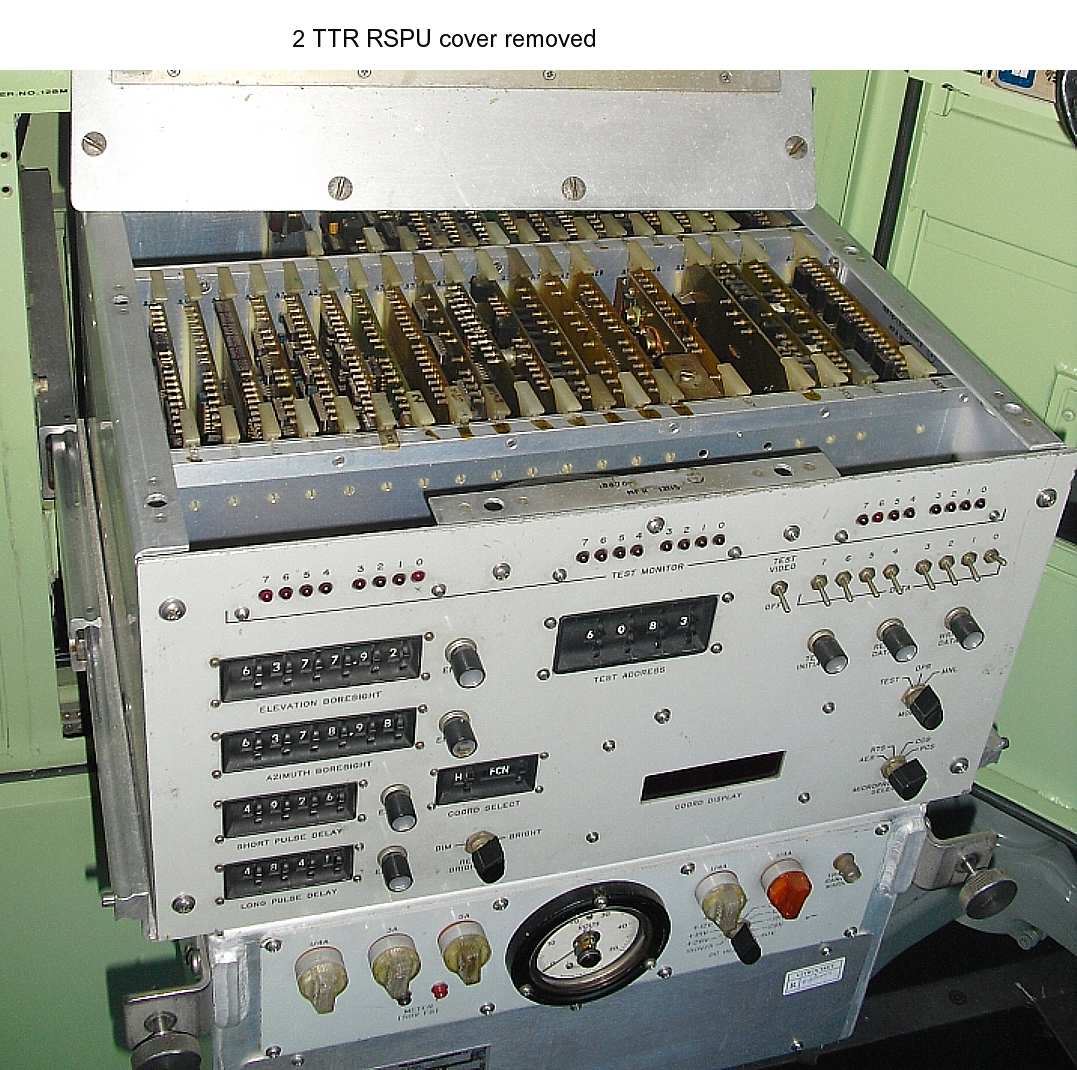
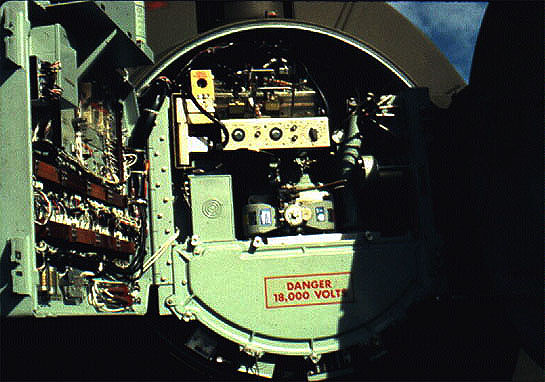
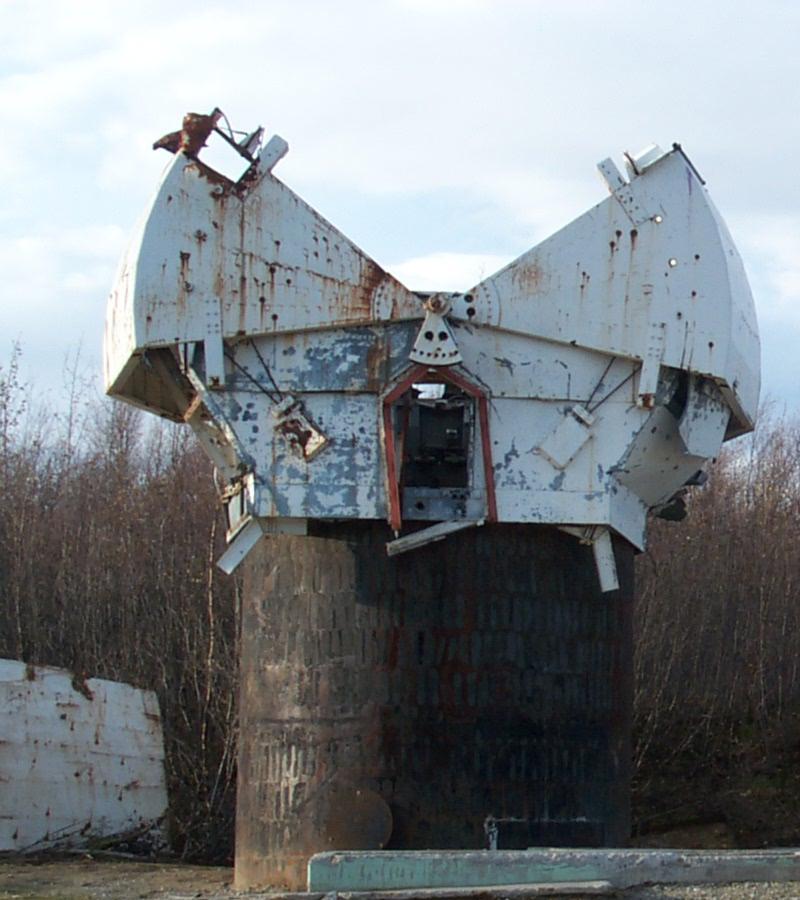
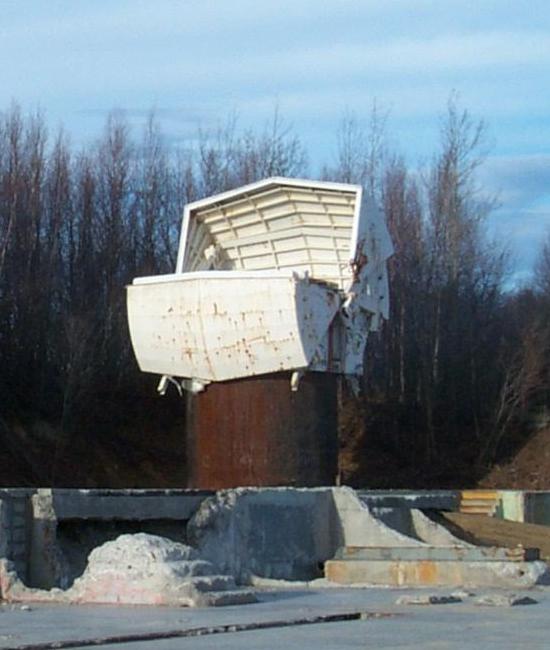
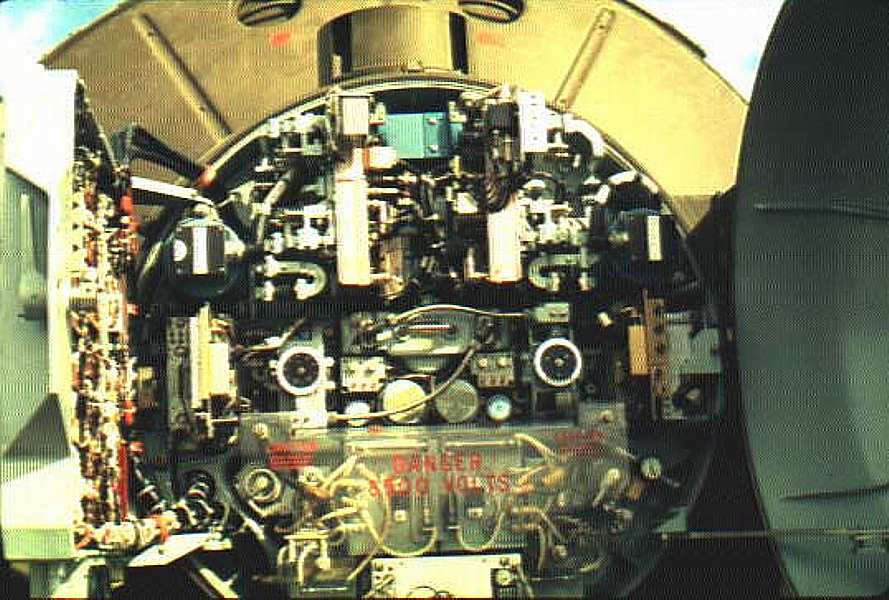
Nike Hercules Target Tracking Radar (TTR) (image is 33 K Bytes) (Photo credit Rolf Goerigk) The rope fence and supports are there only during maintenance to reduce accidents - removed during normal operations. During normal operations, a spherical wind screen surrounds the antenna to reduce wind forces and tracking errors. View of electronics (Photo credit Rolf Goerigk) In special situations, such as typhoon hazard or arctic conditions, a large protective cover was included which could provide additional protection. These covers were shaped like clam shells which could be closed in really bad conditions. See pictures Side view, Quarter view and Alaska location information Site Peter and Site Summit. I am guessing (please correct me) that if the clam shells were closed, the tracking radars could not be used.
From Rolf Goerigk, Specification for the Target Tracking Radar (TTR) include:
Antenna Gain 44 dB = 25,000 Freq. Range 8.5 - 9.6 GHz Pulse Width Short Pulse (SP) = 0.25 microseconds
Long Pulse (LP) = 2.5 microsecondsRF Peak Power Short Pulse (SP) = 201 kW
Long Pulse (LP) = 142 kWAverage RF Power
LOPAR-ModeShort Pulse (SP) = 25.1 Watt
Long Pulse (LP) = 177.8 WattInstrumented Range
from here200,000 yards (113 miles)
![]()
Nike Hercules Target Ranging Radar (TRR) (image is 33 K Bytes) (Photo credit Rolf Goerigk) The rope fence and supports are there only during maintenance to reduce accidents - removed during normal operations. During normal operations, a spherical wind screen surrounds the antenna to reduce wind forces and tracking errors. Note the more pointed cone, this antenna uses a different "optical" system. View of electronics (Photo credit Rolf Goerigk) From Rolf Goerigk, Specification for the Target Ranging Radar (TRR) include:
Antenna Gain 49 dB = 79,000 Freq Range 15.7 to 17.5 gHz Average RF Power Short Pulse (SP) = 15.6 Watt
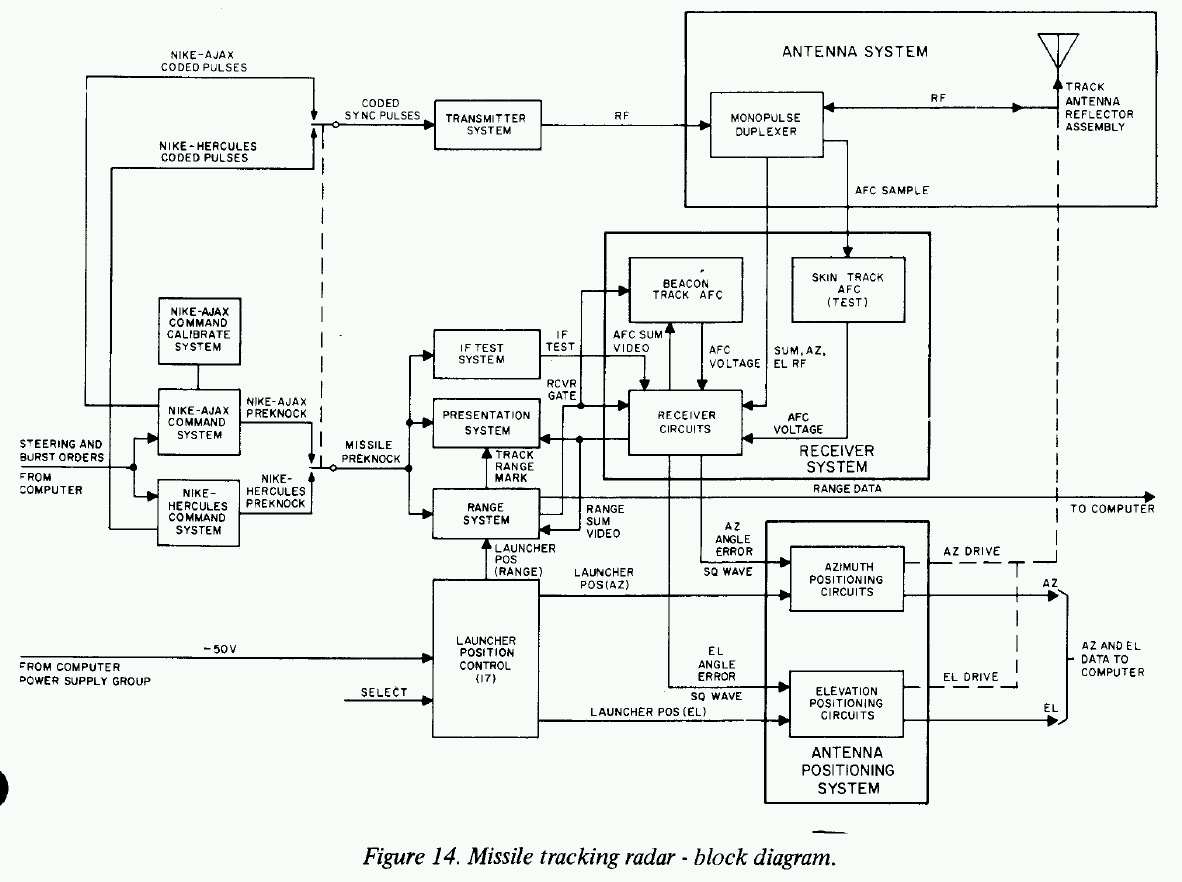
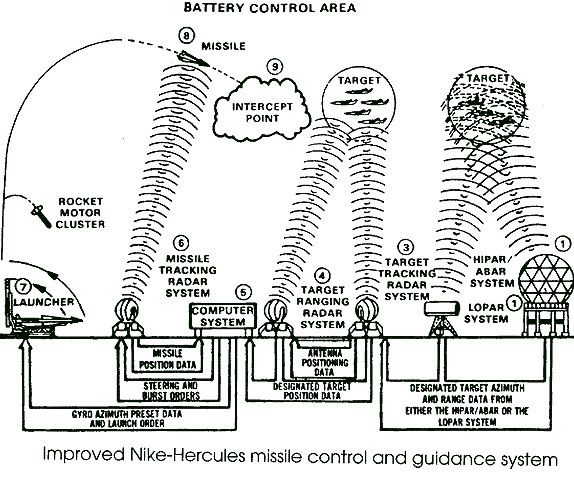
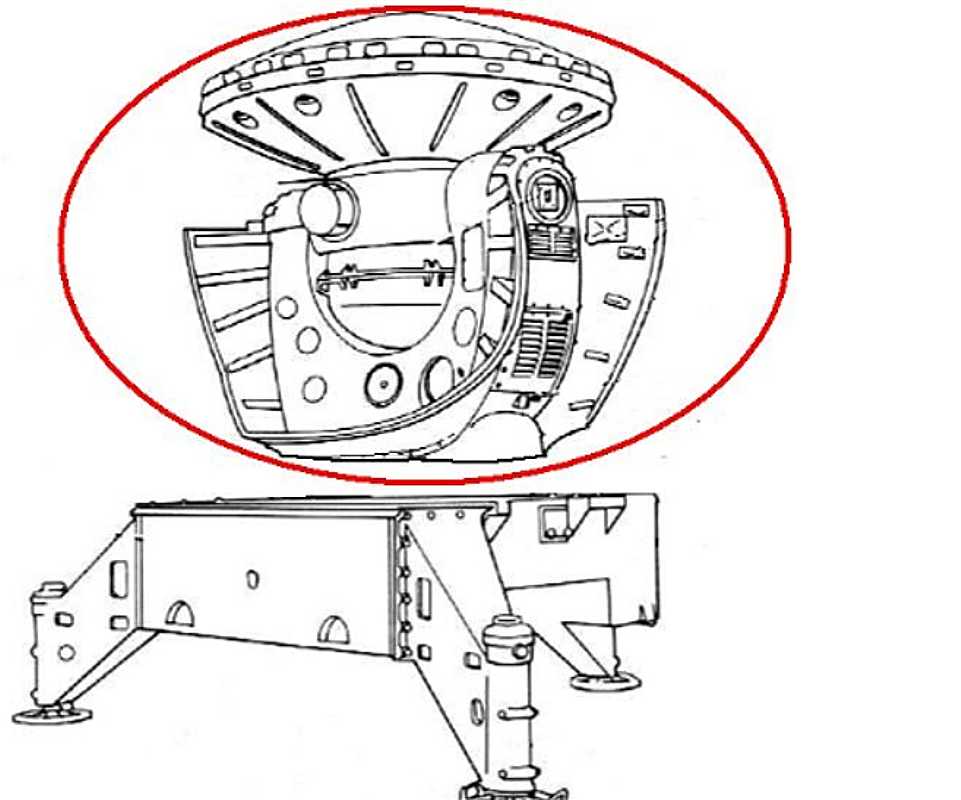
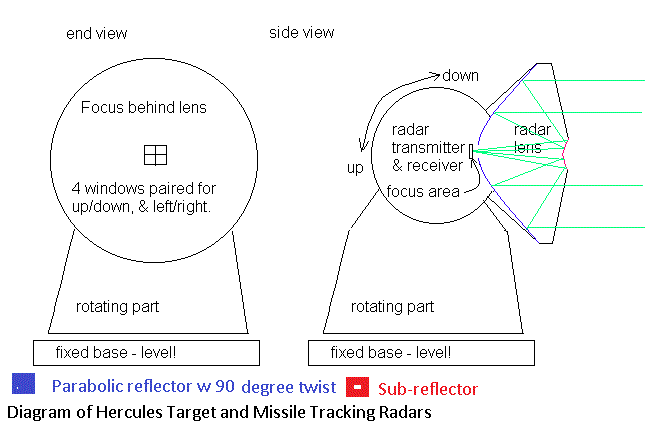
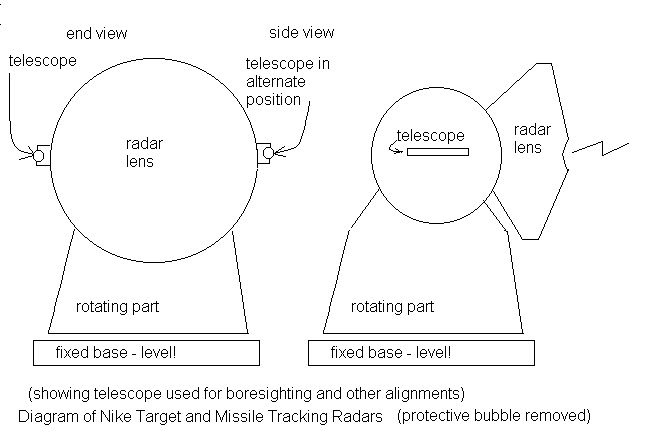
Long Pulse (LP) = 78 WattThe Hercules Target Tracking Radar, and the almost identical Missile Tracking Radar, are diagrammed below
![]()
The antenna shown above is pointed roughly level. As per Vasilis Bourantanis, The antenna could be depressed about -204 mils (about 11.6 degrees) at which point a microswitch prevents further motor drive in the down direction. A shock absorber stops further downward physical motion. The antenna can point straight up and a little beyond.
The Missile Tracking Radar (MTR) has special circuitry to track a missile passing overhead. This is called an "over-the-shoulder-shoot". When the MTR points at 90 degrees, a special circuit spins the antenna mount 180 degrees and missile tracking is resumed on the other side. (This prevents the need for a special no-launch azimuth.) Although the recommended site configuration suggested the missile launch area be toward the direction of an expected attack, practical considerations sometimes caused the launch area to be "behind" the IFC (radar site).
As the diagram mentions, the fixed base was carefully leveled, and checked daily (or until the cement pad finally showed signs of adequate stability). The level system was extremely sensitive and accurate.
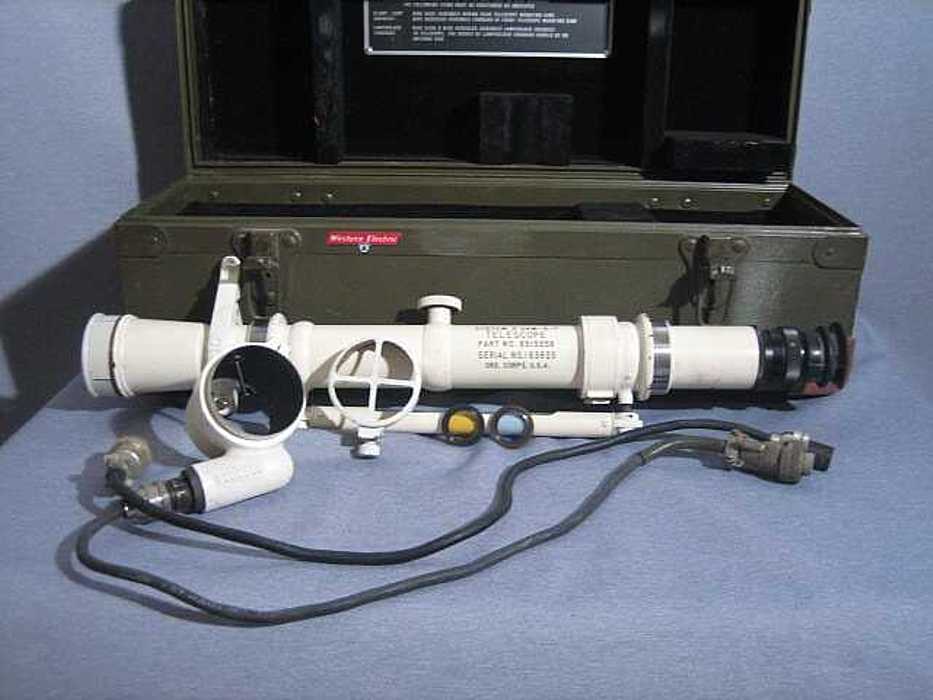
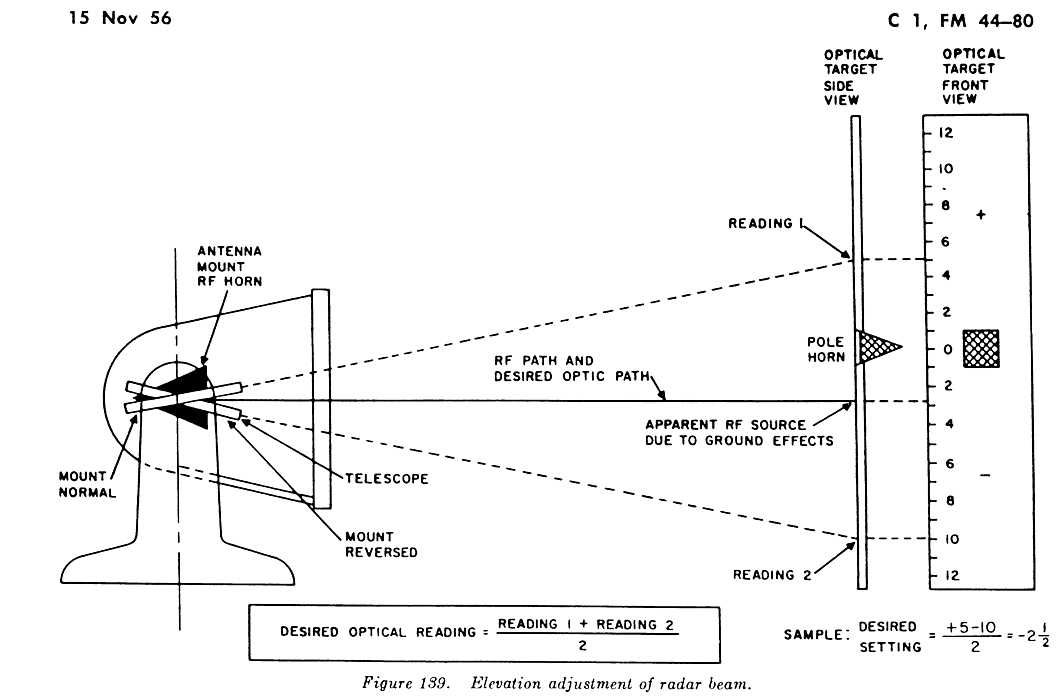
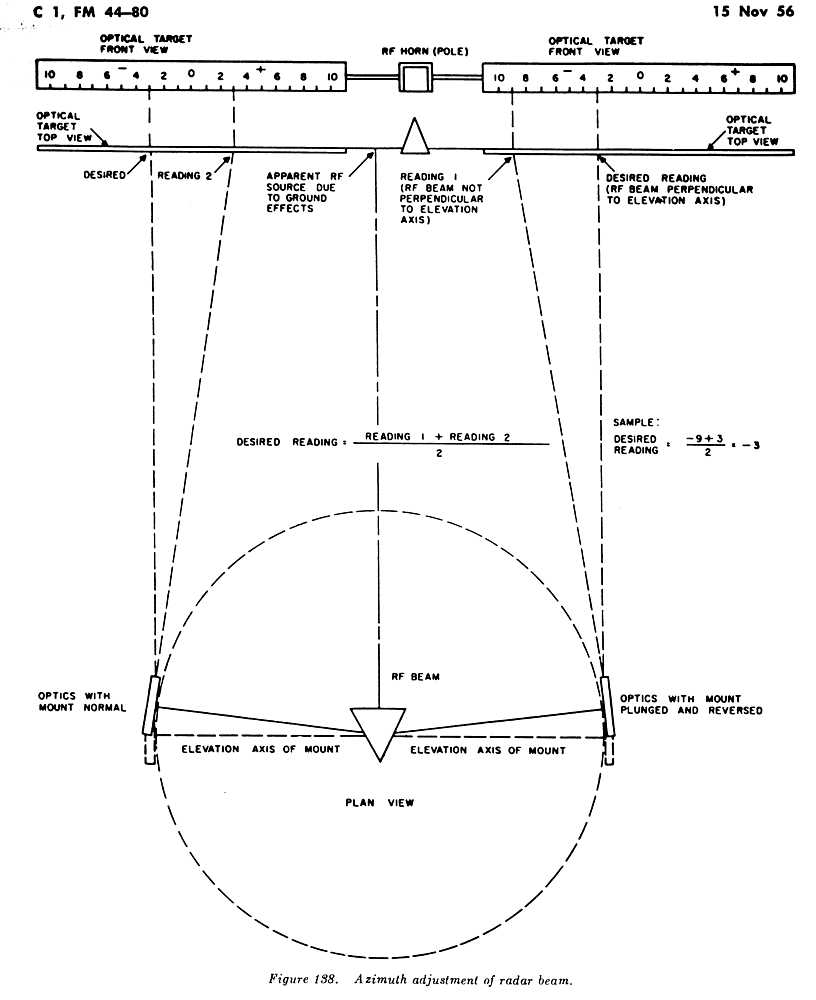
There was a method of "bore sighting" the radar beam to assure that the beam was parallel to a telescope system (with cross hairs). A special microwave transmitter and test mast with optical sights was used in this adjustment.
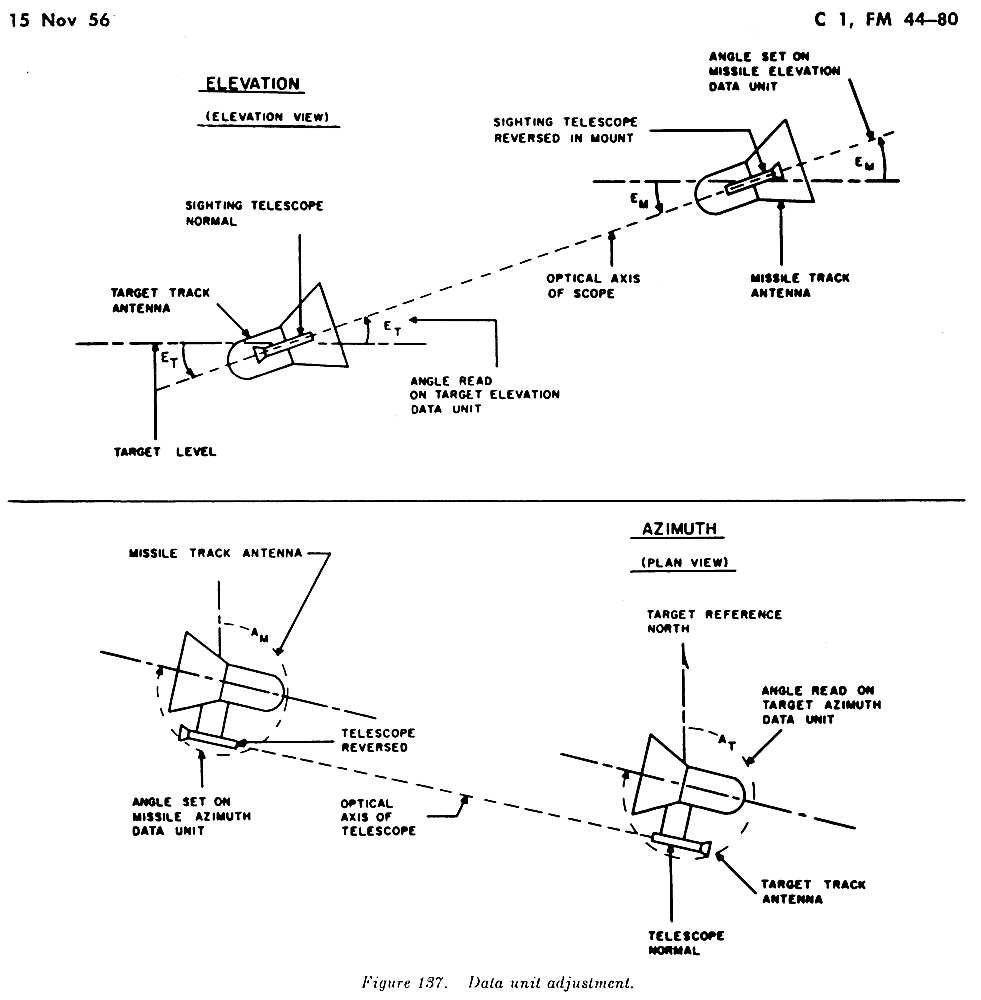
The telescopes of the missile and tracking radars then were pointer at each other to assure that the elevation and azimuth indicators (potentiometers) were correctly aligned.
Target Tracking Operations
![]()
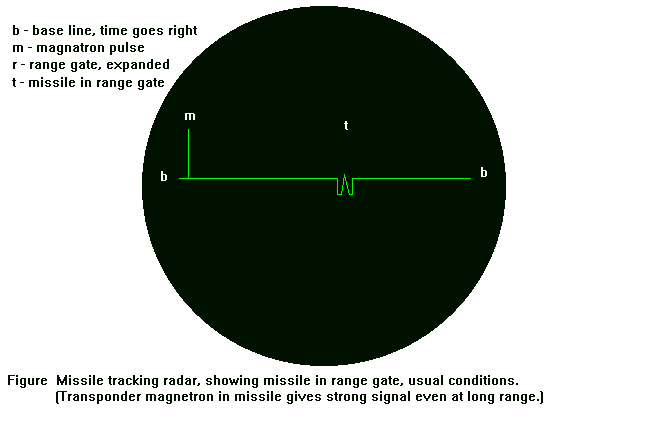
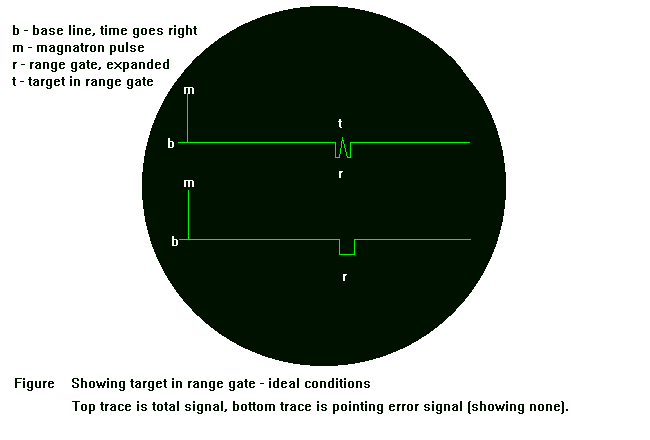
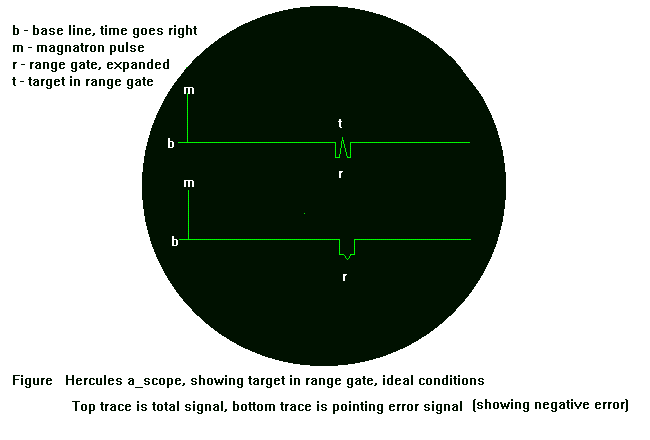
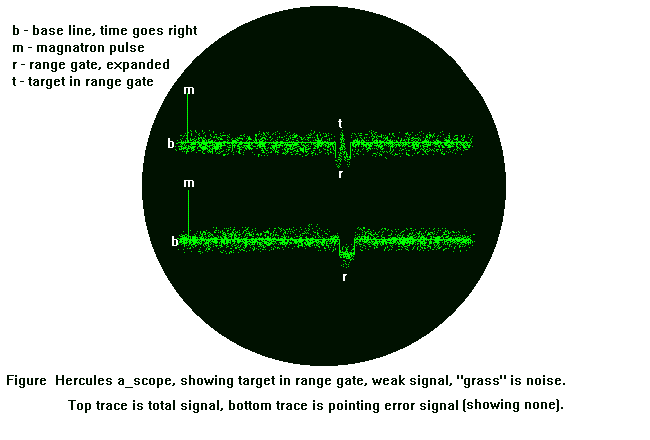
The above Hercules A-Scope type image (thanks to Rick at ShoreRick@aol.com) shows a tracking radar with a single target in the middle of the range notch. This notch gives a range expansion, meaning that although whole base line is 200,000 yards, the lowered section is greatly expanded in range, being about 150 yards in length. This provides a combination of whole picture,
1)the unexpanded base line
2)and the expanded (greater time detail) of the notch.The lower trace is the error channel signal. This shows the operator the success of the servo system in keeping the antenna pointed at the target. It is extremely useful (required) if the tracking is in "MANUAL" or "AIDED MANUAL" due to ECM (jamming) problems.
In the middle of the range notch is the unseen "range gate" which samples the target information and sends it to the azimuth, elevation and range tracking servo systems. The servo systems use this sample to move the hand wheels controlling the tracking antenna in azimuth, in elevation, or the tracking range systems.
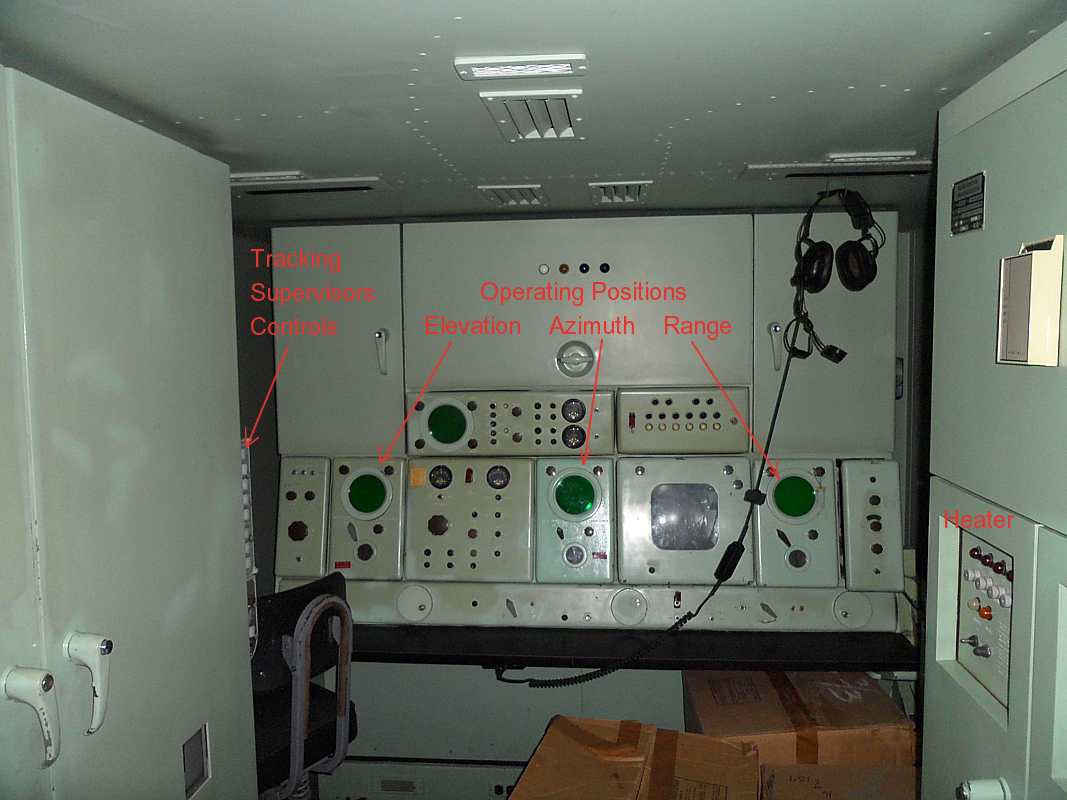
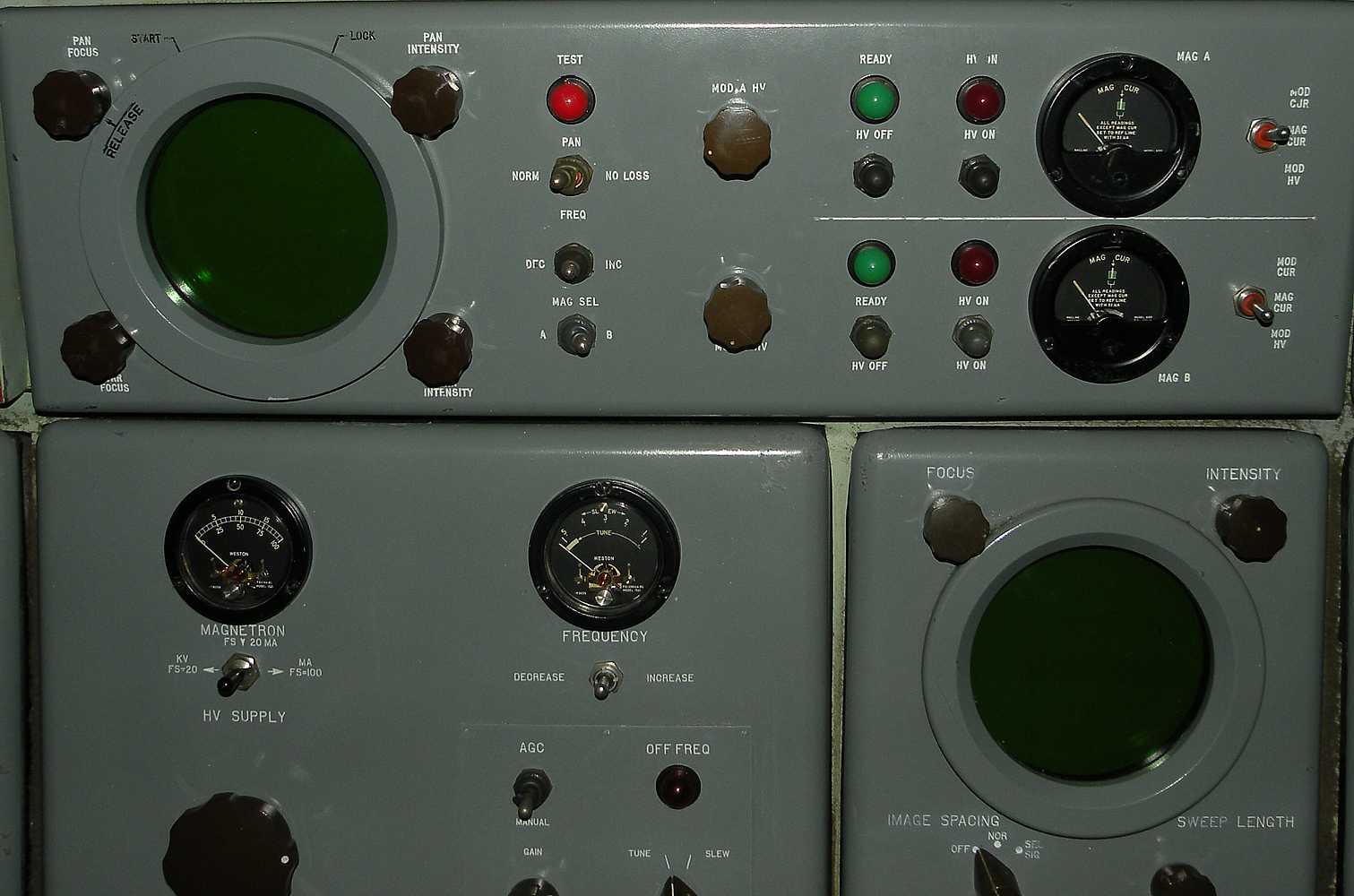
There are three target tracking operators seated in a row. each looking at his own "A" scope. The one on the right is the range operator, the one in the middle is azimuth operator, and on the left is the elevation operator. Between the range and azimuth operator is a PPI scope showing the same picture that the battery commander sees. This helps the tracking operators find the target designated by the battery commander.
![]()
Each operator can also look at the error signal (mentioned above) that goes into the servo systems. Each operator can also select to use the following modes of tracking:
- Manual, the hand wheel is operated by the operator. Usually used for target acquisition.
- Aided, the hand wheel is moved at a rate controlled by the operator. Usually used in high noise or jamming situations. For a more complete discussion click here.
- Automatic, the hand wheel is run by the servo system. Usually used in normal tracking situations.
In the Hercules, the range operator used a separate antenna TRR (the Target Range Radar). This radar used a selection of different frequencies and had the most extensive anti-jamming equipment.
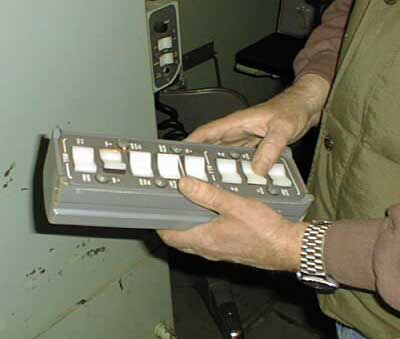
The three seated tracking operators (range, azimuth, elevation) were assisted/supervised by a Tracking Supervisor who stood behind them and also operated the AntiJamming equipment.
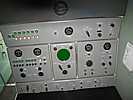
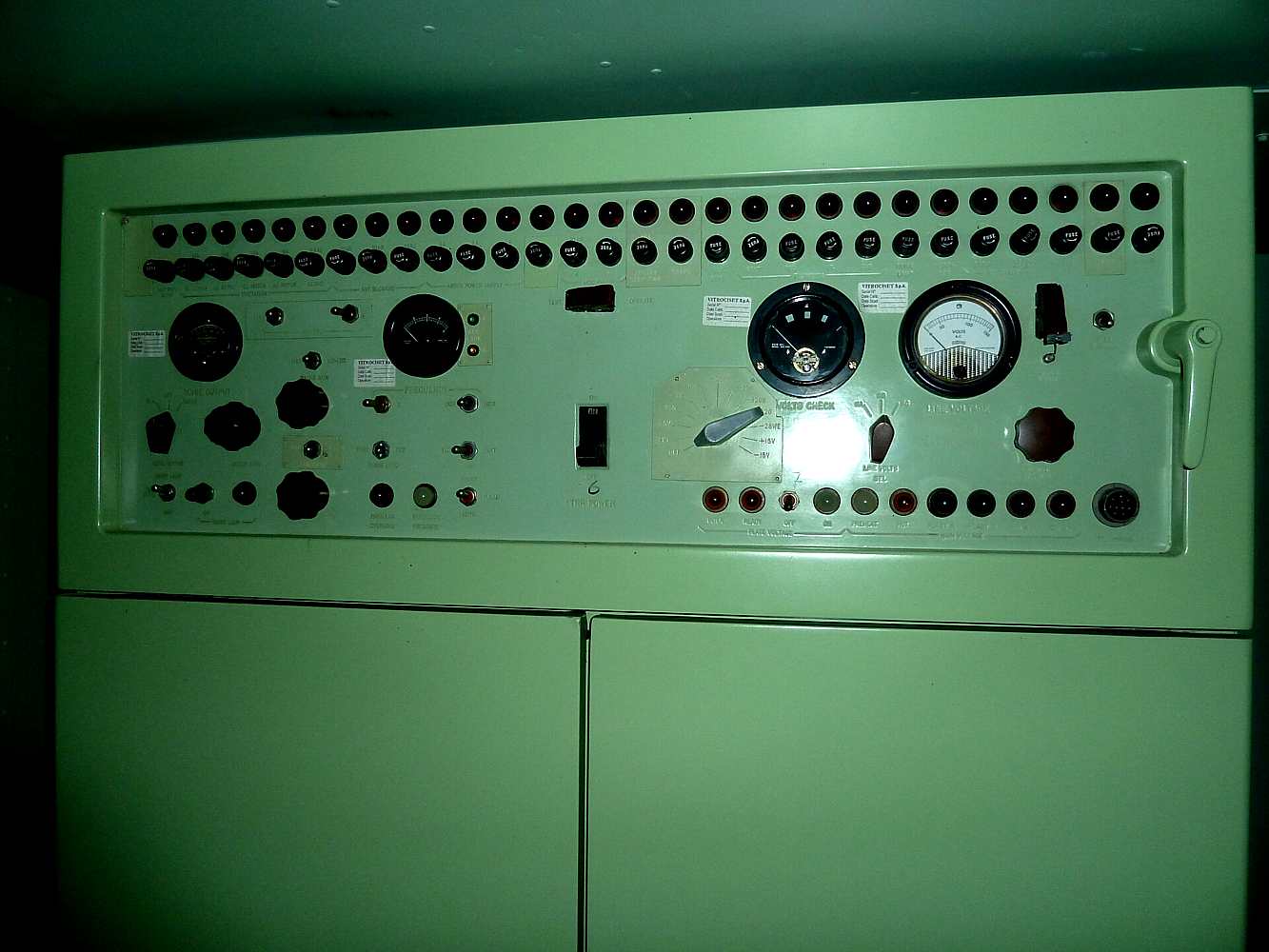
Anti-jamming control box used by tracking supervisor - in the hands of SF-88 site volunteer Ezio Nuriso (who was a tracking supervisor)
from: "Frank E. Rappange" (f.e.rappange@pi.net) " The TTR had 3 different pulse modes: Short pulse, Long pulse, and Multipulse, and the TRR had 2 magnetrons (for eccm reassons). That means that we had to perform the simtrack for: TTR short, TTR long, TRR (both magnetrons) with TTR long and short pulse."
again from: "Frank E. Rappange" (f.e.rappange@pi.net) while discussing Nike sites in Europe " The use of multipulse was strictly forbidden in peacetime, the switch was sealed. By the way we were even supposed to avoid picking up targets in an easterly direction. Before we could fire up the magnetrons we had to check with HQ for the presence of 'Zombies' (= civilian aircraft from Warsaw Pact countries). We had to stay clear 400 mils on both sides with any tracking radar. "
from Rick at ShoreRick@aol.com "The Multipulse mode of the TRR was a ECCM feature that the Tracking Supervisor could select. This was used however in cases of very strong ECM where the operators were having difficulty in tracking. The TRR receiver would "sample" the frequency spectrum and select a frequency that was free from jamming signals and transmit at that freq. The multipulse feature was added later in the life of Nike.
The IF freq of the TTR was still 60 MHz. The TRR operated in the 14 Ghz range, and in fact used three Backward Wave Oscillators (BWO). One for each transmitter, and one for the panoramic receiver. The TRR contained two transmitters and three receivers. Since the TRR had two of everything, it was a simple radar to maintain. (If one unit had trouble, the TRR could still operate.)
![]()
The above display shows an a-scope with a single very weak target signal in the range notch. The fuzz or "grass" is primarily receiver noise, similar the "snow" on your TV screen when the TV station received signal is very weak. When the range gated signal is strong, the Automatic Gain Control (AGC) reduces the receiver gain and system and noise tends to disappear. When the range gated signal is weak, the AGC increases the gain and system receiver and other noise is also amplified more, and becomes quite visible.
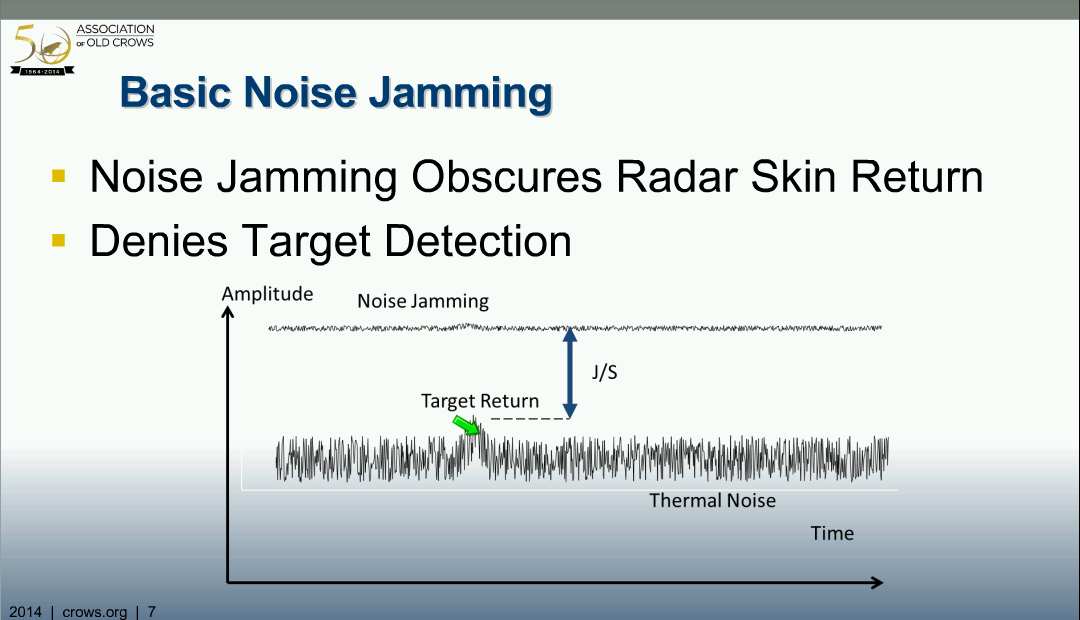
Enemy or accidental jamming can/will cause these and many other interesting displays on the tracking scopes. Go to jamming for more information.
There are various unverified stories that in practice combat between the Air Force with their jamming equipment, and the Nike with their anti-jamming equipment, that the Nike successfully tracked the Air Force planes and would have had successful intercepts with the Hercules missiles. This was reputed to be true even when the Air Force used their best jamming equipment to try to confuse the tracking.
As mentioned above, the external appearance of the Missile Tracking Radar (MTR) was identical with the TTR and TRR above.From Rolf Goerigk, Specification for the Missile Tracking Radar (MTR) include:
Antenna Gain 44 dB RF Peak Power 158.9 kW Average RF Power (PRF 520 pps) = 79.4 Watt
There is one missile tracking operator with one a-scope. The missile tracking signal is a radar pulse generated by the missile in response to a pair of radar pulses transmitted by the missile tracking radar. The missile "echo" is quite strong and gives a high "signal to noise ratio" and looks like the strong target tracking signal above. The missile is always tracked in "automatic" mode. When every thing is working correctly, the missile operator observes the equipment for proper operation, but does not have to touch the equipment during missile firing operations.
![]()
There is one interesting "got cha" - the MTR can lock on to the *ground reflection* of the missile's transponder. (Radar waves bounce off the ground as well as metal and water.) The missile tracking operator must observe that the elevation angle of the MTR is correct when locking on the missile. This can be called "multi-path, a pest even for FM and TV reception. If locked on the ground reflection, the MTR will slew *down* when the missile is launched - causing loss of tracking of the missile during launch - and things happen so fast that there is no recovery from this error. The missile will go straight up, detect that it is not being tracked, and explode in about 4 seconds. :-((
The only practical thing is to slew to and lock onto the next ready round and fire that. The loss of time should be less than 10 seconds :-(( Since the missile tracking radar is not pointing at the target until the last few seconds, the airborne enemy jammers only "see" the MTR for the last few seconds and have much more trouble jamming it, especially with the high signal strength of the transponder on the missile. The possibility of an enemy plane tracking a Nike missile in order to jam it (cause it to fail to see the MTR or to act on false steering and burst commands) would seem to be slight.
The time delay between the missile receiving the missile tracking radar pulse pair and the generation of the response is fixed, and allowed for in the MTR range system.
In the Ajax system, missile steering commands are sent to the missile by the missile tracking radar by changing missile tracking radar pulse rate. You can think of the commands as "tones", one tone range for up/down, another tone range for left/right, another tone for burst. The tone signals are combined and control the generation of radar pulse pairs.
In the Hercules system, missile steering commands are sent to the missile as follows:
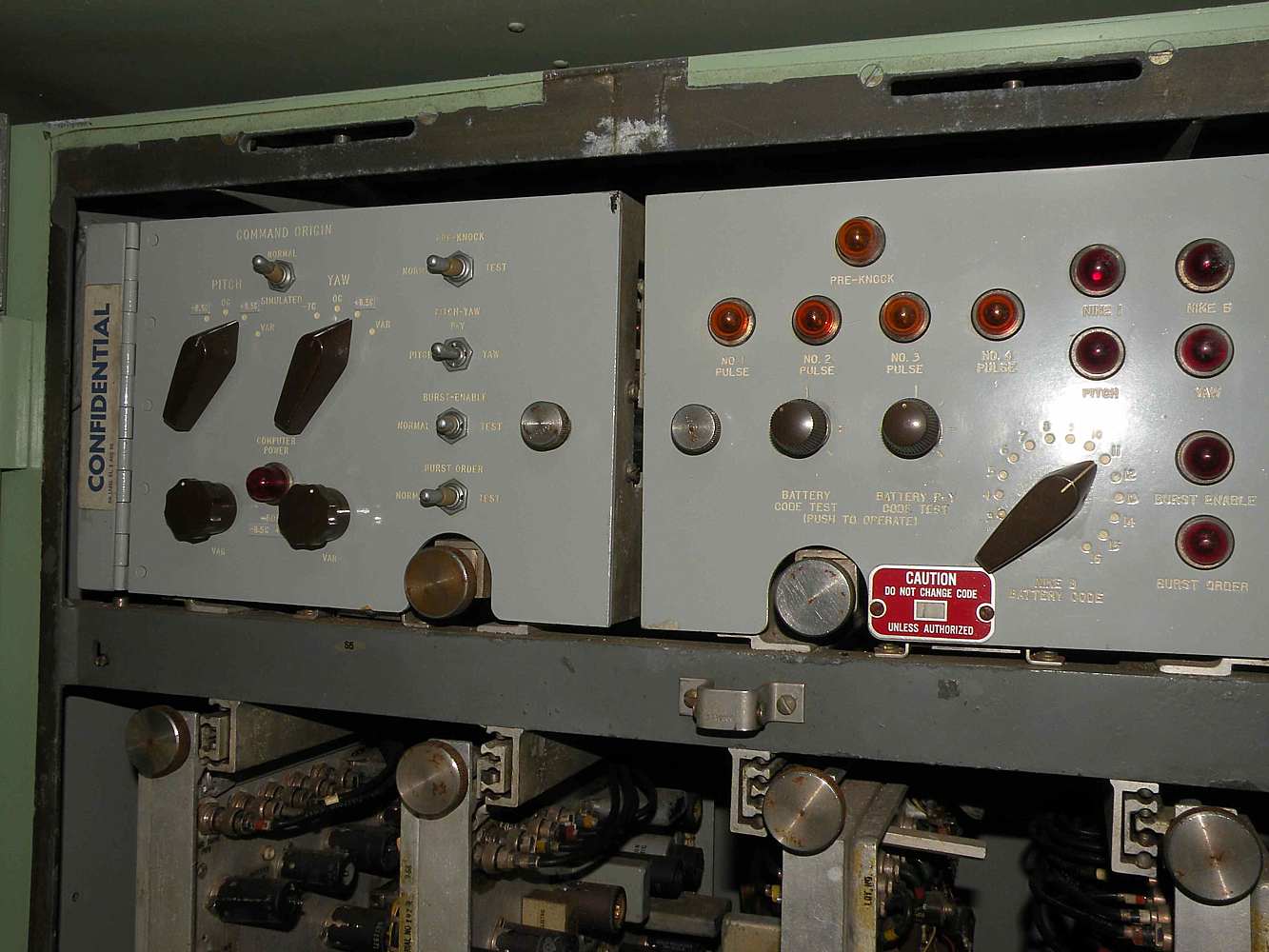
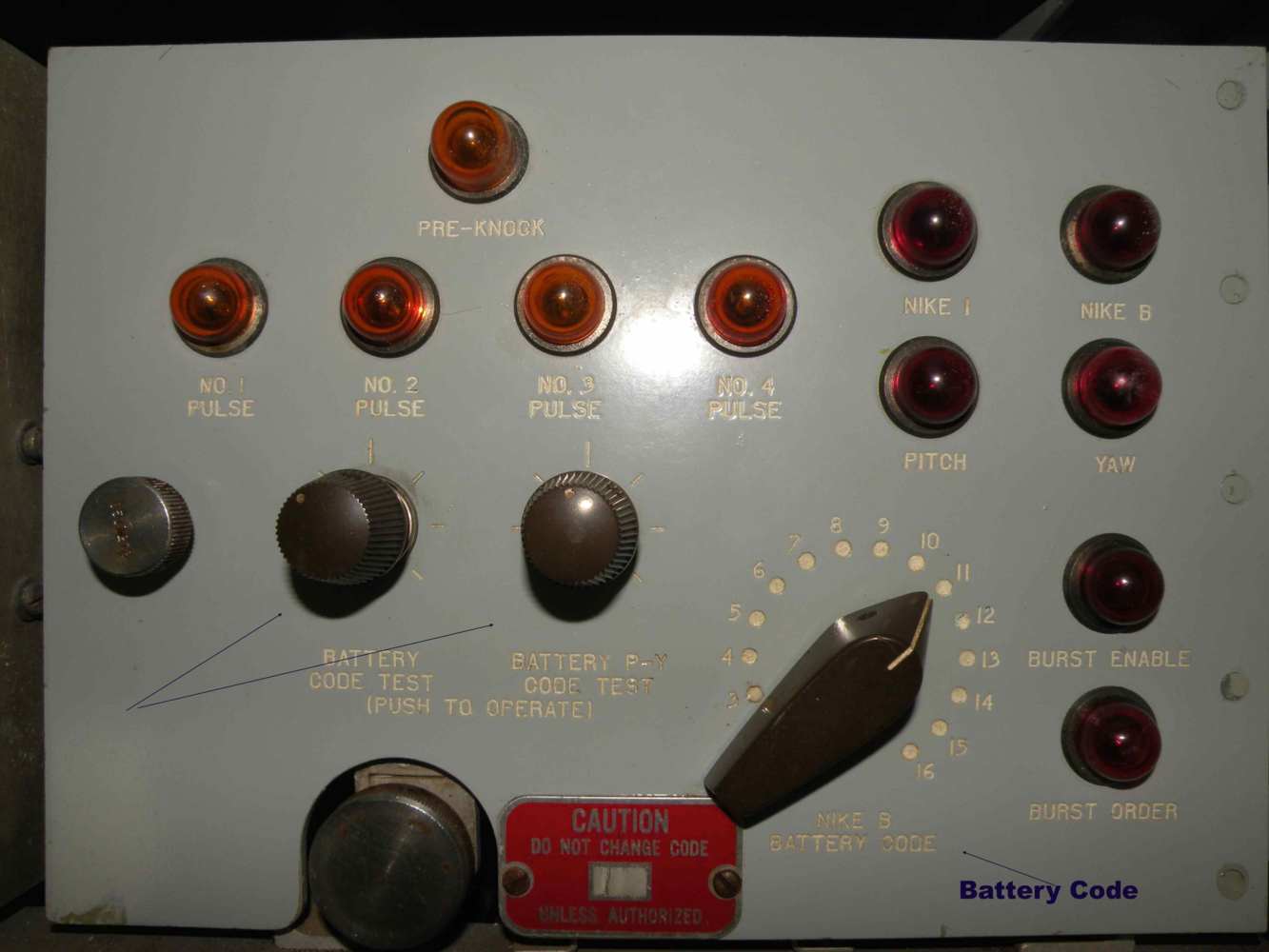
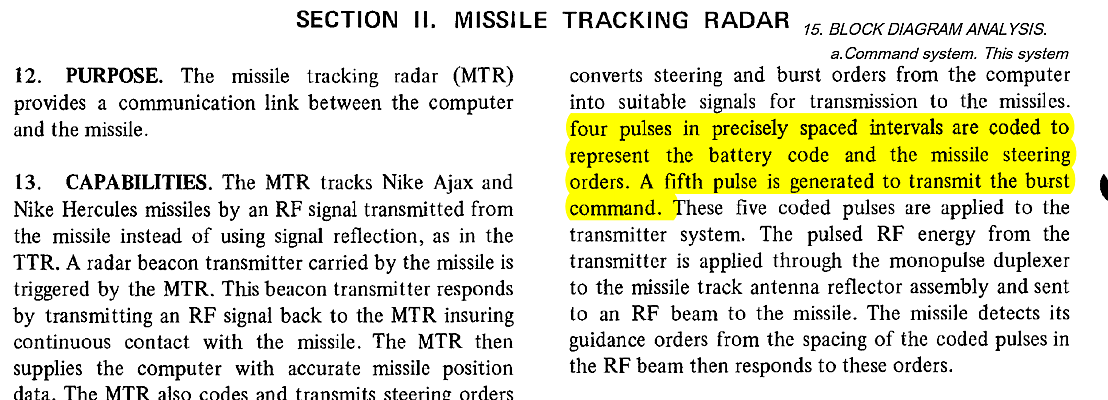
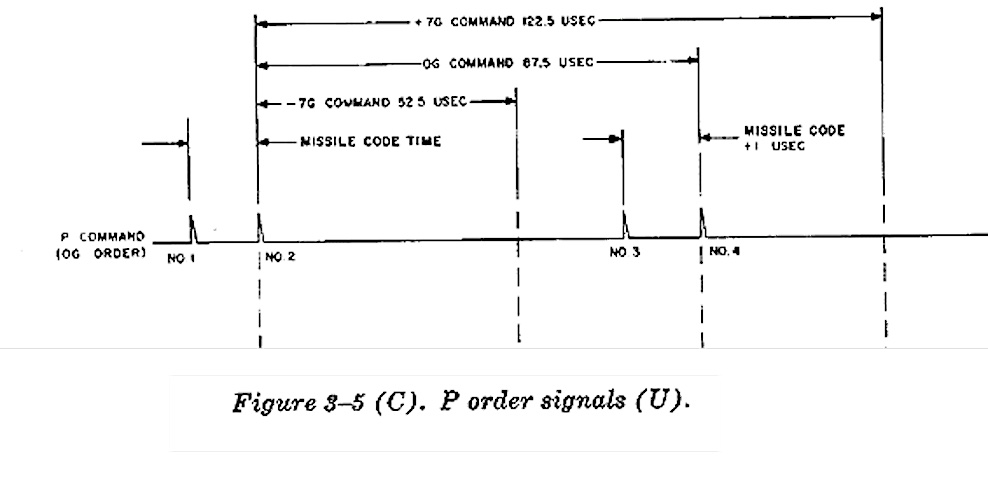
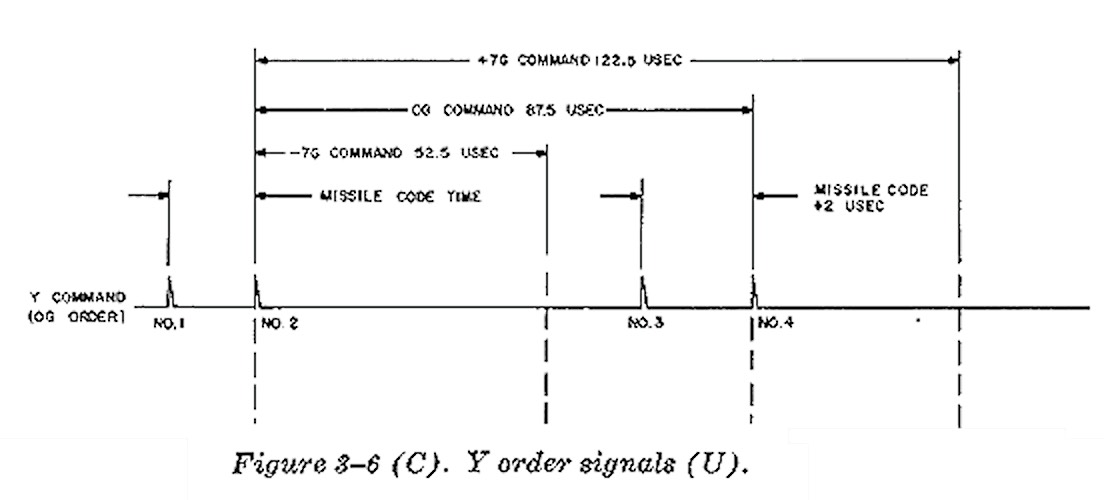
Pitch, yaw and burst commands are not mixed as in the Ajax but are sent out individually. One command is send out each 2,000 microseconds (500 commands per second). Pitch and yaw commands are sent as two pulse pairs. Lets call the first pulse pair the "start" pulse pair, and the second pulse pair the "command" pulse pair. The "start" pulse pair are separated in time by the site specific delay (called "missile code").The command is a pitch command if the "command" pulse pair is separated by one missile code plus one microsecond.
![]()
The command is a yaw command if the pulse pair is separated by one missile code plus two microseconds.
![]()
The delay time between the last pulse of the first pulse pair and the last pulse pair is the value of the command. The delay time for -7 g is 52.5 microseconds. The delay time for 0 g is 87.5 microseconds. The delay time for +7 g is 122.5 microseconds.The Pitch and Yaw commands are sent alternately during normal tracking until 0.5 seconds before intercept. First the pitch, then the yaw, then the pitch, ... . Due to the coding, the missile knows which command is which type.
During the boost phase (4 seconds) and the roll phase (1 second), zero g yaw and pitch commands are sent to the missile. Then normal steering commands are sent to the missile, which is normally starts as a dive (from vertical) to the predicted intercept point.
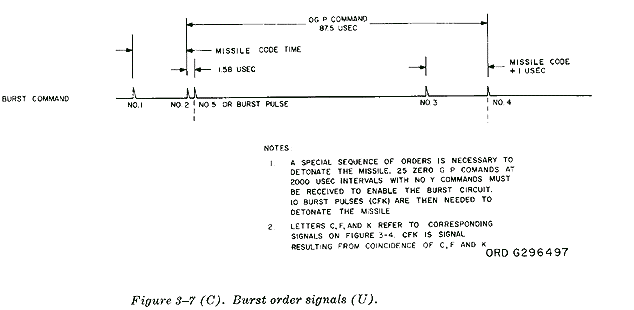
The burst command is a special series of pulses starting 0.5 seconds before predicted intercept. No steering is performed during this final 0.5 second interval.
The Missile Tracking Radar (MTR) pointing system had an added circuit to automatically point the the MTR at the designated missile. If the MTR was not tracking a launched missile, and this circuit was engaged, the MTR would slew (in azimuth, elevation, and range) to the position of the designated missile. The Launch Control Officer would select the next missile to be fired based on:
- warhead selection instructions from the battery commander (and area control)
- local knowledge of the best, most ready missile available for launch.
The position (range, azimuth, elevation) of each launcher was dialed into the MTR system.
How The Tracking Radar Points at an Object
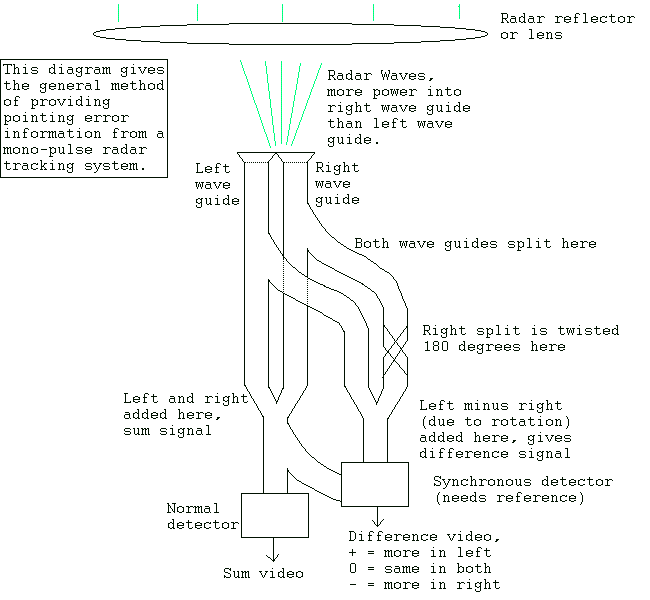
The tracking radars use the system called mono-pulse. In this system, each returning radar pulse provides pointing information by being focused at the antenna onto a group of 4 radar openings. The focusing can be done by either a simple radar lens, as in the original Nike Ajax system (similar to the long refractor telescope of newspaper cartoon fame) or a more complex Cassegrain (folded) system used in the Hercules, similar to many modern optical telescopes.
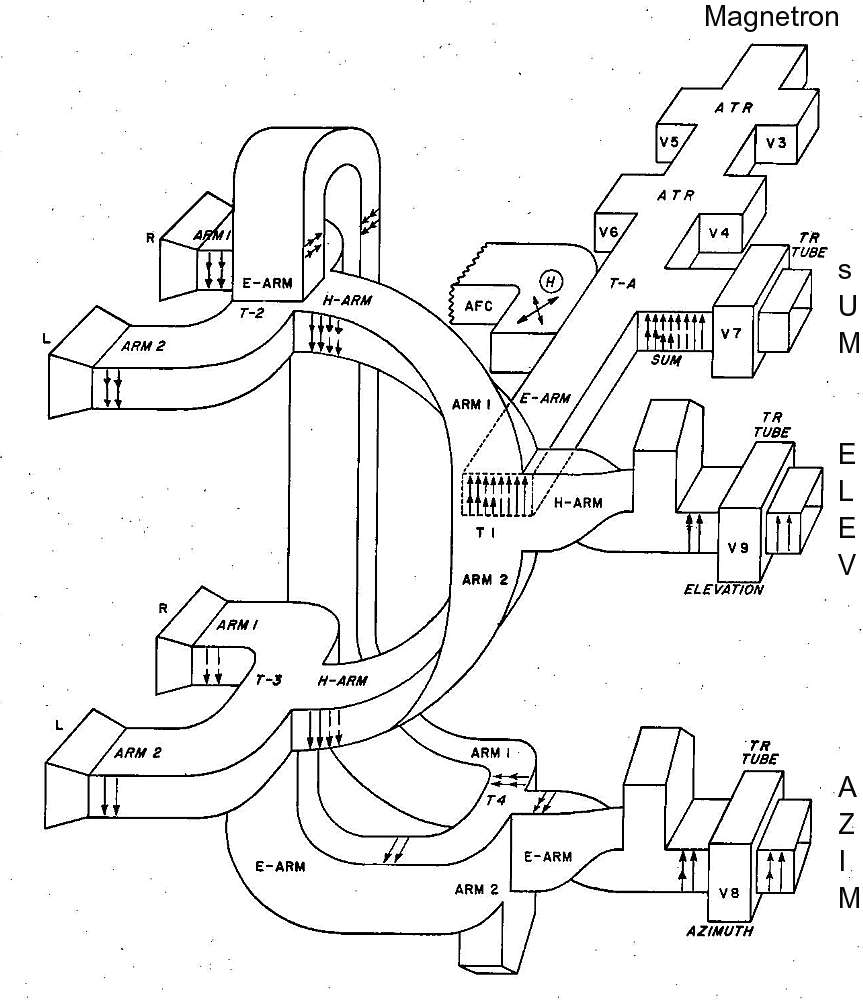
Looking at it from the transmitter out, the Magnetron generates a high power pulse, it travels down the waveguide of the sum channel, hits the comparator, gets broken up equally into each port, and travels out the 4-port feed as horizontally polarized RF.
The pulse of radar waves strike the hyperbolic sub-reflector, (which has horizontal wires so that it reflects horizontially polarized radar waves),
and reflect back to the parabolic reflector, (which is a twist reflector), gets rotated 90 degrees in phase, and is now vertically polarized RF. (There is a trick, wires at 45 degrees one-half wave length from a reflecting surface twist the polarity of the radar wave.)
The now vertically polarized reflected pulse then travels through the horizontally polarized wires of the sub-reflector, and propagates as a vertically polarized wavefront out into space.
This design is beautiful in that you have basically no aperture blockage by the sub-reflector, and the radome design of the antenna means there are no spars to cause aperture blockage and defraction.
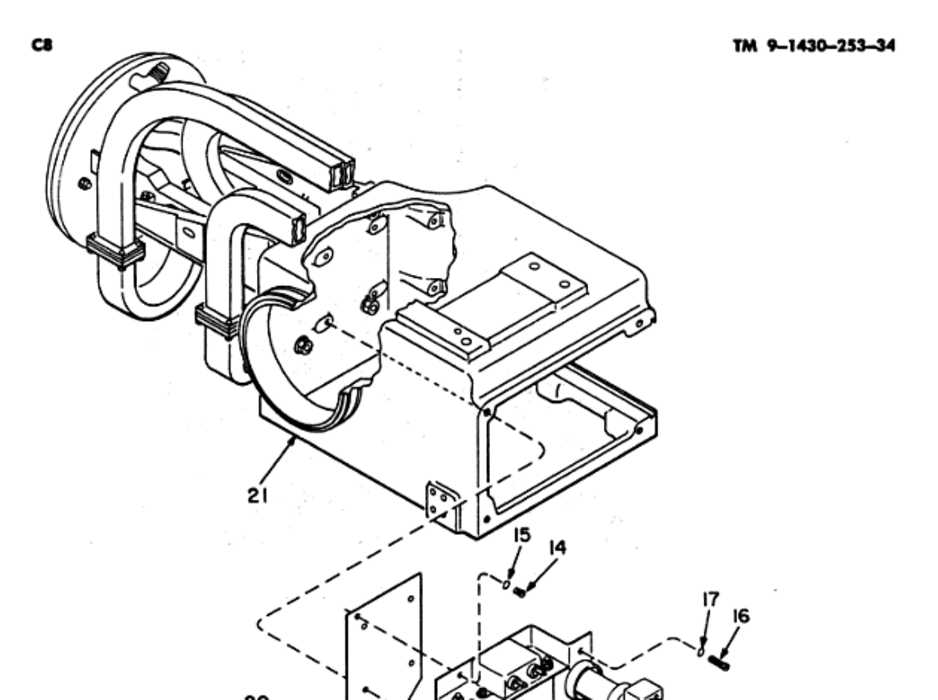
The vertically polarized returning radar signal is gathered, the polarity rotated to horizontal, and is focused onto the four windows shown in the above diagram. The four windows are connected to complicated microwave "plumbing" (discussed in the Wave guide section) which gives the following 3 outputs:
The Sum video signal is sent to the range servo system and is the signal usually displayed on the a-scopes.
The elevation difference and the azimuth difference radar signals are processed by the receiver circuits, and available to be gated into the servo system by the range gate circuits to control the antenna elevation angle and the azimuth angle. The goal of the servo systems is to reduce the pointing error to zero (and also to remain stable - not oscillate about the zero error signal).
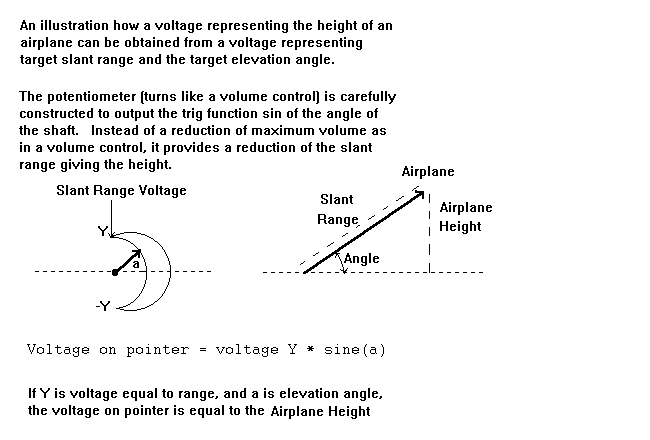
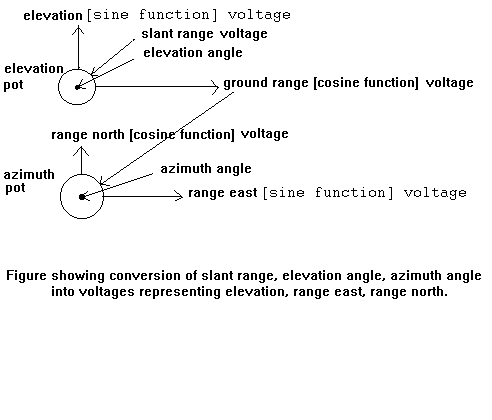
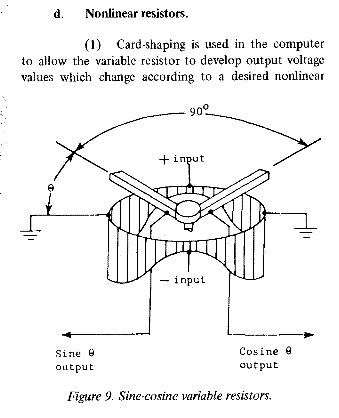
The antenna pointing controls the elevation and azimuth potentiometers which feed position information into the computer.
Comments from the designer of the Hercules tracking antenna.
Multi-path Problems & Work-arounds
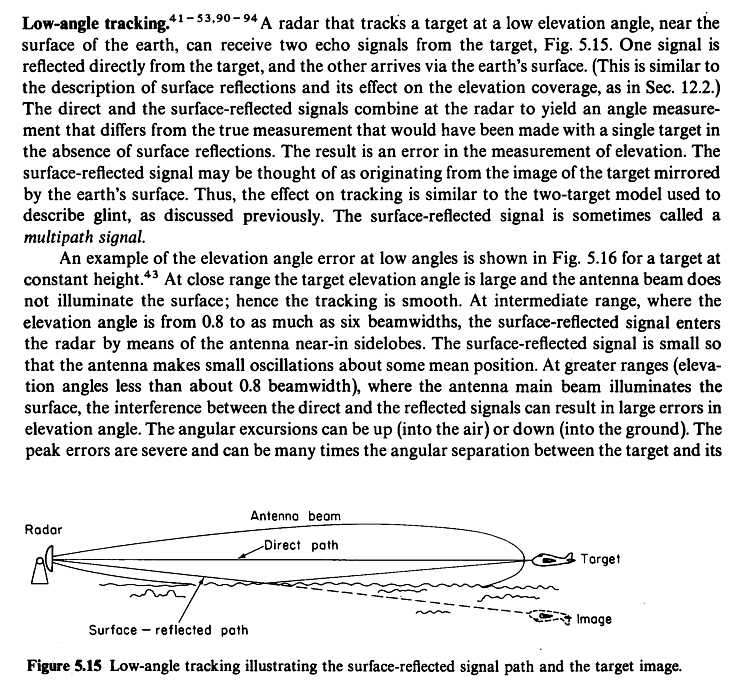
Radar waves are just a (VERY) low frequency light wave. This is both good and bad news.
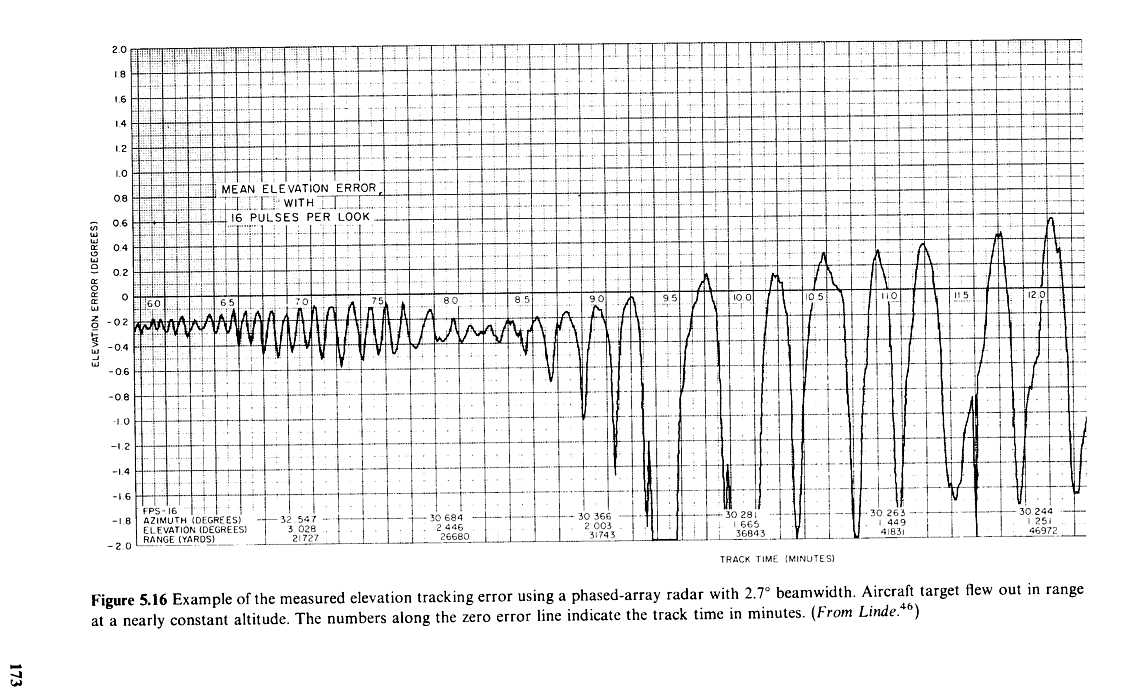
| The above "sample" is from the 1980 edition of "Introduction to Radar Systems" by Merrill I Skolnik. While trying to contact the author for permission to publish, (no contact yet) I found that he is alive, still lecturing and authoring. According to http://www.radarcon2008.org/bio_Skolnik.html , "Dr. Merrill Skolnik served as superintendent of the Radar Division at the US Naval Research Laboratory in Washington, D. C. from 1965 to 1996." and has all sorts of accolades. If you are seriously interested in modern radar (including Lidar) you should get one of his more modern books. |
Good News
Bad News
|
... A good example was the daily MSL {Missile Tracking Radar} acquire procedure. Because of the usually low grazing angle of the antenna beam, multipath effects were monitored in elevation. By using NIKE amplitude monopulse there was no cure. The MSL was rated non-operational. Just imagine, looking thru the mounted telescope seeing some cows instead of the auto tracked missile!
But the view-point or directing point was not the reflection point, instead it was the sum of the direct and indirect RF energy from the MSL. The "reflection point" was changing with season and daytime and sometimes gone at all. It was a really interesting case and I learned a lot. I was engaged (again) in that "secret" story. That case was really hot and sensitive. This matter is discussed in some radar books. The wartime solution! Moving trucks between the MTR and MSL, it worked! |
Radar alignment is reasonably complex. Each radar (target tracking & missile tracking) must be individually leveled and boresighted. Then the two radars must be aligned so that their potentiometers read the same when both are pointed in the same direction. Then the position difference of the missile tracking radar from the target tracking radar must be placed into the computer for that correction.
|
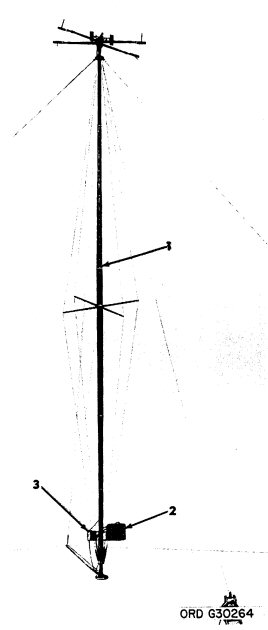
This is a
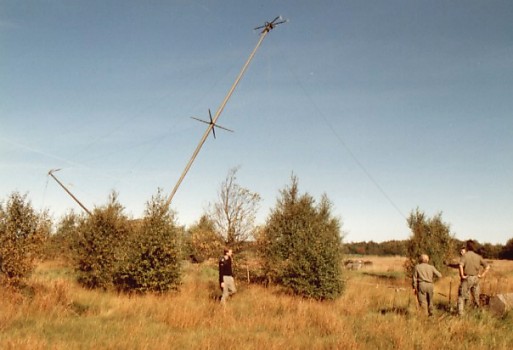
bore site mast (15 K bytes). The test signal radar waves come
out of the center of the X on top, and the 4 side things of the X on top
are optical targets for the telescopes on the radars (TTR, TRR, and MTR).
More details here |
This is a bore site mast (34 K bytes) being lowered. When in place, the long pole is vertical. Image from Rolfs NIKE Pages by goerigk@onlinehome.de.
In list fashion, it can be organized into the following major steps:
This yielded a bore sight accuracy between the Missile Tracking Radar and Target Tracking Radars of about 1.5 inch in a thousand yards (assuming the bore site mast was at about 250 yards from the radars). At 110 miles (200,000 yards) that would be about 300 inches or on the order of 25 feet. There are many more error sources in the system - of course - but the system was/is interestingly accurate. In angular measure, the boresight error was about 0.0025 degrees For an interesting comparison with the earlier (WWII) SCR-584, click here.
Frank E. Rappange
Radar waves (and light and other electromagnetic waves) travel through air almost as fast as in a vacuum. Fortunately for engineers and users, air pressure, humidity, and other atmospheric variables do not affect the speed of travel very much. To make matters even easier for the Nike problem, any variations that do occur are largely canceled out at the end of the flight, as both the radar beams are traveling through very similar air conditions. Errors due to refractive effects due to differences in air pressure along the beams cancel out. So a common crystal oscillator was used to calibrate the range systems of both the missile and target radars. This adjustment was fortunately very stable, rarely needed tweaking unless a component was changed.
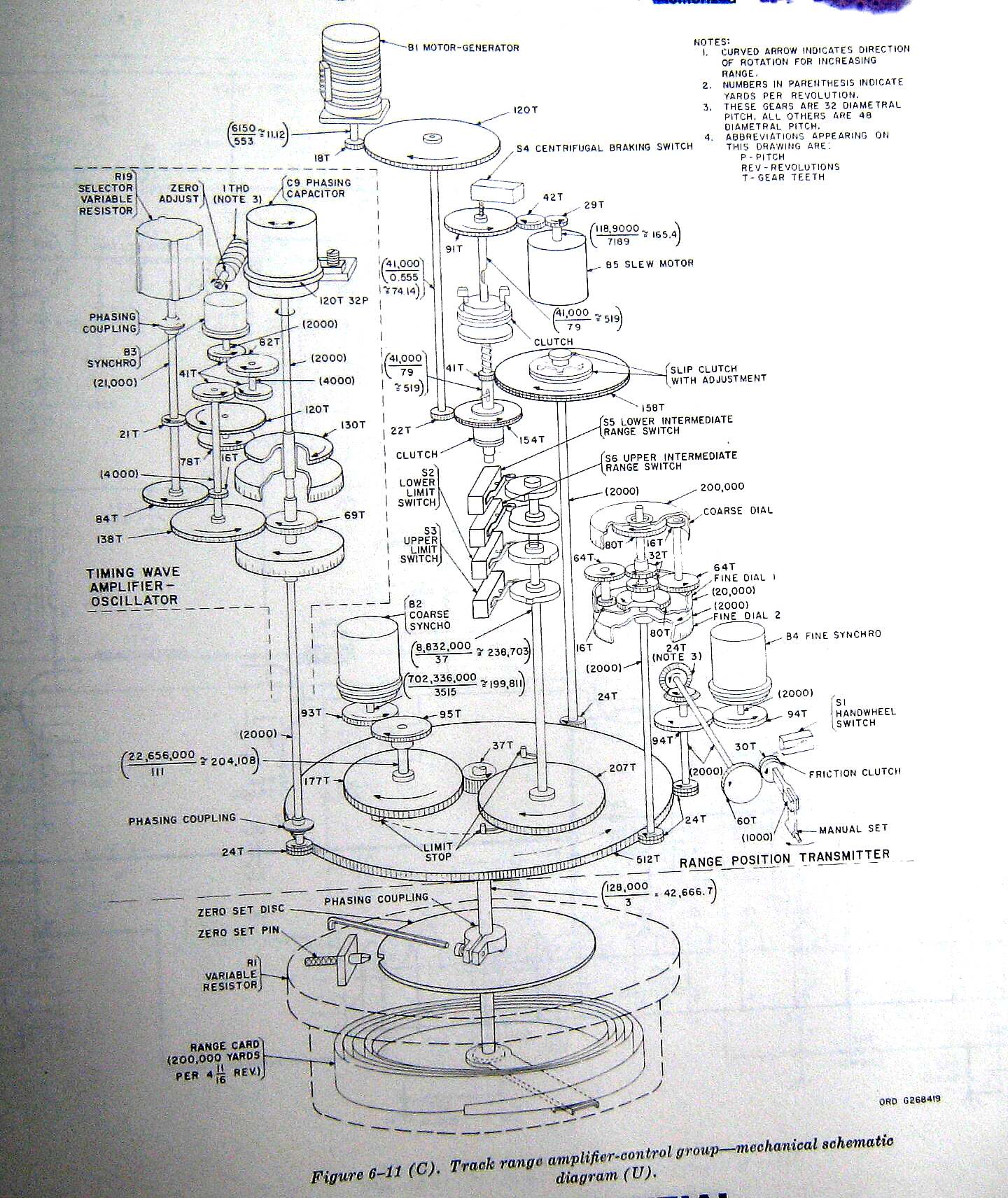
There is a circuit called a "phantastron" that has a remarkably linear pulse delay time from a voltage input. The Range Operator (or range tracking servo system) operates a linear potentiometer which provides the range voltage for:
Radar Azimuth (horizontal direction) Determination
Tracking Radar Physical Support
This way, errors due to radar wave (like light wave) refraction in the atmosphere cancel out if both radars are tracking the same point in space (in this discussion we ignore the slightly different paths due to the slightly different physical location of the two radars.
The Nike Ajax system "assumed" that wind buffeting of the two tracking radars would be sufficiently similar so that accurate enough tracking could be accomplished.
Since the Nike Hercules had an "effective" range more than 3 times the Ajax, and a real range more than 4 times the Ajax, errors due to wind buffeting and similar errors could be 3 or 4 times larger, and possibly render Hercules ineffective (too inacurate) at longer ranges.
Bubbble surrounds each tracking antenna
To counter the wind buffeting, the tracking radars were enclosed in an air inflated
fabric "bubble". This greatly reduced the wind forces on the tracking antennas.
Even if the wind gust shifted the bubble a few inches, the air forces on the
antennas would be greatly reduced during the shift of the "bubble".
The "bubble" also protected the antenna from much of the differential heating due to the sun heating (expanding) one side of the mount and antenna relative to the other side (shady side) of the mount and antenna. Although both tracking antennas would likely be illuminated by the sun the same way, vertical alignment was usually made by one person at slightly different times (an error source) and one was never confident that everything was identical anyway.
Wind Force and Sun Heating on Tower Mount
Ideally, the radars could
be located on high ground, well above surrounding trees, buildings, ... . However,
in flater areas, towers had to be used to get the tracking radars high enough.
The wind also supplies forces and torques on radar towers. The forces and especially the torques shift the top of the tower in space, and shift its angle with the vertical. The shift in space (inches) is much much smaller than other errors, but the shift in angle from vertical could result in much more severe errors.
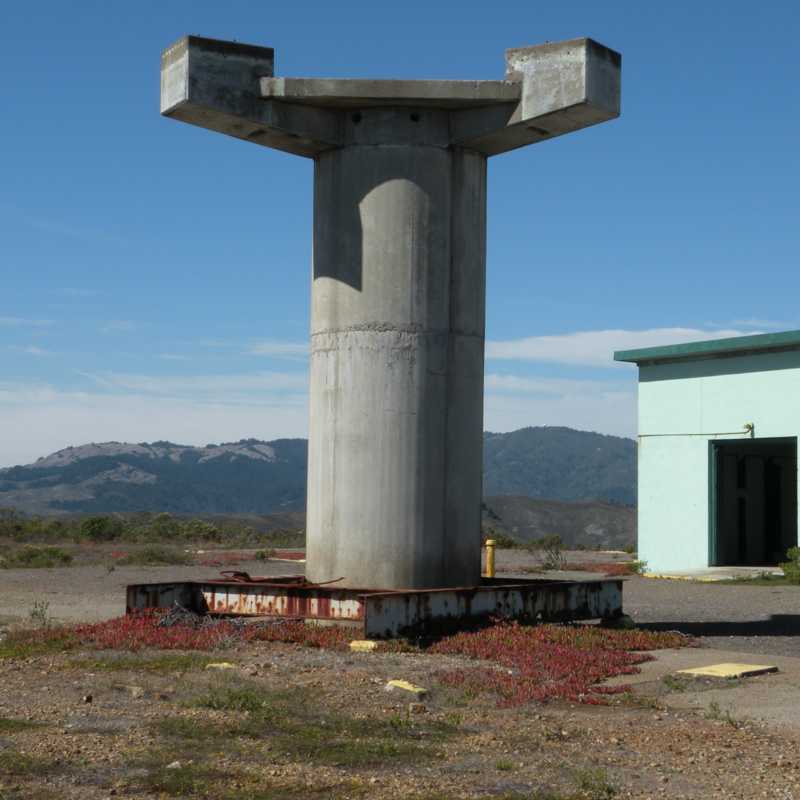
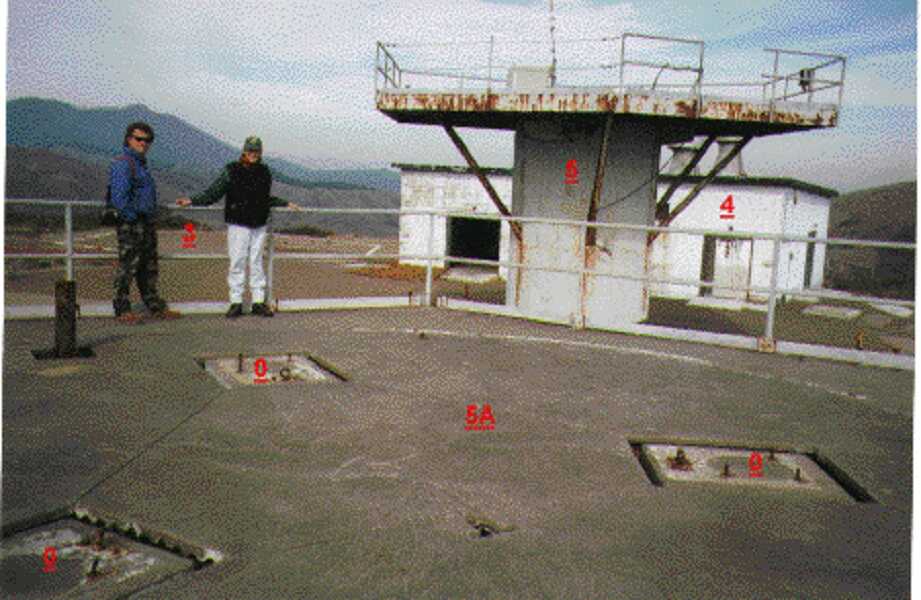
To provide improved resistance to angle errors due to torque in the tower, the tower was actually a double tower.
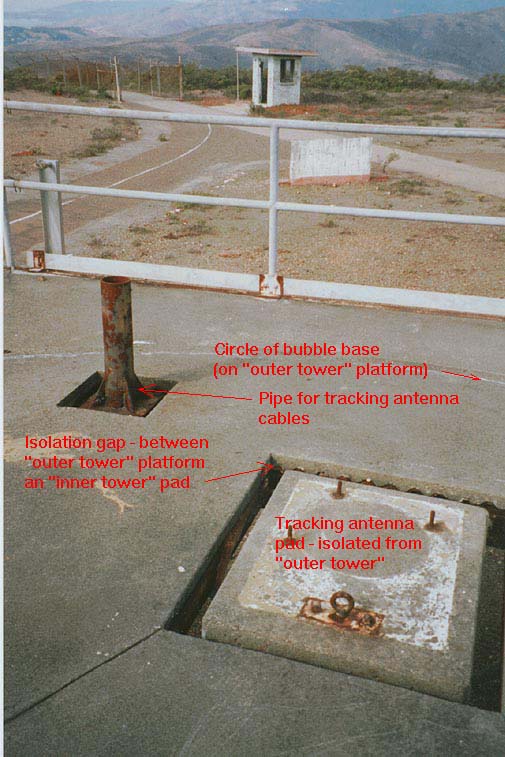
The outer tower was buffeted by the wind, and also the differential expansion due to the sun light heating it. The platform at the top of the outer tower also supported the bubble that protected the antenna from the wind.
The inner tower supported the antenna. The inner tower was largely isolated from the wind and the sun which resulted in much more stablity.
|
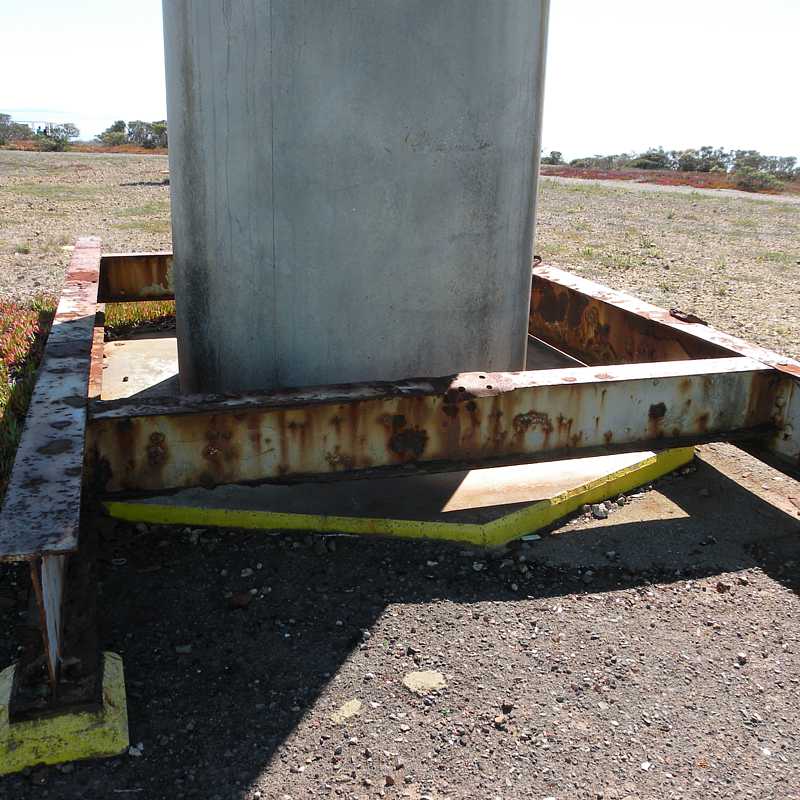
Image of tower showing: - outer tower platform - bubble base - foot pad from inner tower |
Simultaneous Tracking Test (the proof)
Have BOTH the target tracking radars and the missile tracking radar track the same
target (aircraft). If both radars say the aircraft is in the same place,
the tracking system is correctly aligned. Period. No guess work, no theory,
no "it oughta", the tracking system IS correctly aligned. Assuming the computer
works, the missile takes commands, etc., that NIKE system is capable of guiding
the missile to the target!
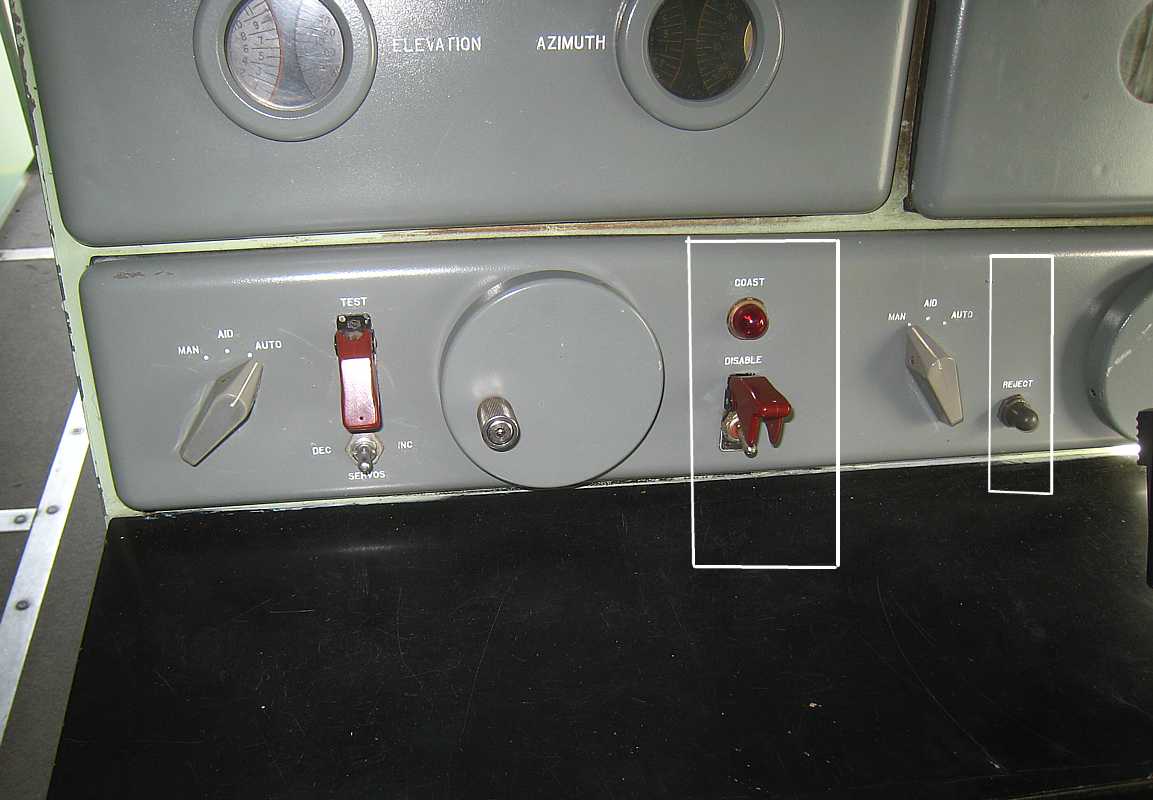
However, you remember that the Missile Tracking Radar (MTR) tracks a beacon in the missile,
not the skin of the missile. So, (FOR THIS TEST) the MTR is set to:
An aircraft flies about, and the computer voltages representing N-S, E-W, UP-DOWN
for the MTR and the TTR are compared. They ideally should be identical. Placing
a sensitive volt meter between say the target radar N-S and the missile radar N-S
should ideally yield zero at all times while tracking the same aircraft. In practice
they rarely are completely identical due to at least the following error sources.
In spite of the above long list of possible error sources, people at NIKE sites had to and did
prove - frequently - that the tracking system errors were very few yards at ranges
in excess of 50 miles. Unbelievable but true!
Simulated Tracking (and jamming)
With no jamming, you can easily teach your junior high school kid to
be a good NIKE radar operator in an afternoon. A group of afternoon trained junior
high kids could do all the NIKE aircraft radar tracking operations necessary to shoot down a
non-jamming aircraft.
The airforces of the world spend a great deal of time and money
to try to defeat radar - and many interesting jamming methods have been developed and are used.
How do you train NIKE people to track aircraft that are using
Electronic CounterMeasures - ECM (jamming)?
How do you maintain and enhance this difficult skill?
Using friendly aircraft for this
training and skill maintenance has many disadvantages, including:
I presume these, and other, reasons led to the development of the AN/MPQ-T1
Electronic Warfare Simulator (developed by ITT Baltimore, MD )
which was housed in one very large trailer. The operators in the
T-1 trailer could exercise the radar operators in both
For more details on the T-1 unit, see
There is a T1 manual on-line at
T1 AN/MPQ-T1
(another site)(.zip -> .pdf files)(10 files totaling 6 Mbytes)
For a more general discussion of jamming, go here.
From Steve Johnson
TTR and MTR video was generated {by the T-1}
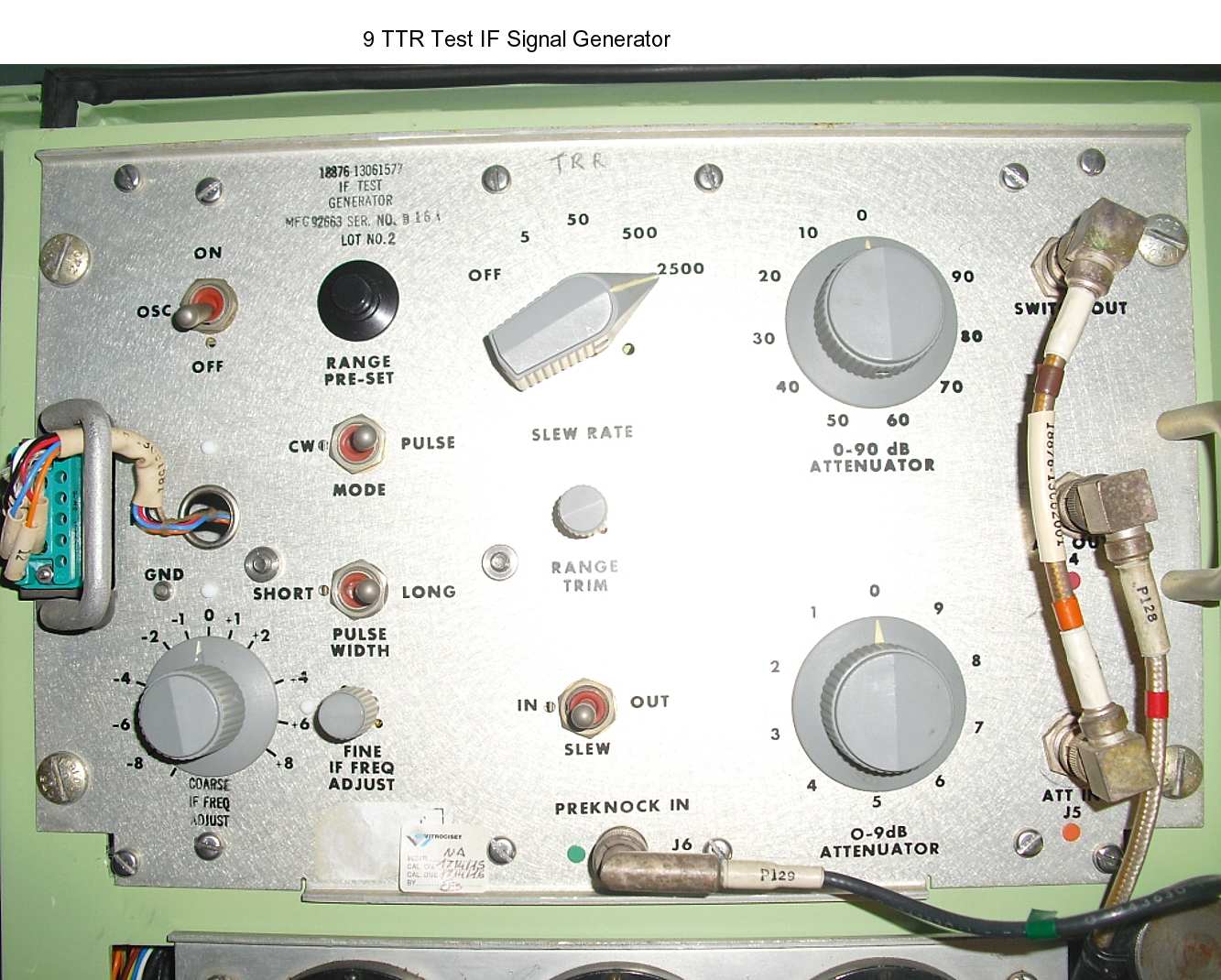
much the same as the IF test pulse except that the TTR was given sum, azimuth
and elevation signals and long and short pulse. Azimuth and elevation signals
were controlled through servos which were slaved to the antenna and range
simulation was done by delaying the video from sync.
The system could
generate 6 independent targets with 4 types of Electronic jamming on 4
different carriers in addition to Acq and track chaff and angle deception.
From Bert Belfer
If you have comments or suggestions, Send e-mail
to Ed Thelen
Return to home page,
Goto Next Section
Return to beginning of Nike Tracking Radars
The above two changes permit MTR to track the aircraft just the same as the TTR system.
using the T-1 System
with many types and quantities of "interesting" ECM (jamming) problems.
LOPAR/HIPAR target video and ECM was created using
sync and preknock signals from the radar. Antenna rotation was slaved to the
radar by a device called a "flying spot scanner" and video was triggered
using
a system called an "antenna pattern generator" which simulated not only the
main antenna lobe but side lobes as well. By changing the position of the
main lobe, the target could be moved in azimuth at will and the ECM would
also
be positioned along the main lobe.
Army Navy Mobile Radar Signal Simulator. I worked on them for about 10 years,
a great training device. Simulated up to 6 targets, ECM, and ground clutter.
The Chaff cabinet was a bitch to maintain. The T1 also had a reusable
missile. The T1 was heat sensitive and the IF strips had to be retuned as the
trailer got warmer. The Simulations were injected at the RC & BC Vans not at
the radars.
Updated September, 2008