A Group of people
Armies, companies, clubs, teams, political parties, ... are all about people. Even an automobile club is mostly
about people who share an interest in some automobile(s).
A Nike "battery" is a group of people somewhat thrown together, whose purpose is
presumably to be ready to fire Nike missiles at an appropriate time in an effective manner.
Most people are not cabbages, and even cabbages have good days (say rain or sun), troubles
(say cabbage worms, drought), and bad days (their head is cut off and sent to market).
|
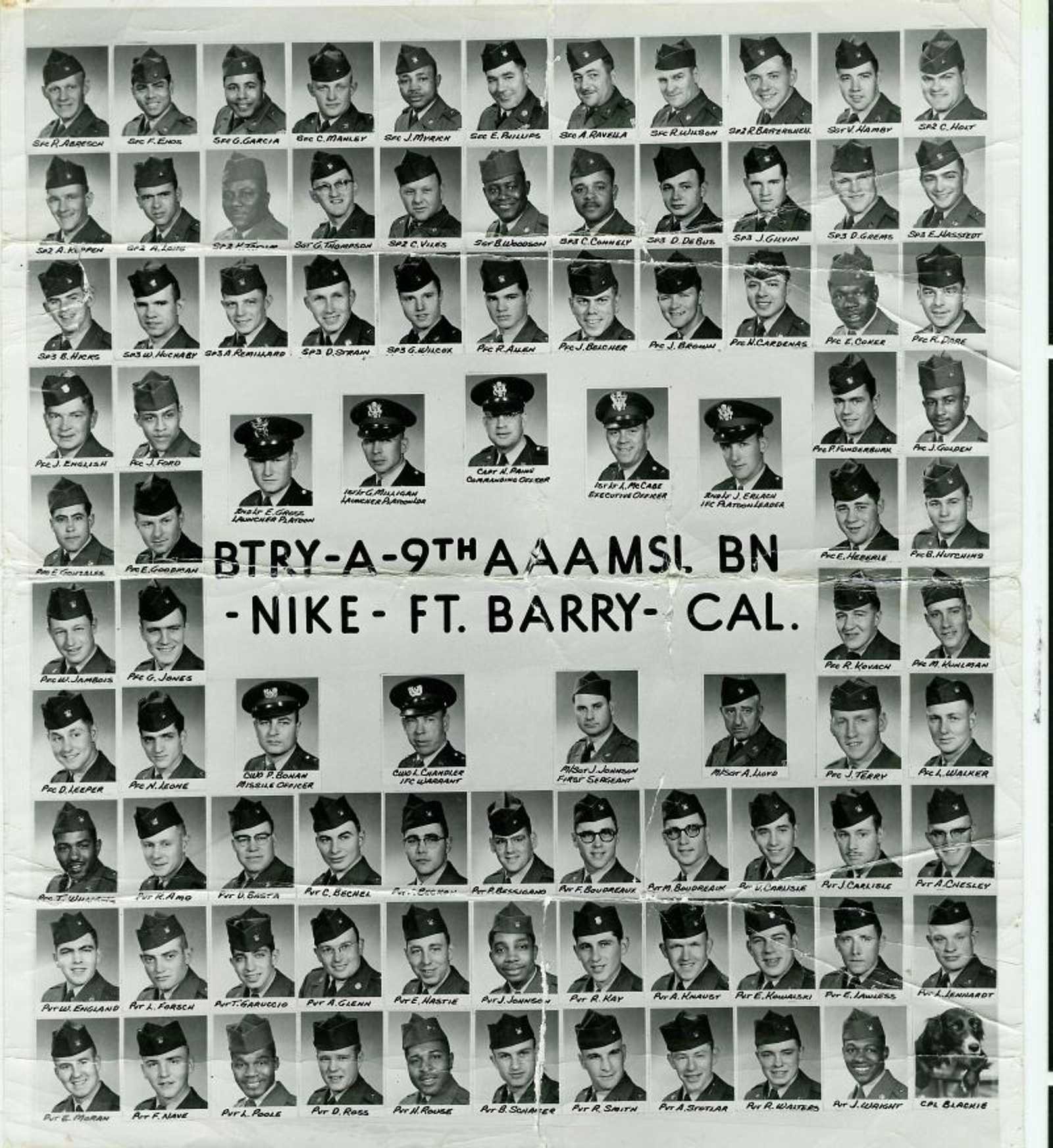
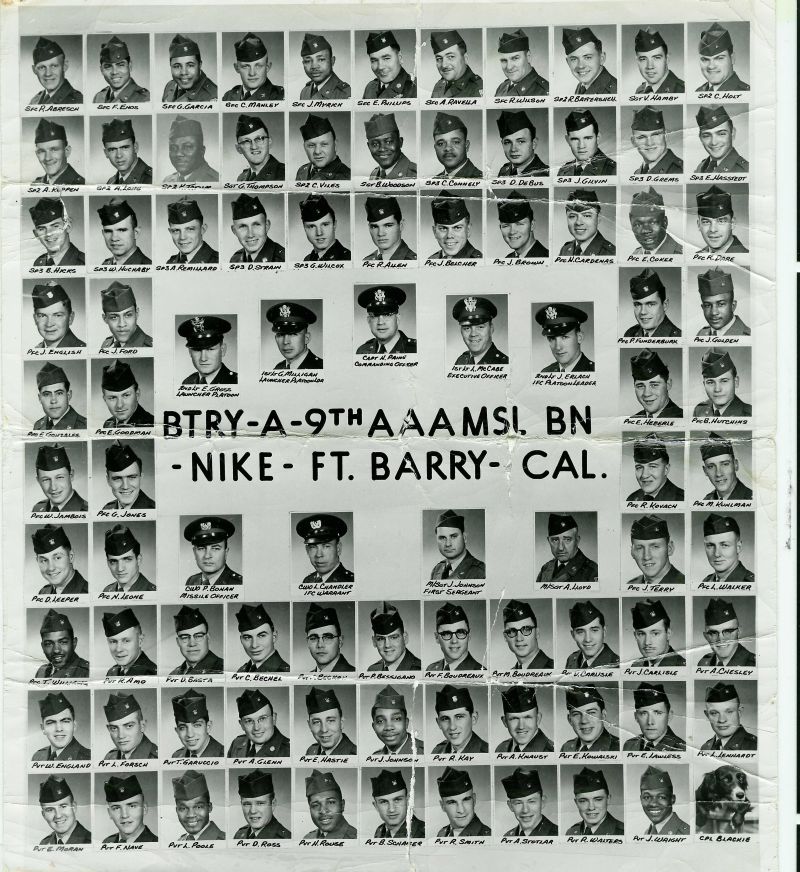
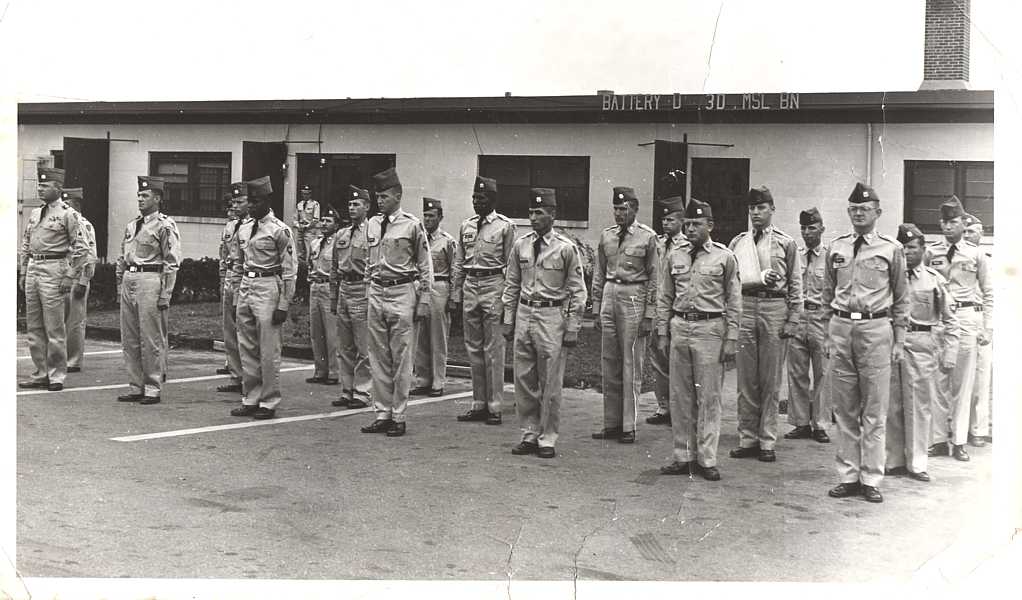
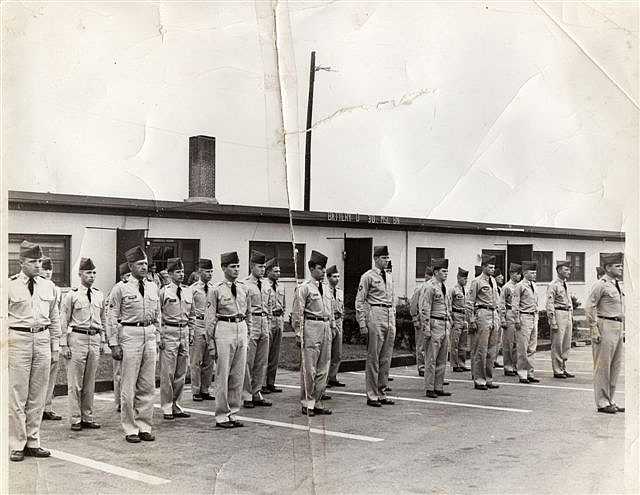
Here is a photo from James English of the folks of Nike Site SF-88.
- Just north of San Francisco.
See - real people, not mindless robots as represented by my "liberal" friends.
"1956 Chain of Command Capt. Henry Paine,Commanding Officer, 1st Lt. G. Milligan Launcher Platoon Leader,
2nd Lt. E.Gross Launcher Platoon, 1st Lt. L. McCabe Executive Officer , 2nd Lt. J. Erlach, IFC Platoon Leader.
CWO P.Bonan, Missile Officer.CWO L. Chandler IFC Warrant. M/SGT J. Johnson First Sergeant. I have a group picture
of all 91 people assigned to A Battery in 1956."
Note that the picture even includes a "CPL Blackie", who looks like a dog ;-))
as sent, (176 KBytes)
|
image enlarged x2 to see the real people
(287 KBytes)
| |
Here is an
Army Autobiography by Recruit William J Auell, RA13303902 reporting Sir!
Return to beginning of Life on a Nike Site
A military organization is mostly about people. If the people are
not housed, fed, clothed, motivated, and trained, then all of the
fancy equipment they might have is under served, or even useless.
Just ask Sadam Hussan about this problem. In the First Gulf War,
his people got pounded
by bombs very heavily, supply trucks didn't come and they got very hungry and thirsty,
communications were cut and they felt isolated and out of touch,
and did not perform up to any body's expectations.
|
Written in 2010. I've been running this Nike web site for about 14 years - and had completely
forgotten "Race Relations" in the Army until this story
popped up in 2010. As far as I could tell (I'm white), the U.S. Army was very well "integrated"
as far as race was concerned. The southern guys at the time just had to ride with the tide.
Race seemed a non-issue, no quotas, no parallel ladders, ... If you did your job,
kept your nose clean, seemed promotable (you know, get along, show a little enthusiasm, learn a little, ...),
you had just as much chance at promotion as the next guy.
|
Housing
The people in the Nike program lived (primarily) in barracks in the
administrative area. Individuals with families in the adjacent city
could live with their families. The barracks were warm but nothing
to brag about. The lower ranks (me) slept in large rooms, about 20
to the room. Your private stuff (would you believe a calculus book?)
could be kept in you foot locker at the foot of your cot.
There was a vertical locker for hanging clothing. Higher
non-coms sometimes had shared or individual rooms. At our site, officers lived
off-post, there was no BOQ (Bachelor Officer Quarters).
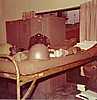
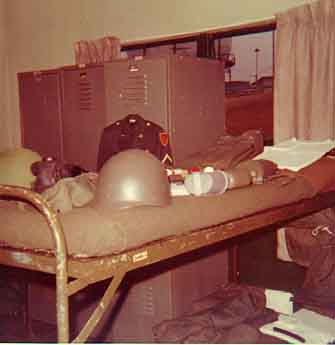
Thomas Zangla sent this photo of an
enlisted barracks.
|
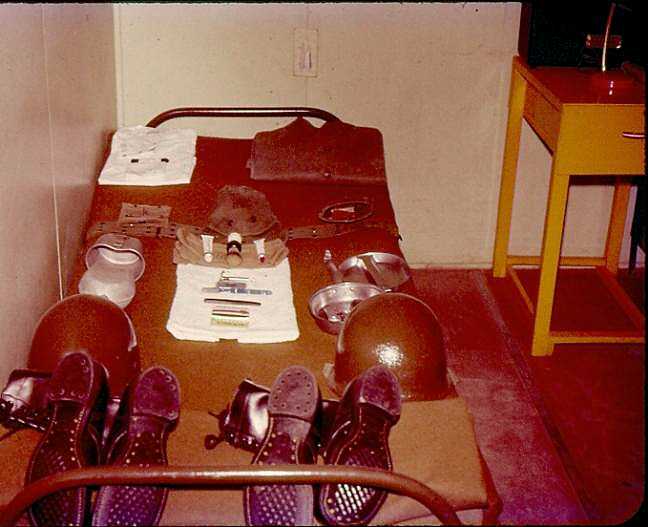
....all ready for inspection. It seemed like we were
always having some sort of inspection. One night one of the guys
phoned home and told his wife he had to stay for a GI party.
She said she wanted to come to the party and did.
Boy was she mad when she found out what a GI party really was...lol.
|
Look! Curtains !! Thomas! your pulling my leg! We certainly did not have lovely curtains like that!
What army were you in anyway?
Each soldier got one vertical locker,
one foot locker (not shown), and a bed. About 20 people would sleep one a large room like this.
Of course folks were coming in late from ..., leaving early for K.P or other duties, not all that restful.
The bed isn't that great, but if your dog tired, who cares. I don't remember any big bay windows.
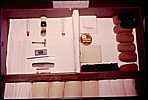
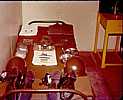
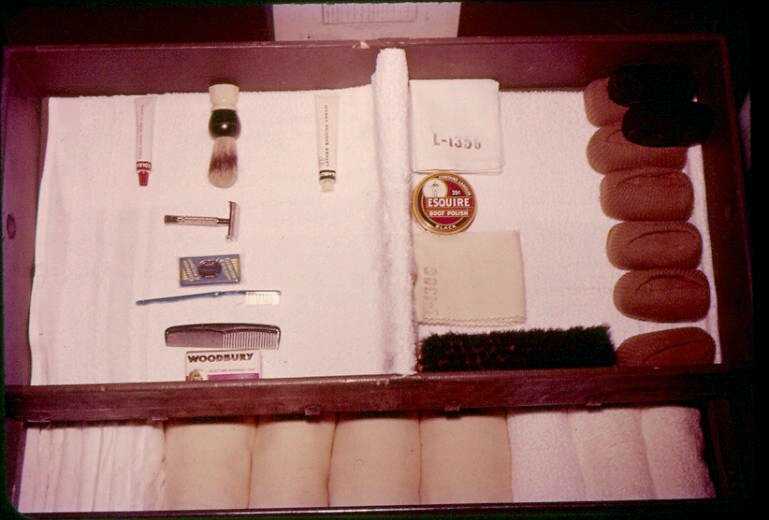
Leroy Lewis sent the following images - with the comment "Check out the footlocker and the fake badger hair shaving brush."
| 
| Ken Fraser said "At ORC [launched targets for Red Canyon] personal inspections were easy. The night before some
of us just carried out our surplus personal junk and hid it behind a boonie. We didn't have many
inspections because they were a terrible waste of valuable off time. The NCOs hated them too."
From Ed Thelen - most guys left the top drawer alone, never touched the stuff. Gluing items down was
considered cheating - inspectors sometimes touched things to make sure they could move ;-))
|
The launcher guys did not have sleeping facilities in the launching area. When one of the many alerts were called,
about half of them would get rousted out of bed and head for the nearby launcher area. You know, undisturbed sleep
is a precious quantity in the army. Some how I don't remember ever "sleeping in" and relaxing. Some damn one or thing
is always disturbing you. I guess that is what leave time is for.
I preferred to live at the IFC "ready room" (eating C rations yet) until forced to come back to the administration area
to shower and swap laundry. Fewer people and things to disturb you. I even set up another electronics hobby shop
in the IFC "ready room".
|
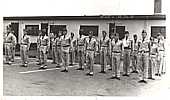
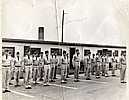
Bob Murray sent these images of B-05,
Danvers, Massachusetts 1961. I presume this was a Saturday morning formation. I succeeded
in avoiding about 95% of such :-)) It ain't that I'm against the military, I just detest
this form of activity that seems universal in the world. Like high school education,
"there just gotta be a better way."
| 
| 
|
Our Location
Our site was in a Chicago City Park (at 63rd and Outer Drive).
All areas were fenced off with serious 8 foot cyclone style fences.
(No traces of the site remain - filled in - flattened - re-planted - Gone!)
The barracks and other buildings were pale green (to fit the park decor?)
There was a guard "shack" at the main gate, occupied to keep the casuals
(and sometimes the police) out. We had an orderly room, with offices for
the captain and 1st sergeant. There was even a clerk that resembled the clerk
"Radar" in MASH. There was a mess hall, complete with cooks (and I haven't
the foggiest recollection of who did "KP").
Food
Mess hall food was really not bad, and there was plenty of it.
We got more food because we were on combat duty (yes, duty on a Nike site
was considered "combat" - if the Russians came - we were on the line -
even in Chicago).
Seemed to get rabbit a lot, not bad, just that once a week was
plenty. Only complaint was their sloppy preparation of Jell-O
yielded shoe leather on the bottom and Kool Aid on top.
I had gotten very hungry in basic training - whether it was that the
cooks were stealing too much food (we saw some strange things),
or that army rations were normally tight, I cannot say.
(Learned to steal "C Rations", acquired a taste for them.)
(And many of us spent most of our money eating ice cream at the PX)
NEW FOOD DISCOVERED - from JP Moore Aug 07, 2016
|
I am probably the last person on earth to finally eat Maruchan Ramen Noodles, chicken flavored.
Know what? I really like them. So does Loraine. I used 2 packages, total cost 40 cents.
That made 4 big bowls of soup, 1 for Loraine, 2 for me and the rest for Pepper, the dog.
Man, would I have loved to have these packages of noodles at
Red Canyon Range Camp
in the 50's. We were always hungry, no money, 15 miles to nearest store over a huge lava bed. Ramen Noodles would have been a
real lifesaver for us GIs starving out there in the New Mexico desert.
JP
|
Sick Call
From Bill Evans
Subject: sick call
|
Hey Ed:
Here's a response Bud Halsey wrote today re my question about what
was done about sick call at the sites.
Me:
Another 'human interest' thing that I was trying to recall is what did
we do about sick call? I do remember going to a _dentist_ at an Army
facility (an annex of Walter Reed, at Forest Glen, which is a very
bizarre place, so I distinctly recall it). And someone must have driven
me there, since I had no car at the time. But I have no recollection of
going to any medical facility. Maybe I never got sick.
Bud:
If your unit was typical, there was a "sick call" formation daily.
Since individual batteries do not have medical personnel assigned, most
likely those attending "sick call" were transported by administrative
vehicle (a sedan or carry-all--usually civilian style but painted olive
drab) to battalion headquarters. The Headquarters and Headquarters
Battery, by TO&E (Table of Organization and Equipment), did have a
medical section assigned. Units, far from established military
installations with hospitals, often had a medical augmentation team
consisting of a doctor and/or additional "physicians' assistants" (then
called aidmen or corpsmen) who could administer medical care. So, your
dental experience was typical. Since your site was near an Army Medical
Center, you were probably screened at battalion headquarters and then
transported to the dental facility at Forest Glen (I agree with your
assessment of Forest Glen--a collection of bizarre and eclectic military
buildings left over from some Victorian nightmare).
Had you been "sick" at your site, you would have probably attended
"sick call" at your site, then been transported to battalion
headquarters for their "sick call"--held by either enlisted aidmen or a
doctor if your unit was augmented. Those things beyond the ability of
your battalion medical section to handle would be treated at the nearest
military medical facility (or civilian hospital if you were in a really
remote area) where you would be sent.
|
Rivalries
The Launcher Area was adjacent to the administrative area,
but basically off limits to IFC personnel. One fine day I decided to pay a
visit. And was ordered by Sergeant Lubsdorf to start pulling grass!
After further discussions with the 1st sergeant I spent a morning pulling
weeds in the launcher area. So we kept the launcher area people out
of the IFC area. Nice.
"They" (the launcher people) said we squatted to pee,
and we (the IFC people) didn't regard them as quite human (with exceptions).
Joe Williams says:
Ed,
Interesting. I have the converse story. While at B 5/6 launch area, I
hitched a ride on the mess truck so that I could see the IFC area. They
wouldn't let me in. I then spent 2 years at 5/6 BOC fifty yards from C 5/6
Hipar van, but I never got to step inside.
-Joe
|
Personalities
Captain Hill - a large fatherly figure, we judged him somewhat brighter
than his boxer dog, a great deal more savvy than the media stereotype.
First Sergeant Miller - again a large fatherly figure, surprisingly alert
to people situations and interactions. Would put the usual marriage councilor
or psychologist to shame. Very good at when to speak loudly, speak softly, and
when to shut up. Don't bet against him any situation.
Sergeant Lubsdorf - reputed to have local underworld contacts.
Two of our more playful black guys irritated the Chicago Police too much.
Their hobby was finding police sleeping in a police car near our site,
pound on the car with their fists - waking the officers,
and run like hell for the front gate, and into the protection of the army.
They got picked off the street by apparent plain clothed police,
and disappeared from the face of the earth.
Lubsdorf's contacts found them, 12 hours later,
30 miles away in a small police station,
laying on a jail cell floor, somewhat bruised.
The sergeant was later transferred under a cloud of missing army equipment.
Cpl. Lopresti - IFC maintenance & chief scrounge, a treasure. He was 5'5",
we called him "Low Butt".
Warrant Officer Langemak - seemed rather academically inclined, was making the
Army a career, 12 year man, did not like the Nike experience and resigned.
Later got to be a big wheel in Germany for Hughes.
Thanks for the tour of the various embassy bars in Bonn, Germany years later!
There are more stories in Nike Stories.
And life on site C-48 from its last commanding officer.
Return to beginning of Life on a Nike Site
This equipment was (and still is) very high tech and also required
much daily, weekly, and other periodic checking and service.
The Missiles and Launching Equipment
The Ajax missiles had very dangerous propellants that had
to be checked, and serviced on a regular basis. There was quite complex
electrical check out equipment to check the missile electrical, guidance,
hydraulic, propulsive and launching equipment.
The IFC (Integrated Fire Control) Area
The three (or more later) radars, the multitude of CRT displays,
mercury vapor rectifier regulated power supplies, the hundreds of tubes
in the computer, the plotting boards, ink for plotting board pens, timings, pulse widths,
voltage balances, switches, relays, cables, ... forever.
Support from outside the battery, higher level
There was technical support from outside the battery, such as supplies and parts.
Also were experts who could come to the site for severe problems, and or
take defective equipment back to "Ordnance" for repair.
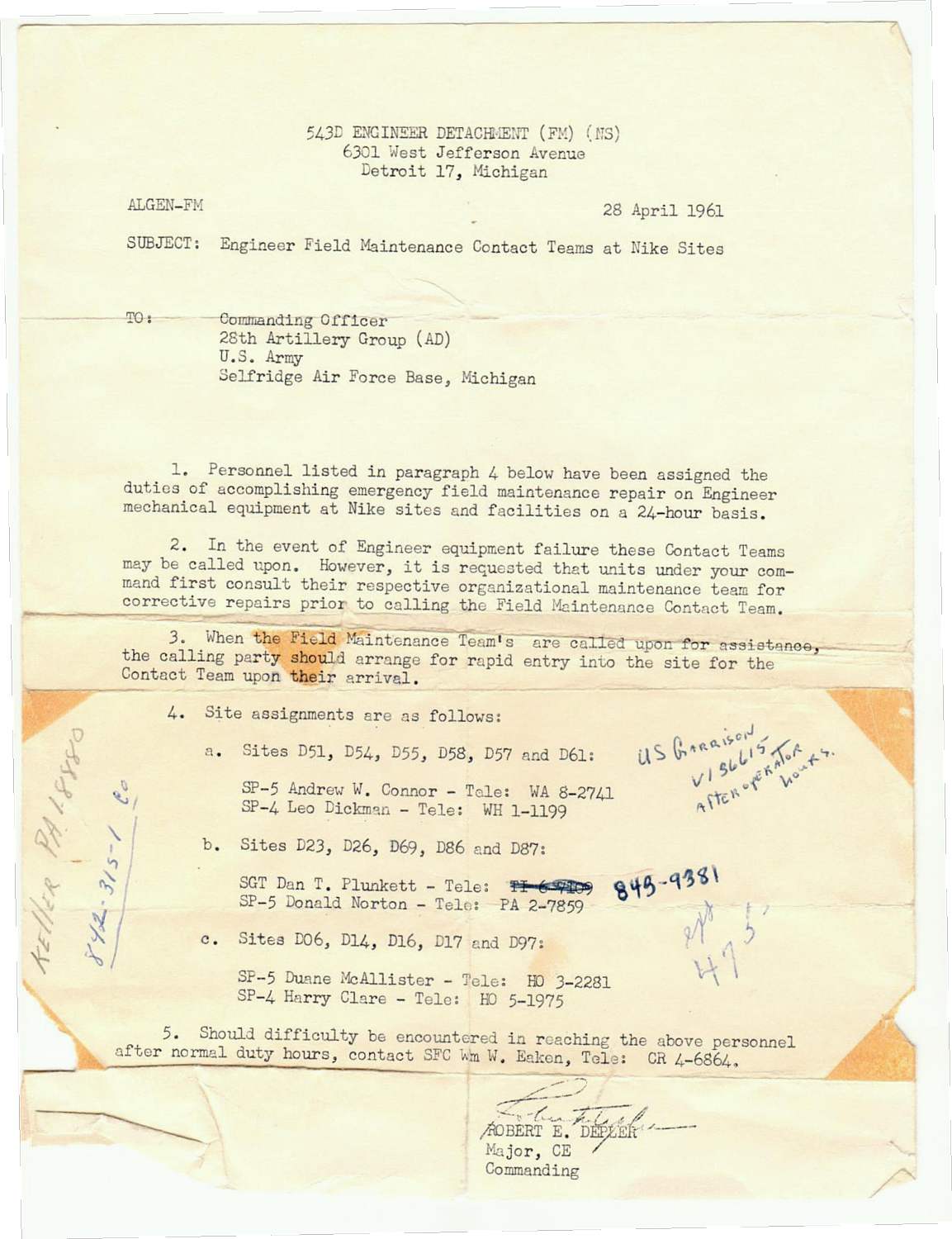
This is a letter which Linda Klais didn't want to just throw out :-))
|
|
A problem common to both areas was the storage of gasoline, for electric generators, heaters, trucks, ...
OH - Gasoline storage!! - and gasoline storage tanks!! -

In Chicago we had some above your head storage tanks,
     like the farmers use -
Due to temperature changes - and air expansion and contraction,
    there were vents to let air in and out to prevent the tanks
    from presurizing and collapsing.
The air had moisture, which would condense inside the tanks
       as dew as things got colder each evening.
The dew would drip and fall into the gasoline and sink to the bottom,
     where the output hose was.
So - in freezing weather, the hose was full of ice,
         and you did not get gasoline
   - if the weather was not freezing, the first few quarts
         from the tank as water.
Good maintenance, not perfect, was to drain a little water/gasoline from
     each tank every morning - throw out the water, recycle the gasoline.
|
Return to beginning of Life on a Nike Site
(Speaking of the early years - 1955) Usually in the form of Alerts tracking anything
flying.
Later there were specialized Training Trailers (T-1)
that could simulate real combat
situations including jamming and groups of aircraft.
Also, once a year, the site would go off of ready status and many of the people
would be flown to Red Canyon, New Mexico to actually launch three missiles.
This was called ASP (Annual Service Practice). (The name was later changed to
"SNAP" - Short Notice Annual Practice - I think.)
I am told that later Hercules re-fire launchings were from "McGreger Missile Range"
due to the limited size of Red Canyon and the longer range of the Hercules. A
jet target
drone was developed for higher speed and higher altitude. The T-1 training system
could also simulate
targets and was sometimes used to simulate a target for actual launches.
The people for the re-fire were generally selected as follows:
- most commissioned and warrant officers
- all technical maintenance people
- one shift of radar operators
- one launcher section
(Nike missiles were never test fired from defensive sites in the "lower 48".
The threat of the falling booster and other missile parts
into civilian areas was considered excessive. People that served in Alaska
report firing from Site Summit up there.)
The planes were chartered from ??Hell??
The planes were the most:
- rickety, propeller driven
- broom cleaned, once a month?
- vomit smelling, stained floor carpet
- oil leaking, that black streak going back from the right hand engine didn't seem to be paint ;-))
- usage scared, the inside looked scratched, dinged, dented from too many ski specials
- drunk crewed, we figured the bulge in the steward's jacket was a pint, the very model of a whiskey nose -
aircraft you ever had in a night mare. Like a kid's Saturday morning cartoon
OK - it did have seats -
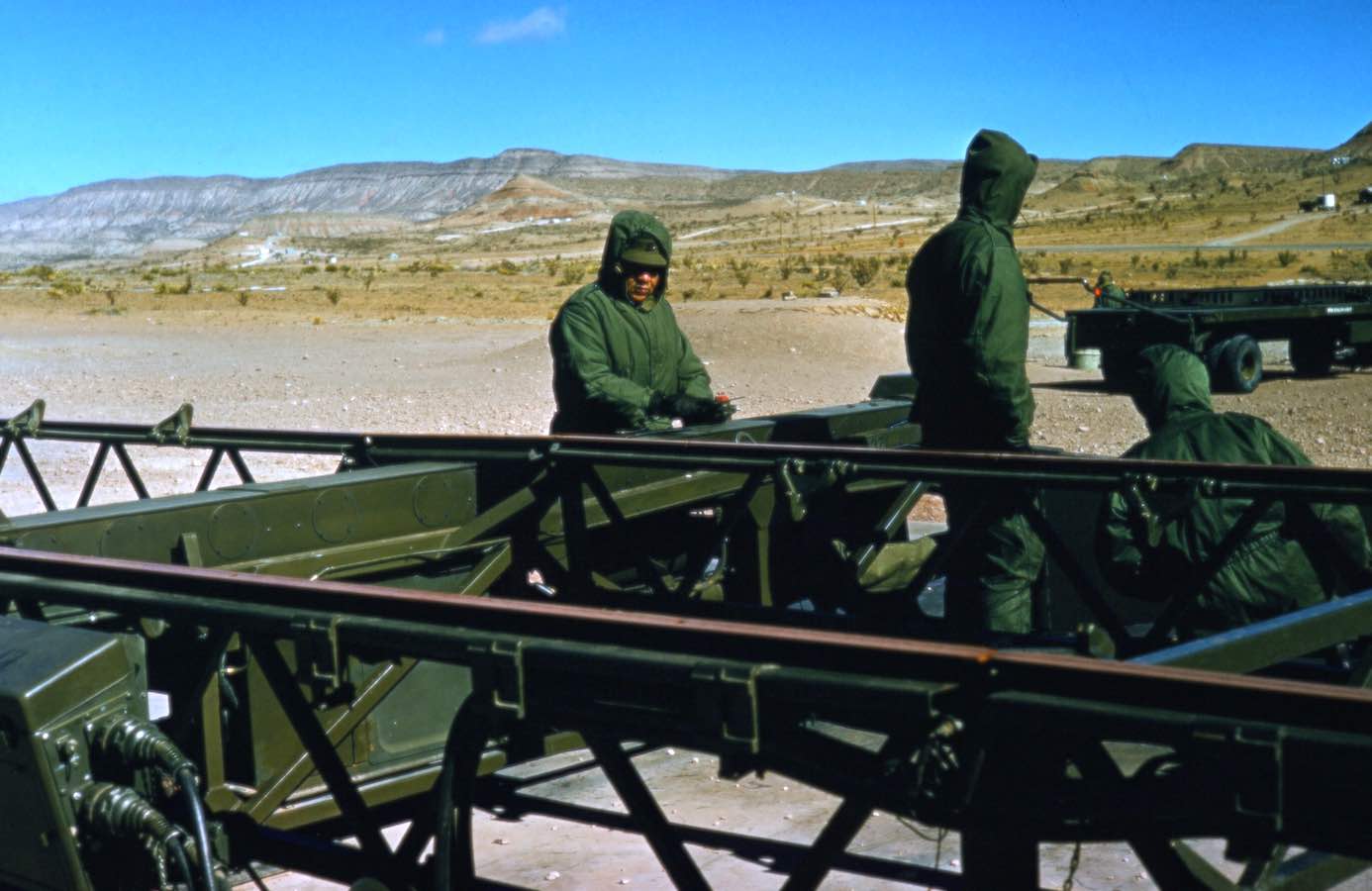
At Red Canyon there were Nike sites all set up and ready to go - except
the equipment and missiles were wildly miss adjusted. The troops were to bring
the equipment and missiles up to operational specification, and fire
three missiles at a little radio controlled drone airplane.
See newspaper article
Log of Activity Shows Tense Air at Practice at
Doyle Piland's
web site.
In any case, those drone aircraft had a very low probability of a safe flight.
The Nike system really worked better than one could reasonably expect of a
complex mix of people, complex electronics, and well proven chemistry.
A fuzzy 11 K byte photo of an RCAT target drone,
no photo credit to protect the guilty. The wing pods (look like drop tanks)
are radar reflectors to present a larger "radar cross-section".
More and better pictures and stories at Ken's & Friend's RCAT Korner and
Camp Wellfleet - RCATS
From Evans, Frank H.
"USARADCOM eventually
switched from ASP to SNAP - Short Notice Annual Service Practice. Units
arriving at Bliss billeted their until a site became vacant, then they
moved to the range. Maintenance crews receipted for several missile,
generally 2 Ajax and one Herc missile, assembled them then the crew prepared
to fire them. Range control would alert the site upon launch of a down
range radio controlled aerial target (RCAT). Two types - one prop driven -
another ram jet engine.
"Several times we used air force planes as targets.
The Site would slip the TTR azimuth pot 1600 mils, so the target flew
south to north over the shoulder and appeared on the system as being on
course from north to south. A few time the azimuth pot got slipped twice so
the system saw it as it was and the missile was fired at the air force
plane. Biggs [Air Force Base] stopped that very fast. One time such was the case and the
battery control officer activated the BURST OVERRIDE switch and the missile
passed the aircraft - ran out of fuel and landed in Mexico."
Return to beginning of Life on a Nike Site
I do not include barracks and shoe shine inspection as "Proficiency Inspections".
Being a low on spit and polish nerd, I avoided most all non-technical inspections by simply
staying in the IFC doing "important things" during the usual Saturday morning ordeals.
When I was in Chicago in 1955, Proficiency Inspections of the IFC were pretty much a joke.
Occasionally some clueless guy would come by to see if some non-technical item
(like the van air filters) were REALLY clean, like sparkling. Or the generator records
were properly filled out.
In Chicago in 1955, there were no tests of operator proficiency or
of technical (equipment and adjustments) proficiency other than annual refire,
which was not sufficient.
For annual refire, the battery took its technical staff and best operators,
and fired at an easy target with no jamming.
In 1956, a Col. Kramer came to the area, and got very concerned about Proficiency.
However, it takes time to collect/train knowledgeable motivated people and establish
procedures to perform inspections that would meaningfully test Proficiency.
(What I meant about Col. Kramer being "Concerned" was that he "rattled some cages"
really hard. He caused other folks to get REALLY concerned.)
|
A little story
In 1956, there was a rumor in our battery that a "full bird" Col. Kramer was the new boss of our area
of Chicago defense, and that he was really tough.
Well, I figured that our officers
had something to worry about - but the net effect on nerds like me would be minimal
- I figured we IFC mechanics were as good as any :-)) and that we kept our equipment in top shape !!
About a week later there was word that Col. Kramer was on his way to our IFC.
We of course made a mad dash to pick up, and I headed for the Radar Control van
to stay out of harm's way - and being a nerd, I also didn't want to cause any trouble.
Heck - even the battery commander hardly ever went into the Radar Control van.
In hardly any time at all, Col. Kramer was in "my" Radar Control van with the
IFC platoon leader, 2nd Lt. O... , who had recently graduated from Ranger School
(a rather elite physical combat facility.) Sorry - I must introduce 2nd Lt. O...
He was a pleasant short rosy faced look-alike to Audy Murphy, a WWII combat hero,
and briefly movie actor.
2nd Lt. O... had undoubted physical courage, had considerable personal charm - but
was lacking in a certain military bearing and also lacking in interest
in the technical aspects of radar, operator training, and other vital working aspects of
the IFC area. A really nice guy - but his mind was elsewhere - somewhere -
maybe parachuting from airplanes, blowing bridges, ....
|
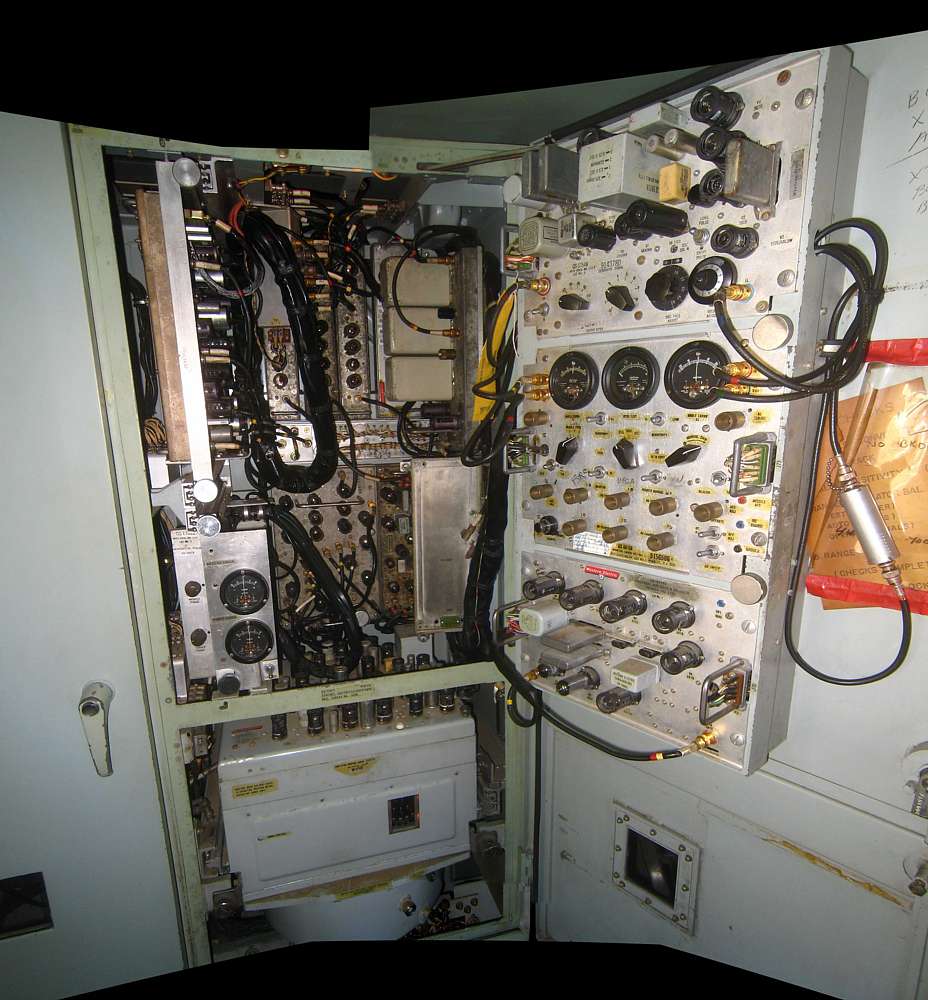
In any case, 2nd Lt. O... was being asked by Col. Kramer to verify some of the
adjustments in the radar receiver and range cabinet for the Missile Tracking Radar
and the Target Tracking Radar - a horrible mass of IF strips, test sets, range servos,
and other chassis - easily the most challenging looking volume in the Nike site.
It had several dozen frequent tests and adjustments for each radar.
|
I don't think 2nd Lt. O... had ever intentionally peered into that or any technical space.
And it was evident that Col. Kramer had at least the names and general functions
of the various chassis well in hand. And Col. Kramer was *very* unhappy that
an IFC officer could not verify that the tracking radar equipment was properly adjusted
and working correctly.
I was partially hidden behind one of the doors of the cabinet
(in the TTR elevation operator's chair) - trying to be very small and quiet -
like a mouse sensing great danger, the cat.
The discussion quickly turned into a heated chewing out of Lt. O... by a loud,
sharp, aware, probing, highly irritated Col. Kramer. In my twenty three years I had heard
various levels of "reaming" but this was off the charts - memorable to this day.
In my now 80 years (2012) of "interesting" life experiences, it still rings the bell for the most
probing, intimidating, life and career threatening reaming I have ever heard !!
That reaming far outclassed any mere in-your-face shouting of the TV/movie drill instructors.
Lt. O...'s goals in life, his hoped for military career, his relations with
people, his responsibilities for the safety of Chicago and his family, his suitability
for adult life, his childhood, his future manhood, ... all came in for harsh analysis.
The reaming moved away from me, and I opened a port hole in the van, crawled out of it, and fled,
not wishing to see a grown man sob.
For a few weeks, Lt. O... asked for our help in his learning the verification
the equipment in the IFC area - but the interest on both sides soon faded. About a month later
I heard that Lt. O... was asked by Col. Kramer to help with a technical inspection
of another Nike site.
We never saw Lt. O... again.
We guessed that Lt. O... had failed to impress Col. Kramer with the expected new knowledge.
There weren't even rumors of where Lt. O... went. He was just gone - pooof -
For a different view point, please see Technical Officers - Air Force
|
I left at the end of 1956 before anything really useful was accomplished. I did wish the
good (bad ;-) Colonel well - he had a lot of comfortable inertia to shake up.
In general I was disappointed in the demonstration of technical knowledge by our IFC officers.
They had no clue if we were ready to guide a missile to a target on not.
To the best of my failing memory, none of them had any clue of how to verify:
- whether the tracking antennas were correctly leveled, or its importance
- whether the tracking antennas were bore sighted, and/or backsighted
- the general function of major sub-assemblies in the radar control van
- or even the specifics of tracking a target
- how to run any computer checks - (most 10 year olds could master them in 10 minutes)
They were completely dependent on the good will of others (us) about the readiness of the IFC equipment.
I have no clue about our launcher area, but suspect the worst-
I can imagine their idea of our proficiency and effectiveness was the polish of our shoes
and ability B.S.
They would sit in the Battery Control chair and see if they could see aircraft - period -
HOWEVER - eventually "Proficiency Inspections" were established - with a vengeance.
As William E. "Bud" Hall (Las Cruses, NM, phone 505-522-6567,
former Nike battery commander, former Operational Readiness Evaluation inspector)
says
"Never have so few, been inspected so much, by so many."
There were an average of 2 inspections a week, not including alerts.
Apparently (after my time of service) there were
- Technical Proficiency Inspections (TPI)
- Operational Readiness Evaluations (ORE)
- ORE REPORTS, images sent by
Steven Dulak
- ??? (CMMI)
- ???
as well as the annual refires, which do not include the
other non-technical inspections so dear to keeping the
soldier looking good.
|
When I first started this web site (1996?), a Jack Emry sent me some images of himself
doing technical inspections of Nike sites.
I took one look and saw the ever present clipboard. Anger flooded through me remembering
all the incompetent clueless nobodies that inspected us, carrying clipboards. I refused to
post an image of anyone carrying a clipboard :-((
Evidently later, trained caring people, like apparently Jack Emry, carried on much more
meaningful tests and inspections.
I am unable to find Jack Emry, (he was a marine in WWII) to apologize. :-|
|
From Ted Willes
|
Just for the record, I wasn't exactly "visiting"
when I went to other sites. While at Group HQ I
was on the Operational Readiness Inspection Team,
so I got to see all the sites in the SF Defense.
They were not usually happy to have us stop by,
however. It was often late at night and 15 minutes
after we cleared the gate, there had better be a
missile ready and a target tracked light. "
... We usually traveled by vehicle (sedan if we were lucky, van if we
weren't). Sometimes we could hitch a ride with the old man in his chopper
if he was going to visit the site. General Lolli liked to go on the ORI's
every so often. He was qualified as a BCO and had fired missiles at the range.
|
And there were stories that if a battery commander was considered marginal,
and his battery failed an ORE, that he left the battery with the inspectors,
never to return. In modern jargon, there was a "high pucker factor".
If you have more information on Nike oriented inspections please let me know.
Return to beginning of Life on a Nike Site
Chicago is a big city, with a lot of everything to offer. Military people
don't make big wages, (some qualify for welfare) - so some of the things seemed a bit pricey.
The bars seemed to get the usual amount of business. Some troops had some
learning to do about alcohol. How much red wine would make you sick? again?
There were interesting stories from the bars. Information that we thought
was confidential or secret seemed to be freely available. The current missile
tracking radar pulse pair spacing was not exactly secret - but how did they
know? They knew the operating limits (range, speed, ..) of the equipment - they were not asking,
they were bragging! They knew when we were going to change IFF codes -
and what they would be - hell - even we did not know that stuff. A bit scary!
I started an electronics hobby shop in an unused room in the barracks.
Several of us had a good time there. We would go up the Navy's Great Lakes
Training center and get navy surplus electronics. Built to withstand
heavy shock, heavy weather, and heavy hands! Made our army boxes and
switches seem wimpy. Cpl. Lopresti found an old bowling alley lane, which when
cut up made great work benches when set on top of desks or short cabinets. I constructed
a Heathkit 5 inch oscilloscope. :-))
We even modified and installed an ex-Navy squawk-box system throughout the
administration area. (You know, the "NOW HEAR THIS" equipment.) We added a
noise generator that sounded a little like a car alarm intended to quickly
wake sleeping soldiers. It turned out
to be very useful (and disliked) for waking launcher folk up for alerts.
(IFC folks stayed at the IFC area for their duty shift.) That squawk-box system
survived sabotage, tall trucks snagging its low hanging wires, ... until one
night a lightning strike hit our area. Inter-building communication wires evaporated,
and the hub squawk-box in the orderly room arced and smoked, The administration decided
the risk was not worth the convenience. :-((
And there were excitements in the big city of Chicago.
Military people, not much pay, usually went to modest bars, pizza places were a treat, etc.
HOWEVER, I knew a guy who knew a guy, and I went as a guest
to Hugh Hefner's rather new Playboy Club. Indeed it was something else !!
The bunnies, pictures, and environment were indeed factual. -
but as they say, considerably above my pay (and sophistication) scale -
|
A few months before my enlistment was up, we got a new executive officer.
He seemed morose, and did not seem to like to see people smile or relax.
We were advised that there would be a serious inspection, and that
this time the electronics hobby shop would not be exempt!
We cleaned up quite well, put everything "away", polished the window inside and out.
I did the final check and final sweep.
During the inspection, a cigarette butt was found in the middle of the floor.
Protests that the cigarette butt wasn't there when we left, and that none
of us smoked, were to no avail. I was confined to the site for the weekend.
I may not be very smart - but I ain't usually stupid. By the next weekend the former
electronics hobby shop was bare - no trace of the former usage;
all the materials including work benches, wall lockers, ... gone from army inspection and control.
I did not even ask for permission. I just rented a U-HAUL trailer and did some
serious moving. (Interestingly, no one asked any questions. Looking back,
I must have violated 15 or 20 federal laws about misappropriation of government
(mostly ex-Navy) material. )
|
Some troops wanted more money and loaded trucks in western Chicago. About 30 % of
the launcher people got involved with that. There was considerable duty shuffling and
job swapping to keep that going in the face of alerts, leaves, and off-site
training.
I made and figured a 6" Newtonian telescope at the IFC area. Toured most of
the cities museums. Some went to various classical and other musical concerts.
Oh, yes, girls. They had to be a bit tolerant of low budget troops working erratic hours.
(I don't remember anyone having any big romance going.)
Available Education
Formal (civilian) Correspondence Education (added 2021)
I forgot to mention that the military
sponsored continuing education. I had quit college after a spotty carrier.
(I didn't know what I wanted to be.)
While on site I took integral calculus again after not understanding liberal arts
(not engineering) calculus in college. I was sent an army manual type calculus book,
and a series of exercises. I diligently studied the book and mailed in the exercises to be graded.
(I really did not expect much.) To my surprise, the grader(s) did a good job of
correcting and commenting. I completed the course, and to my surprise,
I understood the material :--))
Formal MOS Education
Dennis Claudio sent this
16B-MOS-Study-Guide-1974 which strongly
encouraged launcher folks with MOS 16B to keep their knowledge sharp.
I left the Army in 1957, seemingly well before this program.
Not directly related, Dennis also sent this
blank accident report.
|
Leave schedules - interesting. The nominal Christians (or those with nominally
Christian families) wanted the Christmas holidays off. The nominal Jews had
other days. The nominal agnostics ... In any case, there was a lot of
casual negotiation, and everybody seemed satisfied with the results.
From Bill Evans
Subject: tennis
|
Hey, Ed:
I placed a question on the SF88 guestbook about what I thought
were tennis courts, as you might have seen. Here's Bud Halsey's
reply, in case it might be of interest:
-----
Bill...
As a matter of policy, the Army
tried to provide recreation facilities at remote sites to include most
Nike IFC and launching area sites. They developed a "multi-purpose"
"athletic court" that was installed at many Nike sites nationwide. Many
of the maps I have of admin areas, launching areas and IFC sites from
all over the United States show an "athletic court" on the site plan.
These were used as basketball courts, volleyball courts, drill fields or
even tennis courts.
They generally are asphalt pads with different
courts (basketball, volleyball or tennis courts) painted on them. Some
are fenced in and some have backstops, but generally all can be found at
a site distant from a post gym. So, it looks like the Army built the one
you asked about, but perhaps someone else, in later years, has made a
permanent tennis court out of it.
|
Ah, Yes, the recreational fund !! There were persistent rumors that one existed,
but when guys asked about it - like for soft ball equipment, it was always empty.
I don't think the officers ran off with it
- maybe it went for lawn mowers and other more important items?
Return to beginning of Life on a Nike Site
Many Nike people were stationed near population centers.
The selection of areas to be defended by Nike missile often involved
population centers, industrial centers, and government centers.
The site people had a reasonable chance to participate in
ordinary "civilization" - see baseball games, chase girls,
maybe even drive to see family/girlfriend a thousand miles away on a three
day pass (not recommended).
Some defended SAC (Strategic Air Command) bases, which were often
in rather remote areas - rural Maine, rural Texas, ...
where the "advantages" of city life were more remote.
Korea and Okinawa were a bit on the remote, foreign side.
Dale Hall
Jan 2006, re: Site H-06 - Saddle Mountain, Washington

 Mike's certificate