Return to 'Life on a Nike Site'
|
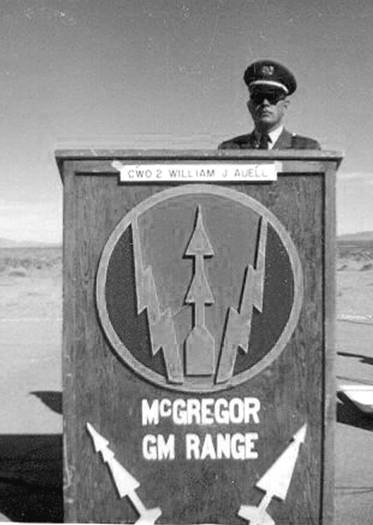
Recruit William J Auell, RA13303902 had a long Army career. Among other adventures he served in
Alaska and McGregor Range. He is now deceased.
This story, with the following comments, was sent by his son Michael Auell. "I quickly edited a few trivial family details out. Much may be boring or trivial, but it's a good overview of one soldier's experience. I tried to highlight some things with the largest type and boldface that I thought may be most applicable. Other smaller bold items were done that way by him. Feel free to use any of it. Hopefully some will get a kick out of some of the character stories or the details they may have forgotten long ago. Feel free to post it or spread it (or any parts). " |
| 
| 
|
You're in the Army now,
You're not behind the plow,
You'll never get rich,
You son of a b-----,
You’re in the Army now.
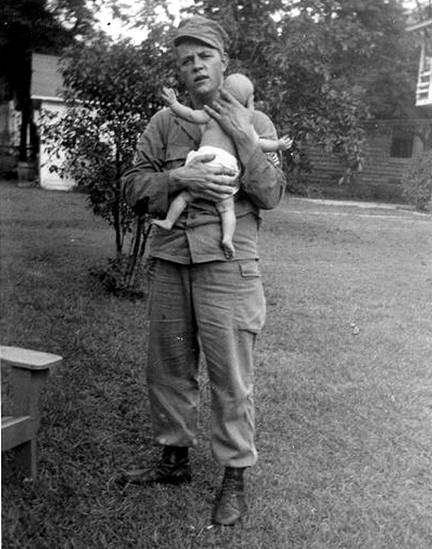
Recruit William J Auell, RA13303902 reporting Sir!
The peace-time military services of 1949 were being manned by only volunteers. The draft had been suspended shortly after the end of World War II and all draftees had left the Army or re-enlisted in the Regular Army. Our war machine was down-sized to the point where engaging in a major conflict would not assure a victory for the United States. Many units were deactivated, and their equipment was put in moth balls. Several military installations were closed except for a small civilian force who maintained the facility and some of the stored equipment. The military appropriations portion of the federal budget was sliced dramatically. Billions of dollars were allocated to the Marshall Plan for the rebuilding of Europe, which resulted in waste beyond imagination.
When I served in France from 1952 through 1955 I saw first hand some of the results of this plan: thousands of electric refrigerators, washers and dryers rusting in acre after acre of open fields because no one in the United States Government took the time to consider the difference in electrical current. The United States uses 60 cycle electricity while Europe uses 50 cycle power. We sent thousands of new farm tractors to the European nations, and here again our governmental experts could not foresee any problems, not even the fact that the farmers were so destitute after the war they couldn’t afford the $2 a gallon of gasoline or diesel fuel. Quite a few French farmers had brand new American made tractors rusting in their fields. So some one had to pay for this plan, and it ended up being the armed forces. Austerity was the name of the game for the United States military. A recruit was paid $50 a month; and when Eisenhower was elected in 1952 he suggested returning to the pre-war pay scale of $21 a month.
I was assigned to a training company of the 3rd Armored Division, issued uniforms and equipment, given a haircut of my choice as long as it was a baldy, and billeted in WWII wooden barracks that were lined up perpendicular to the street. We soon learned that it was extremely important to get to the street in a very short time. In order to do that we had to leave the building via the side door, run down a small path and 'fall in' on the street. Since we were not fast enough to please our Platoon Sergeant [a PFC], especially the men that lived on the second floor, we had to practice in order to get our response time lower. One evening after dinner we were once again practicing our ‘fall in’ drill when one of the soldiers fell on the path. A lot of the troops tried to run around him but apparently some stepped on him breaking both of his legs. The platoon sergeant was a little more tolerant after that incident. He should have been court-martialed, but as far we knew, nothing was ever done.
A TASTE OF DISCIPLINE
I saw this bird one more time during our graduation ceremony. I left Fort Knox and didn’t bother to say goodbye to my friendly First Sergeant. Boy, I would liked to have seen him about 10 years later. He sure as hell would be sorry if he didn’t stand at attention and address me as “sir”..
I will never forget the chow in that training company. They had a lot of guts calling it food. I lost 30 pounds in 12 weeks, and it wasn't all from the exercise. I think the Mess Sergeant had been a pig farmer before he found his home in the Army, at least his way of preparing food would strongly suggest that. Food was in short supply due to the budget crunch and a lot of it was Government surplus, therefore it would have taken someone with a little imagination and creative ability to prepare a meal that would be half way pleasing to the taste buds. We ate a lot of powdered eggs, in fact we ate them six days a week, fresh eggs [or at least they were still in the shell] only on Sunday. The cooks couldn’t fry an egg without breaking the yolk, so everyone ate scrambled eggs. We had canned condensed milk for cereal and morning coffee. No cream for coffee at lunch or dinner. I don't remember seeing a piece of fresh fruit the whole time I was there. I heard that three guys broke teeth trying to eat the biscuits. Another fellow thought he saw one of the green wieners move a little bit. There was a PX across the street from our barracks but we were not allowed to visit it until we got our first pay, which was almost a month after we set foot on the red Kentucky clay, and then we were told what to buy [no candy, chewing gum, cookies, snack food].
For twelve weeks we spend our days and nights learning close order drill, how to roll a field pack, map reading, first aid, camouflage, grade and rank recognition, survival skills, self-defense, tactics and a lot of other training that would prepare the recruit to be a good soldier. Of course, the big thrill of the entire twelve weeks was the issuance of your M1 rifle. We learned how to disassemble and reassemble our rifles, how to fall in love with our rifles and really mean it, how to remember the serial number of our rifles, how to carry our rifles, how to sleep with our rifles, how to clean our rifles, how to do the manual of arms with our rifles, how to guard with our rifles, how to fight with our rifles without firing it, and how to fire our rifles. I think I knew that rifle better than I knew some of my own body parts.
Naturally, being Army ground-pounders we marched, and marched, and marched some more. We took several 5 and 10 mile jaunts and one 30 mile beauty out to the bivouac area where we spent a week and then another 30 miles back to the garrison. Camping out in Kentucky in the winter was a barrel of fun. It just so happened that the winter of 48/49 was one of the worst in several years. It snowed nearly every day and the nights got so cold the sleeping bags barely kept one warm. One night I put my combat boots outside my sleeping bag and they froze stiff by the next morning. My rifle was warm though; I had that sucker in the sleeping bag with me. The food out there in the boonies was a real treat - left over World War II C-rations. The only thing good about them was the packet of four cigarettes with each meal. I didn't think any food could be worse than what we were fed back in garrison. What I wouldn't have given for one of those big greasy hamburgers I used to cook in our restaurant and a big chocolate shake. Using the unique toilet facility was another memorable experience. The original comfort station - the time honored slit trench. I quickly learned what was meant by frozen buns. The privacy was unusually quaint; there was none. You were out there moonin' the world, and right then you didn't give a damn. I wished I had that back yard toilet my Aunt Louise tried to get me to use when I was a small child, at least it had a seat, walls and a door that afforded some privacy. Even her second offering of her thunder mug would have been welcome at this point. There are some things that are better done alone.
After graduating from basic training I was assigned to Camp Lee near Petersburg, Virginia. There were four classes of creatures in that nice little southern town, ranked in the order of respect and worth. Whites, dogs, blacks, soldiers. We felt very unwelcome when we went down town. I attended a nine week administrative course that covered such subjects as filing, preparation of correspondence, mailing, and the numerous duties that would be required of a clerk. I graduated as a Clerk because I couldn't type 45 words a minute; 30 being my tops. I didn't think that was too bad since I had never touched a typewriter before attending that school.
Subsequent to a leave back to Pennsylvania, I arrived at my new duty station in June, 1949. I was assigned to the 3450th Station Hospital at Warren Air Force Base, Wyoming as a clerk. I later learned why I was assigned to an Air Force unit when I was in the Army. I was what was known as SCARWAF [Special Category Army with Air Force]; Army personnel on loan to the Air Force because the Air Force at that time was in its infancy, having broken away from the Army only a year before. There were 450 Air Force enlisted men and 45 Army enlisted men assigned to the hospital. The Army troops were treated just like the fly boys, except there was one gigantic morale problem; they did not have authority to promote Army dog faces. The Air Force got the stripes and the Army got the shaft. Not a real good situation, or at least not good as far as the ground-pounders were concerned.
My duty assignment was the A & D [Admissions and Dispositions] office which was stuck down in the bowels of this old Cavalry structure built about the time Custer was making his last stand against the Indians. They had added several buildings behind the main section of the hospital that were used as wards and one building was the mess hall. All the buildings were connected by covered and heated hallways so that patients wouldn't get cold traveling within the facility. This hospital specialized in the treatment of Rheumatic Fever, serving any patient who was diagnosed RF. Most of the patients came from the Army and Air Force units in the Far East. The hospital had 300 beds that were occupied most of the time. Some of the patients were there over a year and they were assigned to a special hospital unit known as the Detachment of Patients. Their next step would be discharge to civilian life.
A THANKSGIVING TO FORGET
I went through the serving line, helping myself to mashed potatoes, stuffing, gravy, a vegetable, hot dinner rolls and a nice big brown turkey leg. My mouth was watering. Would it be as good as the last one I had about three years when my mother made her last Thanksgiving dinner. I bowed my head in a moment of silence thanking the Lord for his blessings and in remembrance of my mother. Now it was time to sink my teeth into that leg before it got cold.
I picked that sucker up with my left hand and took a big bite. The blood filled my mouth and was dripping onto the rest of the food on my tray. I got up and left without clearing the tray and placing it on the pile of dirty trays. I went up to the Day room and got a couple candy bars from the machine. I didn’t want any turkey for a while.
For several years I used to get sick on Thanksgiving Day and have missed some tasty meals. I have no idea why I got sick on that particular day. Maybe that Thanksgiving dinner back in good old Warren Air Force Base had something to do with it. I don’t know.
One of my duties as an Admission and Disposition clerk was to gather personal data from people being admitted to the hospital. We had a standard form that was used to gather general information including name, rank, serial number, length of service, etc. An Army Master Sergeant who just arrived from Guam was being admitted. I asked his name, grade [which I could see], length of service [which was 25 years], and when I asked for his serial number he removed his wallet from his pocket, took out his ID Card and read the number to me. I knew he had been in the service for quite a while since he had a seven digit serial number, last used in the 30s. I sort of thought he should have memorized his serial number by this time.
RANK HAS IT’S PRIVILEGE
He was in charge of the base theater which he ran with an iron fist. If a person walked into the lobby with their hat on, he would yell “Take that hat off soldier”; not caring whether it was a Colonel or a Private. The national anthem was played each evening before the movie started. A second or two before the first note of the Star Spangled Banner he would step inside the seating section and shout “Attention” at the top of his voice, scaring the hell out of every one in the theater. No one had trouble rising for the anthem because they were half out of their seat already from his frightening announcement.
During the course of my information gathering process, one of the questions was length of service. When I ask him how long he had been in the service, he said “just put down 44 years; that doesn’t count my National Guard time”. His service stripes [hash marks] each signifying 3 years of military service, started at the cuff of his sleeve and stopped at the bottom of his Master Sergeant chevrons.
After completing the paper work I told him he was going to Ward 3 on the second floor of the hospital. “Wait a minute, I’m not going to a ward, I want a private room” he said in his gruff voice, “who do you work for, soldier?”. I quickly realized this one was too much for a lowly Private like me, so I took him upstairs to see Master Sergeant Hagan, the Registrar NCOIC. They then met with Major Elder, the Registrar. Finally, the whole procession ended up at the office of the Hospital Commander, Colonel Blank. I’m quietly trailing along through all this like a little puppy sneaking into the circus. I was surprised no one told me to get lost. After talking to the Hospital Commander and getting the same answer everyone else had given him, he asked the Colonel if he could use his phone. The Colonel agreed and the Sergeant called the Base Commander, another bird colonel.
“Charlie” he said, “I’m being admitted to the base hospital and they want to give me a bed in one of the wards. I think my length of service entitles me to a private room”. The Sergeant handed the phone to the Hospital Commander, who upon hanging up the phone, told Major Elder to give the Sergeant a private room.
It seems that 27 years earlier Sergeant Christensen was the First Sergeant of a company where the Base Commander was first assigned as a Second Lieutenant, and they were assigned to the same unit many times during their long careers, becoming close friends.
I went back to my office understanding a bit more about military protocol; Rank sure does Have It’s Privileges.....
Sergeant Hagan was a little stubby [not fat and not lean] man that stood about 5' 5" in his best shoes. This guy, who became a good friend of mine, swaggered around the halls swinging his arms like someone had just put a key in his butt and wound him up. He and his wife were Seventh Day Adventists, the only ones I ever met in the service. I must admit I got pretty mad at him at times, but he taught me a lot about the proper preparation of correspondence and how hospital administration was supposed to function. When I took a letter that I had typed to him for approval prior to the Majors’ signature, he would check it with a fine toothed comb, measuring the margins and typed letterhead with a ruler. If there were any errors he would make the correction in red pencil and send it back to me for retyping. I soon learned to closely check my work before I took it to him. He had the bad habit of smoking cigarettes, but his wife didn't know it [so he said, but I don't see how she could have missed the smell from the smoke that must have clung to his clothes]. He would puff on cigarettes all day, then about an hour before he went home he started chewing gum like a hungry puppy chewing his first bone. He would leave the cigarettes in his desk, douse himself with a little after shave lotion and go home. He later received a direct commission and was assigned to an air base in Florida not too far from Patrick Air Base at Cocoa Beach. When Cathy was born at the hospital at Patrick on June 21, 1951 Harold and his wife came to see the new child. We were looking at the babies through the window of the nursery when he asked which one was Cathy. I pointed to the one in the end crib. After a quick glance at the little dark baby in the end crib, he mumbled a barely audible cursory congratulatory remark - "she looks like a very nice baby”, never looking at the baby. There was a moment of silence, then I couldn't control my laughter any longer. I informed him and his wife that the little baby in the end crib belonged to a black Air Force couple who were stationed at that base; Cathy was the baby in the third crib from the end. He said " I thought there was something wrong, but I didn't want to say anything that might offend you or your wife".
At Warren AFB I lived on the second floor of another old building with nine other enlisted men, mostly Air Force. My bunk was one on the extreme left and a physical therapist had the bunk on the extreme right. This guy, whom I will call Samson because I don't remember his name, would parade around the hospital wearing the traditional medical white pants and pullover white shirt with short sleeves that were rolled up to expose his muscular arms. For some reason Samson and I got into an argument that turned into a fist fight and wrestling match. I quickly learned that this bird was muscle bound. Those big muscular arms that he flaunted so brazenly actually severely limited his movements and ability to respond with dispatch. He made an attempt to hit me with his right fist to which I reacted by throwing a right then a left to his face. We ended up wrestling on the floor where he bit my left side a little above the waistline. His bite drew blood, infuriating me to the point where I was sitting on his chest rapidly punching his face unmercifully. Three of our room mates came into the room and pulled me off of him. In retrospect, it was probably a good thing they stopped the fight since his biting my side made me so mad I was out of control. I went to the emergency room to get my wound treated and I carried the scar for years.
The A&D office was moved from the basement to the first floor and I was assigned to night shift from 4:30 PM to 8:00 AM the following morning, working every other day. I was required to type the daily admissions and discharges on stencils and then run them off on the mimeograph machine. I had good eyesight until I got this job. I also had uniforms that were free of ink. Another duty was getting information from people that were admitted during the night. Late one night one of the ambulance drivers told me there was a person in the emergency room to be admitted. I went to the ER and found this man who was wearing glasses laying on the table looking straight up at the ceiling. When I got close enough I noticed that what I thought were glasses was actually blood that had run from the bullet hole in his left temple, around his eyes and then down to the right ear. This guy was stone dead. The ambulance drivers hiding in the next room thought that was pretty funny. "Hey, Auell, did you get his name?" "Very funny" I mumbled. This man was an Air Force Sergeant who for months had been burglarizing homes throughout Cheyenne. The law finally was about to arrest him when he saved them the effort. He put a bullet in his head.
Cheyenne, Wyoming was a wild and wooly town. A lot of cowboys raising hell every night of the week. During Frontier Days [July 4 through 14] the frenzy increased many fold; the place became a mad house with crazy drunken people elbow to elbow pushing toward another bar. Everyone threw their empty drink glasses or beer bottles into the street. You were lucky if you survived without cuts and bruises. Glass was 4 inches deep at the curbs. A fight on most streets sometime during the night was most probable. Drunken cowboys would take their horse right into the bar. My friend and I walked into a hotel with the intention of getting a drink at the bar. We never made it to the bar but somehow we came out the other door with a drinks in both hands, not knowing from whence they came. And cared even less.
I don't know why, but I usually went to town with two of my friends. Angelo DeNova was a guy from New York City who was bigger than me. Tom Riseland was a little red-headed squirt from Minnesota who weighted about 98 pounds fully dressed. Invariably, he would pick a fight with somebody, usually a cowpoke, and then run to Angie or me for help. We finally got tired of bailing him out, so we refused to help him one time when he got into a scrap and ended up with a few good licks. That sort of calmed him down and he confined his arguing to our own little group. Another time Tom got smashed so we took him into a restaurant to get him some coffee, the rest of us ordering sandwiches and fries. Right after the waitress put the food on the table Tom raised his head and puked all over the food. [I wonder if he was related to President George Bush who pulled the same stunt at a dinner party in Japan many years later]. A lot of times we left him back in the barracks after that episode, and when we did take him we severely limited his drinking and kept an eye on him the whole night.
Although I had a lot of friends, I was still lonely. Running around with the guys got to be old stuff. Most of my leisure time I spent over in the hospital just talking to the fellows on duty or going to the movies with a bunch of the guys from the hospital. I wrote a few letters, mostly to Berniece McGill in Saegertown who I got to know when I hired her to work in our Saegertown store before I entered the Army and who I took out a couple of times. The only other people I wrote to was my dad and my sister Viola. The letters to and from Berniece became more frequent and serious. Before long we were both talking about how it would be to get married.
Finally in February 1950 I was promoted to Private First Class. At that time the Army adopted miniature rank insignias, the chevrons being about one-fourth the size that they had been. This little one stripe looked lost on the sleeve of a shirt the size of mine. I was proud to get the stripe, even if it was small, and got busy getting my first stripe sewn on my uniforms. Everyone has to start somewhere and in the service that's usually at the bottom, exactly where I happened to be at that time. (The Army changed their rank structure sometime around 1948. Recruit [E1], Private First Class [E2], Corporal [E4], Sergeant [E5], Sergeant First Class [E6] and Master Sergeant [E7]. Later they added specialist grades and E8 and E9 grades.)
In March of 1950 I was notified by the Department of the Army that my 21 month Regular Army enlistment was scheduled to end on October 7, 1950. Due to the’ police action’ in Korea I would be transferred to the Enlisted Reserve on October 8, 1950 and immediately called to active duty as a Reservist on that date for an additional 21 months with the same duty assignment as I currently had. This meant my new tentative date of discharge was June 7, 1952. In reality, the only thing that happened was my serial number prefix was changed from RA [which signified Regular Army] to ER [which signified Enlisted Reserve]. So I had more than 2 years to serve from this March 1950 date. I thought I might as well try to re-enlist for 2 years and collect the re-enlistment bonus that I would be entitled to and could use very nicely since I was now making $90 a month [before deductions]. Although its hard to believe, the Air Force had no idea how to handle this supposedly simple task, so they contacted the Army who apparently couldn't figure out how to re-enlist a Regular Army enlisted man who was scheduled to be transferred to the Reserve. So there I sat in limbo as far as my future in the Army. I was perfectly willing to re-enlist for 3 years which would have only been a year longer than I was going to serve under the present set-up. Since I sort of liked military life I wouldn't mind committing another year. No soap. They would take it under advisement and let me know at a later date.
Berniece and I were getting more serious about each other and decided that we would get married. Perhaps in retrospect, our decision was immature and premature, because we really didn't know each other very well. Nevertheless, over the objection of her mother and father, we were married at the Methodist Church in Cheyenne, Wyoming in August 1950. We took up residence in a small apartment and began learning about marriage and each other. Since we lived away from the base I had to have some means of transportation to get to work, so we bought a 1937 Chevrolet two-door sedan for $200 that turned out to be a pretty good jalopy. At least it started on those bitter cold Wyoming mornings when other cars wouldn't, including my boss' brand new Kaiser. One bright and bitterly cold morning he had his breakfast of humble pie when he mustered up enough courage to ask me for a ride to work. I was happy to give him a ride in a reliable car as I teased him about his nice new Kaiser automobile that wouldn’t start. I claimed it was made from recycled aluminum foil. Actually the Kaiser was a pretty nice car.
Another stripe was added in November 1950, making me a Corporal and my new duty assignment was in the Registrar's office in charge of the Patient Fund, a procedure whereby the patients left there personal money with us for safe keeping and could draw it out anytime they wanted it. I welcomed the new responsibility and small raise. Up to that time I made $120 a month [$90 pay and $30 separate rations - reimbursement for food that the serviceman would have eaten in the mess hall if he was living in the barracks]. Major Elder and Sergeant Hagan practically begged me to transfer to the Air Force, promising that I would be a Master Sergeant in less than two years. Being a stubborn Dutchman and of questionable sanity, I told them I had joined the Army and I would be true to that commitment. That was most likely one of the dumbest mistakes I ever made in my military career. The Air Force was a young organization and I probably could have been promoted through the enlisted ranks to the commissioned officer ranks in the medical administration field like so many others were doing at that time, including Sergeant Hagan. Live and learn. It would take me another nine years to pin Warrant Officer bars on my shoulders.
1951 came in like a lion in Cheyenne, Wyoming, bringing reassignment orders to the 838th Engineer Aviation Battalion at Orlando Air Force Base near the city for which the base was named. I was to report in early April so we didn’t have much time to get prepared for this move. The most important consideration was transportation. I would be paid 6 cents a mile but wouldn't receive anything for dependent travel, therefore travel by public conveyance would require borrowing money for the tickets. We could sell the 37 Chevy but would have to buy another car when we got to Florida. We finally decided to buy a 1947 Dodge 4 door-sedan from a used car dealer in downtown Cheyenne if he would take the Chevy in on trade. He agreed to sell us the car for $600 difference, which seemed to be a fair and reasonable deal. I explained to him that we needed a car that would make it to Florida. He said there was a 50/50 warranty for 30 days and he would stand behind that verbal guarantee regardless of where we were. A few days after we got the car, my pregnant wife and I were on the way to Orlando, Florida with all of our worldly possessions in the back seat and trunk. ala Klampetts!
A TOWN NE’ER FORGOTTEN
The motel owners gave us a tour of the town and dropped us off at the restaurant. After we ate I went to the cash register to pay the bill and the cashier said our dinners were paid for. I thanked her, having no idea as to the identity of the benefactor. We went to the movies and they wouldn’t take our money for tickets, and then brought us popcorn.
The following morning after we ate breakfast at the town restaurant where again the meal was free, I went to talk to the mechanic who was working on the car. He told me a connecting rod broke and it scarred the cylinder wall. They intended to re-bore the cylinder and install an oversized piston and rings. I should be ready later in the day. That sounded good to me and I asked about the cost of the repairs. He told me it would be about $400. I called the dealer in Cheyenne, Wyoming and told him about the breakdown. He said he would send $200 right away; and much to my surprise, he did. I was amazed that I had met a reasonably honest used car dealer [A rare bird in any era]. Of course we needed $200 more, so we called Berniece’s parents and they loan us the money.
I returned to the garage later in the day and the dealer said he had some bad news. The boring bar slipped when they were re-boring the cylinder wall and cut a big groove out of the wall, rendering the engine junk. He said we would have to install a new engine in the car. I asked him the cost of a new engine; about $800. He said “don’t worry about it, our machine caused the problem so I will put a new engine in your car for the price we quoted for the repair. Come back tomorrow morning and your car will by ready to go”.
I returned to the garage the next morning and the black beauty Dodge was purring like a kitten. The mechanic told me the dealer would not let a new engine go out of there with old plugs and points, so they installed new ones at no charge. I couldn’t believe it. Some Higher Power must have been looking out for us. We loaded the car with the things we had taken into the motel and we were ready to go.
I asked the motel owner what I owed him. “Your bill is $18 for the three days, but don’t pay me now. Send it to me when you have it after you get settled in Florida”. I assured him we could afford such a small charge, thanking him for his generosity and hospitality, and insisting I pay the bill right there and then. Reluctantly, he accepted the money, telling me several times that he wished I would pay him later.
The whole time we were in that town we never had to pay for one meal, cup of coffee, soda pop or anything else. The car dealer didn’t even charge me for the long distance calls to Wyoming and Pennsylvania.
How could I ever forget the patriotic and generous down-to-earth citizens who live in the quaint little town of Clayton, New Mexico. When they learned that I was a soldier, they couldn’t do enough for us. When they found out about a young couple having trouble far away from home, they merely responded in their southern Christian way. The thoughtfulness, kindness and generosity that we witnessed in this small rural village was the manifestation of what is known as Christianity and good old American patriotism. It certainly was an unusual experience, seldom seen during an entire lifetime.
Upon arriving in Orlando, priority Numero Uno was to locate an affordable place to live. Considering the amount of cash on hand and my future earnings as a Corporal, we weren’t in a position to consider an estate on one of the many lakes in the city of Orlando; the servants’ quarters might have been more like it. I had to get an advanced pay before I left Wyoming which would be taken out of my pay over the next six months. We found a small house in an area of the city that was not known for its elegant palaces and mansions, but was within our meager budget. After we moved in we found we were not the only occupants of the structure; being forced at least temporarily, to share the house with several generations of a well established cockroach family. Eventually, we got the situation under control. We moved.
I reported to the 838th EAB and was assigned to Headquarters Company motor pool as a clerk. A far cry from the cleanliness and orderliness of the hospital that I had just left. I was notified by the Personnel Section that new regulations established procedures by which an enlisted reservist could reenlist in the Regular Army. In order to obtain the maximum bonus I re-enlisted for 6 years. When the finance section was computing the bonus it was noted that I had been granted an advanced pay before I left Wyoming, which had to be repaid from the final pay of the first term of service. Consequently, I not only didn't receive a bonus, but my entire monthly pay for the month of May was used to cover the advanced pay. My pay for May was zilch. This brought forth a clear and present problem. We were broke! Penniless! Without coin or bill! We didn't have enough money to buy groceries. At one point, we didn't have any food and we only had a dime. A loaf of bread cost 11 cents, so that was beyond our current assets. We finally shared a Mounds candy bar that we purchased with our last dime.
Luckily, before we moved from the first rental we got to know a Scottish couple that lived across the street: Mr. Roberts was the manager of a drive-in restaurant on the outskirts of town and gave me a job as a short-order cook. I would work from 5 PM until midnight after I got home from my Army assignment and on weekends. This job was a lifesaver and allowed us to buy some needed grub and supplies. To further help out with our shortage of food I was allowed to take left-overs home when we closed up at night.
Later I got an after duty job at the snack bar of the Base Exchange which was much closer to our home. I cooked hamburgers, made French fries and sold beer. There was a skinny little Buck Sergeant who was a cook in a nearby mess hall, who came in every night about 6 PM and started drinking canned beer. After he had downed about six beers he would line up the cans and talked to them as if they were junior soldiers. He refused to let us remove the cans from his table. Before the night was over he usually consumed 12 or more cans of beer before he staggered back to the barracks. The woman who was the night manager treated me and all the other employees very well. Little did we know that she was embezzling funds for which she was subsequently fired.
After working as a clerk in the motor pool for about three months I was promoted to Staff Sergeant [E5]. Since a clerk couldn't be a first three grader [at that time there were only 7 enlisted grades, Master Sergeant E7 being the highest] I was placed on temporary duty [TDY] to the Base Headquarters to work with the civilian safety director. This older gentleman taught me a lot about ground safety and assigned me the task of inspecting all structures and roads on Orlando Air Force Base and on another adjoining base that was being prepared for expansion. One of my jobs was the development of a traffic pattern for the new base including placement of all traffic signs, establishment of speed limits and any other safety features deemed appropriate. An additional duty was the investigation of vehicle accidents, working closely with the State and local police units. I really liked the job, especially since my office was in an air conditioned building. I knew it wouldn’t last.
There was a small dispensary on Orlando AFB to serve the military members and their dependents. Only outpatient services were provided, hence maternity cases and other cases that would require inpatient services were referred to Patrick Air Force Base at Cocoa Beach, a distance of about 60 miles. Ambulances were not available for taking prospective mothers to Patrick Air Base, therefore the service member was responsible for getting his dependents to the hospital at the right time. Due to distance involved it was a good idea to be ready to go when there were indications a baby was ready to be born. We just made it to Patrick AFB in time for the birth of Catherine Lucille Auell. So named in honor of my mother and Berniece’s mother [their middle names].
We lived in a nice roomy second floor furnished apartment close to the center of town. One side of the first floor was occupied by the owners and the other side by a retired Army Major who had a big dog. Everyone just called him "Major" and found him to be a personable fellow who had a tale about almost anything in the world. He assumed the role of being the authority on all subjects, being loud and vocal in his communication. His loudness most probably caused more by the amount of spirits that he consumed than a hearing condition. We got along with him quite well and he loved baby Cathy. After we settled in our home and got used to the baby, we were able to take a few side trips to see different parts of the state when relatives from up north visited use. My father, Berniece”s parents and her aunt Grace and Uncle Ken visited us at different times.
ANYONE THIRSTY?
Hum! I’ll fix this guy! I got one of our very large ice tea glasses, filled it with ice water, returned to the table and gave him the water. Just like the first two glasses he gulped it down. I thought to myself ‘Doesn’t this guy have a bottom?’. Okay, I’ve got the answer. I got up from the table and got a large pitcher of ice water and sat it down in front of him. Aha, I fixed him! To my surprise, he moved the glass aside and drank the entire pitcher of water. I gave up. Let him get his own water from now on. I made sure he knew the location of the bathroom. I’d never seen a person consume so much liquid.
But come to think of it, on our first visit to Pennsylvania after we were married we attended a picnic at the home of Berniece’s grandfather. At that time, Carl offered me a drink of hard cider which he had removed from his car. I accepted the gallon jug and with both hands on the jug took a small sip of the contents. “You don’t know much about drinking, do you?”, he asked. Then “do you want another drink?”. When I declined, he rested the jug on his bent arm [ala Hill Billy style], put his lips on the mouth of the jug and downed the rest of the gallon.
In 1951 when we were living in Florida, land could have been bought for a song. The swamp land out near the town of Kissimmee, a few miles from Orlando could be picked up for $25 an acre. Who would have ever guessed that Disney World would occupy that land twenty years later. Now it's probably worth over $25 a square inch or more. The problem I had back then was that I didn't have the extra $25 to buy an acre. If I had been able to foresee the development of this land I would have borrowed as much as I could to buy a few acres. It just wasn’t supposed to happen. Live and learn, so they say.
Here we go again. I got orders to join the 322nd Engineer Aviation Group at Wolters Air Force Base at Mineral Wells, Texas in preparation for deployment to France. This meant that Berniece and Cathy would have to live with her parents until they were able to come to France. We packed up our belongings and made the trip to Pennsylvania. I drove to Wolters Air Force Base, sold the Dodge [Berniece didn’t know how to drive a car at that time, therefore there was no need to leave the car in Pennsylvania] and reported to my new unit. The 322nd EAG was a Reserve unit from New York City that was ordered to active duty for a period of 3 years and was directed to deploy to Toul-Rosierre Air Base, about 20 miles from Nancy, France by the first of June 1952. I was assigned to the Operations Section as a Utility Supervisor. I don’t know why. Maybe due to my vocational school training. Nevertheless, I had no difficulty with the job requirements and duties.
The 322nd was like no other organization I have ever seen. There were about 150 Reservists who were called to active duty for 2 years, and 45 Regular Army troops of which I was one. Some of the enlisted men were the bosses of some of the officers in civilian life. Our Company Commander, Captain Campbell was a vacuum cleaner salesman in NYC and worked for the Supply Sergeant. [One Saturday morning he forgot to put his brass and captain bars on his uniform and the Platoon Sergeants who were all part of the NYC gang refused to call the troops to attention or salute him during an inspection. He stood in front of the troops bewildered until our Regular Army First Sergeant told him he had forgotten to put his brass on his uniform. No inspection that Saturday morning]. The Group Adjutant was a 50 year old homosexual who was so stingy he wrote a letter to the Chrysler Corporation asking for a rebate for the ashtray that came with his car if he sent it to them. I think he had his uniforms left over from WW11 and wore them without benefit of laundry or dry cleaning since that time. The Sergeant Major stayed in bed to 10 or 11 o'clock every day, just in time to arrange transportation for his evening trip to town. The Regular Army people couldn't believe the behavior, disrespect and lack of qualification of most of the Reservists, including some of the officers. After we got to France the Food Service Officer [a Warrant Officer 2] showed up about once a week, the rest of the time he was with his French girlfriend in Nancy. Oh well, if he was needed everyone knew the hotel where he lived and drank. These folks from the Big Apple were the subject of many discussions among the Regular Army personnel.
We left Wolters AFB on May 11, 1952 on a special military train and arrived at Port New Orleans in Louisiana the morning of May 12, 1952 [my father's 59th birthday]. That afternoon we boarded the SS Ballou and left at sundown on our 17 day trip to France. The vessel was a WWII Liberty Ship that was being used to transport displaced Europeans to the United States. The ship was filthy. The latrines reeked with odors of human urine and feces. The sleeping area smelled of perspiration and other body odors. I was bunked on the fourth floor below the main deck. Most of us spent as much time as possible on the main deck to get away from the stench. After experiencing a few days of stormy weather and rough seas, about half the soldiers were leaning over the rail heaving their cookies. I was surprised I didn't become ill, especially since I’m not much of a sailor. We finally debarked at Le Havre, France on May 29, 1952.
So this is France! I was anxious to learn more about the country and its people. I had heard so many things about France and the French, especially when we were still at Wolters getting ready to shove off. It seemed like everyone had a different story to tell, generally passed down from a relative that had served in France during the war or from older family members that had migrated to the United States. As we lulled away our time in the barracks we were subjected to a barrage of information mainly from two GIs who had French relatives and who apparently knew nothing else to talk about. You would have thought we were going to Utopia. They went on and on about all the things to see and do; you wondered if they were going to have time for work. Maybe New Yorkers, especially those from the Big Apple, are better dreamers than people from the other parts of the good ole US of A.
Beautiful women, mannerly and cultured gentlemen, fashionable clothing, savory cuisine, delicate wines, dainty little pastries and deserts, magnificent architecture, priceless works of art, sculptured masterpieces, glorious history, and endless tales of French gallantry awaited our introduction, exploration and appreciation. The Eiffel Tower, the Louvre, the Arc De Triumph, the Seine, little villages unchanged from one generation to the next, the vineyards of Bordeaux and the individuality of Alsace-Lorraine. Would we be able to see most of these sights in the short time we would be there? Will we be so impressed that we will return again to continue our education of France, perhaps even as civilians after we leave the service? It sounded so exciting it was difficult to control the urge to board the first tour bus that came along. Or maybe we will have a different opinion of the French scene after we have had a chance to get acquainted.
We boarded a French train and started on our trip to the eastern part of the country. This was a new and different experience right from the start. The train was pulled by a 1930 vintage steam engine, the freight and passenger cars being at least that old. At times we wondered whether we were going to make it up some of the hills we encountered on our way east. Obviously the cars were the victims of the apparent broom shortage and lack of cleaning material. Luckily, we were fed field rations during the trip. We finally arrived in the city of Toul where we debarked and boarded two and one half ton Army trucks for the final leg of the journey.
Toul-Rossiere Air Base, carved out of a large wooded area was located about 10 miles from the small village of Toul and about 20 miles from the much larger city of Nancy. The Department of Defense engaged French contractors to build an air base according to DoD specifications. The contract specified completion dates for each phase of construction. The first phase included the construction of a 1000 man mess hall, several latrines, a water and sewage system, electrical and fuel oil systems, dirt streets, wooden frames for squad tents and an aircraft runway capable of serving fighter planes. Subsequent phases included various buildings and facilities which would culminate in a fully operational fighter air base that would be a component of the NATO defense system.
The mission of the 322nd Aviation Engineer Group was to insure that the French contractors complied with the construction specifications, supervise subordinate Aviation Engineer Battalions and Maintenance Detachments, assume responsibility for certain phases of construction, and establish liaison between American military and French civilian personnel involved in the construction of air bases. To accomplish this mission the Group had experienced Engineer officers and enlisted surveyors, inspectors, soil analysts, construction foremen, draftsmen, photographers and supporting personnel. I was assigned to the Operations Section [S3] as a utility inspector and a member of an inspection team.
Inspection of the runways and taxiways of various airfields in France and Germany revealed a tremendous difference between the fields in these two countries. The German construction was usually acceptable, possibly with minor corrections. France was a different story. We found concrete slabs on the runways that were up to a foot higher or lower than the one next to it. It would have been impossible for planes to land or take off. Some of the roads to the air strip from the base camp would be washed away or become impassable after a rain storm. The base camp was without water a good share of the time, creating serious sewage problems. The 1000 man mess hall was a disaster; roof leaked, concrete floor was crumbling, the electrical system was inoperable, equipment was improperly installed, water and sewage systems didn't work and the building was never available for use for the 21 months the Group was located at Toul-Rossiere Air Base. Using the French telephone system was an experience that would test the patience of a saint.
The French people were out to get all they could from the Americans. Property owners in the small villages where military trucks traveled frequently claimed the trucks vibrated the roof shingles loose, and would receive a new roof far superior to the original that had probably leaked for years. The merchants in the towns and cities indicated the price of their wares on a small card attached to the article; the price for Frenchmen on one side and the much higher price for Americans on the other side. They would steal anything that wasn't locked down, and even some things that were. They were caught stealing large quantities of food stuffs from the mess halls. They stole tools, construction supplies, gasoline and various other items stockpiled on the base. They even stole some uniforms from the soldiers’ barracks area.
Enlisted men of grades E5 and above could apply to have their dependents join them. The first step was to obtain a suitable apartment, a difficult task in an area that suffered from perpetual housing shortages that were worsened by WWII. Most of the available housing that was half way livable was in the city of Nancy. Fortunately, a reserve Master Sergeant in our group spoke fluent French. He helped several officers and enlisted men get suitable living quarters. One had to accept the fact that housing that was available on the French market was in most cases far inferior to the housing average Americans enjoyed in the States. Many multiple apartment buildings had only one toilet to be shared by all tenants. Most did not have tubs, showers or lavatories in the small dark room housing the toilet. Body cleanliness didn’t seem to be of high priority to the French. Maybe that’s the reason the French are noted for the many fragrances they market around the world???
With the help of our interpreter, I found a small second floor apartment on the outskirts of Nancy. It had a small kitchen and two other rooms that supposedly would serve all household needs. The first floor housed a small slipper factory owned and operated by a middle aged French woman. Her living quarters were on the third floor. She was a real character. When we were negotiating with her at the apartment she offered us a drink of 'Mirabelle', a very strong clear substance that tasted more like gasoline than it did a refreshing drink. She poured a half of a water glass for each of us. She downed the drink without hesitation. The interpreter took a good slug. I took a small sip and thought the top of my head was going to blow off. I have never tasted anything so strong and putrid in my life. I rented the apartment in July 1952 with the understanding that Berniece and Cathy would join me in early October. I was happy to move from the tent city we lived in at the base, even though I had to ride in the back of a deuce an a half truck each morning and night to get to and from the base. While I was at the base during the day, the landlady would enter my apartment, at times rearranging things as she saw fit. This lady had serious mental problems. She would rant and rave for no known reason. She would scream at the top of her voice, at times in the middle of the night. I think her mental illness coupled with all that Mirabelle she consumed every day was enough to make her a basket case most of the time.
Every evening our truck or bus driver would drop us off in front of the same small hotel near the train station in Nancy. Some evenings I would stop in the bar of the hotel since they served my favorite beverage. A Danish beer or two tasted pretty good before I went home to make my supper and take care of other chores. A male [?] piano player at the bar provided American music for the patrons, most of whom were Americans. The piano player and I quite often chatted about different songs, French food and weather. I told him I had an apartment in town and was patiently awaiting my wife and daughter. He asked me if I would like some paintings which he would show me at his apartment. I quickly refused his offer. He was as flaky as a Pillsbury biscuit and sure acted like he was loose in the loafers. Whether I was correct or not, I pegged him as a homosexual, and never gave him the slightest chance to prove it. A couple of years later I walked into a crowded bar in Paris and someone screamed in broken English "Hey Beel". It was the piano player. He asked me over to his table, saying he wanted me to meet the love of his life. The man sitting next to him was a big burly, fully bearded dirty looking Frog who just stared at me and grinned from ear to ear. I didn’t know if he was mentally ill, retarded or stoned, but he sure acted and looked strange. I made my exit post haste, declining their invitation to join them for a drink. Ah, Gay Paree!
Naturally the French had some mores, customs and habits that were different than what I knew as a good ole American boy. I usually went in the train station in downtown Nancy to await the ride to the base. There was a coffee bar in the station that served strong bitter coffee in a wine glass in which the Frenchman would drop 3 or 4 sugar cubes, but would not stir the coffee. He would sip on his coffee while reading the paper or talking to his friend, and when he was finished with the coffee he would take a teaspoon and eat the sugar that was in the bottom of the glass. Yuk!
Another thing that I couldn’t get used to was the urinal that was placed at the curb of the many of the city streets; the waste flowing down the gutter. Generally, there was one of these things every few blocks in the cities. The structure was nothing more than a piece of sheet metal that was held up by a metal post at each end. The sheet metal started about a foot off the ground and rose to a height of about 4 feet. The Frenchman would stand there doing his business as he chatted with people passing by. “Bon Jour, Madame”. I could never bring myself to use one of those crude facilities and I think most American men would be too embarrassed to take part in such a gross custom. No similar facility for women, but it wouldn’t surprise me if there had been. Stink? You wouldn’t believe it...
Berniece and Cathy arrived from the States in October 1952. We settled in the little apartment in Nancy above the crazy lady. One thing that happens when military families need help is that the other families in that military organization assist in any way they can. Although some people were less than complementary toward them, First Sergeant King and his wife were particularly helpful to us and many other families in the outfit. In a place as remote as Toul-Rosierre Air Base there were few conveniences like the super markets or the local well stocked store. Getting a fresh quart of pasteurized milk was a big deal. It cost a fortune to have dry cleaning done locally. The commissary and PX on the base when it finally opened was severely limited by the availability of stock and capable French help. Most families took a trip to Frankfurt, Germany to shop in the PX and enjoy the niceties of a well managed Exchange system.
The Operations Sergeant, a young Regular Army Master Sergeant from Oklahoma was the unit's first victim to the attraction and personal magnetism of the French women that frequented the watering holes around Toul and Nancy. He would stay out all night, then be late for work the next day. His ability to function as a Section leader or a NCO was diminishing daily. He would come to work with the smell of alcohol on his breath. Half the time he didn't have a complete clean uniform. After several counseling sessions with the First Sergeant, Sergeant Major, Company Commander and Operations Officer he was relieved of his duties as Operations Sergeant and demoted to Sergeant First Class [E6]. That was only the beginning. Within 3 months he had been demoted one grade at a time to Corporal [E4], and within 6 months he was discharged from the Army with a Bad Conduct Discharge. This was a tragic case of a bright and capable young man who couldn’t resist the temptations of the French wine, women and song. He allowed his own destruction.
I was appointed Group Operations Sergeant when the previous Operations Sergeant was relieved of his assignment. This meant that I was the NCO in charge of the Operations Section [S3] where the mission planning and implementation supervision took place. Although I was only a Staff Sergeant [E5] and had less than 4 years service, I suppose the Commander and Operations Officer felt that I possessed the necessary know-how and demeanor for the position, and vowed to back me up if there were any problems with individuals senior in grade who were reluctant to take orders, indirect as they may be, from a junior sergeant. To increase my knowledge I went to a 12 week Construction Foreman Course at Murnau, Germany about 50 miles south of Munich in the heart of the Bavarian Alps. After I was in the school at Murnau for a short time I had Berniece and Cathy join me. We stayed in a small hotel owned and operated by a friendly German family. Our room at the hotel was clean, comfortable and no comparison with anything in France.
When I returned to the Group after successfully completing the course, I was promoted to Sergeant First Class [E6] in April 1953. The Commander, Executive Officer and several other officers wanted to promote me to Master Sergeant as soon as possible, but had to wait for at least 6 months and had to have an E7 vacancy. We had an abundance of E7s in the Group and subordinate units, so I didn't think I would receive that other stripe in the near future.
In April 1953 we purchased a new 1953 Plymouth Cranbrook,4 door sedan at the PX in Munich, Germany for $2050. It was equipped with radio and heater. It was light green and had a standard transmission. We were happy to have wheels at last and I taught Berniece how to drive, practicing on the unused part of the Autobahn between Ramstein Air Base and the French border [the part that Hitler never got to finish]. Our happiness with our new vehicle didn’t last very long. Almost from the day we got it, we had trouble starting it in the morning. I had to push that damn car with Berniece trying to catch it in gear. It didn’t matter where we lived, it acted the same. Every time I took it to the Chrysler garage in Paris or in Frankfurt it was the same story. Nothing wrong. After over two years of frustration we got rid of it just before we left Europe in May 1955. That car was undoubtedly the worst car I have ever owned. I got so mad one day I let my frustration and temper get the best of me when I hit the hood with my fist causing the chrome Plymouth emblem to snap like a dried stick. Pop, and there it went. Not too smart, but the broken emblem served as a constant reminder of how much I hated that car. I wouldn't even look at another car of the Chrysler family for several years after I got rid of that hog.
We moved from our apartment above the slipper factory as soon as we could find another apartment in Nancy. We finally located one on a side street closer to the center of town. The second floor apartment was in a row house that also had apartments on the first and third floor that were occupied by French families. Our apartment consisted of a living- dining room, a kitchen and two small bedrooms. The flush toilet in the hallway served all the residents. We purchased a collapsible bath tub from Sears. Our rent was 35,000 French Francs [$100 at that time], ten times the rent the Frenchman paid for the first floor apartment which had 3 bedrooms. Our car was damaged twice while we lived at this place, most probably by Communist vandals who paraded regularly around the neighborhood. One time they twisted the antenna off, and another time they got in the car and tried to pry the clock loose that was mounted on the top of the dashboard, leaving scratch marks and dents on the painted dash.
We twice received very bad news from back home. On October 31, 1952 the Red Cross notified me that my father died on October 29th of a fatal heart attack while he was at work as a watchman in a Saegertown plant. Then in March 0f 1953 we learned that Berniece's parents home burned to the ground and her father died of multiple burns. We didn't go home for either of these tragedies, but our mourning and pain was as great and genuine as if we had been there for both funerals.
The officer in charge of S3 was transferred. My new boss was a short, pudgy, 50 year old Major who possessed few characteristics of a military officer or civil engineer. He must have been a hang-over from WWII, biding his time until retirement. His appearance left a lot to be desired since he weighed about 225 pounds and wasn’t over 5’6” tall. He wore the same uniform day and day out. Maybe it was the only one he had. He wasn’t what you would call a good example of a United States Army fighting man. As I was moving my few personal items to my new desk, the Major summoned me to his desk, only about 6 feet from mine. Whispering in my ear he informed me that he had some personal and private possessions that would be locked in the lower right drawer of his desk. He instructed me in an unusually authoritative tone, noticeably very different from his squeaky monotone, that no one was to have access to his desk except himself and me. I didn't know what to expect. Perhaps, secret classified plans or documents of some type. Maybe a health record he didn't want revealed. Perchance some possessions he didn't want to keep in his apartment in Nancy. Possibly a gun. Oh my God, what if it’s a gun! I’ll have to report it; there are strict regulations about firearms. At last he put the key in and unlocked the drawer. He pulled the drawer out and removed a dilapidated old brown briefcase. He handed it to me and said "Take a look". I sat down, put the briefcase on my lap and threw back the flap. There were several folders filled with risqué jokes, photographs of naked women, prurient articles of questionable social value, and other salacious material. Possession of this stuff could get you in a lot of trouble, maybe a court-martial, demotion and/or dishonorable discharge. This was forbidden stuff! I almost dropped over. I couldn't believe it. I assured him that I would physically prevent anyone from gaining access to his desk. Especially me. I couldn't imagine what would happen if the CO or XO walked in and caught me reading some of that trash. The fear of these superior officers learning that I was part of a cover-up of this type material sent cold chills up my spine. I finally convinced myself that I couldn’t do anything about it, so I planned what I would say and do if the briefcase was ever discovered. I sure kept my distance from that desk. How do you put that in a job description? I guess it could come under "other tasks and duties as directed". I worried about this situation every single day until he was transferred back to the States.
One of the duties of an Operations Sergeant is to be aware of the status of each of the projects being completed by subordinate engineer units or contractors. To assure compliance with contracts or military orders it was necessary for an S3 supervisor or myself to head up a team to visit the job site to perform specific soil or material tests or to check the progress toward project completion. Since we had projects throughout France and western Germany, there were people on Temporary Duty [TDY] a good share of the time. Requiring people to be away from their permanent duty station could create problems, especially for some married personnel.
The 322nd Engineer Aviation Group was ordered to move to Landstuhl Air Base, Germany by April 1, 1954. Landstuhl AB was located adjacent to Ramstein Air Base, the home of the 12th Air Force. Both bases were only a few miles east of the eastern border of France. In order to prepare for the move, an advanced party of officers and senior enlisted men would be dispatched to the new site to arrange for troop and family needs, housing, administrative functioning and logistical support.
Lieutenant Colonel John Welsh, a gray-haired college professor from Memphis, Tennessee had been called to active duty for a period of two years and was now the Executive Officer of the Group. He was chosen as the advanced party commander and I was selected as the NCOIC. Contributing to my selection was the fact that my wife was pregnant and was tentatively scheduled to give birth to our second child around the first of March. Colonel Welch was an excellent military officer and a fine gentleman. When we arrived at Landstuhl the welcoming party officer in charge told the colonel he would show him his quarters. Colonel Welsh told him "I can usually take care of myself. First I want to see where the men I have with me will be billeted and fed. I also want to see the quarters for our families. Then we'll get to the other details".
Colonel Welsh and I worked very closely the next few weeks and got to know each other quite well. He was going to leave active duty and go back to teaching as soon as his two year tour was completed. He told me about his wife, his family, his home and the University of Tennessee where he taught. Apparently he was impressed with my service, character, and potential when he offered to put me through college when I got out of the Army. I told him I had about four years to serve on my present enlistment and I would soon have 3 dependents. He told me we could live in part of his house, and he would find me a job at the University to supplement my GI Bill allowance. I thanked him and told him I would let him know at a later date. Obviously I didn't take advantage of his offer because by the time I reached the end of my enlistment there were too many other factors to consider, including the birth of a third child.
Our quarters at Ramstein Air Base were recently constructed multiple apartment structures. We lived on the third floor, accessible by stairs only. There was a large living - dining room that accommodated several pieces of furniture, a well equipped kitchen, three bedrooms and a bath and a half. The government provided good quality furniture, the only complaint by the nit-pickers was that all the furniture was of the same design and just like your neighbors. I thought we were extremely lucky to have such a mansion, a far cry from the places we had in France.
One evening as Berniece, Billy Piper [the wife of Master Sergeant Ralph who worked in our Operations Section] and I were playing hearts, Berniece said we better get her to the hospital. The ambulance took her to Landstuhl Army Hospital located on a high hill overlooking the German town of Landstuhl, where William John Auell junior was born a short time later on February 11 , 1954. A new German citizen, subject to military service when he becomes 18 years old. Achtung!
The officers and men of the 322nd Aviation Engineer Group just got nicely settled at the new home at Landstuhl Air Base when communication from the Department of Army notified the commander that replacements for the personnel of the 322nd would arrive in June 1954. Since most of the officers and men now in the 322nd were not due to rotate to the States until May or June 1955, these new replacements were not needed for a year. Being true to form, the powers in the Pentagon wouldn’t acknowledge their mistake or retract the orders, so by June there would be two people for each slot [another example of the inefficiency of Washington wheels that cost the taxpayers a bundle]. Colonel Young, the Group commander and Colonel Welsh summoned me to their office to tell me the 821st Aviation Engineer Battalion, currently under the Group, had a Master Sergeant [E7] slot vacant in the Operations Section [S3] at Dreaux Air Base in France, about 60 miles from Paris.
They would transfer me there so I could be promoted to Master Sergeant, but it would involve moving back to France, which really didn’t appeal to us. Considering the alternatives, I assumed this was the best chance for promotion I would get in quite a while since it would take time to get to be known in a unit after returning to the States.
We moved to the Dreaux area and found a house in one of the little villages not too far from the base and I reported to the 821st EAB. When word got around Group headquarters back in Germany that I was being reassigned to Dreaux, several of my friends applied for transfer to the 821st, some of them were E7s. These transfers filled all the E7 slots in the Battalion and left me once again working in an E7 slot but being unable to get promoted because the Battalion now had their full compliment of Master Sergeants. Nevertheless, I was assigned to the Operations Sergeant slot under a Major Ferrari and a Captain Larson.
The commanding officer was a Lieutenant Colonel, a native Frenchman who became an American citizen and graduated from the United States Military Academy at West Point. He was a brilliant engineer who liked to work with me in the planning of the various projects that had been assigned to this battalion. He had no faith in the Operations Section Major or the Captain, and would usually send them on an errand or home when we were working on the construction plans for the projects. He had good reason to be skeptical of the S3 officers. Every time the Major would get a telephone call about one of the projects, I would have to get on my phone and listen in on the conversation, then either shake my head to indicate yes or no, or write him a note with the answer. The Major, an Italian tailor from New York City rode around in his shiny Buick and always wore his Class A uniform, even out to the muddy construction sites. About the middle of every month he would call me into his office and ask "Do you have an extra $50 you could let me have until payday?". I usually let him have the money which he always repaid. The Captain spent most of his time trying to prove the inefficiency of the Major, or was out of the office doing who knows what????
The Colonel was a rare and unusual character. He was a tall slender man who would have looked good in a clean and serviceable uniform. However, I have never seen a soldier, especially an officer, that looked more shabby wearing the uniform of the United States Army. His wife apparently washed his tropical worsted uniforms with other family clothing so his TWs became a light purple instead of the light tan they were supposed to be. He wore shoes that had big holes in the bottom of them. I don’t think his brass had been polished since the day he left West Point, a little green along the edges. He drove an old rattle-trap Plymouth that had never known water except when it rained. His kids looked like poor ragamuffins and smelled as if they hadn't been very close to a bath tub in quite a while. He lived in a run down place not far from the base. But, he had an allotment to a bank in the States for over half of his pay every month. I often wondered if he made full colonel? probably he did, because he was a graduate of the Academy which qualifying him as one of the full-fledged ringknockers who had a better chance at getting promoted to full Colonel and into the General ranks that the average non-Academy officer.
The Battalion had several projects at the base including perimeter storm drainage and the construction of a 400 unit trailer court, both major projects. The Colonel would come over to the S3 Quonset building which was next to his Headquarters, and ask me to go with him to check the projects. He drove his own Jeep. When we arrived at a work site he would stop and ask a soldier that may be digging a ditch if he was getting tired. The soldiers usually answered that they were not tired, but the Colonel had him come over to the Jeep and would say something like "You look tired. You sit down here and rest. I'll do your job while you're resting". The soldier didn't know what to say or do, so he just sat down by the Jeep and watched his commanding officer dig a ditch. He would do the same thing if we stopped at a site where heavy equipment was working; I saw him operate a grader, a bulldozer and a roller. Quite a bird. As I said, a brilliant engineer, but a poor example of a military officer.
We lived in two different small towns near the air base, sharing the houses with Ralph and Billy Piper who had two small boys about the same ages as Cathy and Bill. The oldest boy fell madly in love with Cathy. Here again, the accommodations weren't comparable to on-post housing in Germany, or any other place for that matter. The Commissary and PX were in Paris so we made our trip to the big city about once a month. We tried to get all the supplies we needed at one time. One time we were returning from the commissary and decided to eat in a fancy looking French restaurant in one of the small towns along the way. The kids got French fries, coke and some other thing that I can’t remember. Berniece, Billy and I decided to splurge $25 on roast duck. [a lot of money in 54]. As the waitress was bringing the duck we commented how delicious it looked. When she put it on the table it was a different story. The pin feathers were still on the bird. This disgusting thing quickly destroyed our appetite so we finally ended up eating only the parsnips that came with the duck. A really expensive vegetable. We passed this place every time we went to Paris, but never got brave enough to try more of their French cuisine.
The year of 1955 finally arrived and we started thinking about going home. We had to decide which items we would take back to the States and what we would sell or give to someone. I sure wanted to get rid of that Plymouth , and we needed transportation when we got back to the States. We ordered a new 1955 Mercury 2 door hardtop from a dealer in New Jersey to be picked up when we got to the States. We left Dreaux and went to Paris where I sold the Plymouth. We took a train from Paris to Frankfurt, Germany and then went to Rhein-Main Air Base for our flight to the States. We boarded the 4 turbo-jet propeller plane and along with some of our friends settled down for our trip across the Atlantic. We taxied to the end of the runway, the pilot revved up to engines, then shut them down and announced that he "did not consider the plane worthy of transcontinental flight". We went back to the terminal and waited a couple of hours for the plane to be repaired. It now was about ten o'clock at night. Once again we boarded the plane and the pilot took the plane to the end of the runway and went through his pre-flight checks again. Once more, he repeated his previous comment and told us we would not leave before the next day. The following day we were a little hesitant to board the same plane, but we got settled down and waved goodbye to Europe, landing in New Jersey about 15 hours later.
I wanted to get down and kiss the ground. We were back in the good old U S of A.
The people that live in the larger towns and cities have much better accommodations, but nothing like those in most US locations. The more fortunate families may have a small car for which they waited years to get. Throughout Europe a large part of the population owned bicycles which they rode everywhere. There were hundreds of bicycles parked around big factories, but very few cars. The average Frenchman considered himself very fortunate if he was able to buy one car in his lifetime; most didn’t. The buildings in the towns and villages are marked with the scars of war. Entire blocks of cities in Germany lay in rubble. Some of the less fortunate individuals lived in cardboard boxes or lean-to shanties 8 years after the end of World War II. I last viewed these deplorable conditions in 1955, so I’m sure there have been many improvements since that time. Thank God I’m an American.
We took a taxi from the airport where we landed to the car dealer in New Jersey where we purchased to new Mercury. There it was sitting in front of the show room with its red paint and white roof gleaming in the sunlight! I was anxious to get behind the wheel of this beauty with white upholstery, AM radio, heater, power brakes, power steering and automatic transmission that cost $2500. After we completed all the paper work we headed northwest to good old Saegertown, Pennsylvania.
Our vacation in Pennsylvania completed, we started on our trip to Beale Air Force Base, near Marysville and Yuba City, California. I was assigned to the Operations Section of another Aviation Engineer Battalion. Prior to leaving France I had applied for Officer Candidate School. Within a few weeks I was interviewed by a board of officers at the Presidio of California at San Francisco. We rented a small apartment in Marysville where we only lived for three months before we were traveling back across the States to Pennsylvania. I had been selected to attend OCS at Fort Sill, Oklahoma, a 3 month course. I reported to Officers Candidate School and immediately embarked on one of the most challenging and memorable experiences of my military career, at least up to that point. I was wearing my Class A uniform on which my five stripes indicating my rank as a Sergeant First Class.
A LESSON QUICKLY LEARNED
That’s when I got a chance to meet the Battery Commander, after which I called everyone and everything “Sir”. I had a hard time getting used to addressing the Battery Clerk, who was a Private First Class, as “Sir”, but I did. One quickly learns to accept the ration of humility, embarrassment and exhaustion that is dished out abundantly every day.
Zero week at OCS was the beginning of several weeks of unadulterated hell, supposedly designed to see if the soldier had the stuff to become a commissioned officer. It started by each dogface being issued a duffel bag full of field manuals and another duffel bag of field equipment. The manuals had to be lined up according to size, not in numerically or alphabetical order, which made about as much sense as some of the other things we had to do. We quickly learned the power and authority of the 'Red Bird', an upper classman who was in the last 2 months of the program. Their authority usually went to their heads making them the meanest bunch of bastards one could ever meet. They were much worse than the cadre and seemed to be everywhere. I suppose it was especially difficult for me to accept these young smart asses because I was 27 years old, had over 6 years of Army service, had achieved the next to the highest enlisted rank [at that time] and had a little experience in the Army and the world.. Nevertheless, I had to play the game for as long as I was there. I knew it wasn’t going to be easy.
Going to the mess hall was a real treat. We would assemble on the street in front of the barracks and march to the mess hall. The Mess Hall had 8 steps leading up to the front door. Each man was required to remove his cap [flying saucer; a cap with a bill like a policeman’s cap] with his right hand and place it under his left arm at the exact moment his left foot hit the first step. If the last man screwed up the entire platoon would be required to start over, taking up to ten or fifteen minutes each time there was a mistake. When you finally entered the mess hall you stood at attention, looking straight ahead. The 'Red Birds' would walk up and down the line of men to see if anyone 'dog eyed' [not looking straight ahead]. If you were accused of this terrible crime the 'Red Bird' took you on a tour of the mess hall totally embarrassing you and making you go to the end of the line. Once you arrived at the rack that held the trays you did a ‘right face’, came to ‘parade rest’ , removed a tray, came back to ‘attention’ and did a left face. A few steps further the same procedure was repeated at the silverware. Once you got to the serving line you silently received your food, then you went to one of the tables. At the table you spread your napkin on you lap and began eating your meal. One hand had to remain on your lap at all times. You had to eat 'square' meals, which meant you took food on your fork, lifted it straight up to the level of your mouth, then you moved it toward your mouth, opening your mouth at the exact moment the food arrived. You then reversed the procedure to return the fork to your tray while you chewed the food. You repeated this exercise until all the food was gone. And I do mean ALL.
A BREAKFAST TO REMEMBER
We finally completed ‘Week Zero’, the most grueling and miserable 7 days one could ever imagine, and we were now ready to begin our adventurous and very demoralizing task of getting a little gold bar on our shoulders. We were up each morning at 4 AM, getting ready for our first inspection at 6 AM before we went to breakfast. We wore at least two clean uniforms every day; sometimes more depending on what was going on that day. We always had to have a clean khaki uniform for the evening meal. You never wore the same uniform more than once without it being laundered. Laundry cost the candidate a small fortune.
The second week we spent several hours on the parade field. Each candidate had to demonstrate proficiency in the squad leader, platoon leader, battery commander, adjutant and battalion commander positions. To run everyone through all those positions took hours of marching up and down the field. After spending about ten hours on the parade field my left knee was swollen up so big I could barely get my pants off. The next morning it was still swollen so I was sent to the hospital for evaluation. The Orthopedic surgeon wanted to operate, but he said he was required to inform me that there was no guarantee of success and there was a fifty-fifty chance I would end up with a stiff leg. Oh no, not with my leg. I didn't like the odds so I refused the gamble and reconciled myself to the fact that I would never be a Second Lieutenant with a little shiny gold bar on my shoulder. That ended my short period as an officer candidate and I was transferred to a holding unit for further reassignment to a permanent unit. The first thing I did once I got out of my OCS uniform was go to the NCO club and ordered a great big greasy cheeseburger, fries and a double bourbon and water. Boy, did that taste good! And I picked that sucker up with both hands and took a big bite, then I ate my french fries without the use of a fork. What a slob. If I had still been a candidate I probably would have been flogged at sunrise.
I was the senior enlisted man in the holding unit, so I was appointed First Sergeant over about 30 men. People were being transferred in and out every day so you rarely got to know anyone. I was there about a week when I got orders for Fort Hood, Texas, the home of the Third Armored Division. The post was adjacent to the town of Killeen. I was assigned to the 24th Armored Engineer Battalion as a platoon sergeant. But first, I had to go back to Pennsylvania to get my family.
Shortly after I arrived at my duty station, the 4th Armored Division along with many other Army units from throughout the United States departed for maneuvers in Louisiana for an exercise known as 'Operation Sagebrush'. I was detailed as an Operations Sergeant and assistant to Captain Hester, a big burly Texan who was designated Brigade Engineer Operations Officer. Our mission was to determine the capacity of the roads and bridges in the area, suggest alternative routes when appropriate, arrange for heavy equipment to retrieve disabled or stuck tanks and other vehicles, and determine the manpower necessary to improve traveling conditions for the armored vehicles.
We had a jeep and a quarter-ton trailer driven by a wild character by the name of Smith who didn’t particularly care about taking orders; so we did a lot of turning around after he would go down the wrong road. We were on the go day and night, making it a lot more interesting than being confined to a certain job area with a platoon of men. We ate, slept and rode in that Jeep. When the C-Ration cans got to deep on the floor, we had Smitty perform a little first echelon maintenance. And Boy was there mud? Mud was everywhere; all over the vehicles and other equipment. Even the cooks had to set up their serving line in several inches of muck. The daily rain was cold and produced more mud.
One day we came across one of our construction platoons that was assigned the job of repairing a bridge. The platoon sergeant asked if we would put a couple cases of C Rations in our trailer and deliver them to him the next time we were in that area. When we got back to the base camp I told the mess sergeant to put two cases of rations in our trailer for one of the platoons out in the field. The next morning we were passing the platoons’ location so we dropped off the C-Rations and proceeded on our way. The following day we were in the platoon area again so the captain asked the sergeant if the rations helped out. I'll never forget this Sergeant Patterson, a tall black sergeant, when he said "Sir, if you're gonna bring us some more food like you brought yesterday, would you mind throwin’ in a couple rolls of toilet paper? You brought two cases of apricots".
We all had quite a laugh out of that, and the troops took it good naturedly, but we could understand their desire for some regular rations. As soon as we got back to base camp that day the captain had the driver deliver two cases of rations to Sergeant Patterson's platoon; and I made sure they were C-Rations before the driver left.
Thanksgiving morning of 1955 found us in a field near Deridder, Louisiana sitting in about 3 inches of water. Our air mattresses were floating. Everything was saturated. The noon meal was served from the side of the mess truck, each mess kit being filled with turkey, dressing, potatoes, gravy, rolls, pie and other goodies. It was raining so hard that by the time a man got back to his tent the food in his mess kit was running together to make a big cold mess of slop. I think there was more food thrown away that day than was eaten. I remembered a Thanksgiving dinner of past at the hospital mess hall at Warren Air Force Base, Wyoming. At least this turkey was thoroughly cooked and edible.
After 55 unforgettable days of Operation Sagebrush we returned to Fort Hood. We spent the rest of the year cleaning our equipment and getting it ready for a CMI [Command Maintenance Inspection]. A lot of people took leave over the holidays . Others started working on getting ready for our new assignment - basic training for new recruits. About six weeks after returning from Sagebrush the Division Engineer Sergeant was reassigned and I was selected to fill that position. It couldn't have happened to a more appreciative fellow. I was elated to be away from those grimy recruits, many of whom couldn't speak or understand English, or at least they pretended they didn't understand. A lot of Spanish speaking Caribbean Islanders were entered the service at this point. My immediate supervisor was Captain Moore. A very pleasant, soft spoken man that was easy to get along with. Our office was on the second floor of 3rd Armored Division headquarters. We were authorized one other enlisted man, a Map Distribution Specialist.
Our mission was to coordinate division engineering projects by getting military or civilian personnel to complete the desired tasks. This could involve anything from building a bridge in one of the tank training areas to processing a work order to replace a broken window. We were responsible for the requisition and distribution of all maps, some of which were wall size relief maps. [at one time a draftee with a masters degree in History was assigned to this map distributors job for training. One incident I remember was when I ask him how many maps were in a particular pile. He got 3 different answers after counting them three different times]. We were also responsible for conducting unannounced monthly fire drills in every unit on the post, culminating in a report that indicated response time and hazards noted during the inspection for each unit. The division commander was adamant about the fire prevention and safety programs so I didn’t play any games or overlook anything during my surprise inspections.
Fort Hood was not without its’ share of crazy rules and regulations instigated by the commanding general’. Every officer or enlisted man was required to wear a helmet liner, the only authorized headgear on the post. Each helmet liner had to bear the 3rd Armored Division emblem, the battalion emblem and rank. The liner was supposed to shine brilliantly. Most were waxed with car simonize. Being caught “uncovered” [not wearing a helmet liner] was a serious offense punishable by courts martial or nonjudicial rules. The Military Police were required to issue tickets for non-compliance.
A GENERAL’S ORDER
We moved out of the mobile home after I returned from Sagebrush and rented one side of a duplex on a hill about a mile from Killeen. The other side was occupied by Tom and June Myers who we met in France when he was assigned to my old position as Utility Inspector. On September 9, 1956 Michael Carl Auell was born at the station hospital at Fort Hood, our third child.
Captain Moore, a Specialist-4 Williams assigned to our office and myself were designated as ‘couriers’. We really didn't know what this designation meant until one day in the spring of 1956 we were notified at 2 PM that we would be leaving on a mission at 4 PM that day. This didn't give us much time to get ready, but we were able to pack a light bag and report to the Post Headquarters Intelligence Section [S2] for further instruction. Another grunt was added to our team, making a complement of l officer, 1 NCO and two peons. We were taken to a classified air base near Fort Hood where we were issued parachutes and then boarded a plane. We landed in Delaware that evening and were escorted to the dining hall for supper. About two hours after we had first landed we were back on the plane heading east. The Captain opened the envelope he had received when we were at Dover airfield; withdrawing a single sheet of paper containing instructions if we had to jettison some of the cargo; basically floatation devices were attached to each container and if a container had to be thrown overboard a soldier would leave the plane with the cargo and stay with it until rescued. Of course, smoking was prohibited. We landed in the Azore Islands and as soon as we got a safe distance from the plane the Captain and I lit up. A cigarette was hanging from his mouth when he said to me "Hey Sarge, let me have a cigarette, will you?". I told him he already had one lit. He was having a real nicotine fit. When we finished our meal we boarded the plane. Five hours after leaving the Azores the Captain was permitted to open the final envelope. The previous plan for dumping the cargo was reiterated and we were informed our final destination was Rhein Main Air Base near Frankfurt, West Germany. As soon as we landed and pulled off the runway, the plane was surrounded by several military police in jeeps, tanks and armored personnel carriers, each sporting 50 caliber machine guns and cannons. We were taken to an awaiting military sedan and rushed to the airport office, then taken to a nearby hotel. Our suspicions were later confirmed; we were carrying sensitive [nuclear] weapon components, which was a hush-hush deal in 1956. Saturday was drawing to a close, so the Captain told us to get some rest and meet him at the airport at 9 AM Tuesday. We saw some sites in Frankfurt and the grunts were happy they had made the trip. We arrived back at Fort Hood on Thursday just in time for a well earned weekend of rest.
May 1957 found me at the end of my enlistment. I was a Sergeant First Class with over four years in grade. Every time I thought I had a chance to make E7, I ended up in the right place at the wrong time, or the wrong place at the right time. Promotions were just about frozen, so the chance of getting promoted was slim or next to none. I had eight and a half years of service, but was willing to give that up for a good job. I submitted an application, was tested, interviewed and accepted by Metropolitan Insurance Company in Austin, Texas where I intended to go to work after I was discharged.
After considering spending our life in Austin, we decided to go back to Pennsylvania to seek our fortune. I was contacted by the Metropolitan Regional Manager in Oil City and he made arrangements for me to attend a two-week course in New Jersey, then come back and have a debit route in the Oil City - Franklin area. Meanwhile I visited the Army Recruiting Office in Meadville to see if there were any fields open where I could advance in rank. The day before I was supposed to leave for New Jersey I called the Manager and told him I would not be going to the school. I re-enlisted in the Army for four years providing I was accepted for the Nike Ajax Electronics School at Fort Bliss, Texas. I was sworn in exactly eighty days after I was discharged in Fort Hood, Texas. Since this was legally my “first reenlistment”, I was authorized 30 days pay for each year of re-enlistment. or 4 months base pay. I received a total of $880 less taxes . It’s was quite clear, the Army wasn’t guilty of squandering their allocated funds for troop salaries.
I reported to Fort Jackson, South Carolina for reentry processing into the Army. There were about 200 men assigned to the processing detachment at any given times, all of them being reassigned to another unit or post somewhere in the world. At the morning formation all master sergeants and sergeants first class were assigned a specific task with a given group of men. [This was done so it would look like the top two graders were doing something, but in reality the task took less than five minutes]. The detail was quickly turned over to an E5 or E4 and the senior sergeants spent the rest of the day at the NCO Club, PX or at appointments.
One morning I was given 12 men to police a big field across from the administrative building. I turned to a corporal who appeared to be close to 50 years old and told him to march the troops over to the other side of the field, spread them out and have them police the field. He said "I'm sorry Sergeant, but I don't know how to march the troops". I told him he looked like he had some service and surely as an NCO must have learned close order drill. He explained to me that he had been the post adjutant general as a full colonel, but was caught in the reduction of forces [RIF] program and had been reduced to his permanent rank. He had never been an enlisted man, getting his commission through ROTC. He had to serve another year to get his twenty years in for retirement. I felt real sorry for him and told him to walk the men over to the field as best he could. I saw him later that day and told him I watched him and he had done a fine job. He was apologetic about not being able to drill troops. Good luck ole buddy!
After completing all the paper work and other gobbly-gook in about 3 days I returned to Pennsylvania to pick up the family and move them to El Paso, Texas. Once again, under the protective arm of the United States Army; and I was comfortable with my decision.
I guess after serving over 8 years it’s in your blood. I sure didn’t want to remain a civilian if I had to work at the menial jobs that might have been available to me just to scratch out a meager living for my family. We deserved better than that and it was up to me to get it for them.
We finally pulled into the city of El Paso in the big Lone Star State. Cathy was 6, Bill was 3 and Michael was 1. Our entourage also included our little reddish-brown mutt named Freddie. We found a small apartment near the main gate of Fort Bliss and I reported to my new training unit. We soon realized we couldn’t survive in that small apartment much longer, so we started to look for a bigger place. We discovered that we could buy a new house for less money a month than rent would be on an apartment. We bought a new 3 bedroom in a new residential tract about 4 miles east of Fort Bliss. It wasn’t bad for the price of $5700.
Shortly after we moved into our new home I bought a used Vespa motor scooter to travel back and forth to school and later to work. It cut down on our gas expense and Berniece had our 1954 Buick Super to do the shopping and hauling the kids where they had to go. I worked on the scooter and had it looking pretty nice with a new paint job and a wire basket on the front to carry my books. One afternoon Berniece said she wanted to ride the scooter. I made sure she knew how to use the hand throttle that automatically returned to the idle position when released, the clutch and shifting mechanism, and most importantly the brake. She assured me she understood and had no questions. She went about 300 feet, turned right, went one block and turned right onto the street that ran parallel to our street in the development. She seemed to be gone a long time for just going around the block, so I loaded the kids and dog in car and went looking for her. It didn’t take to long to find her. She was trying to get up from the sandy ground where she had landed when she flew off the scooter. Apparently when she got on the street behind our house she gave it full throttle, then became frightened and held it wide open until she hit the high curb at the next intersection in an area that had not been developed yet. When she hit the curb she was thrown from the scooter and landed on her face. Luckily the scooter didn’t follow her trajectory and landed a few feet from her. She had a nasty burn on one side of her swollen face, and plenty of aches and pains for quite a while. She never again wanted to ride the scooter. I picked up the scooter and began my rebuilding project that included replacing the steering fork and several other parts. A couple more minor accidents convinced me to get rid of it before someone got more seriously hurt or disabled.
Within a few months we sold our first house and bought a 3 bedroom brick home nearer Fort Bliss and in a little better section of town; plus it had a second bathroom and a back yard enclosed by a 4 foot rock wall. Of course, the yard was nothing but sand, little sharp thorns, and an occasional stray tumbleweed blowing in from the West.
The Electronics and Ajax Missile Maintenance class consisted of about 40 men, mostly first three graders [MSgt, SFC and SSgt]. Several in the class had been commissioned officers who were recently released from active duty due to the Reduction in Forces [RIF] that took place earlier in 1957. This action by the Army had a demoralizing effect on the senior NCOs because these former officers were giving a date of rank that went back to when they were commissioned, thereby being higher on the promotion list than most of the NCOs, including me. And those former commissioned officers that were appointed as warrant officers were appointed as a W2.
The course was not as easy for me as it was for those who had experience with radio and other electronic equipment. My only experience in anything concerning electricity was the training I had in vocational high school 13 years prior to this course. I had a pretty good grasp of electrical theory, but I still had to work hard to refresh my memory.
After we completed the 9 month course, we immediately entered into the 3 month course covering the Hercules missile.
After graduation from the United States Army Air Defense School Nike Ajax and Nike Hercules Missile Maintenance Courses, I and several others that didn’t come from active missile sites, were assigned to a training battery and I was further assigned to a launcher training site with the responsibility of equipment maintenance and teaching students, many of whom were foreign nationals, how to use the equipment. We usually had Saturday morning inspections and several times spent the afternoon working on the trucks in the battalion motor pool. I could never understand why the US Army couldn’t master the art of keeping vehicles in operational condition. At one of these work sessions a Buck Sergeant who was married and had 3 children, was repairing a flat tire from one of the trucks. When he applied air pressure to the tire the retainer ring on the wheel sprang off and hit him in the head, killing him instantly. Shortly thereafter every motor pool had a 2 inch steel pipe enclosure that would contain any part of the wheel that came loose when the tire was being inflated. Lock the barn after the horse is stolen. I’ll bet the sergeant’s widow and children wondered why this gadget couldn’t have been installed prior to the accident. One would think that a simple apparatus like the enclosure would have been thought of years previously, especially since the Army employs high- priced “Engineers” and awards lucrative contracts to manufacturers. It just did not make sense.
A BAR ON MY SHOULDER
I was assigned to McGregor Guided Missile Range, New Mexico, about 28 miles north of El Paso. The range was named in honor of a prominent family of cattle ranchers who had used the land for several decades. It covered an area of approximately 2800 square miles, about the size of the Commonwealth of Rhode Island. It was adjacent to the White Sands Missile Range on the west and Fort Bliss on the south. The terrain was primarily flat around the firing sites covered with sand, tumbleweed, mesquite, sagebrush, and more sand. Down range where the ranchers lived was moderately fertile land, setting up on a large mesa. The wind was frequently of such strength that it played havoc with automobile paint, chrome and glass, or any other finished surfaces. There were several occupied ranches on the range that were within a potential danger zone during missile firings. These folks had to be evacuated prior to firing a missile. Guards were posted at the entrance of all access roads to prohibit travel on the range during the launching time, normally Wednesday afternoon, Thursday and at times Friday. Prior to the construction and activation of McGregor, the Ajax Surface to Air Missile {SAM] was fired from Oro Grande Missile Range, a much smaller facility about 25 miles north of McGregor. There was an abundance of coyote, jack rabbits and rattlesnakes at both areas. Too many for me. It was reported that a mountain lions family took up residence in a cave to the southeast of Launcher pad #1. Could be!! I never met anyone who was brave enough to check it out.
The missile range complex was comprised of an administrative area with offices, mess facilities, quarters for officers and enlisted men, a large motor pool, several missile assembly buildings, maintenance facilities and the appropriate utility structures. The down-range portion of the range consisted of 26 fire control sites, each with its own launching area. A Range Control system situated on the highest point on the range had visual and command control of all the sites. The planners of the facility were derelict in failing to provide adequate on-site recreational facilities, particularly since the outpost was so isolated and far away from the recreational facilities at Fort Bliss. It took several years just to get a movie theater at McGregor Range.
McGregor was the home of Range Command, a military organization responsible for supporting all aspects of preparing and firing Nike Ajax, Nike Hercules and Hawk surface to air guided missiles. There were approximately 60 commissioned officers, 20 warrant officers, 1000 enlisted men and 50 Civil Service personnel assigned to the Command. Range Command was a subordinate unit of an Air Defense Brigade based at Fort Bliss.
Each Nike Ajax, Nike Hercules and later Hawk firing battery was incorporated into the world-wide surface to air missile defense system and was required to assemble and fire one or two missiles every year. This system was known as' Annual Service Practice'. All US and several foreign units returned to McGregor each year for their ASP. There was one exception to this procedure, the units stationed in Alaska used a missile range at Eilson Air Force Base north of the city of Fairbanks [I had the distinct pleasure??? of visiting this isolated mountain top six times during my 3 years in Alaska]. All of the operation, from removing the missile from its shipping container through the acquisition and destruction of the target, was evaluated at the McGregor assembly, fire control and launching sites by commissioned and warrant officers assigned directly to the North American Air Defense Command [NORAD], headquarters in Colorado Springs, Colorado. Failure to achieve a satisfactory evaluation could have dire consequences, including the relieving of officers, warrant officers and enlisted men of their positions, and returning to McGregor within 3 months to try it again, or both. Some personnel of the ASP unit couldn’t endure the embarrassment and dejection associated with the failure to accomplish their mission. Naturally, the ASP crew felt bad about their shortcoming, especially if it was the result of their mistakes or omissions. But it wasn’t the end of the world. Yet there were those that couldn’t stand the outcome of their failure, and would attempt to relieve the pressure by doing some bizarre action [one Master Sergeant took his own life by drinking a can of Brasso after his unit failed the ASP tests]. It was absolutely essential to have officers, warrant officers and senior NCOs who could maintain their own mental stability, thereby assisting their subordinates through depressing situations and taking immediate positive action to assure the unit wasn’t completely demoralized.
The support of ASP units presented gigantic logistical challenges to the Command. On a weekly basis, exclusive of 2 weeks at Christmas and New Years, great quantities of food and expendable supplies were needed for the permanent personnel of nearly a 1000 men and a potential 300 ASP personnel. Fire control and launcher sites down range had to be maintained in tip-top condition. Each unit would have the use of 2 deuce-and-a-half trucks, 2 jeeps and 1 three-quarter ton truck, all with Range Command drivers. Buses provided transportation into El Paso after duty hours. Over 3600 meals had to be prepared every day the ASP unit was at the range. Large commitments of support personnel were required on a daily basis.
To gain some insight about the size of this operation, consider the amount of equipment at McGregor Range, all requiring operators and maintenance personnel: There were 7 complete fire control systems valued at over $10M each. There were 54 missile launchers, over 60 launching rails, 6 complex Launching Control Trailers and 6 Section Control systems down range. That’s a lot of equipment. The equivalent of 6 active Nike firing batteries.
There were 36 two-and-a-half ton trucks, 40 three-quarter ton trucks, 30 Jeeps, 5 wreckers, 5 tractor-trailer combinations, 20 pick-up trucks, 10 buses and 3 sedans in the Motor Pool. The Engineer Department had 40 Generators, 10 air compressors, and 3 portable welders. The Launcher Maintenance Section was responsible for all launcher equipment and over 4000 electrical cables, some 5280 feet long, that were used at the range. Presenting this information may be boring to some, but it was felt that to get a picture of the size and complexity of McGregor Range it was necessary to include some cold and hard facts and figures. I happen to know this information since I was asssigned to several different departments during my tenure on the Range.
"Warrant Officer William J. Auell reporting, Sir", I addressed my new commander, Major Billy Strong. Major Strong had been a Major for several years, normal for the pre-Viet-Nam army. He was a small, ruddy man with a good sense of humor. He was constantly trying to improve the living conditions of his enlisted men, never forgetting his time as an enlisted man himself. There was two things I admired about this man; his concern for the welfare of his troops and his willingness to make on-the-spot decisions, unlike many officers who hem and haw about the slightest thing and refuse to take responsibility commensurate with their rank.
Assignment to McGregor Range was a large part of my military career where I started my service as a United States Army Warrant Officer. I spent a total of 10 years and 4 months as a member of the Range Command; 7 years before being assigned to Alaska and the remainder after I returned to the lower forty-eight. No other person, officer or enlisted, had more service at the Range than I did when I retired in September 1972. Perhaps I have been displaced, but I doubt it because the mission and purpose of McGregor Range was later changed with the obsolescence of the Nike air defense system. During my tours I met some very fine officers, enlisted men and civilians. I also met a few jerks. That’s par for the course anywhere in military or civilian life. Who knows, maybe I was one of the jerks! I knew most of the Range operation like the back of my hand. After I had been there a few years I was frequently contacted for information and suggestions. Sometimes I felt like I was the mayor of this barren spot; an abundance of responsibility and no authority. During my tours at the Range I helped create several systems and procedures that were adopted and used for a long time, hopefully for the good of the personnel and the betterment of the facility.
My first duty assignment at the Range was the of the Launcher Maintenance Section. There were 20 men assigned to service and maintained all the launcher area equipment and cables on the range. It took the next 3 months to inventory all the equipment and several thousand electrical cables that were the responsibility of this section. I promptly learned there’s more to this game than the information and data presented in the Nike course or that meets the eye of an inexperienced observer. Replacement of faulty equipment or cables was not an easy task; it involved a lot of coordination, safety, manpower and equipment. I approached this task with the zest of a proud new warrant officer who had finally got his bar on his shoulder, but I never forgot the contributions made by the enlisted men. I kept my mouth shut and listened to those seasoned sergeants, which I was one of in the recent past, albeit in a different field of military specialty.
No sooner had I settled down in my new job when I was given the additional duty as OIC of the Engineer Section with 25 men and another bunch of new equipment, some of which I had little knowledge and no experience. I had my hands full, especially since I had never seen some of the special equipment that was now my responsibility. That can be a dangerous situation, especially if the officer is not smart enough to call on the expertise of his subordinates and keep his trap shut until he learns something. Here again I paid attention to the sergeants that seemed to have a lot on the ball. I learned a lot from them as they went about their daily tasks. After a few months I felt pretty confident about my job, and enjoyed working with my crews
Major Strong retired in 1960 and was replaced by a Lieutenant Colonel that was so unimpressive I don't even remember his name. Major Eugene Towne arrived to be the Range Executive Officer. One hot and sunny June day of 1960 the Sergeant Major called to tell me the Range Commander wanted to see me immediately. All sorts of things entered my mind but I had no idea what this was all about. Had I goofed up? They certainly weren't calling me to pin a medal on my chest; I hadn't done anything to deserve it. None of my men were in trouble, at least I didn't know about it, so it couldn’t be that. Beats me, I couldn’t think of what they wanted with me. I found out soon enough.
I walked into the Headquarters and reported to the Range Commander. He introduced me to the Brigade Commander [one star] and Major Towne, then asked me to sit down. I obeyed. "Mr. Auell, have you ever been a Motor Officer or Motor Sergeant?". "No Sir", I answered. "Well, this command hasn't received a passing grade for a Command Maintenance Inspection of the motor pool in three years. We cannot tolerate that any longer. We are going to relieve Mr. B>>>>> and assign you to the motor pool as your primary duty. We want you to straighten out that mess ". "But Sir, I have no experience whatsoever. I don't even have military drivers license", I pleaded. "You'll learn. When I was a young lieutenant I was the motor officer and I was there when the first vehicle left in the morning and I was there when the last vehicle came in at night. You do the same and you'll be all right. Thank you Mr. Auell, you will work directly under the supervision of Major Towne. I know you don't have any questions, so you are excused." were the final words of the colonel. "Thanks a lot, you s-- -- - -----" I whispered under my breath. In retrospect, the assignment to the motor pool was a challenging experience that taught me several techniques that I have used successfully ever since. Most everything has some good about it; the secret is recognizing it.
I arrived at the motor pool the next morning and was greeted by my new team of 125 men, including 8 sergeants, a motor sergeant and a maintenance sergeant. Well, here we go! This would be one of the most formidable tasks I had ever lived through, at least so far in my 32 years of existence. Anyone who has spent much time in the Army knows that the cream of the crop troopers are not in the motor pool; if the powers in charge didn't know what to do with some one they put them in the motor pool.
A case in point was a Private Brown, a draftee who hailed from Nome, Alaska where he must have spent too much time chewing his blubber during one of those long hard winters. He was an assigned driver and had been in the motor pool 9 months when I got there. One of the problems was that he didn't have a military drivers’ license because no one ever sent him to the vehicular training and testing center at Fort Bliss, assuming that he couldn't pass the course. I personally interviewed him and he assured me he had Alaska drivers’ license, but he didn't exactly say it was for a motor vehicle, and could have been for his dog sled, reindeer or mukluks. After the interview I only had one question in my mind "What was I supposed to do with him?". Let’s give him a chance. We sent him to the driver’s course and he got his license, after taking 5 weeks to complete the 1 week course. But what the heck, at least he made it. He was assigned a jeep and the job as an ASP driver. One Monday morning about 8:10 AM a visiting ASP Captain, who appeared to be quite upset, came into my office and said to me "Chief, I'm not riding with that lunatic, he scared the living hell out of us". "Hold on Captain, what's the problem?" I asked. "He doesn't slow down for curves or corners, he just keeps his foot on the pedal and goes like hell. We almost rolled over twice since we left here 5 minutes ago" was his answer. I gave him another driver and suggested to the Motor Sergeant that we do a little more training with this snowbird. Finally, after many hours of trying to teach him how to operate a motor vehicle, we assigned him to a jeep that was on jack stands at the rear of the maintenance shop because we were waiting for an engine for it. We had also removed the tires that we needed for another vehicle. I wanted to assign him as the colonel's sedan driver, but I thought better of it since I was still hoping for W2 bars. He spent his remaining time until his discharge making sure there was no dust on his jeep. I'll bet the natives weren’t too happy to see him return to Polar Bear land; probably still cursing the Army for that dastardly deed of sending him to drivers’ school in the lower forty-eight and then sending him back home to burn up the roads.
A SHINING EXAMPLE
Private Andy thought for a minute, looked the General in the eye and said “Because You have an aide, Sir, and I don’t”. The General had no response that would top that one, so he went to the next man in the formation and never mentioned his shoes again. Later he remarked that was one of the best and funniest answers he ever heard.
Major Towne called the motor pool to get a pickup truck to take him down range. All of our men, including the mechanics, were out driving a vehicle for ASP units. The only people left in the motor pool was the Motor Sergeant, the Maintenance Sergeant and myself. I called the Major and told him we didn't have any drivers, to which he said "I don't want any excuses, I want a truck. Do you understand that Mister?". "Yes Sir" I replied, "You will have your truck in a minute". I determined it was more important to have the two sergeants stay in the motor pool instead of me, so I got a Trip Ticket, slid behind the wheel of a pickup truck and reported to the Major at Range Headquarters. As we were going down range through the last guard post, the Major asked me if I had a license to operate this truck. "No Sir, I don’t" I answered. "What happens if we have an accident?" he wanted to know. "I don't know, Sir, but you’re the senior officer and would be responsible for anything that happened" responding to his question. "Turn this damn thing around and take me back to Range Headquarters" the Major instructed. Whenever he called for a vehicle after that incident, he would always request a vehicle and a licensed driver. I wonder why? Even Majors can learn something now and then.
We passed the CMI with a rating of very good. Not the best, but a lot better than the previous unsatisfactory ratings. I put a lot of hours into that place. I was there many mornings when the first truck went out and I was there when the last truck came in at night, just like the colonel had suggested. Many times I got there at 5 AM and didn't leave until 8 or 9 PM, then drove the 28 miles to my home. I pushed hard. I informed the sergeants of their value, authority and responsibilities. I expected them to be in control of every situation for which they were responsible. The men of the motor pool were treated with respect and dignity for the first time in many moons. I fought for and won promotions for my men, who were previously ignored or forgotten when it came to passing out stripes. The strategy worked. Everyone pitched in and gave a hundred percent plus. Men were voluntarily coming back to the motor pool at night and on weekends, without any indication of further reward. All they needed was someone who cared about them and appreciated their contributions. Throughout my career as a NCO and as a Warrant Officer I never lost sight of my days as a lowly private when I too was treated with respect and dignity at my first duty assignment at Warren Air Force Base.
I heard through the grapevine that the Brigade was going to send a lieutenant who was getting out of the service in less than a year to a 5 week Personnel Officer course at Fort Benjamin Harrison at Indianapolis, Indiana. I called the warrant officer in charge of training at Brigade Headquarters to express my view that sending the lieutenant was a waste of time and money, and that they should select a man who planned to stay in the Army. He wanted to know if I had anyone in mind, and I told him that I was interested because I was currently working out of my field and would like to get away from the motor pool. I told him if he sent down the request to the Range Command, they would select someone other than me. I suggested he send down the orders sending me to the school. A week later orders were received directing me to the 5 week Personnel Officer Course at Fort Benjamin Harrison, Indiana. The CO wasn't too happy about the deal and asked me why I didn't inform him beforehand. I told him if I had informed him he would have canceled my request. Surprisingly he agreed.
The Colonel appointed a Second Lieutenant named Sanders to take over the motor pool. Sanders was a 6'6" black whose only interests were pay, basketball and who was discriminating against the Afro-Americans. We began to take inventory so he could sign the hand receipts for the property. He decided that it was his job to give me a hard time every step of the way. We had painted all 3 of our quarter-ton trailers but had only re-stenciled the Army numbers on two of them at that time. I pointed to the trailers and said "There's the 3 trailers on the list". He said "I only see 2". "What the hell do you call that other piece of equipment you see sitting over there, a tank?" I asked. He replied "I don't see a third piece of equipment". "Okay Lieutenant, that's enough for today. We'll start tomorrow morning again". At that point I'm furious. That incident coupled with the other shenanigans he was pulling, [particularly one morning when he got to the motor pool before I did, he called all the NCOs into the office and told them that one of them would lose their stripes within 30 days after he took over] forced me into action. I went directly to the Range Commander and told him what was going on. He asked me what he should do, so I recommended putting the Motor Sergeant [an E8] in charge since he knew more about the motor pool than both the Lieutenant and me together. He bought my recommendation. He instructed the Sergeant Major to have Lt Sanders report to him immediately. The Colonel immediately relieved him of all his duties and gave him 24 hours to find another assignment or he would initiate action against him for conduct unbecoming an officer and other misdemeanors. Sanders found a new assignment at the gymnasium on the main post, and I was off to the Personnel school at Fort Benjamin Harrison, Indiana.
I was in a class of 35 captains, lieutenants and warrant officers. 34 of them were assigned to the Adjutant General Corps, working as personnel or administrative officers in their unit. I was number 35, the only Air Defense Artillery Warrant Officer in that class. Before starting any courses on the first day, we were given a test to determine our knowledge of personnel management. Results of the test revealed that I wasn’t the dumb cluck I thought I might be, since my score ranked number 4 out of 35. No wonder personnel records are all screwed up. Final exam results put me at 11 out of 35. Still not too bad for an ADA WO.
The school’s Management Controls course was taught by a middle age lanky Major who went from his office to the classroom pushing a well-made wooden cart that measured about 6 feet long, 3 feet wide and 5 feet high. The cart had a big red emergency light flashing every time the cart was being moved. There was also a squeeze horn that made an ‘Ah hooga’ sound which he used as he was going down the halls to get the students out of the way, as he entered the classroom or whenever he want to make some noise. When he got to the classroom no one would hazard a guess of what he would do next. One time he reached into his cart of goodies, pulled out a cap pistol, aimed it a one of the students, fire and said “You’re dead - now that’s control”. Another time he pulled a ladies corset from his bag of tricks and explained how that was another form of control. On other occasions he would pull other tricks or do some goofy thing. Finally he would get down to the topic of personnel controls which he knew well and was a very effective instructor. I’m sure the students remembered him and what he taught us for a long time after leaving the school.
I returned home to Range Command, wondering what was going to happen next. Back to the motor pool? Back to my old job at Launcher Maintenance? Receive a letter of reprimand? I had no idea what the wheels at the headshed had in mind for me.
"Mr. Auell reporting as ordered Sir" as I saluted the Range Commander at his desk in the headquarters in response to a request received from the Sergeant Major. After a bit of general chit-chat and a cup of coffee, the colonel wanted to know what I had learned and was interested in my pre and post course standing. Finally, the colonel seemed happy with his decision concerning this lowly warrant officer "Mr. Auell, I would like you to be our Adjutant. We think you could handle the job. Major Towne and I will back you all the way. Can you handle that?". I was too shocked to say anything. Why were they putting a junior W2 in an authorized major slot? I arose, saluted and stated "I'll do my best". The colonel stopped me as I was at his doorway "Oh by the way Mr. Auell, you can handle the motor pool as an additional duty for a while can't you?" "Yes Sir" I meekly replied. What the hell do they think I am? Superman? What's wrong with putting one of the other officers in these jobs? These are both time-consuming full time jobs. My only consolation was knowing they could not give me a poor performance efficiency report since they were using me out of my MOS [Military Occupational Specialty] and Army regulations specifically state that warrant officers cannot be assigned tasks out of their Military Occupational Specialty unless the move was justified and approved by a higher authority; and, these warrant officers will not be given a poor performance evaluation because they were not an expert in the field they were put in. [I learned that in Personnel Officer school - see, it's paying off already.]
Every Wednesday afternoon visitors from far and wide gathered at McGregor Range to observe missile firings. The little show was known as "Operation Understanding"; the program was initiated to give the visitor a better understanding of the Nike Hercules missile that was guarding their cities. This was "big doin's" at the range. We set up OPs [observation posts] at some of the vacant fire control sites, a reasonably safe distance from the missile launching site. We provided goodies for the guests, and everything had to be spit and polished. A briefing officer made a presentation about the missile system and directed the observers’ attention to the direction of the missile liftoff and initial thrust. Many of the visitors were from the city where the missile battery that was firing that day were located, thus trying to promote a more harmonious relationship between the community and the military unit. Other visitors included United States and foreign representatives that had some interest in learning more about the system, perhaps to purchase the system for their country. Wives clubs seemed to enjoy the visit. We had 500 to 600 people most every week. One day each year we had the junior class from West Point observe the firing, attempting to convince them to select Air Defense Artillery as their branch of service after graduation. It was not unusual to have 2000 visitors on ‘West Point’ day.
Major Towne was in charge of all Operation Understanding activity on the range. He wrote the text that was presented by the briefing officer. He selected the officers that would make the presentations, testing each officer for their ability to act in the capacity of a briefing officer. All officers and warrant officers were required to “try out" for this "starring role". Only a few officers were chosen; I was the only warrant officer selected. [Why me? a person that never had public speaking training or experience. Why not pick a few of those officers who were college graduates, some with master's degrees?] After all my bitchin' and complainin' you would find me down range on an OP almost every Wednesday afternoon. "This first chart depicts the missile-booster combination in the firing position on the launcher prior to the initiation of the fire command and missile liftoff. When the acquisition radar acquires a target and it is selected as the primary target, it is transferred to the Target Tracking Radar, then the Missile Tracking Radar will lock on the missile to be fired. The officer in charge of the firing will press the FIRE button in the Fire Control Trailer sending a small DC voltage to the booster squibs that activate the solid propellant booster motors, lifting the missile-booster combination off the launcher. The missile will be carried aloft by the booster cluster which burns for approximately two and one half seconds. At booster burn-out the aerodynamic drag of the booster cluster pulls a lanyard that activates the solid propellant missile motor. The missile will go straight up to the approximate altitude of the target, complete a 7G dive that puts the missile in a horizontal position on line with the target, then proceed down range to destroy the selected target, etc, etc , etc”.
I remember it as if it were yesterday. On one of the West Point days I had 1500 guests at my briefing site.
INTERNATIONAL RELATIONS
After about 5 minutes into my spiel I glanced over to the front row where the bigwigs were sitting. The Vietnamese General was very alert and attentive, but his two hosts, the Post commander and the Range commander who were sitting on each side of the Vietnamese General had their heads bowed and were fast asleep. Boy, was I proud of our American leaders!!!!! Where else could I find such dedicated men who would endure the heat of the desert for their country? I don’t know if I bored them, the sun got the best of them, they had a rough time the previous night, or they were just plain rude. All this, and no acting fees or residuals, not even a little token amount for baby-sitting these birds all afternoon.
After I had been Adjutant for about a year, I applied for a direct commission as a Captain in the Adjutant General Corps. I figured if I’m doing the job as Adjutant I might as well have the rank and pay that goes with it. I received a commission as a First Lieutenant with orders for assignment to J3 Section of the United Nations Headquarters in Korea. After a lot of thought and soul searching, I refused the commission. The main reason was that I was a Reserve Warrant Officer [most commissioned and warrant officers were Reserve on active duty] and had I accepted the appointment I would have been a Reserve commissioned officer, which meant I would have to resign my Reserve warrant. If there was ever a Reduction in Forces [RIF] that included me before I completed 10 years of active duty as a commissioned officer I would revert back to my permanent rank of Corporal, and could retire at that grade. This was too great a gamble because many Reserve officers were being forced out of the service prior to the completion of 20 years active duty, and in many cases had to serve the rest of the time as an enlisted man. So there goes my second attempt at becoming a commissioned officer.
In 1965 I was of one of 200 warrant officers out of a warrant officer force of 17000 that were offered an appointment as a Regular Army Warrant Officer. This was the first time appointments were offered since 1948. Although it was an honor to have been selected giving me a permanent rank of warrant officer, it did carry with it some disadvantages. First, a retired Regular Army officer cannot work for the Federal government without losing a large portion of the retirement pay [the Dual Compensation Act effects only Regular Army Commissioned and Warrant Officers]. Second, a Regular Army Warrant Officer retiree is subject to recall to active duty until reaching the age of 62 years [56 for a commissioned officer]. I had orders that gave me 7 days to report to Fort Bliss, Texas if the President declared a national emergency. These orders were effective until January 20, 1990 when I reached the age of 62 years. I often wondered what they would have done with an old cantankerous salty dog who would have almost 20 years time in grade. Obviously, I was never called, and the military lucked out again.
After receiving a Regular Army warrant officer appointment I once again applied for a direct commission, this time as a Captain in Air Defense Artillery. I was rejected because of insufficient education. At that time I had about 3 years college credit. When I was offered a commission a couple of years earlier I had a little over 1 year college credit. That's the way the Army works. I can understand the rejection since I had refused the commission previously and they had no assurances I would accept it now. I had no alternative but to accept their decision. This was my third and final application for a direct commission. I reconciled myself to the fact that I would never serve as a commissioned officer. Hopefully, I would retire as a warrant officer W4, the highest warrant officer grade at that time. Since then the Army created a W5 grade, over 20 years after they were using the possibility of promotion to W5 or W6 to retain selected warrant officers. I was one of them. They told me I was one of a very few who was Regular Army and had a Bachelors Degree, therefore I would be one of the first to be promoted to W5 and W6 when these grades were established.
Commissioned officers came and went quite rapidly, especially during the Viet Nam war. We had several Range Commanders in the period of years I was assigned to the unit. There were none so rare as Elmer B. K------, Colonel, date of rank 1951. A 6'3" lanky sort who looked much older than his actual age due to his baldness and wrinkled face. His personality was an absolute and constant "ZERO". This bird was the rarest of creatures ever to fly over the Good Lord’s fruited plain. He came from a long line of military officers; his father and his brother both rising to the rank of Major General. This fact, coupled with he being one of the senior colonels in the entire United States Army, made him a grouchy and bitter old man, admired by few, hated by many. Well, as luck would have it I was his Adjutant with an office next to his office. Every afternoon about 1:30 he would come out of hibernation, lumber over to the coke machine to get a cold drink, and then return to his retreat where he closed the doors. About 1:45 every day he would be fast asleep, keeping the whole office snickering about his snoring and snorting. The entire staff knew better than to call him during his siesta. He usually woke about 3:00, just in time to get ready to go home.
Although I was holding down the Adjutant job, officially I had to be placed in a warrant officer slot for my particular MOS, so I was carried in one of the slots in the Missile Assembly Section. Captain Jaynes, now deceased, the commissioned officer in charge of the Missile Assembly Section, met with me one afternoon to discuss my efficiency report [the bread and butter of a career as a commissioned or warrant officer]. He showed me the report and said "You are due an efficiency report in two months. If nothing changes, this is the way I will rate you". I looked at the report and knew we were in for a long discussion. "You have rated me with a score if coupled with a like rating from the endorsing officer would give me a score of less than 200 out of a possible 240 points. With a rating like that I will never make W3 and I will be lucky to be retained in the Army. I can't accept this report Captain. I feel I am being punished for working in a job that I was asked to do for the good of the organization" I said. "I'm sorry Mr. Auell, but that's the way I see it. Your rating is higher than the other 7 warrant officers I am rating", he said as we both were getting up from the table. I went directly to the Assistant Operations Officer [S3] Major Klusmeier, an older officer who had been around and pretty well versed on how the Army works. He and I went to see LTC Harper, the Operations Officer. After I told him that Captain Jaynes was literally going to ruin the careers of 8 warrant officers because he was unfamiliar with how the rating system worked in the Army, he told his clerk to have Captain Jaynes come to the office. When Captain Jaynes was seated, Colonel Harper said to him "I just finished discussing your tentative efficiency report of Mr. Auell and other warrant officers you were asked to rate. I realize the officer rating system is over inflated and that you just came on active duty from the National Guard within the last few months. Now Captain, you know as well as I do that I can't legally tell you how to rate any individual. However, I can tell you that your own efficiency report score could be 10 points under the lowest rating you give to any one of the warrant officers you rate. So do as you see fit. If you want help or more information about rating subordinates, Major Klusmeier will be happy to assist you. That's all Captain. Have a nice day". Captain Jaynes apparently learned a little more about the officer rating system and went about rewriting some efficiency reports. I suppose I could have just accepted his initial report and hope that I would promoted on schedule anyway. However, I didn’t want to take that chance, and furthermore I cannot sit idly by when I think I, or someone else, is being treated unfairly. I had nothing to lose by bringing this matter to a head. Obviously, my efficiency report was good enough for me to get promoted to W3 later on. Jaynes remained my friend and was promoted to Major sometime later after I left the Range Command.
Every Wednesday about noon, an hour before Operation Understanding was scheduled to start, the brigade commander Brigadier General John D--- would arrive at the Range main office. He would walk into my office, the second one on the right [the third one was Colonel K------'s office] and say to me "Get your hat Chief, I want to take a ride down range". Naturally I went. As we were going from one site to another he would always say "What does that lazy Son-of-a-Bitch do all day?", referring to Colonel K------.. "Sir, I don't keep track of him but he seems to be quite busy doing his job as the Range Commander" I said with tongue in cheek. I was hoping he would drop the subject. But he wouldn't. "I know the Son-of-a-Bitch. He has no idea what’s happening here on the range. He doesn't know anything about Air Defense. He's dumb". I wished I could climb into the trunk. He hated Colonel K------ with a passion and Colonel K------ hated him even more. At one time Colonel K------- was then Lieutenant Colonel D----'s commander. D---- was promoted to full Colonel and then Brigadier General while the Big K------ remained a very senior full Colonel. I would always have to remind the General that I had to get back to the office to get ready for a briefing at an observation site. At 4.30 PM every Wednesday Colonel K------ would walk into my office and ask me if I needed a ride into Bliss. Other days he didn’t care if I crawled on my knees the entire 28 miles to El Paso, and generally would not even say ‘Good Night’ to anyone as he was leaving. I usually tried to drive my car on those days so I wouldn't have to ride with him. "What did that horse's ass want today?" the Colonel would ask me. I always replied that we only discussed general subjects. "Don't give me that line Mr. Auell, I know he wanted to know what I did all day, didn't he?" he queried. "No Sir, we didn't talk about you" I lied. I couldn't wait until he left the office for the day. This particular situation put me in one hell of a position. Why do I always run into these yo-yos? Maybe I should have told each of them what they said about each other. Maybe we should have dusted off the sabers and let them go at it at sunrise in front of the flagpole. This Wednesday situation with General D--- always upset Colonel K------ and he was hard to get along with for the rest of the week. Weekends must have had the same effect as General D---'s visits since Colonel K------ was also miserable on Monday and Tuesday. In fact he was always a miserable old man. Stone Face personified. I never saw him smile or laugh. Maybe he didn’t have any choppers, I never bothered to find out.
Upholding the traditions of the Air Defense Artillery and the United States Army, the Range Command officers had a ‘Hail and Farewell’ party every month, usually complete with the notorious Artillery punch. Officers and their mates would gather to greet the newcomers and bid a fond adios to those that were leaving the Command. The event took place at various restaurants, officer clubs and private homes. The celebration generally included a cocktail hour, dinner and more drinking, and at times a receiving line. I must confess, I usually enjoyed it after I got a few bourbons and water under my belt. As the Adjutant, it was my job to stand at the head of the receiving line next to the commander and introduce him to each officer and their mate. This was a real treat when Colonel Stone Face was the commander. What an honor to stand there next to the Big Cheese while the others were consuming the hors d’oeuvres at a record pace, guzzling down their favorite beverages, puffing on their smokes and enjoying the camaraderie with their friends. Boy, what I wouldn’t give for a few drags on a cigarette and a good stiff bourbon and water. I didn’t know if my poor parched throat would last until the end of this ordeal.
One Friday night we scheduled a formal party [dress blues for the officers and gowns for the ladies] at the Officer’s Club on Biggs Air Base adjacent to Fort Bliss. That afternoon prior to leaving the headquarters, Lt. Col. Rosenagel [Executive Officer] and I were in Colonel K-------’s office for some reason I cannot recall. Lt. Col. Rosenagel told Colonel K------- that the party was at the air base Officer’s Club with the receiving line starting at 1900 hours [7 PM], followed by the cocktail hour at 2000 hours and dinner at 2030 hours. We arrived at the Club prior to 1900 hours and Lt. Col. R------- and I unfurled the colors and stood there ready for the commander. All the other officers and their mates began arriving at 1900 hours and got in the line anxious to get this ordeal over so they could get down to some serious drinking and relaxation. 1915 hours came, but no Colonel K-------. The waiting officers were getting restless; some throwing protocol to the wind dashing over to the bar to grab a drink. At 1930 hours Lt. Col. R------- called Colonel K------’s home and learned that he knew about the party at 2000 hours and had left his home wearing his dress blues about 1900 hours and went to a local FedMart [like KMart]. [We didn’t know if he was married, but we never saw him with a woman]. We didn’t know what to do, so we got a drink and sat down to wait for the Big Guy. Precisely at 2000 hours, the Big Bird appeared at the door. When he saw all the officers and ladies standing in line he went directly to Lt. Col. R------- and bellowed in a belligerent manner, “Why didn’t you tell me there was a receiving line”? “Sir, I told you this afternoon before we left the range that the receiving line would start at 7” R------- said meekly. “You’re a liar. I can’t trust you. You never told me anything about this” he hollered at the top of his voice. Everyone was embarrassed. “Forget the receiving line and get on with the damn party” were the Colonel’s final words before we sat down to eat. Everyone was anxious for him to leave so we could relax and have a party. The Big K, the supreme party pooper. As they say “What a guy?” It was easy to understand why this joker was still a colonel. In my opinion he should have been forced to retire about 10 years ago, or when he first demonstrated signs of senility, whichever came first.
For years, Range Command officers presented a small memento to departing officers for their service at the Range, usually a silver tray or similar item engraved with appropriate data about the tour at McGregor. In addition, they each received the “Range Command Scroll”. We had a lot of fun with the "scroll" which cited amusing or unusual incidents in which the officer was involved while at the range. The truth of the matter was that an incident didn't have to be funny, all we needed was some hint of an occurrence or event and we would elaborate and embellish it to the point where one would think it was a major factor in the military life of the officer. Fibbing was not against the rules, and exaggeration was the rule of the day. Most of the scrolls were quite comical and earned the applause and laughter of the audience. The scroll was presented to the officer after dinner and the officer being honored had to stand up on a chair where everyone could see him. If I do say so myself, some of these scrolls were priceless masterpieces. I wrote many of them and helped on nearly all of them. The scroll at times was 10 feet long. There was a signature block for each officer at the end of the scroll, many times more than 80 signatures.
A TOUCH OF NATURAL BEAUTY
“What would the Colonel like us to give an officer when he leaves the Command? I know you previously stated the trays and other mementos were too expensive. When he answered me I almost dropped to the floor laughing. Luckily I was able to control myself until I got back to my office. “You go out in the desert and pick out a nice rock and we will give that to a departing officer” he said seriously. I said “Yes Sir” and never again approached the subject. [Okay, Mr. Nature Lover, what color rock do you want? Is there any particular size that you had in mind - maybe something a little smaller than the one in your head? Shall we scribble his name on it with an old rusty nail? Perhaps we could find one with a little jack rabbit poop on it. That might make you happier].
I went back to my office and laughed my butt off. What an imagination! Then I realized how sick this bird had to be. His sense of humor was Zip. Some of the things that he said or did were truly out in left field. [Maybe that’s where we could find a suitable rock]. Many thought he was either a scatterbrain or senile. I personally thought he was more than a little of both. Every day was a challenging experience with this fearless leader.
Lieutenant Colonel Rosnagal, a new-comer to the Range,, had been assigned as the Executive Officer, replacing Major Towne who had orders for an assignment overseas. He quickly established himself as ‘Jerk #2’. That’s all we needed; another character in the Headquarters building.. A short slightly built man who was called to active duty from his high school teaching position during the build up of forces during the Viet Nam war. He thought of himself as a "lady’s man”. Whenever he was introduced to a lady he would lean forward to kiss the hand of the new acquaintance, making sure he didn't hit anyone with his cane [whose only purpose was to emphasize his vision of himself as a debonair gentleman ]. During the lunch hour one bright and sunny day, I was working on the Officer of the Day duty roster when I received a phone call for Colonel Rosnagal. I happened to be using a red ball point pen since I was recording weekend duty, so I completed a telephone call form using the red pen I had in my hand. A few minutes later, the Executive Officer returned from lunch, went into his office and apparently looked at the form on his desk.
SHOWING YOUR COLORS
I had no idea what the hell this scatterbrain was talking about. Was this a joke, a trick or was this bird serious about whatever he was talking about. “No Sir”, I replied “I haven’t got the slightest hint of what you are referring to”. I could see he was getting a little flustered with me because I didn’t understand his game. I’m talking about my color. Don’t you understand that? I can’t make it any clearer” he yelled. After a moment of silence he continued “You used red ink to write a note to me while I was at lunch. This is not acceptable to me. Do you understand that, Mr. Auell?” he said sarcastically as his face was beginning to become his favorite color.
“I was using a red pen to post the duty roster as prescribed by the regulations, and I wrote the note in red because I had a red pen in my hand at the time the message was received. I saw nothing wrong with my action and I certainly didn’t know that using a red pen would offend you”, I said firmly when I finally realized this jerk was not kidding. I sure as hell wasn’t going to apologize for using a red pen, especially since it was United States Government property, not the property of this little former school teacher. As bizarre as it seemed, this was really happening.
“How many people have red pens?” he wanted to know. I told him I had no idea, but I was sure the First Sergeants had them to work on their duty rosters. He ended up getting all the red pens that came into the command and kept them in a locked desk drawer. Whenever anyone that used a red pen to perform their duties needed a new pen or a refill, they had to turn in the old pen or refill to him, and only then would he issue a new one.
There was no doubt in my mind that this little exercise in control would be recorded in the annals of military history and would have a profound and lasting effect on the national defense of our country. I was so proud of my contribution to the effort. Who else has made such an extraordinary sacrifice? I could hardly contain my emotions as I wrapped my red pen in imported lamb- skin and hid it among the top secret plans in the office safe. I considered requesting a 24 hour guard.
A few weeks later I told the XO, in a mildly sarcastic tone which he didn’t grasp, that I had selected a color of my own - ‘pale white’. “Good, very good, everyone should have an identifying color to make office management much easier. Good work Mr. Auell, I’m glad you saw it my way”, he said proudly.
He didn’t get. Dumb Ass. I don’t know what he taught in school, but I hope it wasn’t logic or business management.....
When missiles were fired the hot boosters and missile parts that fell to the dry terrain of McGregor Range caused frequent fires, usually reported by the down range guards or the civilians near the area where the fire was located. Range Command procedure required the Officer of the Day to obtain a small plane from Fort Bliss and fly over the area to assess the situation and determine the need for equipment and manpower. One particular firing day I was the Officer of the Day, and as luck would have it there was a fire reported down range. Captain Kilgore, Service Battery Commander, volunteered to get a plane at Fort Bliss and take me to the site. He arrived back from Fort Bliss in a two seater, open cockpit biplane. I was none too thrilled about flying in this old crate or in any plane for that matter, but I had to make an assessment of the problem. He took me to the location of the fire and I called Range headquarters for the vehicles and manpower I deemed necessary for the job. On the way back to the Range airstrip, he explained various aspects of the plane and how its maneuverability made it such a great plane for observation. As he was telling me all this stuff we were rolling, twisting, turning, going end-over-end and all kind of other tricks. I thought my guts were going to leave me at any moment. My heart was pumping so loud and fast, the Range acquisition radar picked it up as an unidentified flying organ. I never thought I would be alive to walk on earth again. I thanked the Captain for the ride as he took off for Fort Bliss to return the plane to the airfield. Captain Kilgore was one of the finest officers I have ever met, but he sure scared the tar out of me that day.
About 5 years later when I was nearing the completion of my 3 year Alaskan tour, I called the warrant officer assignment branch at the Pentagon. The clerk who answered the phoned asked me what I wanted and I told her I would like to know where they were going to send me when I left Alaska in a couple of months. A minute or so later, a male voice said "Where do you want to go?" I stated I would like to go back to Range Command at Fort Bliss. The officer on the other end said "Why, do you want to take a ride in an open cockpit plane again? Don't you remember me? This is Charlie Kilgore, your old McGregor buddy". He told me he would cut orders sending me to Range Command in the next couple days. I thanked Lieutenant Colonel Kilgore for his help and told him I often thought of the plane ride at McGregor Range. If he didn’t wear the stars of a General some day, the Army was really missing the boat. He was one of the finest officers I have ever met in my entire career in the Army.
My replacement finally arrived. Major Torres took over as Adjutant and I was free at last from those loony-tunes known as Colonel Stone Face and Lieutenant Colonel Step-and-Fetch-It. Where do I go from here? Back to the assembly buildings I hoped. Guess what? Lieutenant Colonel Harper, the Operations Officer [S3] wanted to see me almost as soon as I got up from chair in the Adjutant’s office. He explained to me that I had done a good job as the Adjutant, and he was especially impressed with my writing ability. After buttering me up with his flattery and promise of his full support he broke the news to me. He wanted me to write the Basic Plan for Range Command. Each unit in the Army was required to prepare a top-secret document that prescribed exactly how the unit would respond to any and all emergencies that take place in the vicinity of the unit. “Well Chief, will you do this job for Range Command?” he asked. Since he put it that way and his shiny silver leaves were practically blinding this Warrant Officer W2 who wanted to make W3, I had no alternative but to support the guy who previously straightened out the efficiency report mess of Captain Jaynes which could have cost my W3 bar and my Army career. “Sir, I’ll give it a shot”.
The Basic Plan is a detailed document that prescribes how officers, enlisted men and equipment would be used under any and all emergency conditions such as earthquakes, riots, invasion, insurrection, nuclear detonations, conventional warfare, missile attacks, violent storms and/or any other disastrous event. Personnel and equipment was designated for specific teams and tasks; i.e., Battery A would provide 100 men and the necessary equipment in response to a report of a downed aircraft on McGregor Range. or Headquarters Battery would provide 50 men to assist the El Paso police during a disturbance in that city. The assignment and responsibilities were completely detailed to include officer and troop requirements, exactly what equipment would be used, reporting systems to include radio frequencies and codes and anything else that would be necessary for a specific event. It was a complex document over 4 inches thick which took me over 3 months to write it. I presented it to LTC Harper who read it and gave it his approval, thanking me for a job well done. I, too, thought I had done a pretty good job, and now I could finally get out of this Puzzle Palace known as the headquarters building. Not so fast, I was wrong again. LTC Harper had one more job for me. He wanted me to present it to Colonel K-----, who was required to sign the document before it was taken to Post headquarters. Here I go again, dealing with Colonel Stone Face. I was faced once again with the nearly impossible task of figuring out what ran through this birds’ noggin, if anything.
MISSION IMPOSSIBLE
I took the document back to him every morning for the next 30 working days, each time he would look at the first page or two and then fall fast asleep. Taking it to him every morning for 30 days may seem to be an exaggeration, but it actually happened as I have stated. Perhaps he wanted to understand every word of the Plan before signing it; or maybe he couldn’t read; or maybe he had sleeping sickness. I don’t know why we were going through this day in and day out. One thing for sure, I didn’t go in to his office because he enjoyed my company. He didn’t enjoy anyone’s company. He spent so much time on the first two pages he should have had the title and table of contents memorized, especially after the first 10 or 15 readings.
Finally, after standing at the side of this bird’s desk for more times than I want to remember, I told LTC Harper “Colonel, I refuse to take this Plan into him one more time. Court martial me if you must, but I have had it with that guy”. LTC Harper agreed we had spent enough time on this matter, so he sent it to Post Headquarters without the signature of the commanding officer. It was accepted at Post HQ without a signature since they were well aware of Colonel K’s shenanigans. Three years later when I returned to McGregor after my tour in Alaska, I checked the sign-out register to see if he ever looked at the Plan before he left the command. He didn’t disappoint me, he hadn’t......
I witnessed several changes and events in 7 years at the Range. Commissioned officers and enlisted men came and went, while the warrant officers usually stayed for quite a while. Equipment was changed, modified and deleted. A French Lieutenant standing on the roof of the Launching Control Trailer during a missile firing was killed when the missile exploded prematurely. One of the sergeants that worked for me was down range when a missile accidentally blew up and hit him in the groin, causing the loss of the one testicle he had left; he had lost the other one in a similar incident on Okinawa two years previously. A despondent Master Sergeant from an ASP unit committed suicide by drinking a can of Brasso [a chemical used to clean brass insignia] because the unit failed to assemble and fire a successful missile. Jack rabbits and rattlesnakes were killed by the hundreds. The wind blew most of the time. The terrain changed with each gust, but stayed near the same. The wind took away the old and brought in the new. The tumbleweeds seems to be the same as the ones that just left. The blowing sand could destroy a new car in 5 minutes. The sand gets into everything and plays havoc with metal. It gets in you eyes and irritates them. It gets in your teeth and you feel the grit as you open and close your mouth. It gets in your hair, making it stiff and unmanageable. It's in your clothes rubbing against all parts of your body. At times the food that you eat has a sandy and gritty taste. The coffee you drink has the added flavor of sand. This was life on the desert. This was life at McGregor Range. This was what I would miss in the near future. No more sand storms, tumbleweed, Road Runners or sweltering heat. In May 1966 I received orders to report to the 4th Guided Missile Battalion at Fort Richardson, Alaska in June 1966. Fort Richardson bordered Elmendorf Air Base and the city of Anchorage.
After a brief vacation in Pennsylvania we began our journey toward Montana where we would cross into Canada and head for the Alaskan Highway [sometimes called the Alcan Highway]. A brand new 1966 Valiant station wagon loaded with 2 adults, 4 kids, a small dog, pulling a 13' travel trailer headed out for parts unknown. We didn't break any speed limits with that rig, but we would eventually get there in one piece. It would have been impossible to enjoy the beauty and splendor of the wilderness if we had tried to go like a bat out of hell. Of course our slowness didn’t do much for the restlessness and anxiety of the family. One fellow driving a Cadillac at the same time we were on the Alcan would go hell bent for election passing everything on the road, then we would see him in one of the rare service stations buying new tires. He told me the last time I saw him close to the Alaskan border that he had used 36 tires on the trip, which was hard to believe. Of course, he also had the broken windshield like everyone else that made the journey on the Alaskan Highway at that time of the year..
The one frightening incident we experienced was when the left rear tire on the car blew out, causing the car to head toward the left of the road, causing the trailer to jack-knife. When we stopped, the front left wheel was hanging over the side of the road. There were no guard rails and there was a 100' drop down to a creek. Another few feet and it would have been Katie Bar The Door, Good Night Irene and Bye, Bye Cruel World. After I had everyone, except me, get out of the car I backed up enough to be able to change the tire. Finally we were on our way again, traveling a little slower especially near sharp drop offs. Once we got on the 1387 miles of dirt road I quickly learned to stop or go very slow when a tractor trailer rig was approaching from either direction, since they created a dust storm that made it impossible to see for a couple of minutes.
The ruggedness, grandeur and isolation of the wilderness surrounding us as we traveled north to Alaska was awesome. We would see an occasional moose and some small game, but I can’t recall ever seeing a bear the entire time we were in Alaska. We would stop each night using our little trailer to relax and become as comfortable as we could with 6 people in a tiny area, even though 4 of them were not yet adults. One night as were we getting ready to hit the hay I removed my shoes and socks and counted 32 mosquito bites on the inside of my left foot from the ankle bone down to the sole. I have never seen so many mosquitoes in my life, they were everywhere. One of the memorable moments was our stop at a hot springs bath house that was located out in the boonies where we relaxed in the stimulating warm water. Back a little further in the bush there was an impressive waterfall that provided a welcomed cool shower that washed away any remaining dust of the Alcan. Finally we had to leave this oasis of the north and head out for the big A. Our short visit at this spot temporarily rejuvenated our tired and dirty bodies.
We crossed the Alaskan border and eventually reached Anchorage, the largest city in the State. I reported to the 4th Guided Missile Battalion at Fort Richardson and was notified that I had been promoted to W3 as we were driving to Alaska. We were assigned an apartment in one of the multi-unit buildings in the housing area. The quarters were large, well furnished and quite comfortable. Each apartment had an assigned parking slot with an electrical plug where motor heaters had to be used in the winter time or the car would end up being frozen to the point where it had to be towed to an indoor garage. Fort Richardson had an abundance of services directed toward the recreational needs of the soldier and his family. There were well stocked Officer's, NCO and EM Clubs. Every Friday night the Officer’s Club offered all-you-care-to-eat Alaskan King Crab for $3 a person. The PX, Commissary and craft shops were amply supplied. The theaters, curling barn, bowling alleys, sport fields, and a large field house offered the military personnel and their dependents a wide variety of leisure time activities. In addition, skiing and golfing facilities were available; and if you didn’t want to take advantage of the on-post activities there was a recreation and camping facility near the town of Seward for Army personnel and their dependents.
The Valiant station wagon and small travel trailer just didn't cut the mustard in the ruggedness of Alaska. We got rid of both and purchased a three-quarter ton Ford Truck and an eight foot cab-over camper. We bought a small folding tent trailer from an Major that was returning to the lower forty- eight in the near future. He had been trying to sell it for a couple of weeks for $400. I was looking at it one day and I ask him what he would take for it. He pondered for a minute with chin in hand and then blurted out $127.50. I quickly told him he just sold his trailer. It seemed like a pretty good bargain to me. I towed that trailer all around Alaska, many times with the snow mobile sitting on top of it, and then took it back to El Paso where I sold it for $300.00. Not too bad for a dumb Dutchman. I also bought a used Renault to drive to work and do some running around, which proved to be another joy of my life: something happened to that car every day such as the door handle falling off, the window opening with any assistance, the wind shield wipers falling off, and numerous other aggrevations.
Seward, named for the Secretary of State William H. Seward who bought Alaska from the Russians in 1867 for the sum of $7.2 million, is a fishing village located on the shore of Resurrection Bay, a 7 mile long and 3 mile wide body of water. The earthquake of 1964 practically devastated the town. Large oil storage tanks and railroad tracks were tossed around like tinkertoys. The Army and Air Force each had a recreation facility at that location. The Army facility had Quonset hut cabins and parking areas for campers. A Mess Hall provided delicious meals at breakfast, lunch and dinner at unbelievably low prices. Breakfast cost 27 cents plus 5 cents surcharge. Lunch and dinner were slightly higher. Bill and Michael got more than their money’s worth in chocolate milk alone. Even a box lunch was available when you went out on the boats. A Post Exchange [PX] stocked essential toiletry, groceries and a good selection of fishing equipment. At one end of the PX building there was a facility for cleaning, wrapping and freezing fish. There was a large room for relaxation, pool, Ping-Pong and table games. And last but not least, there were several 22' boats with twin 40 motors, an operator, all rods and line available for the serviceman and his family at the rate of $12 a day from 6 AM to 6 PM. Now that was a bargain!
We camped at Seward a few times, albeit not as many times as we would have liked. We saw some beautiful silver salmon being unloaded from the recreation boats. The commercial fishing boats operating out of this port would bring in bountiful catches of shrimp, clams, scallops and various fish. There were all kind of recreational boats being used to fish the bay for the silvers when they were running in late July and August. When the salmon got close to the shore they would jump two feet in the air. On one occasion as I was watching the fishing going on in front of me, my attention was quickly drawn to an old man rowing his small boat about 50’ off shore. All of a sudden it happened. No, he didn’t catch his first fish of the day or fall into the water. A big silver salmon jumped into his boat. He held the fish down to the bottom of the boat with his foot and removed a stringer from his tackle box. Once he got the fish under control he continued his trolling, but I didn’t notice him catching any more fish, legally or otherwise.
On another occasion when Joyce and Coonie were visiting us, we went camping at Seward and rented one of the Rec Complex boats to go fishing out in Resurrection Bay. We were almost in the middle of the bay when we first noticed two good sized whales about a hundred feet in front of us. Coonie wanted to get even closer but I told the boat operator to head toward the shore until they finished their afternoon antics. When those big tails came out of the water and then splashed down they would have demolished a small boat like the one we had. I had no desire to die at sea and I was perfectly willing to let Jonah have all the fun with the big fish. On this same trip we caught a few silvers and decided one evening that we would enjoy some fish the way only Joyce could fix them. We got the Coleman stove roaring, put some oil in a pot and Joyce did her thing with the fish. Boy, was that delicious! Coonie and I gobbled up most of it before we went to bed.
We fished for salmon whenever we could. Berniece and Bill Jr. enjoyed fishing, but Cathy and Michael didn't show much interest in the sport. However Michael did have a short- lived venture as a business man along the Kenai River. The flies that were required at that location cost 2 to 3 dollars. I ordered the material and made my own for about a nickel apiece. Michael and I put 12 of the flies on a piece of cardboard and he went along the shore selling the flies for 1 dollar, fifty cents for each of us. He sold a few of the flies before the long arm of the law informed both of us that it is against the law to sell anything on Federal land without a permit. So much for his brief experience as an entrepreneur. David was an avid fisherman from the time he could hold a rod in his little hand, but wasn’t quite big enough to land one of those fighting salmon. We fished quite a bit at the confluence of the Kenai and Russian Rivers on the Kenai Peninsula. The Red salmon ran up the Kenai to the Russian, then up the Russian to spawn during the month of July. The Silver salmon came into Resurrection Bay at Seward in late July and August, and the Kings ran in a few small controlled rivers , where fishing was permitted only 2 weeks a year, or less if the runs were small. Alaska rigidly enforced their fishing laws for all fishermen other than native Eskimos. Limits of 3 red or silver salmon a day were strictly enforced. At the Russian River I saw fish wardens confiscate a fisherman's rod and reel, take the salmon he had caught and give him a hefty fine because the fly was less than the required 18 inches below the sinker. King salmon fishing was restricted to catching one a day, or two a year. When a King was caught the fish wardens would remove a scale, take some of the eggs, weigh it, measure it and punch the fisherman’s special King salmon permit.
In the summer of 1968 our neighbor LTC Bill Green, his son Kyle, Michael and I went to Deep Creek to fish for the King. We camped in our cab-over camping rig on the shore where Deep Creek flows into the bay. When we arrived at the creek on Friday afternoon, Bill Green noticed that a Warrant Officer that worked for him was fishing the creek and hadn’t caught anything in two days. I rigged up my pole with a red and white spinner that I had bought at the PX for 17 cents, and started fishing. On the second throw, I locked on to a King, weighing out at about 25 pounds. The second day we went fishing again and shortly after I put my line in the water with the same rig I had used the day before, I latched onto another King, this one being about 18 pounds. My fishing for King salmon was over for the year of 1968. Incidentally, neither Green nor his friend had to bother cleaning any King salmon. The Warrant Officer was scheduled to visit my missile site the following Monday for an inspection of assembling a nuclear missile; although he jokingly talked about how the embarrassment of not catching a fish while I caught two was going to have an effect on the inspection, as usual we passed with flying colors.
The crystal clear waters of the Russian River flow into the gray glacial waters of the Kenai River at a point near a very small settlement known as Cooper's Landing. The rather chilly waters of the Russian flow quite rapidly and the depth in most areas is less than 3 feet. Wearing Polaroid sunglasses the fisherman can see the fish in the clear water of the river.
A CATCH TO REMEMBER
I picked the jacket out of the water, and once I realized the contents of the garment I yelled “My God, it’s David”. He was still asleep. I took him to shore and gave him to his mother, then went off to an area where I could be alone. As I thought about what just happened, I became very enraged and disgusted. I could not believe that everyone just stood there like statues, especially when someone thought there might be a child in that jacket. I had to be alone where I could vent my frustration and disappointment in my fellow officers. If I had returned to the group that were still fishing, I’m sure I would have done something I might have regretted later .
I often wondered how those people that did nothing when they thought there might be a child in that jacket, would have felt if that little fellow kept going downstream and ended up in the cold and rapid waters of the Kenai River. I almost lost my youngest son and I didn’t like thinking about what could have happened. If I had fallen, slipped, missed when I grabbed for the jacket, or just stood there like the rest of those dumb asses, who knows what might have happened to that little kid.
I finally realized my mind and body were guided by a force much stronger than anything I could ever muster on my own. Thank You Lord! I then went back to the group, but pretty well lost my desire for fishing for the rest of the day.
For years we have joked about this incident, making wisecracks about David’s swim in the Russian River and other remarks that were considered humorous. I have been guilty of taking part in these discussions and laughed along with all the others. But as I think about it, I realize there wasn’t much amusing or entertaining about it...
The camping area at Cooper's Landing served as our base camp on more than one excursion when we were in search of the delectable meat of the red salmon. [Actually the only way we liked red salmon was smoked]. Most of the time we camped with other families we knew from the missile unit. The presence of bears was evident along the banks of the Russian and Kenai rivers. Claw marks where they had picked up the carcasses of fish that had been filleted were numerous, and feces could be found around the area. No one knew when these creatures might decide to visit an area and their behavior was unpredictable, therefore it made good sense to take a few precautionary measures. In addition to being careful about the handling of food, almost every group of people had at least one person packing a side arm or a high powered rifle. I always carried a loaded 357 magnum revolver I borrowed from our neighbor Bill Green. Thank Goodness I never had to use it.
Although it may seem far fetched, the Army did indeed send me to Alaska to serve at one of the missile sites. This is where being shuffled around from one job to another at the Range took its toll. I was totally unfamiliar with all the intricate operations of an active missile launcher site, and especially one that had other than conventional warheads. I had been a Warrant Officer for 7 years and had attained the rank of W3 but had never been responsible for supervising the assembly of a missile that was to be fired. I was totally bewildered by the installation and maintenance of nuclear weapons. I had never participated in an ASP [Annual Service Practice] or an ORE [Operational Readiness Evaluation]. Most of the people at the range thought I had done a good job in the many positions I had served, but it sure didn't prepare me for life at an active missile site. I'm sure some of the senior individuals at the missile site would have rather had a private with experience than an inexperienced W3 who had a million questions every day. I was the proverbial fish out of water. So I had to shift my brain to high speed in order to learn a lot of complicated procedures in a very short time.
I was initially assigned to Battery C, located across Cook Inlet from Fort Richardson. A twin engine Otter fixed wing plane or a big "banana boat" helicopter provided a ride to and from the site most mornings and evenings, weather permitting, taking about 15 minutes to make the flight. Landing at the site was sometimes tricky due primarily to cross winds. The choppers were supposed to cross the inlet at 3000 feet altitude because the fall ratio is 1 to 1 for choppers while it is 11 to 1 for a fixed wing plane. Many of the chopper pilots just came from Viet Nam and were accustomed to flying at low altitudes, so many times we were scraping the pine trees as we left the shore and flew at 200 feet all the way across the inlet. One morning nine of us boarded a fixed wing Canadian Otter, taxied to the runway, took off and began our climb. At about 400 feet the plane leaned to the left and the nose headed down. We were lower than the telephone wires when Captain Harris, the pilot, got control of the plane and lifted it up once again. Believe me, everyone was upset and scared. It was what was known as "a white knuckle ride". I don’t think there were many drawers that were perfectly clean once that incident was over. When we landed at Battery C all 9 of us went to the Mess Hall and drank great amounts of coffee and smoked a few packs of cigarettes to settle our nerves [?]. Getting to Battery C by motor vehicle involved traveling 90 miles around the head of the inlet, much of it on dirt roads. All in all, I can honestly say that I hated that plane ride every day, but it beat that long and monotonous ride over land. When I was on Duty Officer on the week end, my tour of duty started at 4:30 PM Friday after I had already worked 8 hours, when everyone else was going home. My tour as Duty Officer officially ended Monday morning, but I couldn't go home until 4:30 PM that evening at the end of my normal duty day. When an officer was on weekend Duty Officer he was on duty for 80 continuous hours at the missile site without a break. Most of the time there were 6 officers assigned to the Battery so I was on weekday OD roughly every 6 working days and weekend DO every 6th weekend, unless some one was on leave or absent for some other reason. After 3 months I was transferred to Battery A.
Battery A was located about a half mile from the Anchorage Airport, in fact one of our missions was the protection of that airport. Going from Fort Richardson to A Battery involved going through the outskirts of Anchorage. The vast majority of married enlisted men and all of the officers lived at Fort Richardson. Battery A was known as a double battery, which meant it had twice the number of launcher sections and missiles that were found in an ordinary firing battery. The fire control section was the same as in an single battery. What this meant as far as a Launcher area Warrant Officer was concerned was the work load was twice as much as in the single battery. "Double Your Pleasure, Double Your Fun".
Major James Revels was the Commanding Officer of Battery A. He was a short stocky black man whom I considered one of the outstanding officers I had the pleasure of serving with. He was in control at all times. He never let anything excite him. He treated everyone equally, regardless of race, rank or anything else. He loved to party and always brought a bottle of Chevas Regal scotch which he would drink that evening. He would challenge some of the officers at Battalion and Group headquarters when he thought they were wrong or unfair. He had more than one heated discussion with the powers that were, and was known to have run people off the Battery premises. Officers, warrant officers and enlisted men alike respected him as an officer and a gentleman.
Battery A was authorized a Major as the Commander, a Captain as the Executive Officer, a Fire Control Platoon Leader Lieutenant, 2 Fire Control Warrant Officers, 2 Launcher Section Platoon Leader Lieutenants, and 3 Launcher Area Warrant Officers. Most of the time we didn’t have the lieutenants for the platoon leader slots, therefore the warrants had to fill those positions as an additional duty. I was the senior Warrant Officer in the Launching Area, making me responsible for 4 Sections of Nuclear and Conventional warhead missiles and everything that was involved in keeping them combat ready at all times. This was an awesome job considering the number of missiles , the intricate policies and procedures that had to be followed verbatim, the complexity of the missile and warhead systems, and the supervision of 2 warrant officers and 125 men, 10 of which were trained missile technicians and the rest of the men being launching area crewmen. There was a tremendous amount of stress and pressure assuring that every- thing operated like clock-work 24 hours a day every day of the year. There were always unannounced OREs at least twice a month, dependent on how well the unit performed their duties during the previous exercise. Each missile had to be disassembled, inspected by Ordnance personnel, tested by my maintenance crew and then reassembled once a year, meaning this double firing battery had at least 1 missile out of action every week for maintenance. There was never a dull moment.
During the mating of a nuclear warhead to the missile body every step had be performed exactly as delineated in the 3-inch thick procedures manual. One error in procedure or one safety violation would be sufficient to declare the entire operation unsuccessful. The NCOIC and myself had to personally observe every action taken by one of the 5 man crew. Each tool had to be inspected before it was used, regardless of how many times it was previously checked and used. It was a major deficiency for anyone to step on one of the many electrical cables or air lines. Torque wrenches had to be checked and set for each nut, bolt or screw [the Hercules missile had hundreds of flathead short bolts that had to be torqued]. It was amazing how the slightest error or mishap could cause termination of the evaluation. Many Launcher Warrant Officers and NCOs on the missile sites throughout the air defense system had been relieved of their position because of this inspection, literally ruining their Army career. Someone once said that this examination was where the term "chicken shit" originated. I think it was just a carryover for Artillery OCS.
Annual Service Practice [ASP] was conducted at one of the firing batteries stationed in the mountains adjacent to Fort Wainwright and Fairbanks, about 400 miles north of Fort Richardson and Anchorage. Since we were a double battery we had the pleasure of going twice each year, once for each side of the launching area. So my assembly crew and I were the 'lucky' ones to go 6 times during our 3 years in Alaska. One time Michael and I took the pickup camper to the missile site, plugged into the electricity and lived in it while we were at the site.
Another time I rode the 1930 vintage train powered by a steam engine of the same era. The route was picturesque beyond imagination. The scenery was spacious, majestic and breathtaking as we went through small Eskimo villages, over narrow bridges spanning deep valleys and around the base of Mount McKinley. The trip took at least 12 hours depending on how many people wanted on or off somewhere along the route. A hunter or fisherman could be dropped off anywhere along the route and then be picked up at a predetermined date and time on the return or subsequent trip.
Four times I flew with the rest of the crew on a 727 that took 43 minutes for the trip from Anchorage to Fairbanks. The plane would climb to 30000 feet, level off at Mount McKinley which could be seen at the left side of the aircraft, then start the descent toward Fairbanks. Most flights were uneventful; though our team probably wouldn’t notice one way or another on the return trip to Anchorage because of the celebration in Fairbanks while waiting for the plane. On one of those return trips we were all strapped in and ready to leave Fairbanks, the pilot revved the engines and we started forward, then suddenly came to a screeching halt. Fortunately, the pilot realized he was on the taxiway, not the runway before something more serious occurred. That woke us up real fast and we were very happy when we touched down in good old Anchorage.
We usually had a perfect score, or near perfect score every time we went to Fairbanks for annual service practice. On one of these occasions the Group Commander Colonel Asa P Gray was at the firing site and asked me how I thought our Battery would do. I said we would be the best Battery in his command in all of Alaska. He asked me if I wanted to bet on that? The bet was a fifth of whiskey. We had a perfect score. He made 3 visits to our home before he found me at home so he could pay his debt in person. That's the kind of man he was. Colonel Gray was an excellent commander, an outstanding soldier and a true gentleman. I was deeply saddened to learn that he was killed in Viet Nam [the only Air Defense full colonel to be killed in that war]. He and his driver were ambushed and didn't have a chance. He was sadly missed by his family and his many comrades in the Army who were honored to have known him and to have served in his command.
The Battalion Commander rotated to the States and was replaced by a gung ho Lt Col who was determined to rule this battalion with an iron fist. The first Saturday morning officer meeting after he assumed command eventually turned out to be a good lesson for this eager whippersnapper. As is proper to show respect, everyone came to attention when he walked into the room. He said "While you are all standing, the Warrant Officers move to the left of the room", emphasizing our status as being subordinate to any and all commissioned officers. This was his first of many stupid mistakes. I don't know if he disliked warrants or he was just dumb as hell, maybe both. We moved to the left side of the room and each one of those warrant officers sat there silently planning his demise. His second mistake was the exclusion of warrant officers from battalion officer parties. If he wanted to play games he was about to face a group of players who knew every trick in the book, and although he didn’t know it, he never had a chance in this little skirmish.
The first taste of his own medicine came when the firing batteries started to fail all of the OREs ran by Group and Battalion staff. He couldn't understand this sudden drop in the efficiency of the firing batteries, since previous records and reports indicated proficient and competent firing batteries. The next thing that happened was the Warrant Officers complained to their Battery Commanders, which was passed on to the colonel, that they could no longer perform the duties of the platoon leader such as getting ready for barracks inspection, or teaching equipment drills because it was interfering with the maintenance of the equipment. We understood that there was a shortage of lieutenants and the Battery Commander or Executive Officer would have to assume the work of the lieutenants which was being done by the warrants. The warrants declared themselves "technicians only". The next battalion party included invitations to the warrant officers; none attended. The colonel was thoroughly confused. What happened to this supposedly highly efficient and well disciplined missile battalion?
The Battery Commanders personally asked each warrant officer to attend the next party.
Since the warrants didn't want to hurt their Battery Commanders who were suffering enough because of the colonel's stupid mistakes and I’m-better-than-thou attitude, we all attended. I usually had a few drinks which put me in the right mood to tell the colonel what I thought of him and the way he was running the battalion. Being as diplomatic and respectful as I could after consuming a few bourbon and water drinks, I told him in so many words that the warrant officer was the life blood of an air defense firing battery. They knew the system. They knew how to keep the system up and running, and they had full support of the enlisted men. Furthermore, I pointed out rather arrogantly that warrants didn’t just come in the Army yesterday, they had several years as successful NCOs before being appointed as warrant officers and they were intimately familiar with the grade structure and hierarchy of the Army. I told him until he starts treating the warrants with the respect and dignity they deserve and he himself expects, he was going to continue to have major problems within his battalion. I laid it on pretty heavy and had thoughts of him reprimanding me for being insubordinate. He could prevent me from making W4 when the time comes, but he sure couldn't kick me out of the Army; I'm Regular Army, pretty well protected from frivolous actions short of a court-martial. Lucky for me the colonel accepted my comments with an open mind and finally realized how he was ruining a good battalion. As they say, he "saw the light" and bent over backwards to rectify his past mistreatment of warrant officers and NCOs. Thereafter, he made a point to visit the warrant officers when he came to the missile site. He no longer separated the officers from the warrants. He had a complete change of attitude and couldn't do enough for the warrants. Some people have to learn the hard way, especially if they have a hard head and think they are better than someone else just because they have a star, chicken, leaf or bar on their shoulder. That sort of thinking generally leads to disastrous ends in the military.
It seemed like the Army had their share of boneheads, and its been my experience that they are not primarily in the enlisted or warrant ranks. Another case that supports this premise is that of the Group Commander who replaced Colonel Gray. His name is not remembered or important, but his deeds and conduct will forever be deeply engraved in the minds of those he tried to harm or ruin. For the sake of this discussion, we’ll call him Colonel Dud [very appropriate for this character]. One of his first acts was to sneak up on the sentinels and dogs guarding the missile sites around Anchorage and Fairbanks during hours of darkness. He would harass and torment the guards and their dogs by whistling and making various and weird noises from concealed positions. He would later identify himself to the guard and give him a nasty dressing down about his performance of his duties. A couple of times the guards in Fairbanks shot at him.
He would make unannounced inspections of the missile sites, totally disregarding what was going on at that particular time. He would grill and harass anyone to the point of near breakdown. He loved to show up at night or on holidays. He had his daughter inspect the Battery A mess hall the first Christmas his family was in Alaska. She looked through the kitchen and tasted the food on the serving line, telling the Mess Sergeant his stuffing wasn't as good as her mothers. The Mess Sergeant told me later that he felt like asking her why the hell she didn't stay at home and eat her mother's damn stuffing instead of disrupting Christmas dinner at the Battery. Of course he couldn’t say anything, unless he was willing to give up his Army career and thoughts of retirement, because Colonel Dud would have used him as an example of his power as a Group Commander. The next work day the Mess Sergeant volunteered to go to Korea just to get away from that madman and his antics.
His wife entered Elmendorf Air Base Hospital for a double mastectomy. The hospital called him the morning she was ready to go home, but he informed them he was too busy to pick her up until after 4:30 PM. The Commanding General finally called Colonel Dud and ordered him to pick up his wife immediately. He dropped her off at their quarters and went back to the office. Nice guy, huh?. At least he didn't discriminate against any one group, he was mean and hateful to everyone, including his family.
Colonel Dud called his acting Group Supply Officer [S4] into his office and informed him that he wanted hand-receipts prepared for all the small expendable office articles such as staplers, scissors, rulers, tape holders that staff had in their desk and have the Group staff sign for the articles in their desk. CW4 Forshay, an old warrant officer who had 3 thousand years of service and was going to retire as soon as he left Alaska told him this is a very unusual order, and sarcastically added "Does the colonel want to include pencils and paper clips on the hand receipt?". Colonel Dud shouted to Mr Forshay "You make one more smart remark and I'll courts martial you! I don't care how much service you have". The first hand-receipt the Chief prepared was for the colonel, and when he took it to him for his signature on a Friday afternoon, the colonel wanted to know if the other ones were signed. When the Chief told him he was working on it, he ordered the Chief to get them signed over the weekend and have them on his desk at 8:00 AM Monday morning. The Chief worked all weekend going to the homes of the staff getting them to sign the documents. No wonder everyone loved this Colonel so much.
Missile launcher areas need several pieces of equipment and a wide variety of hand tools to properly maintain operationally ready firing systems and missiles. In the launching area of Battery A there were 2500 hand tools and several pieces of testing equipment for which I was responsible and had signed a hand-receipt for the items. The Army long ago recognized that small hand tools get lost, broken or stolen so a system was established that authorized a quarterly dollar allowance for each military unit. They could use this allocation to replace small expendable tools, among other things. Each Army post set up a facility known as the 'Country Store' where Supply Sergeants could select the items needed in their units. This system had been used successfully for years. However, our most excellent and infallible leader thought the system allowed units to be lackadaisical about controlling hand tools and forbade any battery to use the system.
He sent his Group staff to each of the missile sites to inventory all tool sets. The tool sets I had signed for were missing some small tools valued at $55. In accordance with Army supply regulations these tools could be replaced by the Country Store system, unless there was some indication of foul play which would require a “Survey” to determine what happened to the missing items. A Surveying Officer was appointed by the Post Supply Officer after receipt of a request from a unit commander [in this case Colonel Dud]. The Lieutenant that conducted the survey found no indication of misdeed and recommended that I be relieved of any pecuniary responsibility. The Post Adjutant General issued an order to that effect. However, enter Colonel Dud. He didn't like the results of the survey and told his Supply [S4] Officer, CW4 Forshay again, to prepare a cash collection form so I could pay for the tools. The Chief told the Colonel that collection proceedings could not be initiated because the survey resolved the matter and any further action was forbidden by regulation. Not to be outdone by a few Army regulations, the Colonel ordered the Battalion Commander to put a letter of reprimand in my permanent file in Washington, D. C. and send him a copy so he would know that it was done. The Battalion Commander presented the letter of reprimand to me and said he would not send it to Washington. I remembered when this same LTC arrived and made the warrant officers go to the left of the room, so I didn't fully trust him. I called the Warrant Officer personnel branch in Washington and spoke to another Warrant Officer. I told him the whole story and he promised the letter would never make it to my files. Apparently, the Battalion Commander or the Warrant Officer made good on their pledge since I was promoted to W4 about a year and a half later. I often think about how this egotistical and overbearing person almost completely destroyed the esprit de corps and proficiency of the Air Defense system in Alaska.
I heard later that Colonel Dud relieved the new Battery A Commander after the Major had only been there 3 months because the Colonel came to the site and inventoried a tool set in the Fire Control section and found that a pair of pliers was missing. Reports of other unbelievable conduct by this wild man would be hard to believe unless you at one time were subjected to his sadistic and domineering ways. I never met a man that had a good word for him. In fact most of the officers and men hated him with a passion. I only hope his conduct was discovered in time to prevent him from getting promoted to Brigadier General, and that his erratic behavior was eventually curbed before he hurt any more people. It’s idiots like this horse’s butt that force some good dedicated officers and enlisted men to consider a career other than the United States Army..
There are a lot of fond memories of Alaska. Everyone knew Charlie the moose who roamed freely in the back yards without a concern in her world. Enjoying the sport of curling by trying to get your 42 pound 'stone' down the alley of ice to score a point for your team or sweeping like crazy to help your partners 'stone' go an extra few inches. Seeing the crowds at the Kenai-Russian Rivers not more than 2 feet apart desperately trying to hook a salmon. Seeing someone fight frantically to save their fishing rig after hooking a salmon by the tail. Watching people catching crabs and clams on the beaches, then trying a hand at it yourself. Watching the dogsled races take off from Anchorage. Seeing the biggest sea-plane seaport in the world at Anchorage. The experience of driving up to Alaska and then back down on the Alaskan Highway. The list could go on and on. It was a segment of my life I will cherish forever.
A HUNTING WE WILL GO
We arrived at the town [?] of Eureka in late afternoon and decided to park our ‘rig’ in the parking lot of the lodge, the only structure in Eureka, Alaska. We unloaded the Skidaddler and set up the tent camper. After eating supper, we decided to go to bed so we would fresh the next morning because pulling caribou out of the woods was no small task. The Colonel slept in the station wagon, Bill and Sgt. Bush slept on one side of the tent camper and Michael and I slept on the other side.
When the lights in the lodge were turned off after they closed, we were in total darkness. It was like standing on top of the world, seeing neither man or beast. The magnificent breathtaking show of the Aurora Borealis was beauty beyond imagination. The different brightness and colors were a sight never to be forgotten.
About 4:00 AM I awoke shivering so bad I could hardly pull the zipper down on the sleeping bag. Michael was awake and also shivering from the cold, so we decided to get a hot drink at the lodge. So sorry - not open until 6. We got in the front seat of the wagon, turned the heater on and waited until we could get in the lodge. I’ve never been colder, and I’m sure the rest of the group felt the same way. After breakfast we were ready to go hunting.
I told the Colonel I would take him out toward where the herd was supposed to be and then I would come back for the others. He was apprehensive about riding a snowmobile, but I assured him it was perfectly safe and I would go reasonably slow. Finally, he sat at the back of the seat as we left for the big kill. We went about 15 feet when I rolled that sucker over and the Colonel fell off, never again mustering enough courage to ride the snowmobile. He didn’t find any-thing amusing about the incident, but the rest of us thought it was pretty funny.
We relocated to another site where there were hundreds of people back in the brush waiting to ambush the herd when they passed by. Michael and I went for a ride back into the hills where we saw a big bull moose standing on a little mound and staring at us. It startled him when I started the engine and he ran off away from us. Sitting up there on that hill made it feel like Michael and I were the only people in the whole world, a rather eerie sensation.
We never fired a shot. In fact, we never saw a living caribou. I was glad we didn’t see any of those animals because I had no desire to kill one of them. I sold my guns and decided to stick to fishing.
We shared the weather, beautiful scenery, fishing and a lot of other activities with the friends we met in Alaska. There was Jim and Sandy Duke, Charlie Mann, his wife and 5 kids that ate 25 pounds of popcorn a month, Bill and Luanne Green, Bill Franklin and his wife, LTC Crapser and his wife. There were many more whose names I can't recall. My Assembly Crew headed by SFC McCutchen were a fine group of men dedicated to excellence, proficiency and faithful duty. They were top notch guys; proven by being the best firing battery in Alaska 3 years in a row. Obviously, without them I would have been nothing. I spent 3 years with them and they taught me a lot about Hercules missiles. I missed them very much when I left Alaska.
I left Alaska a lot more informed and proficient in my career field than when I arrived there 3 years earlier. It wasn't easy. In fact, it was downright embarrassing to be so unfamiliar with a subject that other people are discussing and you should know as part of your job. More than once I got the manuals out and studied them trying to understand what was being discussed, after of course everyone left so I wasn't further embarrassed. I was very fortunate to have some very good enlisted men whom I watched carefully to pick up additional information for my memory bank. They seemed to like me very much as I did them. I owe a lot to the enlisted men that worked for me when I was a NCO and a Warrant Officer. My approach was so simple. Our Ph.D. management experts would probably fall to the floor laughing their butts off about this Pennsylvania yokel’s goofy approach to leading men. How can a leader be effective without several management course, workshops, lectures, testing, and measures that determine efficiency? I’m not saying these tools are not helpful, but they alone will not produce a competent leader without a basic workable philosophy that is tested through application. My simple philosophy? The 'Golden Rule'. Then add the goodies as needed.
I reported to Range Command at McGregor Range, my old stomping grounds, and was assigned to the Supply [S4] Section as the Maintenance Officer. My duties included inspecting all of the equipment on the range to determine if proper and timely preventive maintenance was being performed. The records of each piece of equipment were examined to assure compliance with applicable maintenance procedures. Particular attention was paid to calibrated test sets and safety procedures. The amount of equipment scattered on the range kept me busy most of the time. In addition, I was the Range Ground Safety Officer.
After completing high school through GED at the beginning of my military career, I began taking college course that were offered on post or at the University of Texas at El Paso [UTEP]. When I had accumulated about 140 credit hours I made application for enrollment at the University of Nebraska at Omaha through the Armed Forces Boot Strap Program. The only other learning institution with this program at that time was the University of Maryland. The student had to have at least six months of full time residency at the university. I graduated with a Bachelor of General Studies [BGS] degree in June 1970, with a major area of concentration in Economics, a minor in Political Science and a minor in Military Science. I took advantage of the educational program offered to military personnel and their dependents, but it wasn't easy. I still had the pressures of a full time job over the 15 years it took me to amass enough credits. I used my GI Bill educational entitlement which was more than adequate to pay for the cost of attendance at UNO. In addition I was receiving my full pay and allowances as a W3. While at Omaha I shared an apartment with retired Navy Lieutenant Commander Jake Jacobson who lived in San Diego, California and went on to get a law degree.
I returned to my position at Range Command with shiny new W4 bars on my shoulders.
I had been promoted to W4 in May 1970 while I was attending school. I finally made it after serving 1 month short of 11 years as a warrant officer. I had never been passed over for promotion; the problem was that promotions were very slow in the warrant officer ranks. I was obligated to serve at least two more years on active duty after completion of my educational leave, and I had to serve two years after being promoted, but these service commitments could run concurrently. I could not leave the Army until after June 1972 even if I had wanted to; but I had no intention of leaving the Army at that time.
In March of 1972 I called the Army Warrant Officer Assignment Branch in Washington to see what plans they had in mind for this trooper. I figured they had something up their sleeve since they had just sent me to college for 6 months and had promoted me to W4. I told them I would like to volunteer to return to Alaska for another 3 years. The officer I was talking to informed me it was against Army policy to send anyone back to the same overseas area where he had last served. Furthermore, orders were going to direct me to attend the year long advanced Missile Maintenance Course at Fort Bliss, at the end of which I would be sent to Korea for 13 months. I saw no need for me to attend another missile maintenance course at this point in my career, and furthermore I had no desire to go to Korea. To make a long story short, I applied for retirement effective the first day of September, 1972.
I left the United States Army after completing 23 years, 6 months and 4 days of active military service. During the course of my service I had earned the Good Conduct Medal with two knots [each of these three awards signified an award for a 3 year period of service as an enlisted man], the National Defense Medal, the Occupation Medal, the Army Commendation Medal with an oak leaf cluster [two awards], and the Meritorious Service Medal. Additionally, I had received over the course of the years many certificates of achievement and letters of commendation. I was a good soldier and I was damn proud of it. I think I gave the Army their moneys worth. And conversely, the Army was very good to me and for me. My only regret was not being able to serve in Viet Nam since the Hercules missile system was never deployed in that theater. I thought I should be allowed to participated in that war if I wanted to, and even volunteered to serve as a personnel officer while there. Obviously the Army didn’t see it my way.
Where else could an unskilled high school drop-out, who failed 6 physical examinations over a period of 3 years, finally enter the Army 12 days short of his 21st birthday and rise through the ranks to reach the top warrant officer grade of Chief Warrant Officer-4?
Persistence finally paid off. For the first few months that I was in the Army I thought they might catch up to me any day to inform me they made a mistake and I would have to leave the Army. Doing my best at all times was the only thing I had to offer the Army, and I suppose this quality was recognized by more than one person and was enough to advance me to higher pay grades.
What greater honor for this fat kid from Pittsburgh than to have his name alphabetically placed in the United States Army Register along with all other Regular Army officers and warrant officers, some of whom have become great leaders and national heroes. I am not inferring in any way that I am a man of equal qualification nor do I consider myself to be on a level with these and other outstanding leaders. But just the fact that my name is in this document gives me great satisfaction and makes me very proud of my military service.
Appointment as a Regular Army warrant officer was another occurrence that sort of inflated my ego a bit. I was one of only 200 warrant officers that were chosen for a Regular Army appointment out of corps or over 17000 Army warrant officers on active duty in 1963. The last RA appointments were in 1948. So this made the RA warrant something special and honorable. This does not insinuate that the selected individuals were better people than the ones that weren't selected. It did mean however, that the overall accomplishments, enlisted and warrant records and efficiency reports of those selected were superior to the same data for those that were not selected. However, being appointed a Regular Army warrant officer does have some disadvantages. A RA warrant is subject to recall until age 62 if a national mobilization is ordered by the President; 56 for commissioned officers. Regular Army commissioned and warrant officers are penalized by the Dual Compensation Act if they accept employment with the Federal Government after retiring from the military. The penalty is a limit on the dollar amount of the retirement that can be kept by the officer before they start losing money. As an example - A Reserve officer retires at $2000 a month and accepts a job in the Post Office for $2000 a month making a total of $4000 which he will retain as his income. However, if a RA officer retires at the same pay grade as the Reservist and accepts the same job, the RA retiree would get a combined total of about $3000 a month. This 1954 law is discriminatory and stupid. It was intended to prevent RA officers, normally full Colonels and above, from creating a Civil Service slot in their office and then retiring to take that job. It should never have been applicable to any person under the grade of full Colonel.
Another accomplishment in my Army career was being accepted for the Boot Strap Program that authorizes the military persons’ full time attendance at a participation university in order to complete their college education. In my pre military years if someone told me I would go to college some day I would have thought they were loco. I hated school when I was young; that's the reason I didn't return to high school after we moved from Pittsburgh to Venango. I never wanted to crack a text book again. But all that changed once I got in the Army and realized the only way for me to advance was to get at least a high school education in order to qualify for the Army technical schools, and then work toward a college degree.
And now, I remove my uniform for the last time. Friends congratulated me. Everyone was happy for the new retiree; laughing and having a good time celebrating my final day in the military, and I laughed and joked with them, saying how glad I was to be getting out of the Army. Little did my well-wishers know that deep in my heart it was one of the saddest days of my life. I loved the Army. I loved being a warrant officer. I loved the regimentation of it all. I loved the challenges I faced every day. I loved knowing that tomorrow will be different than today. I loved the authority vested in me. Sure, there were times when I didn't like what was going on, but I learned to live with it. So why didn't I just stay in the Army? I really don't know. I can't truthfully say what made me decide to retire, perhaps a decision too hastily made. It wasn’t just the career agenda of completing a maintenance course and assignment to Korea the Army had outlined when I spoke to them. I just don't know. If I had it to do over I might make a different decision.
My military service took me to, or allowed me to visit France, Germany, Luxembourg, Austria, Switzerland, Italy, Scotland, Canada, Mexico and the Azore Islands. In addition, I have been stationed in, or have traveled to or through 46 of the 50 United States. I have never been in Hawaii, Wisconsin, North Dakota or Minnesota.
I attended a 12 week Administrative Course, a 12 week Construction Foreman Course, a 5 week Personnel Officer course and a 52 week Missile Maintenance Course while in the military service.
I probably had as many serial numbers as any one that has served in just one service.
Farewell, United States Army. The famous and honorable organization that helped me make myself what I am today. I have great respect for the people that serve in the Armed Forces defending our freedom and protecting our American way of life. When I think about the many men and women who have made the ultimate sacrifice, I realize my contribution to the defense of this nation was insignificant, but I did the jobs that were assigned to me to the best of my ability, hopefully adding one small piece to the national security puzzle.
As could be expected after serving 23-1/2 years in the United States Army, I will always remember certain elements of that great organization in which I and many of my friends and comrades proudly served. Some of the events of my military career are recorded in this book.
It is time for me to shift gears into the civilian mode. As much as I try to become the ordinary Joe next door, I will always be influenced by my military experiences.
At this point in my life I already felt like a fish out of water! What was next on the schedule of my life?
Time will tell....
| Could you add this to his file and tell them he was buried with Full Honors at Arlington National Cemetery? I would greatly appreciate it. It was great to have him buried there, it was like the old soldier was going back home to the army after all these years. He qualified for the full band and the horse-drawn casket,etc., but when we found that out, we had already made arrangements to be there the week before. It takes a week longer to schedule the full ceremony. As it was he had a squad with eight riflemen, a chaplain and a bugler. Click on image for larger view. | 
| 
|