Return to Home Page
Return to Illinois Nike sites
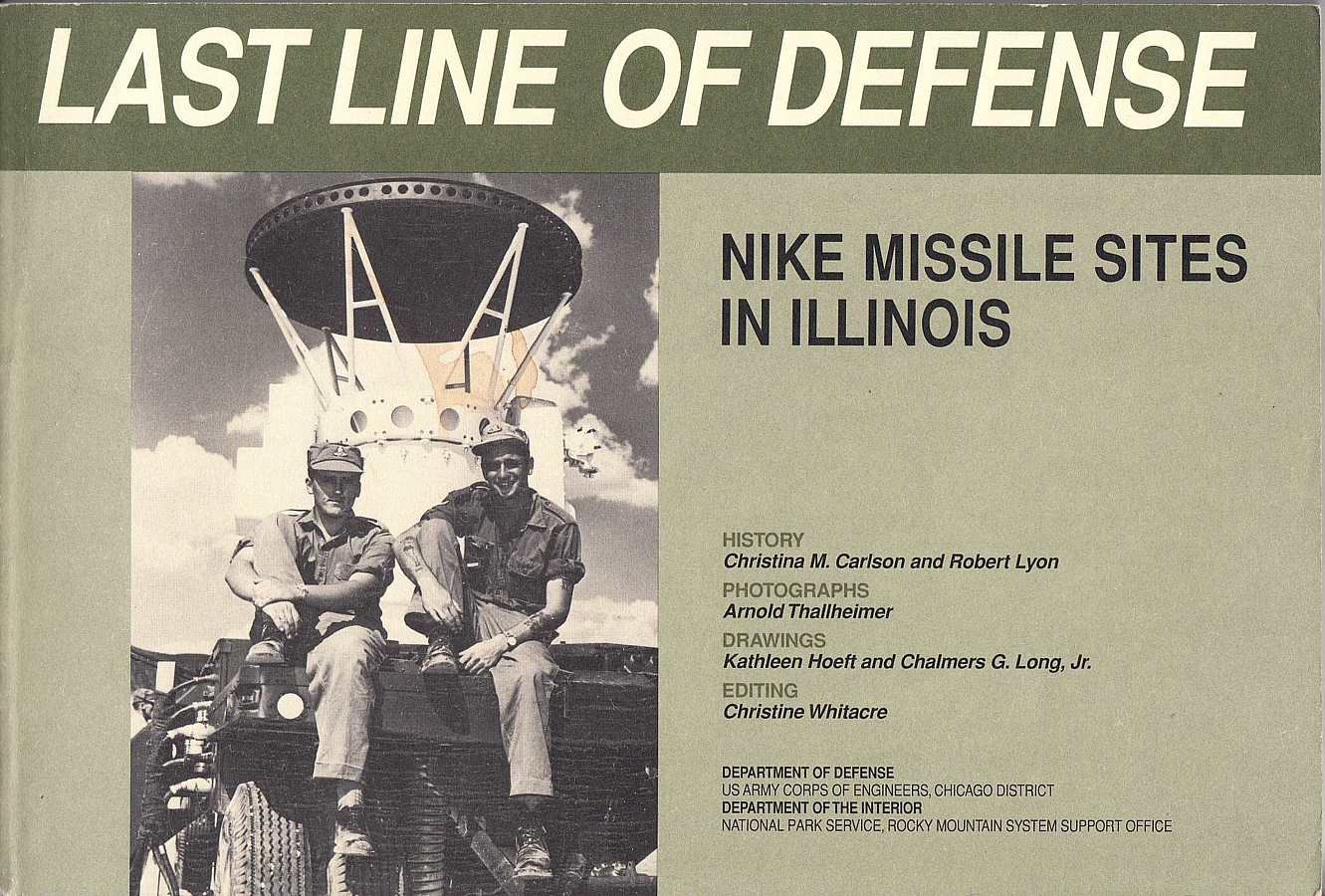
The U.S. Government booklet "LAST LINE OF DEFENSE, NIKE MISSILE SITES IN ILLINOIS" was very kindly sent to me by Corey J. Motel who reports that it is available from:
|
Mr. Keith Ryder Archaeologist U.S. Army Corps of Engineers 111 N. Canal St. Chicago, IL 60606-7206 |
(312)353-6400 x2020 keith.g.ryder@usace.army.mil |
The good news is:
HISTORY - Christina M. Carlson and Robert Lyon
PHOTOGRAPHS - Arnold Thallheimer
DRAWINGS Kathleen Hoeft and Chalmers G. Long, Jr.
EDITING Christine Whitacre
DEPARTMENT OF DEFENSE
US ARMY CORPS OF ENGINEERS, CHICAGO DISTRICT
DEPARTMENT OF THE INTERIOR
NATIONAL PARK SERVICE, ROCKY MOUNTAIN SYSTEM SUPPORT OFFICE
1996, Denver National Park Service,
Rocky Mountain System Support Office
Printing 9 8 7 6 5 4 3 2 1
Publication Design by Richard M Kohen
Front Cover: Nike crewment and tracking-radar equipment during a missile test at White Sands Proving Bround, New Mexico. No Nike missile was ever fired from a U.S. installation, other than for training and testing purposes. Smithsonian.
Title Page: Nike Ajax on launcher-loader. Redstone Arsenal.
TABLE OF CONTENTS
LAST LINE of DEFENSE
PREFACE
Gregory Kendrick, Program Leader
Christine Whitacre, Historian
Nike Operations
ENDNOTES
BIBLIOGRAPHY
BOOKS
If you have comments or suggestions, Send e-mail
to Ed Thelen
Return to Home Page
Updated December 2, 1998
Cultural Resources
Stewardship and Partnership Team
Rocky Mountain System Support Office
National Park Service
Stewardship and Partnerships Team
Rocky Mountain System Support Office
National Park Service
The Nike Ajax was the first in the Army's family of guided missiles, and the world's
first operational, guided, surface-to-air missile system.40
(The name "Ajax" derived from Greek mythology, where there were two Ajax characters
-- both swift, skillful, and strong.) The first Nike Ajax site was activated in
December 1953, at Fort George G. Meade, Maryland. The 36th Antiaircraft Artillery
Missile Battalion tactically deployed at this site on March 20, 1954, as part of
the Washington-Baltimore Defense Area.41 The Nike Ajax
was a two-stage, supersonic missile. The missile was extremely slender, only 12
inches in diameter. Twenty-one feet long and 34 feet high with the booster attached,
the missile weighed slightly over 2,455 pounds.42
Nike Ajax carried three high-explosive warheads, weighing 12, 179, and 122 pounds,
each wrapped in 1/4-inch, optimum cubic fragments. The warheads were mounted in the
nose, center, and aft sections. Two arming mechanisms and five detonating cords
activated the warheads, following burst orders issued from the
ground.43
The Army began developing the next generation of Nike missile -- Hercules --
in 1953, the same year that Nike Ajax became operational. The Army named the missile
for one of the most celebrated heroes of classical mythology, a figure renowned for
strength and endurance. The new guided missile would need these characteristics
in order to destroy the newer, more sophisticated generations of military aircraft.
Aircraft capabilities had increased in range and altitude, demanding an improved air
defense system. In addition, nuclear payloads were a greater threat. Designed to
carry either nuclear and/or high-explosive warheads, the Nike Hercules missile could
attack supersonic aircraft operating at altitudes in excess of 150,000 feet and at a
range of more than 87 miles.49
Type of Pit
Missile Type
Launcher
on Elevator
Length of Pit
Width of Pit
A
Ajax
Yes
42 Feet
63 Feet
B
Ajax/Hercules
Yes
49 Feet
60 Feet
C (converted to
Hercules from A)
Hercules
No
42 Feet
63 Feet
D
Hercules
Yes
62 Feet
68 Feet
Nike Zeus, the final Nike missile, was aimed at intercontinental ballistic missiles
(ICBMs), Zeus was the third missile in the Nike family, and brought Nike development
into the ICBM era. Named for the ruler of the Greek Gods, the Zeus missile measured
63 feet 3 inches, had a diameter of 60 inches, and weighed 40,000 pounds at launch.
The tandem booster, designed by Thiokol, had a thrust of 450,000 pounds --
then the highest ever attained through a single nozzle. The Zeus had a range of more
than 250 miles. The Nike Zeus system also included the Zeus Acquisition Radar (ZAR),
a significant improvement over the Nike Hercules HIPAR system. Shaped like a pyramid,
the ZAR featured a Luneberg lens receiver
aerial weighing about 1,000 tons. The first successful intercept of an ICBM by
Zeus was in 1962 at Kwajalein in the Marianas Islands.56
Site selection for Nike facilities involved several phases of planning, design, and
evaluation. A fundamental military principle was that a circular defense provided
the best protection. As such, Nike installations ringed their protected cities and
industrial centers -- called, in military planning parlance, "vital areas." Each
vital area was surrounded by a buffer zone. The size of each buffer zone was
determined by the amount of damage the enemy could theoretically inflict, as
related to the ability of the area to absorb damage and continue operating. Army
experts soon found that no two sites were exactly the same. Although each Nike
installation included essentially the same facilities, the configuration varied
from base to base. Preliminary siting plans were sent to ARAACOM Headquarters at
Colorado Springs, Colorado. These plans were then forwarded to the Pentagon for
final approval.62
The Army designated Chicago as Priority No 3 for Nike Ajax installations,
following Washington, D.C., and New York.71
Prior to the construction of Nike bases to defend the Chicago area, antiaircraft
artillery battalions, armed with 120mm and 90mm guns, were already present in and
around Chicago. In April 1954, the Army Corps of Engineers advertised construction
contracts for the first Nike bases in the Chicago area: C-93 (near Skokie), C-45
(Gary, Indiana), and C-51 (Alsip). Nike Missile Bases C-03 (Belmont Harbor), C-41
(Jackson Park), C-40 (Burnham Park), C-61 (Lemont), C-44 (Wolf Lake), C-80
(Arlington Heights),
C-72 (Addison), C-49 (Homewood), C-92 and C 94 (Libertyville), and C-98 (Ft. Sheridan)
were deployed by 1957.72
Nike Missile Base C-84, Barrington, Illinois
191 K Bytes
Site overview
71 K Bytes
Launch Area Site Plan
57 K Bytes
Initially, St. Louis, Missouri, was to receive only 90mm guns as its main defense
against enemy aircraft. Since the mid-1950s, 90mm and 120mm guns had been a mainstay
of air defense around America's major population centers. However, St. Louis officials
fought to obtain the Nike Hercules weapon system. On February 4, 1956, the St. Louis
Globe-Democrat reported:
Nike Missile Base SL-40 Hecker, Illinois
191 K Bytes
Site overview, topographical map
71 K Bytes
Battery Control Area Site Plan
57 K Bytes
Launch Area Site Plan
57 K Bytes
In 1955, the standard Nike Ajax battery consisted of 106 officers and enlisted men.
By 1960, that number increased to 115 men.87 The buildings
and structures that housed these crewmen were also standardized, although (like the
number ofcrewmen) there were variations. Initially, the Army considered the use of
pre-fabricated buildings for Nike installations, but the Army found that they were
unsightly and did not contribute to troop morale. As a result, the Army constructed
more substantial buildings that were of "modified emergency" type design. Typical of
most Nike missile installations, Nike Missile Bases C-84 and SL-40 each included sentry
guardhouses, an administration building, barracks, mess hall, a basketball court, and
various storage sheds. Most of these buildings were vernacular, one-story structures
with cinder-block walls and slanted metal roofs.
The Battery Control Area-- often referred to as the
Integrated Fire Control (IFC) Area included all of the necessary radar, computer,
and control equipment needed to detect and identify a target, and to launch and guide a
missile to intercept that target. In general, the Battery Control Area was located
on higher terrain that was relatively level and well-drained. Since this area contained
all of the Nike system's radar equipment, the location also had to be free of any
visual obstructions such as trees, radio towers, power and telephone lines, and smoke
stacks.88
The Battery Control Area required a minimum of ten servicemen to operate, and was the
focal information and communications point for the battery. Communication cables
connected the various elements within the Battery ControlArea, as well as with the
Launch Area. The major structures within the Battery Control Area included:
The mast assembly was used for collimating (adjusting the line-ofsight), testing, and
adjusting the missile-track ing and target-tracking radars. Typically, the mast
assembly was located approximately 600 feet from the missile-tracking radar and
the target-tracking radar. Spatially, the mast assembly and the two tracking radars
formed a tall triangle.
The Launch Area provided for the maintenance, storage, testing, and firing of the
Nike missiles. The selection of this area was primarily influenced by the relatively
large amount of land required, its suitability to extensive underground construction,
and the need to maintain a clear line-of-sight between the missiles in the Launch
Area and the missile-tracking-radar in the Battery Control
Area.95 At Nike Missile
Base SL-40, the Launch Area included a sentry guardhouse, a ready building for the crew,
a water treatment building, a missile test and assembly building, a warheading building,
a generator building, a canine kennel, an acid fueling station, an acid storage shed,
and three missile launching sections, each equipped with four missile launchers.
An estimated 21 men, including the launching control officer and the section chief,
operated launch control. Ofthese, six missile crew members manned each of the three
launching sections.96
room, the building included a stock room, first aid room, restroom, and boiler room. A
concrete walkway for missile movement connected the Missile Test and Assembly Building
with the acid fueling station.
Nike Ajax and Nike Hercules Missile Drawings
73 K Bytes
Underground Storage Magazine and Launcher-Loader
Assemblies - Plan and Section
65 K Bytes
Nike Missile Base - SL-40
95 K Bytes
Once the Army Air Defense Command Post received word of an impending attack, it
notified its battalions. As the target entered the range of the acquisition radar
and the missiles at each battery readied for launch, a "blue alert" status sounded,
signalling that all personnel should go to battle stations. Three missiles were
brought above ground, one at a time, on the elevator, and pushed to the satellite
launchers and locked in place with pins. The fourth missile was brought to the surface
on the elevator, where it could also be launched.107
The Army Air Defense Command instructed its commanders to:
1) Maintain 25 percent of all Nike batteries so that they were "capable of launching
one effectively controlled missile within fifteen (15) minutes of receipt of
signal or warning, and of maintaining sustained fire until the supply of ready
missiles is exhausted;"
2) Ensure that 50 percent of all batteries were "capable of launching one effectively
controlled missile within thirty (30) minutes of receipt of signal or warning, and
of maintaining sustained fire until the supply of ready missiles is exhausted;" and
3) Allow 25 percent of all batteries to be on a training and maintenance cycle,
retaining the "capability of returning to an operational status within two (2)
hours of receipt of signal or warning.112
1 John Lewis Gaddis, The United States and the Origins of the Cold War, 1941-1947
(New York: Columbia University Press, 1972), 137.
2 Ibid., 139.
3 Ibid., 136.
4 Ibid., 163.
5 William O'Neill, American High: The Years of Confidence, 1945-6960 (New York:
The Free Press, 1986), 66.
6 John Patrick Diggins, The Proud Decades. Amercica in War and Peace, 1946-1960
(New York: W.W. Norton & Company, 1988), 82.
7 Ibid., 76.
8 Post-War Hopes, Cold War Fears. Executive Producer: Mert Koplin. Produced by
Imre Horvath. Writers: Imre Horvath, Bill Moyers, Bernard A Weisberger.
Created and developed by The Corporation for Entertainment and Learning,
Inc. and Bill Moyers. Washington, D.C.: PBS Video, 1984.
9 Diggins, 80.
10 Greece and Turkey were added to NATO in 1952; West Germany was added in 1955.
11 Diggins,81.
12 Ibid.
13 John Newhouse, War and Peace in the NuclearAge (New York: Alfred A. Knopf, 1989), 110.
14 Lawrence S. Wittner, Codd WarAmerica -- From Hiroshima to Watergate (New York:
Praeger Publishers, Inc., 1974), 144-5.
15 Lieutenant Colonel Roy S. Barnard, The History of ARADCOM, Volume 1:
The Gun Era 1950-1955 (Headquarters ARADCOM, Historical Project ARAD 5M-I, n.d.), 3.
16 BDM Corporation, Vienna, VA. "Draft: History of Strategic Air and Ballistic Missile
Defense, 1945-1955" (For the Department of the Army, Chief of Military History,
Washington, D.C., March 15, 1975), Volume I, Section A, 12.
17 Barnard,3.
18 Ibid.,5.
19 BDM Corporation, Volume I, Section A, 14.
20 Barnard,8.
21 BDM Corporation, Volume I, Section A, 14.
22 Barnard,S.
23 Jacob Neufeld, Ballistic Missiles in the United States Air-Force, 1945-1960
(Washington D.C.: Office of Air History, 1990), 239.
24 Ibid., 52; and Barnard, 27.
25 Neufeld, 53.
26 Merle T. Cole,"W-25: The Davidson Site and Maryland Air Defense,"
Maryland Historical Magazine, Volume 80, No. 3 (Fall 1985), 241.
27 Neufeld, 91.
28 Cindy Sage, A. Schilz, M. McDonald, "Mt. Gleason Nike Missile Site LA-04,"
HAER No. CA-57, (April 1988), 7.
29 Emest J. Yanarella, The Missile Defense Controversy -- Strategy, Technology,
and Politics, 1955-1972 (Lexington: The University Press of Kentucky, 1977), 19.
30 Ibid.
31 Thomas R. Ross, "Air Force Seeks to Abolish Chicago Nike Installations,"
Chicago Sun Times, 1 September 1958.
32 Ibid.
33 "Poor Rating for Hercules," The Milwaukee Journal 27 May 1959, Center of Military
History, Washington D.C.
34 M.D. Fagen, ed., A Histoy of Engineering and Science in theBell System --
National Service in War and Peace 1925-1975) (Bell Telephone Laboratories, Inc.,
1978), 360.
35 Barnard,l5.
36 Fagen,370.
37 Ibid.,371.
38 Mary T. Cagle, Historical Monograph: Development, Production, and Deployment
of the Nike Ajax Missile System, 1945-1959 (Redstone Arsenal, Alabama:
U.S. Army Ordnance Missile Command, 30 June 1959).
39 Ibid. 133.
40 BDM Corporation, Volume I, Section B, 29.
41 Cagle, 181
42 Bill Gunston, The Illustrated Encycdopedia of the World's Rockets and Missiles
(London: Salamander Books, 1979).
43 Ibid., and Environmental Science and Engineering, Inc., Gainesville, Florida,
Historical Overview of the Nike Missile System (Aberdeen Proving Ground, MD:
U.S. Army Toxic and Hazardous Materials Agency, December 1984).
44 The Antiaircraft Artillery and Guided Missile School, Introduction to Nike 1 System
(ST44-161-1 (Fort Bliss, Texas: U.S. Army, April 1956), 66-67
45 Environmental Science and Engineering, Inc., 5-5.
46 Fagen, 462.
47 Cagele, 180.
48 "Nike-Ajax, Now 'Senile' Missile, Institutionalized," The Pentagram News,
12 November 1964, Center of Military History, D.C.
49 Gunston.
50 Ibid.
51 Fagen, 388.
52 United States Army Missile and Munitions Center and School, Nike Missile System
Orientation (Redstone Arsenal, Alabama: United States Army Missile and Munitions
Center and School, Rev. February 1976), 4.
53 Cole, 255.
54 Gunston; and United States Army Missile and Munitions Center and School, 4.
55 Gunston.
56 Ibid,
57 Yanarella, 60, 99.
58 Fagen, 395.
59 James M. Gavin, Maj. Gen., "Memorandum: Nike Deployment and Site Availability Plan,"
21 April 1954, Office of History, Corps of Engineers, Fort Belvoir, VA, File 813313.
60 Cagle, 181-3.
6l Ibid., 182-3.
62 "One on the Lake Front Won't Take Extra Land," Chicago Daily News, 6 March 1956,
Chicago Historical Society, Chicago, IL.
63 Department of the Army, U.S. Army Air Defense Employment (FM 44-1)
(Headquarters, July 1962), 105-9.
64 Cagle,188.
65 Ibid.,l9O.
66 Ibid., 190, 193.
67 Ibid.,l91.
68 Ibid;,193.
69 Chicago Sun Times, 20 November 1955, Chicago Historical Society, Chicago, IL.
70 "Army's Nike Guided Missile to be Installed in Nation's Anti-Aircraft Defense
System," Department of Defense, Office of Public Information, Washington, D.C.,
No. 1185-53, 17 December 1953, Center of Military History, Washington, D.C.
71 Gavin.
72 Memoranandum: Report of Nike Sites Advertised," 12 April 1954, Office of History,
Corps of Engineers, Fort Belvoir, VA; ENGMN 4666, Nleroorandum, 22 April 1954,
Office of History, Corps of Engineers, Fort Belvoir, VA; "Memorandum: Proposed
Nike Deployment and Site Availability Plan," 6 April 1955, Office of History,
Corps of Engineers, Fort Belvoir, VA; and CONUS NIKE Program, "Memorandum:
Proposed Nike Deployment," 3 December 1955, Office of History, Corps of Engineers,
Fort Belvoir, VA.
73 United States Army Corps of Engineers, Chicago District. "Defense Environmental
Restoration Program Inventory Project Report," Project No. E105IL007700 (n.d.),
U.S. Army Corps of Engineers Office, Chicago District, Chicago, IL.
74 Oliver P. Frost, Comptroller, U.S. Army Engineer District, Chicago, "Memorandum:
To ENGMC-CO," 5 June 1962, Office of History, Corps of Engineers, Fort Belvoir, VA.
75 James A. Sawicki, AntiaircraftArtillery Battalions of the US Army, Volume I
(Dumfries, VA: Wyvern Publications, 1991); and Directory and Station List of the
US. Army, Center of Military History, Washington, D.C.
76 In the October 15, 1959, Station List, a Palatine site (no site number given)
is listed as Battery C for the 3rd Artillery, 6th Missile Battalion, Nike-Hercules.
Nike Site C-84 was sometimes referred to as being in Palatine, a neighboring
community. (It was also referred to as the Lake Zurich site). However, simultaneously,
Site C-84 is included as Battery D for the 60th Artillery, 2nd Missile Battalion,
Nike-Ajax. Given the information available regarding the use of C-84 solely as a
Nike-Ajax Battery, the placement of the "Palatine" site, Nike Site C-84, under a
Nike-Hercules Battalion appears to be an error.
77 R,E. Vollendorff, Colonel, GS Office, Chief of Legislative Liaison, to
Honorable Marguerite Stitt Church, U.S. House of Representatives, December 28, 1961,
Office of History, Ft. Belvoir, VA.
78 Annual Report of the Chief National Guard Bureau (Washington, D.C.: Center of
Military History, 1957).
79 Annual Report of the Chief National Guard Bureau (Washington, D.C.: Center of
Military History, 1961).
80 "Army Plans No Nike Defense for St. Louis," GLobe-Democrat, 4 February 1956,
Mercantile Library, St. Louis, MO.
81 Karsten Requests St. Louis Priority for Nike Missiles," unidentified newspaper,
11 March 1956, Mercantile Library, St. Louis, MO.
82 Army to Consider Sending Nikes Here," unidentified newspaper, 25 March 1956,
Mercantile Library, St. Louis, MO.
83 "Nike to Protect St. Louis by 1958, General Promises," Globe-Democrat, 25 May 1956,
Mercantile Library, St. Louis, MO.
84 Janice E. McKenny, Army Lineage Series, Air Defense Artillery (Center of Military
History, United States Army, Washington, D.C., 1985); Troops to Man Nike Sites
Here Around Sept. 15," 26 August 1959, unidentified newspaper, Mercantile Library,
St. Louis, MO.
85 "Defense Environmental Restoration Program Inventory Report.
86 Engineering Neu/s Record 161, No. 12 (18 September 1958): 85.
87 Cole,251.
88 Introduction to Nike 1 System (ST44-161-1), 84.
89 The Antiaircraft Artillery and Guided Missile School, Underground Launching
Equipment (ST 44-161-31) (Ft. Bliss, TX: U.S. Army, November 1955).
90 The Antiaircraft Artillery and Guided Missile School, Battery Control Circuits
and A C Transmission Circuits (ST 44-161-3G) (Ft. Bliss, TX:
U.S. Army, November 1955).
91 Ibid.
92 Introduction to Nike 1 System (ST44-161-I 93 Cagle,187.
94 United States Army Missile and Munitions Center and School.
95 Introduction to Nike 1 System (ST44-161-1) 88.
96 Battery Control Circuits and A C Transmission Circuits (ST44-161-3G), 6.
97 Ibid.
98 The Antiaircraft Artillery and Guided Missile School, Underground Launching
Equipment (ST44-161-3I (Fort Bliss, Texas: October 1955), 3.
99 Department of the Army, Nike 1 Systems. Nike 1 Round Launching Area and Assembly
Area Equipment (TM9-5000-4) (Army Headquarters: April 1956), 27.
100 Ibid.
101 Ibid.
102 Ibid.
103 Sage et al., 30.
104 Battery Control CircIlits and AG Transmission Circuits (ST44-161 3G), 6.
105 Cole, 242.
106 Brochure issued for 29 January 1958 presentation to Lieutenant Colonel Adam J. Eisenhauer,
by the 32nd Antiaircraft Artillery Brigade, US. Army stationed in West Germany,
in the files of the Center of Military History, Washington, D.C.
107 Ibid. 11-24.
108 United States Army, The Nike-Hercules Story, produced by Herbert Kerkow, Inc.,
New York, NY, presented by Bell Telephone Co., n.d.
109 Cole. 251.
110 Introduction to Nike 1 System (ST44-161-I, 57.
111 Battery Control Circuits and AG Transmission Circucts (ST44-161-3G), 8-9, 24.
112 Barnard, 184-5.
113 Cole. 254.
114 James W. Dunn, Historian, Fort Belvoir, VA, interviewed by Christina M. Carlson.
Mr. Dunn was a 2nd Lieutenant at a Nike site in Los Angeles, CA
115 Barnard, 171-2.
116 Cole, 254.
117 Chicago Tribune, 18 May 1973; and "Certain Mileposts Re: Nike Site New Lake Zurich
(n.d.) photocopy, files of the Lake County Museum, Wauconda, IL.
118 Nike Missile Site C-84 files, Lake County Museum, Wauconda, IL; and "Defense
Environmental Restoration Program Inventory Project Report.
119 Lake Zurich ((IL) Daily Herald, 23 January 1992; and Pioneer Press, 21 November 1985,
in the files of the Lake County Museum, Wauconda, IL.
120 Sage et.al. 1; and Richard J. Sommers, Department of the Army, Carlisle Barracks,
Pennsylvania, to Christina Carlson, October 1992, transscript in the files of
Christina Carlson, BREGMAN & COMPANY, Inc., Bethesda, MD.
121 United States Army Corps of Engineers, Chicago District, "Report of Excess Real
Property" (Chicago, IL: United States Army Corps of Engineers, Chicago District,
9 June 1969).
122 Defense Environmental Restoration Program Inventory Report."
123 Duncan S. Lennox, ed., Jane's Strategic Weapons Systems(Surrey, United Kingdom:
Jane's Information Group, 1990); and Gunston.
124 Tim O'Gorman, Curator at U.S. Army Air Defense Artillery Museum, Fort Bliss,
TX, interviewed by Christina M. Carlson.
Military Monographs and Reports
Historic American Engineering Record (HAER) Reports
Military Manuals
Journals, Magazines and Newspapers
Films
Interviews
Archival Sources
Return to top