Return to "Visible Storage"
*** Please note: This website (comp-hist) was completed before I found out about Wikipedia in 2002.
Since then I have added material occasionally.
Items are certainly not complete, and may be inaccurate.
Your information, comments, corrections, etc. are eagerly requested.
Send e-mail to Ed Thelen. Please include the URL under discussion. Thank you ***
PDP-5
Manufacturer DEC - Digital Equipment Corporation Identification,ID PDP-5 Date of first manufacture 1963? Number produced - Estimated price or cost - location in museum - donor - Contents of this page:
- Photo
- Placard
- Architecture
- Special Features
- Historical Notes
- This Specimen
- Interesting Web Sites
- Other information
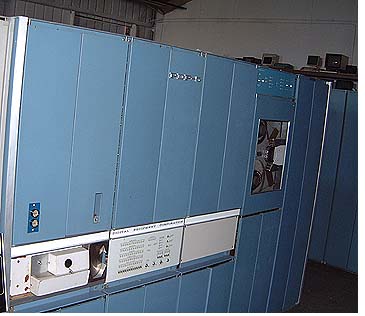
Photo Photo
Dec PDP-5
-
Word size - 12 bit words,
Max addressable memory - 4096 words max

The 12 bit accumulator had a 13th bit (past high order bit) was "link bit".
The "link bit" was very useful in multi-precision arithmetic
   - common in a machine that can only count 0 to 4095.

8 instructions, instruction code was 3 bits - see "small computer handbook"
This makes the  modern "RISC" machines look "complex" like the CISC machines!

Op Code
bits

000 -
001 -
010 - Conditional Skip Instruction, TRUE skipped the next instruction.
        The next instruction could be a jump instruction.
	Remaining 9 bits defined the skip conditions
           such as: skip on zero, skip on negative,

011 - Deposit Accumulator (store accumulator) and sets accumulator to zeros

100 -
101 -

110 - Jump to Subroutines, return address placed at target address,
	and execution started one address higher
111 - Unconditional Jump


Instruction format (12 bit word)
------------------------------------------------------
3 bits opcode | 1 bit page  | 1 bit indirect | 7 bits of address
  (see above)
---------------------------------------------------------------
page bit - if 0 - then use low memory (ignore hi 5 bits of P register)
           if 1 - use "current page (use hi 5 bits of P register)

indirect bit - if 0 - use regular addressing
               if 1 - use address as indirect address

7 bits of address - low seven bits of addressing

---------- start page 0 description ------------
Memory locations
000 - 177 octal

000 007 = normal page 0  memory
010 017 = special memory, refered to as autoincrementing locations
              If you referenced it indirectly, it autoincremented
	      you can do a block move using 2 autoindex locations.
	This concept copied by Ed DeCastro for the Data General NOVA series.
020 177 = normal page 0  memory

---------- end of page 0 description ----------

DEC divided memory into 128, 177 octal pages


There was no load instruction, you deposited the accumulator,
     which cleared it, then added the operand to the zero.

The disadvantages of this system were
  - the inability to address more than 4096 words,
  - the addressing across the 128 pages was really awkward,
  - the 128 page zero words required careful management.
The advantages of this system were
  - you could do a surprising amount in 4096 12 bit words
      - including compile and run a FORTRAN program
  - price, price, price.
see Architecture and Timeline at PDP-8.
from PDP-8 Summary of Models and Options
- P register (Instruction counter) was in memory
- Macro 5 was assembler,
Subject: What is a PDP-5?

Date of introduction:  Aug 11, 1963, unveiled at WESCON.
Date of withdrawal:    early 1967.
Total production run:  116.
Price: $27,000

Technology:  The PDP-5 was built with DEC System Modules, the original
        line of transistorized logic modules sold by DEC.  The supply
        voltages were +10 and -15 volts, with logic levels of -3 (logic 1)
        and 0 (logic 0).  Logic was packaged on boards that were about
        4.75 inches high with each card mounted in a metal frame with a
        22 pin edge connector.

        Input output devices were connected to the daisy-chained I/O bus
        using military-style armored cables and connectors.  Use of
        toggle switches (as opposed to slide switches) on the front
        panel was another vestige of military-style design.

Reason for introduction:  This machine was inspired by the success of
        the CDC-160, Seymour Cray's 12 bit minicomputer, and by the
        success of the LINC, a machine that was built by DEC customers
        out of System modules.  These demonstrated that there was a
        market for a small inexpensive computer, and from the start,
        DEC's advertisements were aimed at this market.  "Now you can
        own the PDP-5 computer for what a core memory alone used to
        cost: $27,000", ran one 1964 ad.

        Ken Olson has stated that the PDP-5 was not originally meant to
        be a computer; it was designed for a company that wanted an
        automatic controller for some industrial work.  He told them
        they could make a small programmable controller instead of the
        hardwired machine they were asking for, and since they weren't
        entirely certain of the control equations they wanted to run, they
        accepted the idea. The result was the PDP-5.
Historical Notes
DEC produced a lot of inexpensive manuals. They were passed out free at trade shows, intended for the college crowd. Many high school kids snuck into those shows, and learned computers from those books.
From "Digital at Work" , Digital Press, copyright 1992, page 49
        12-Bit Family Timeline

1962 Laboratory Instrument Computer (LINC)
        developed at MIT
1963 PDP-5, Digital's first 12-bit computer
1965 "Classic" PDP-8 world's first mass-produced
        minicomputer
1966 LINC-8 combines LINC and PDP-8 processors PDP-
        8/S, serial version of the PDP-8
1967 PDP-8 systems manufactured in
        Reading, England
        Annual sales:$38 million
1968 LAB-8, small, general-purpose laboratory
        package
        TSS/8 timesharing software
        PDP-8/I, integrated circuit version
        of be PD18
        PDP-8/L
1969 PDP-12, third member of LINC family
1970 PDP-8/E features OMNIBUS synchronous bus
        for bidirectional communications between
        system elements
        TABS-8 newspaper application
1971 PDP-8/M, OEM version of 8/E
1972 PDP-8/F
1974 PDP-8/A miniprocessor
        PDP-8/A package allows OEMs choice
        of memory type and quantity
1976 PDP-8/A 600 series
        WPS-8 word-processing software
        CMOS-8 chip
1977 VT78,complete PDP-8 system in a terminal,
        uses the CMOS-8 chip, anticipating the
        DECmate series
        WS 102, multiuser WPS
1982 DECmateII word processor
1984 DECmate III
This Specimen
-
- Digital Equipment Corporation PDP-5 Manual, 1964 @7.2MB.
-
If you have comments or suggestions, Send e-mail to Ed Thelen
Go to Antique Computer home page
Go to Visual Storage page
Go to top
Updated February 6, 2002