Return to "Visible Storage"
*** Please note: This website (comp-hist) was completed before I found out about Wikipedia in 2002.
Since then I have added material occasionally.
Items are certainly not complete, and may be inaccurate.
Your information, comments, corrections, etc. are eagerly requested.
Send e-mail to Ed Thelen. Please include the URL under discussion. Thank you ***
ETA
Manufacturer ETA - a "spinoff" of Control Data Corporation Identification,ID ETA-10 Date of first manufacture 1986 Number produced - Estimated price or cost - location in museum - donor John von Neumann Center Contents of this page:
- Photo
- Placard
- Architecture
- Special Features
- Historical Notes
- This Artifact
- Interesting Web Sites
- Other information
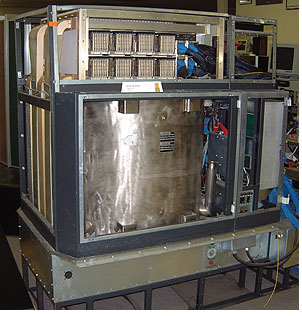
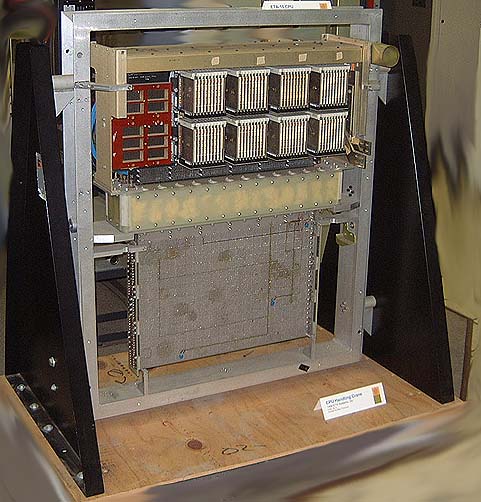
ETA-10 including liquid nitrogen tank ETA-10 in service rack
-
Designer: Neil Lincoln
http://wotug.ukc.ac.uk/parallel/internet/usenet/comp.parallel/FAQ/18
says "
'Long-vector' machines: TI ASC, CDC 203/205, ETA-10[EGQP]
'Short-vector' machines: Cray, Convex, Alliant, Weitek based chip set IBM 3090
"
Models/variations
From John Swensen
From John Swensen
The "big" ETA-10 was cooled in liquid nitrogen (not pressurized, so no steam problems), and I believe the nitrogen flow from the cryogenerator (big refrigerator) to and from the cryostat was high enough that boiling was not much of an issue. Niel [Lincoln] can tell some pretty funny stories about development in the labs, however, when some things did go wrong. The big machines had from two to 8 processors. Each circular tank held two processors, each with its own "toaster slot", filled with liquid N2 (the round cryostat without the processors or memory looked like a futuristic toaster).The Piper was an air-cooled version of the ETA-10, with either one or two processors. The clock was relaxed from 7ns to about 16-18ns, depending on the model. By the way, the reason for marketing the Pipers was to get the volume of chips high enough to allow selecting the fastest parts for the LN2 machines, while still providing a market for the slower parts and developing a user base for the ETA-10 architecture (that was the theory, at least). For a while, the Pipers were beating Cray-2s at LINPACK (until Cray started doing better code scheduling and strip-mining of loops).
CMOS is now the circuit family of choice, with switching speeds in the low tens of picoseconds; both Intel and AMD have announced 1 GHz processors, implemented entirely with CMOS. I'm not a circuits guy, but I think that once the geometry got small enough, the gate capacitance of CMOS dropped to the point where it got really fast. Cooling CMOS to LN2 temperatures speeds it up by about a factor of 4, in theory; in practice, a speedup of 2 is achieved, once the realities of a reliable circuit family are taken care of. I can't remember the voltages used then, but I think it was a bit below 5V at the time. Although much slower than ECL at the time, CMOS could be packed much denser on a chip, saving lots of off-chip and on-chip delays so, for certain types of designs, CMOS could run faster than ECL, overall. By the way, the memory (both the local, fast memories, and the shared, dynamic memories, were not cooled; they would run a bit faster in LN2, but not enough faster to justify the cost of cooling them.
Historical Notes
Neil R. Lincoln ( nrl at windlogics. com ) 651-483-3560, Shoreview, MN 55126 sent some corrections to an e-mail "I became the "Chief Architect and project manager of the STAR-100 in 1972, and went on to be the architect of the CYBER-203 and CYBER 20_machines. I was the creator of he ETA-10 and was the founder, VP and board member of ETA." "Trevor Pearcey "kind of" worked for Chuck Hawley at CDC who was head of the department in the Advanced Design Laboratory which was responsible for the STAR-100 CPU hardware. Peter D. Jones helped create the virtual memory system for the STAR and then architected the "station" concept for the supporting peripheral computers (software and hardware). Family responsibilities led to his returning to Australia in 1972 about the time Jim Thornton retired from CDC. Jim continued as a consultant to CDC helping with the entry into VLSI technology. Later Jim, Peter Jones and Gary Christianson founded ZYCAD."
Richard Offerdahl, Richard @ offerdahl . com - 593 Lariat Circle, Incline Village, NV 89451 775-772-0467 objected to the last sentence above - he said (Jan 2007): "Here are some facts: Jim Thornton was a Board of Directors member of Zycad. Zycad was founded by Richard Offerdahl, Nick VanBrunt and Jeanne Mehlhoff. Jones was an early investor in Zycad, along with Thornton and 30 or so other investors. Christensen was not associated with Zycad. I believe that Thornton and Christensen (and maybe Jones) founded an interconnect company (Network Systems) to connect hardware from different manufacturers together. "
From Rick Sanner, sanner @ pindi . com -- Jan 20,2009 The comment from Richard Offerdahl is true.
I was one of those investor in Zycad.
I also had friends working for CDC and on the ETA project.Rick Sanner
R&D Engineer"ETA was a spin-off company of Control Data Corporation. Its ETA-10 supercomputer, introduced in 1986, proved popular with universities and research institutions. Using a 44-layer PCB, the entire CPU was constructed on a single board. This family of machines (spanning a 27:1 performance range) offered peak performance of up to 10 GFLOPS, used CMOS logic, and came in air and liquid-nitrogen cooled versions."
http://wotug.ukc.ac.uk/parallel/documents/misc/timeline/timeline.txt


========1983========
ETA Systems, Inc. spun off from CDC to develop a new generation of
vector supercomputers.  (GVW: CDC, ETA)
========1987========

ETA produces first air- and liquid nitrogen-cooled versions of ETA-10
multiprocessor supercomputer.  (GVW: ETA)

ETA 10 with 1 processor achieves 52 MFLOPS on 100^2 LINPACK; NEC SX-2
with 1 processor achieves 885 MFLOPS (against a peak of 1300) on
1000^2 LINPACK.  (JD: Linpack Benchmark, ETA 10, NEC SX-2)

========1989========

Control Data shuts down ETA Systems in April; National Science
Foundation subsequently shuts down the John von Neumann Supercomputer
Center at Princeton, which was operating an ETA-10.  (MW: CDC, ETA)
========1990========
The two ETA-10 systems at the closed John von Neumann Supercomputer
Center are destroyed with sledge hammers, in order to render them
useless, after no buyers are found.  (MW: ETA)
Life ain't fair department
from http://www.tjhsst.edu/TechLabs/CS/Systems/Piper.html
Piper : the ETA 10-P Supercomputer Piper is an ETA 10-P vector supercomputer with 64 MB of RAM and 2 GB of disk space. It is running ETA System V Unix. At the current time however, it is not working as a leak in the roof has put it out of commission. It appears that the problem is a corrupted fiber optic link between the disk storage and the processor, but we can't fix it ourselves.
Don Hyatt (dhyatt@tjhsst.edu) is the administrator for piper.
and software problems
from The Scientist 3[23]:2, Nov. 27, 1989
http://www.the-scientist.com/yr1989/nov/anderson_p2_891127.html
Without NSF funding, the von Neumann center could be doomed. "I don’t think we can function without federal support," says Cohen. Even if the center does operate at a vastly reduced level, its machines continue to be plagued by software problems. The NSF review panel found that the ETA-10 suffered a software failure once every 30 hours, and that its ability to run programs on more than one of its eight processors at any one time was poor. Although its hardware is still considered state-of-the-art, the overall package is an "extremely immature computer system," the panel concluded.
This Artifact
-
- ETA and CONVEX: between -40 and +40 Centigrade
User Experience
A History of Supercomputing at Florida State University by Jeff Bauer
If you have comments or suggestions, Send e-mail to Ed Thelen
Go to Antique Computer home page
Go to Visual Storage page
Go to top
Updated Jan, 2009