Return to "Visible Storage"
*** Please note: This website (comp-hist) was completed before I found out about Wikipedia in 2002.
Since then I have added material occasionally.
Items are certainly not complete, and may be inaccurate.
Your information, comments, corrections, etc. are eagerly requested.
Send e-mail to Ed Thelen. Please include the URL under discussion. Thank you ***
PDP-1
Manufacturer DEC - Digital Equipment Corporation Identification,ID PDP-1 Date of first manufacture 1960 Number produced - Estimated price or cost $120,000 (1960 dollars) location in museum - donor - Contents of this page:
- Photo
- Placard
- Architecture
- Special Features
- Historical Notes
- This Specimen
- Interesting Web Sites
- Other information
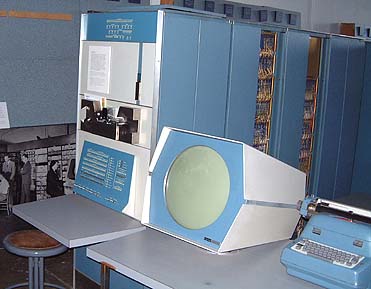
Photo Photo
DEC PDP-1
-
The PDP-1 was the first of the DEC 18 bit computer series, consisting of PDP-1, PDP-4, PDP-7, PDP-9, PDP-15. See Instruction List of PDP-9
From "Digital at Work" , Digital Press, copyright 1992
                 Specification - PDP-1


Word Length
   18 bits

Speed
   5-microsecond cycle time
Primary Memory
   4K word core
instruction Set
   Memory address instruction
   Operate class, 1/O class
Input/output
   Typewriter, paper tape
   Cathode ray tube
   Options: Light pen, magnetic tape,
   ultrahigh-precision scope
Size

   4 cabinets: 8' x 2 V5' x 6'
Software
   Diagnostics, assembler, debugger,
   Editor, conversion routines for punching tapes
Number Produced
   50
Price
   $120,000


Nothing as Affordable at the Time
Its short word length and high speed suited the PDP-1 to laboratory
and scientific control applications that required its computation ability
and real-time control. Lawrence Livermore Laboratory first used the
PDP-1 for periphery support processing for their large scientific
calculators and for graphics input and output. Atomic Energy of Canada
used a PDP-1 for pulse-height analysis and Van de Graaff generator
experiment control, and International Telephone and Telegraph used
PDP-1 computers in message-switching systems.

Digital brought the prototype PDP-1 to demonstrate at the Joint
Computer Conference in Boston in December of 1959.
From "Digital at Work" , Digital Press, copyright 1992, page 30
Spacewar!
In the early 1960s, MIT wasn't the only institute of advanced research on the north bank of the Charles River. The augustly named Hingham Institute was, in reality, a dingy tenement on Hingham Street a few blocks from MIT. Home to two programmers, the institute served as a meeting place for assorted students who shared one common trait: a growing addiction to MIT's new PDP-1.
When he wasn't pursuing his avocation, Steve "Slug" Russell assisted John McCarthy's artificial intelligence research on MIT's IBM System 704. But he preferred the PDP-1: "It had a switch. You could turn it on. You got a satisfying clunk. You could type a single character at it and it would type a little message back. It gave you a great feeling of power."
Fueled by this sense of power, which was supplemented by their interest in Japanese monster movies and the pulp science fiction of E.E. "Doc" Smith, Russell and his Hingham Institute associates created the most elaborate computer "hack" of their era: a two-player game called "Spacewar!" played on the PDP-1's CRT screen.
After Slug wrote the main control routine, Shag Graetz, a Hingham fellow, recalls, "it was like Tom Sawyer with the whitewash brush." Unimpressed with Russell's random stars, one hacker wrote a program that put them in their proper constellations (and respective magnitudes, naturally). Another found the whole thing annoyingly nonNewtonian, so he added gravity to the paths of the spaceships and missiles.
Robert Garner points out in Jan 2004
For your PDP-1.org web site, [a PDP-1 restoration effort] here's a better link to Graetz's entertaining "The Origin of Spacewar" article http://www.wheels.org/spacewar/creative/SpacewarOrigin.html (This one has the pics, unlike one from ed-thelen.org.)
http://www.wheels.org/spacewar/ also has some other interesting links.. Historical Notes
A video of the restoration and demo of this PDP-1
From "Digital at Work" , Digital Press, copyright 1992, page 16
18-Bit Family Timeline
1960 PDP-1, Digitals first 18-bit computer
1963 PDP-4
1964 PDP-7, uses flip chip modules; used by Ritchie and
         Thompson to develop UNIX
1966 PDP-9, program compatible with PDP-7

1969 PDP-15 replaces PDP-9
1972 MUMPS-15 (Massachusetts General Hospital
         Utility Microprogramming System), PDP-15 -based
         timesharing system designed to handle medical
         records, still in use
1979 PDP-1 with working Spacewar! game installed at
         The Computer Museum, Boston
1988 A PDP-1 system (serial no. 44) is saved from a barn
         in Wichita, Kansas, and donated to the Digital
         Historical Collection
Presentation at decworld2001 (Computer History Museum) June 16, 2001
the name PDP-2 was reserved for a 20 bit machine
     - never produced
the name PDP-3 was to be a 36 bit TX-2
     - sold to the AirForce - never produced
     - sold the AirForce two PDP-1 machines instead
           does an 18 bit machine
            and an 18 bit machine
       add up to a 36 bit machine?
From "Digital at Work" , Digital Press, copyright 1992, page 33
A distinguished Lineage
Interactive Computing with the PDP-1 Edited by Bob Hofmann from interviews with Edward Fredkin
Digital's PDP-1 was the direct descendant of the TX-0 computer, developed along with the larger TX-2 system at Lincoln Laboratory in the late 1950s. Designed by Wesley Clark, the TX-0 and TX-2 were among the first transistor driven computers in the world. With many of the features pioneered on the massive Whirlwind system CRTs, consoles,paper-tape input and output-the TX-0 and TX-2 effected many advances in interactive computing. The TX-2 was planned as a large-scale 36-bit system for advanced graphic display research. The smaller TX-0 was built first, to test the transistor circuitry and complex core memory of the larger system. That process produced the TX-0 Direct Input Utility System, a set of programs that made it possible to communicate directly with the computer with an online typewriter. This primitive operating system was the first ever developed for a real-time computer. Soon the power of the TX-0 was applied to other tasks. A program to analyze electroencephalograph recordings for sleep research utilized the first moving window display ever to appear on a CRT. To create scientific characters on the display for mathematical equations, team member (and later PDP-1 architect) Ben Gurley developed a light pen. "The TX-0 could do everything a personal computer does today," remembers Ken Olsen, another member of the team, "limited only by the fact that the memory was small." The much larger TX-2 was less limited, especially after 65 K of memory from the TX-0 was added to it. At the first official meeting on interactive graphics, a young graduate student named Ivan Sutherland introduced his TX-2-based Sketchpad system, a new kind of simulation language that enabled the computer to translate abstractions into concrete visual forms. Many of Sketchpad's capabilities were sophisticated even by the workstation standards of the1980s."If had known how hard it was to do," Sutherland said later, "I probably wouldn't have done it." Stripped of most of its memory, the TX-0 was sent on a long-term loan to MIT, where it inspired a new generation of graphics pioneers. Assistant Professor Jack Dennis gave access to the system to members of the Signals and Power Subcommittee of the MIT Model Railroad Club, students who were to win fame as the first computer "hackers." Dennis himself designed a symbolic debugger for the system. Called FLIT, after a popular insecticide, this Flexowriter Interrogation Tape was the first of many playfully named but useful programs created by the group. The TX-0 was considered the ultimate in interactivity by the hackers-until the first PDP-1 arrived a few years later. ... This Specimen
-
- Demo of PDP-1 by Lyle Bickley, video by CuriousMarc (22 minutes) (2017)
- Spacewar!
- The PDP-1 by George Michael
- Digital Equipment Corporation PDP-1 Manual, 1960 (original version) @2MB.
- Digital Equipment Corporation PDP-1 Manual, 1961 @5.5MB.
- Article on PDP-1 and SpaceWar
If you have comments or suggestions, Send e-mail to Ed Thelen
Go to Antique Computer home page
Go to Visual Storage page
Go to top
Updated January 26, 2017