Return to "Visible Storage"
*** Please note: This website (comp-hist) was completed before I found out about
Wikipedia in 2002.
Since then I have added material occasionally.
Items are certainly not complete, and may be inaccurate.
Your information, comments, corrections, etc. are eagerly requested.
Send e-mail to Ed Thelen.
Please include the URL under discussion. Thank you ***
IBM-7094
| Manufacturer | IBM
| Identification,ID | 7094
| Date of first manufacture | 1962
| Number produced | 130 7094 I's, 125 709 II's
| Estimated price or cost | -
| location in museum | -
| donor | -
| | | | | | |
Contents of this page:
Photo
Photo
Placard
|
IBM-7094 -
by Ron Mak
IBM 7094
The 7094 was IBM's most powerful scientific computer in 1963. It could perform
500,000 logical decisions, 250,000 additions or subtractions, 100,000 multiplications,
or 62,500 divisions in one second. It had hardware to do double-precision
floating-point arithmetic.
The computer gained considerable I/O bandwidth from its separate data channels
with direct memory access, and so it was also used to run business and
general-purpose applications. The 7094 had an operating system called IBSYS,
and FORTRAN and COBOL compilers.
A typical system cost $3,134,500. IBM stopped selling them in 1969.
| Manufacturer: | IBM | Memory technology: | magnetic core
| First introduced: | 1963 | Memory size: | 32K 36-bit words
| CPU technology: | transistor | Cycle time: | 2 microseconds (0.5 MHz)
| | |
|
Sources:
- C. Gordon Bell, et al. Computer Structures: Readings and Examples. New York: McGraw-Hill, 1971. pp. 515-523
- IBM 7094 Principles of Operation. IBM Systems Reference Library, 1962
- IBM 7090/7094 IBSYS Operating System. IBM Systems Reference Library, 1964
- IBM 7090/7094 IBSYS Operating System Version 13 FORTRAN IV Language. IBM Systems Reference Library, 1968
- http://www.multicians.org/thvv/7094.html
- http://www.multicians.org/mga.html
- http://www.ibm.com/news/ls/1999/07/articles/sidebar_13.phtml
- Also see 7094 WORD.doc
by Ron Mak
|
Architecture
|
The IBM 701, 704, 709, 7090 (709T) and 7094 were 36 bit parallel computers.
The IBM 701 stored 2 instructions per 36 bit word,
the rest stored 1 instruction per 36 bit word and were somewhat upward compatable
(code written for a lower number machine might execute correctly
on a higher number machine).
|
Special features
from Terry Harris 11/03/2003
|
Some years ago I had a chance to work on one of those old beasts. The Physics department at my old school got a 7090 donated to them. Some of us got it running as a project. The oil memory unit had a circulation pump that would move the oil through either a heater or a radiator depending on the oil temperature. As far as I remember the set point on the oil system was 104F.
We were lucky. Some folks at another university ( Purdue ) had gone through this before and were able to offer help. Also the machine came with a complete set of manuals. It took a few days just to cable it up. That thing had bundles of 92 ohm coax going all over the place.
One problem you had with the oil memory was metal fatigue in the plumbing. One night a small diameter tube in the circulation system developed a crack. Fortunately it was not a fast leak. Only lost a couple of gallons. Unfortunately the lab where the computer was located was right above the reading room for the branch of the university library in the Science building. They had a couple of books with translucent pages after that.
This was about 1970/71. There were several Universities then that were collecting old computers and nursing a little more life out of them. It seemed like a reasonable way to get some computing power cheap. In the early 1970's a 7090 or 7094 or a Univac 1103 was still a reasonably powerful machine and you could often get them for hauling them away.
|
Hmmm - I think the Computer History Museum IBM-1620 Restoration Crew said that the
1620 air cooled memory box had a thermostat set of 104 degrees F. - and the unit would
think about executing programs until the memory box was up to temperature?
I will try to verify that today.
from Gordon Bell, 10/26/2000, see
web site
| BTW: the IBM 7090 core was in oil. Not sure
about Stretch, but it probably was too as it pioneered technology that the
7090 exploited.
|
Ah Yes, the early magnetic core material was quite temperature sensitive.
The magnetic characteristics changed quite a bit with temperature, and magnetic
flipping used energy and warmed them up. I guess the oil helped stabilize their
temperature. I remember magazine articles about the major efforts to find less
temperature sensitive core material - which would eliminate the maintenance
nightmare of having the core stacks in a tub of oil. Later core stacks (after about 1960)
had the cores in air. :-)) A machine I worked on in 1960 had core stacks in air,
but the core drivers had temperature sensors to adjust their current with the
air temperature. Yes, the good old days were "interesting".
|
from Coslet, Tim July 2004
|
I've done a bit of research and found that both the 7090 and Stretch did use
the same core memory unit:
IBM 7302 - IBM 7030 Core Storage (16384 - 72-bit words:
64 data bits & 8 ECC bits)
IBM 7302 - IBM 7090 Core Storage (32768 - 36-bit words)
It was probably a different model with some different logic (as Stretch used
8 bits of each 72 for ECC and the 7090 used all the bits as data), but it
would have been the same core, the same heated oil bath, the same cabinet,
etc.
|
Question:
|
Historical Notes
from Robert Garner, May 28, 2010
Classic computing aficionados,
I've been contacted about the potential availability of a complete IBM 7094 system in Rosedale, Australia. It's owner is Susan Vigors. Included are docs, tapes, punched cards, etc.. Also two 1401s.
Here's what Susan has written about the collection so far. Please contact her at
< vigors at iinet dot net dot au > and please cc John Deane (Australian Computer Museum Society)
and I (or whole list) if interested.
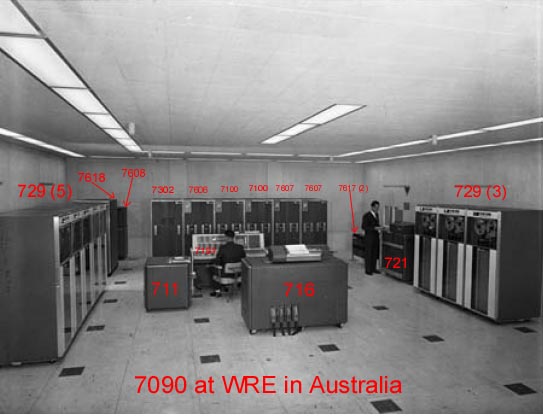
[The computer collection] started with David's purchase of the Weapons Research Establishment (WRE) IBMs at auction, following a suggestion by his cousin (then Purchasing Officer for WRE) that it would be prudent to keep the Defense computer in working order for a while in case a need for it arose. He added that its scrap value was unlikely to be recognised by the scrappies, and additionally it was the first computer on which David worked in the late 50's and early 60's. By the way, the 1401's we used at WRE as front end consoles for the 7094, which is why they were sold in the same lot. To this very large computer (I believe the largest ever in the southern hemisphere) was subsequently added a collection of computers over the years including calculators, manuals and accessories, with a view to one day assembling a computer museum on the property. We are in the process of converting the property to a tourist centre, but lack resources to initiate or manage the museum. So - any ideas? The shed where they are stored is needed for tools and equipment, but I have so far restrained my sons from sending them for scrap, partly on the grounds of their value far exceeding anything the scrap yard will offer.
The computers were initially stored securely in our barn, but the 7094 drum was so heavy it broke the floor boards. So after a few years they were banished to the machinery shed with a concrete floor, high iron roof and walls and iron sliding doors (like an aircraft hangar). They were kept dry, but not covered, so that dust, insects and rodents over the years have deposited on the tops of the cabinets, and infiltrated where doors were not securely shut. In the last 10 years my sons have pushed the cabinets close together and stacked smaller computer equipment on top of the 7094 to make space for a workshop in half the shed, so photos are hard to come by. There is no catalogue of the hardware and software. ... We have a set of manuals for the 7094 equipment, paper tapes and card decks for boot-up, tapes for the tape drives, and I'm not sure what software is included. ... We never planned to [restore the system], as the cost of power and air conditioning would have made it quite impractical. We envisaged a working tape unit, possibly driven by a 1401 or a more modern PC, and perhaps a tape or card reader to demonstrate the older technology.
Regards,
- Robert
more info about the and this 7094?? is at
WRE_IBM7090_1401.pdf
There were many e-mails in February 2011 trying to determine if the above machine was a 7090 or a 7094 -
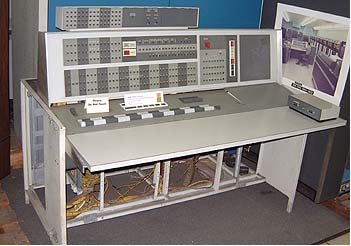
A 7094 has three index registers, displayed by an add-on panel.
There no add-on panel on the Australian machine. Could it have been removed for moving?
A list of differences was formed by some experts including Paul Pierce, Lyle Bickley, John Van Gardner.
The following is a summary:
The display panel (above) and name plate
a 7090 has a 7108 IPU, 7094 a 7110 IPU
A field upgrade 7090 -> 7094 was a major event
disconnection/removal of 7108 IPU cabinet
insertion/connection of 7110 IPU
The 2.18 microsecond 7302 memory was replaced with a 2.0 microsecond memory.
lots of wire wrap work done on the 7606 Multiplexor frame.
wire wrap and card changing work done on the 7109 Arithmetic Sequence Unit
... both 7606 Data Channels.
The plant called it a 76 hour change and they sent two wire wrap men and a trouble shooter.
... The local office supplied 3 7094 trained men.
The Australian machine was judged to be a 7090 -
February 25, 2011, - From Ian
" First of all, thanks for your help. IBM machines are not my strong suit, and your input and advice
has been invaluable.
"I'm sorry to say we did not come to an agreement to purchase the machine. It is clearly a 7090
rather than a 7094, and our goal was to restore a 7094 and then reverse-engineer the RPQs
to enable it to run CTSS. Needless to say, a 7090 is 'a bridge too far.' However, we did choose to make
an offer regardless, which the current owners chose to decline. "
The IBM 7094 and CTSS by Tom Van Vleck
Compatible Time-Sharing System
from Wikipedia
|
This Specimen
Interesting Web Sites
Other Information
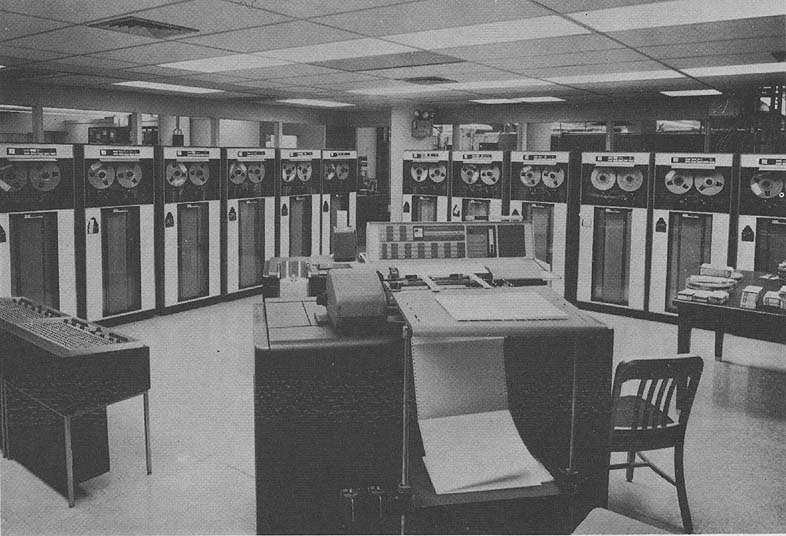
I was curious why BIG IBM systems had so many tape drives
for instance,
http://www.ed-thelen.org/comp-hist/BRL61-0549.jpg
linked from
http://www.ed-thelen.org/comp-hist/BRL61-ibm7070.html#IBM-7090
with 12. - Effective sorting can be done on six or less
| John Van Gardner commented: (July 2008)
The 7090 at Lockheed Georgia had 10 729 tape drives.
Drive 1 contained a tape with the IBSYS Operating System.
Drive 2 was the input tape containing programs and data.
Drive 3 was for the printed output sent to a peripheral print system.
Drive 4 was for punched card output sent to a peripheral punch system.
That left 6 drives for the programs to use as needed for work space and to create tapes to be sent to the tape library.
|
|
There is a 7090 "someplace" which may be going to a museum "someplace".
To aid that planning and possible restoration, John Van Gardner, Feb 8, 2011,
has scanned his copy of
7090 Power Supply Control and Distribution - 223-6904 4 megabytes
John Van Gardner wrote
"I never worked on or saw a 50-Hz 7090 but it raised some questions. The normal 7090 had its own 400 Hz mechanical generator mounted in the 7608 frame. It was driven by a very large 208 volt 3 phase 60 Hz motor. I seem to remember it was about a 50 hp motor. It was directly coupled axially to the generator. The ones I worked on were the brush types that had very large carbon brushes on the slip ring to excite the field winding. We replaced these brushes once a year and pumped grease into a Zerk fitting on each bearing until grease came out a hole at the bottom of the bearing housing. The 7608 frame did a great job of containing the noise of the motor and 400 Hz hum of the generator. You never realized this until you opened one of the covers and the noise hit you. The motor and generator created a lot of heat and there was an exhaust blower to pump it out the rear of the top cover. Some installations had the 7608 outside the computer room. The generator was manufactured by General Electric and any repairs to it had to be done by them. After they decided to get into the computer business they didn't seem to want to help us in a reasonable amount of time. We found out the best thing to do was get a loaner 7608 from IBM while GE fixed the customers generator.
"All the DC power supplies in each frame ran off the 400 Hz but there was a long squirrel cage blower on the bottom of each gate that ran off 60 Hz. These blowers were probably the most troublesome parts in the 7090. There were multiple squirrel cages on the shaft and it was cog belt driven. They were noisy and the belts would strip or break. The bearings would fail. There were air flow sensing cards in the row above the blower to shut the machine down if a blower failed."
|
Some Q&A, Stan Paddock asking,
John Van Gardner responding:
> How did the 7090 boot? Cards, tape, other?
There is a Load Cards and a Load Tape button on the 7151 Console. The Load Tape button causes the necessary boot commands to be sent to tape drive #1 on channel 1.
The Load Cards button causes the commands to be sent to the 711 Card Reader on Channel 1.
> What language was used?
Everything was in machine language which descended from the 704 then 709. There was an assembly program, Fortran which compiled a machine language object program and later on there was Cobol. The instruction set was very extensive and you could make the machine do anything you wanted to. I loved to write programs in machine language. There was a 729 tape drive diagnostic called 9T55 that would print out a graph depicting the performance of the prolay arms.
> Was the 7090 code generated on the 7090 or on another machine like the 1401?
The 7090 came before the 1401. The 7090 was compatible with the 709 and that was one reason IBM won the contract for the BMEWS computers. They were able to debug the programs on a 709 while the 7090 was being developed.
An annotated picture of WRE in Australia
|
More Q&A, same questions from
Stan Paddock, different view point from
Lyle Bickley
> How did the 7090 boot? Cards, tape, other?
It could boot from Cards, Tape and Disk (with a small loader). At Lockheed, Sunnyvale we used almost entirely tape..
> What language was used?
Lockheed used mostly Fortran and Assembly with some COBOL.
> Was the 7090 code generated on the 7090 or on another machine like the 1401?
The 709x card reader was seldom used. We copied cards to tape on a 1401 and then mounted the tape as input on the 709x.
Our "operating system" was "IBSYS" (really a "monitor" program). "Job" and other control cards would be used to create a batch jobstream which could consist of Fortran, Assembly, Loader, Sort, Edits, etc. There were typically many jobs loaded on to a single tape.
Output was seldom to a 709x printer - rather the "printer" output was sent to tape. That tape would then be processed by a 1401 doing a tape->printer job.
So the 1401 did the slow I/O, freeing up the 7090 to concentrate on computation.
IBM also released a multiprocessor 7040/709x combination that was truly incredible. Because 709x channels were so expensive, it was actually cheaper to configure tape drives and disks on a 7040 with a fast processor to processor link between the 7040 and the 709x. In this configuration, the 7090 had no I/O channels attached - only the processor to processor link! This created an amazingly fast and cost effective system. (I developed a Fortran compiler written in Fortran on such a system in the development lab in Poughkeepsie.)
------ following comment by Ed Thelen ------------------
The above combo system was called HASP
Fortunately (for their customers) superceeded in
- some Bouroughs systems,
- and General Electric 6xx systems (using GECOS)
- and Control Data 6xxx systems (using SCOPE with the imbedded peripheral processors (PPs))
by "spooling" where the same processor did the fast processing, outputing
blocks to system disk and -
specialized sub-processes in the same computer read from the system disk
and output to the slow devices such as printers and card punches.
IBM finally was able to do the above in the 360 MVS operating system, I think.
At GE and CDC, we felt really sorry for IBM customers.
|
Lyle Bickley responding:
|
If you have comments or suggestions, Send e-mail
to Ed Thelen
Go to Antique Computer home page
Go to Visual Storage page
Go to top
Updated Feb 8, 2011