Return to "Visible Storage"
*** Please note: This website (comp-hist) was completed before I found out about
Wikipedia in 2002.
Since then I have added material occasionally.
Items are certainly not complete, and may be inaccurate.
Your information, comments, corrections, etc. are eagerly requested.
Send e-mail to Ed Thelen.
Please include the URL under discussion. Thank you ***
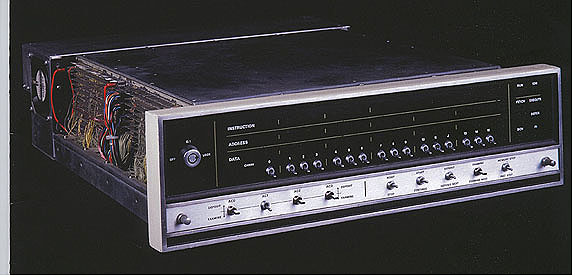
DG-NOVA
| Manufacturer | Data General
|
| Identification,ID | NOVA Serial Number One (1968) X2066.2001
Data General NOVA 1200 (1973), X2067.2001
|
| Date of first manufacture | 1969
|
| Number produced | 700 by 1970; 50,000 (all Novas)
|
| Estimated price or cost | $8,000
|
| location in museum | -
|
| donor | EMC Corporation
|
Contents of this page:
Photo  from Computer Museum History Center "CORE" 2.1
Placard
Architecture
from Computer Museum History Center "CORE" 2.1
Technical specifications
Architecture: Four accumulators (registers); two of which can be assigned
as index registers
|
|
Special features
from Computer Museum History Center "CORE" 2.1
Technology: Medium-scale integration (MSI) TTL
Word Length: 16-bit
Memory: 4,096 16-bit words; 20KB (max) within cabinet; 32K (max), with
external cabinet. Both core and ROM
are available and can be mixed (ROM typically used in industrial control
applications once software has been
developed in core or for userdefined routines)
1/0: Teletype, paper tape reader, paper tape punch, plotter, printer, disk,
general purpose wiring board (for
customerdesigned interfaces); 16-level interrupt scheme, DMA supported
Memory Access Time: 1.6uS (625kHz)
Clock speed: approx. 1.5MHz
Size: Rack-mount: 5 1/4" x 19" x 23" (HWD); Desktop 7" x 23" x 25" (HWD)
Weight: approx. 50 Ibs Package style: Desktop or rack-mount
MTBF: approx. 5,500 hours
Price: $3,950 basic unit (1968); $7,950 w/ 4K core and Teletype interface
Power requirements: 400W
|
From Data General
Price - $8,000
Units Shipped - 700 by 1970; 50,000 (all Novas)
Technologies - Medium-scale integrated circuits, single-board CPU, 16-bit architecture
Inventor - Edson de Castro
Software - DOS, Algol 60 compiler, Fortran IV, Basic
Inventor - Edson de Castro
The Nova was one of the first 16-bit minicomputers and led the way toward word lengths
that were multiples of the 8-bit byte. It was first to employ medium-scale integration
(MSI) circuits from Fairchild Semiconductor, with subsequent models using large-scale
integrated (LSI) circuits. Also notable was that the entire central processor was
contained on one 15-inch printed circuit board.
The Nova was known for its economy and efficiency -- its designers were able to do
without transformers and other costly components in the machine's memory system,
and they used a wireless backplane design that allowed unprecedented flexibility
in configuration.The chassis could accommodate seven printed circuit boards and be
used for either memory or I/O device controllers. And upgrades to the system were
easy because boards could be unplugged and replaced with newer components.
High-schooler Steve Wozniak, Apple's future co-founder, was said to be enchanted
with the Nova's elegantly designed architecture, and had photos of the machine
taped on his bedroom wall. Wozniak wasn't the Nova's only fan -- the machine
sold very quickly and helped cast Data General as a formidable competitor to
Digital in the fast-growing minicomputer and OEM markets.
|
|
Historical Notes
|
Carl R. Friend wrote (November 2006)
|
This evening I took a look at your page devoted to the Data General
NOVA computer and humbly offer the following comments:
Peter Simpson's comments about the NOVA being completely unlike the
DEC pdp-11 are spot on; the two machines bear no architectural
similarity whatsoever. However, the assertion that the NOVA was a
"copy" of the PDP-X is off the mark as well. If I recall my reading
of "Ultimate Entrepreneur" (a biography of sorts of Ken Olson), there
is a subsection in there in which Ed DeCastro mentioned that the PDP-X
was "way to complex for a startup to produce" and that he and his
cohorts spent a few nights "around the kitchen table" coming up with
a produceable machine that became the NOVA.
There are architectural "echoes" of the PDP-8 in the NOVA, but
those are mainly in the I/O subsystem; the rest was new. Only at
a long stretch could one term the NOVA as a "super -8"; the number
of new instructions and the number, and usage, of registers (ACs)
put the kibosh on that notion. So, whilst the NOVA may have been
*influenced* by the -8 (hardly surprising, as DeCastro played a large
role in the development of the -8) it is in no way a "stretched"
PDP-8.
Cheers.
+------------------------------------------------+---------------------+
| Carl Richard Friend (UNIX Sysadmin)            | West Boylston       |
|
Peter Simpson wrote (September 2004)
| Here's a real interesting link -
Details on DeCastro's unchosen design for "PDP-X"
|
As a DG alumni, I'd take issue with the first part of the note.[below] The NOVA was not at
all similar to the PDP-11.
The PDP-11 had many more registers (8, usable as data or index). The NOVA was much
more like an extension of the PDP-8 architecture.
The story *I* heard (I won't vouch for it's accuracy either), was that Ed DeCastro
and his team were in competition with another DEC design team, to develop the follow
on processor to the PDP-8 (which became the PDP-11). DeCastro's team lost the contest,
and at least some of the team decided to leave DEC and start a new company to implement
and market their design.
The similarity of the NOVA architecture to that of the PDP-8 is one reason this story
is plausible, and the other is DeCastro's later preference for multiple engineering
teams to be working on different approaches to the same project (see Soul of a New
Machine, where the "Eagle" team was competing with the "FHP" team to develop a 32 bit
system).
|
Keith wrote (February 2004)
|
Data General Nova: To historical notes, it should be noted the
architecture of the system is very similar in many respects to the PDP-11,
and accusations have flown around about DEC stealing from DG, vice versa,
and the Nova being developed by engineers who were [highly irritated] that DEC
rejected their design. I can't vouch for the accuracy of such commentary.
|
|
This Artifact
Interesting Web Sites
- February 2013, Thomas David Rivers writes
" ..., and.. unfortunately, www.dg.com appears to no-longer be Data General... it now
directs me to "Dollar General".
"It also appears the internet archive at
web.archive.org
never had a reason to archive the site. As far as I can tell,
it is regrettably lost to history."
|
Other information
from Computer Museum History Center "CORE" 2.1
References/for further reading
www.dg.com/about/htmi/data-general-nova.htmi
Fundamentals of Mini-Computer Programming,
1973, Data General # 093-000090-00, Computer History Museum document #102622936
NOVA/SUPERNOVA Brochure, n.d., Data General, Computer History Museum document #102622937
NOVA Price List, Effective: Dec 1, 1968, 1968, Data General, Computer History Museum document
#102622938
NOVA 1220 Computer, Product Data Sheet, Computer History Museum document #102624096
NOVA 800 Computer, Product Data Sheet, Computer History Museum document #102624095
NOVA 1200 Computer, Product Data Sheet, Computer History Museum document #102624093
NOVA 820 Computer, Product Data Sheet, Computer History Museum document #102624094
|
|
If you have comments or suggestions, Send e-mail
to Ed Thelen
Go to Antique Computer home page
Go to Visual Storage page
Go to top
Updated Feb 22, 2013
 from Computer Museum History Center "CORE" 2.1