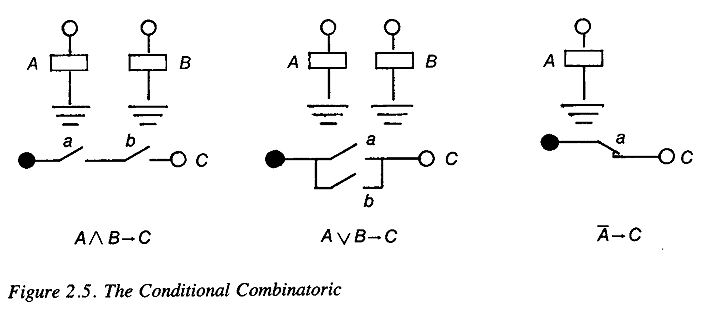
In the Conditional Combinatoric, the expression
(A,B) = > C
would be fulfilled (logically "true," numerically "one") when either A or B
was true. The
expression
[A,B] = > C
would be fulfilled only when both A and B were true. The expression
-A
would have the opposite value of A, whatever that was. The following
expression yields
the algebraic sign of the product of two numbers, assuming that the value
"true" represents
" + " and "false" represents "
[(Lm,Ld), ([Vx,Vy], [-Vx,-Vy])] => Vr
The expression says that the sign (V) of the result (r) is positive for the
operations of multiplication (m) or division (d), when either the signs of x and y are
both positive or both negative. Note that the result of the operation appears at the right,
and is indicated by the arrow formed by typing an equals sign and a greater-than sign. This
convention indicates the dynamic aspect of what actually goes on in a machine, and is
the opposite of the way mathematical functions are ordinarily written (with the function
name at the left and an equals sign joining it to an expression on the right). Zuse's
convention avoids confusing equality and the assignment of a value, a confusion that many
modern programming languages exhibit. (There was an attempt to have a
right-pointing assignment statement in the programming language ALGOL, but it was never adopted. This
question will be discussed again in Chapter 6.)20
The conditional chains intended to form the basis for Zuse's computer were
the three primitive logical operations: conjunction (the square brackets),
disjunction (the parentheses), and negation (the minus sign), corresponding to the logical
"and" statement (true only when both statements are true), logical "or" (true when either
statement is true), and logical "not" (true when the statement is false, and vice versa). He
also combined those primitive statements into a logical equivalence statement, true only when
each elemental part of the statement has the same truth value, both true or both false (as
in the example of the sign in multiplication).
| Reckoners, Germany, page 0024
|
Mathematicians knew further that chains of these primitive logical
statements could express the laws of ordinary arithmetic as well. Since before the turn of
the century there had been an effort to show that all mathematics was reducible to a logical
basis. As with the discovery of binary arithmetic, that too had its roots in the work of
Leibniz. In a remarkable anticipation of the computer age, Leibniz had attempted to
construct a universal language, a Lingua Charactera, in which both logical and
numerical information could be expressed. But like his exposition of binary arithmetic
that idea was all but forgotten by 1935.21
In Germany in the 1930's, Gottingen was the center of efforts to establish
a logical foundation for mathematics. There David Hilbert and W. Ackermann led the
"formalist" school of mathematics with their Foundations of Theoretical Logic,
published in 1928. In the English-speaking world Alfred North Whitehead and Bertrand
Russell, in their Principia Mathematica, stated an even bolder "logicist" case.
But Zuse was unaware of those works, including Hilbert's, even though those
ideas were at the center of a vigorous debate going on concerning the nature of modern
mathematics. When Zuse wrote to his former mathematics teacher, a Professor Naumann, and
told him of his "Conditional Combinatoric," Naumann informed him that he had just
independently rediscovered what Hilbert had already described as the "Propositional
Calculus.22
Naumann further suggested that Zuse study Hilbert and Ackermann's book,
which he promptly did, finding in it what would become the theoretical basis for his
further efforts to construct a working computer.
So with the help of the Propositional Calculus (nee Conditional
Combinatoric), Konrad Zuse could write out the arithmetic and control operations that he wanted
his computer to perform, and manipulate those expressions without worrying about how they
would be implemented. Only at the final step, after the operations were specified
and put into their simplest form, would the "words be made flesh"-put into the form of
mechanical pieces that would actually carry out those functions. The mechanical world that he
would build would be one generated by mathematical statements-that was a reversal of
ordinary applied mathematics, in which the equations described a world already
there. Zuse proposed the name "logistic" (as mathematical logic was known in Germany)
to describe it; it might well have been called "computer science," which is hardly a better
phrase. (In Europe today computer science goes by the name "Informatics.")23
CONSTRUCTION OF THE FIRST COMPUTERS
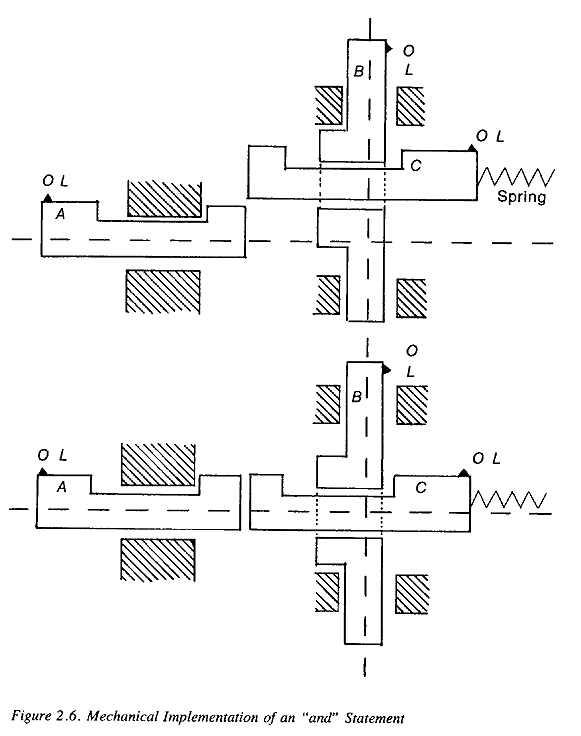
Now to return to the problem of getting metal plates and levers to obey
those logical expressions. With the help of the Propositional Calculus it was possible to
simplify expressions to the point where they could be made up of and, or,
and not
statements. That may not be the shortest or most concise form, but those statements are the
easiest to implement mechanically, by a system of interlocking bars (see Figure 2.6).
| Reckoners, Germany, page 0025
|
But despite the aid of the Propositional Calculus, the job proved to be
difficult. Zuse completed a small mechanical arithmetic and control unit in 1938 and joined
it to the mechanical memory he had constructed the year before. It did not work very
well. But it was a start. (Later on, he called that device his "V 1," for the German
"Experimental Machine One" [Versuchsmodell 1 ]. After the war he called his machines
"Z1," "Z2," etc., to avoid confusion with the V-1 and V-2 rockets that Wernher von
Braun had built.)
| Reckoners, Germany, page 0026
|
The V1 worked just well enough to
convince Zuse that he was on the right track, but it also convinced him
that mechanical computing elements were too difficult to get to work reliably. They were
all right for the memory, but for the other units of the computer he began looking for a
better method.
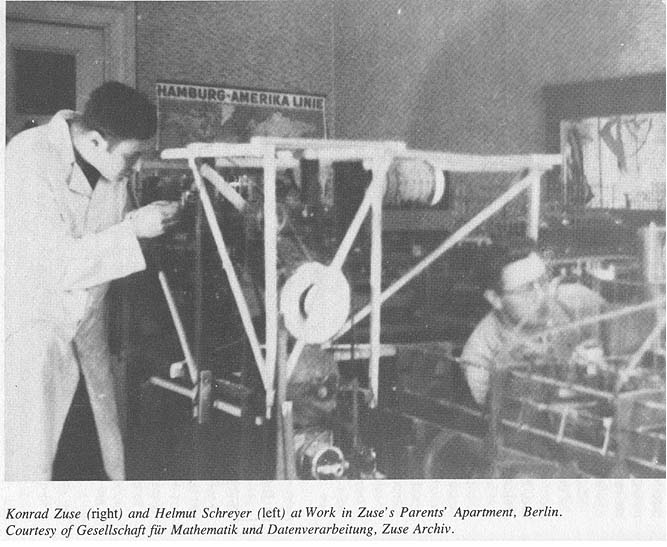
Throughout those early days in Zuse's home workshop, he could always rely
on the help of Helmut Schreyer, a college mate, a student of electrical
engineering, and a handsome amateur actor of considerable charm. Schreyer was one of those who helped
cut out all the metal plates for the Z1. While a student Schreyer had worked as a film
projectionist-he and Zuse were especially fond of the sensational American film King Kong,
then just released in Germany. He remembered that in a movie projector, the film
advances through a gate where each frame is stopped for a moment so that it can be projected
on the screen.
That was precisely the kind of motion the programming unit of Zuse's
computer needed-a quick reading of the calculating plan, one command at a time. From then on
Zuse designed his computers to have their programs supplied by perforated movie film
instead of paper tape. (Discarded 35mm film was cheaper than commercial paper tape
anyway.)24
From Schreyer's training as an electrical engineer came a conviction that
electrical computing elements could be made to work much better than Zuse's mechanical
elements. Schreyer had a confidence and familiarity with telephone relays that Zuse
did not have. Telephone relays were not that expensive-a few dollars each-but remember,
thousands would be required. Nevertheless he convinced Zuse to adopt them. They
managed to find very cheap second-hand telephone relays and they rebuilt them to work in a
computer.
Zuse had already been using the relay notation as a design aid, so the
transition was not hard to make. In 1938 and 1939 Zuse pressed on with that approach: a
mechanical memory, an arithmetic and control unit made of relays, and program control
by perforated 35mm movie film.
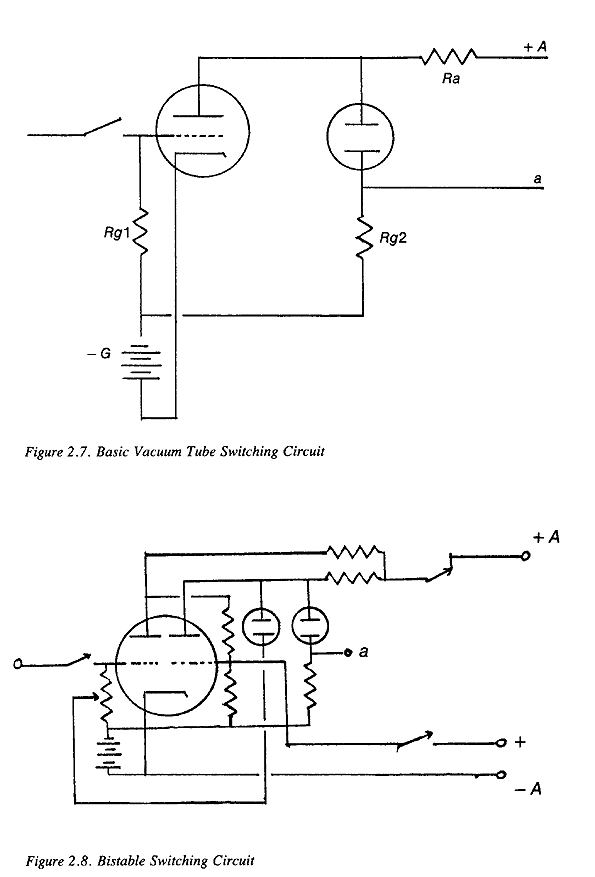
Schreyer went one step further. Why not build the binary functions out of
vacuum tube circuits? Up until that time tubes were used to amplify continuous signals,
but he knew he could build a tube circuit that would have the same on-or-off properties
that relays and mechanical linkages have. Such a "tube relay," as he called it, would
switch by moving streams of electrons and would be many times faster than any
electromechanical relay.
By that time Zuse was convinced that his chances of success with telephone
relays were too good to pass up. There was a lot of developmental work needed to
perfect the "tube relay" circuit, which he was not willing to undertake. Schreyer in
turn suggested to Professor Stablein at the Berlin Technical College that an investigation of
the electronic switching circuit be the subject of his doctoral thesis. Stdblein agreed,
and in 1941 Schreyer was awarded a doctoral degree for his thesis, "The Tube Relay and the
Techniques of its Switching." Figures 2.7 and 2.8 show two of the circuits that Schreyer
built.25
| Reckoners, Germany, page 0027
|
| Reckoners, Germany, page 0028
|
The key to their operation was the use of a gas-filled lamp which conducted
only after a certain threshold of voltage was passed; but once conducting, it would
continue to conduct with a lower "holding" voltage flowing through it. (The
familiar fluorescent light is such a lamp; it requires a "starter" to turn it on.)
This threshold effect gives the circuit two well-defined states, analogous to the open and closed
positions of a relay and quite unlike the continuous output of an ordinary vacuum-tube
circuit.
While Konrad Zuse was going ahead with a calculating unit that used
telephone relays, Schreyer proposed to build one out of vacuum tubes, using, of course,
Zuse's overall design and the binary scale. He managed to obtain special tubes well suited
for his circuits from the Telefunken Company. But when he submitted his proposal for a
full-scale computer to the German Army Command (OKH) in 1942, he was turned down. At
that time, the German authorities thought the war would be over within the two
or three years Schreyer knew it would take to complete the machine. And they did not want
to fund anything that would not directly benefit the waging of the war. The
proposed machine was to have about 1,500 tubes, and as many glow-lamps.26
The story of Schreyer's attempt to build an electronic computer in Germany
during the war is one of the more interesting "what-ifs" of that entire period. By
1942 he was working independently of Zuse, and had his proposal been accepted, Germany
might have had a working electronic computer before either the Americans or the
British. It was true that his circuits were not as fast, nor was his proposed machine as large
as the American ENIAC, but with his use of Zuse's elegant overall design, and especially
with his use of the binary system, he might have come up with a very powerful computer.
So for a moment, then, Schreyer cracked open the door to an awesome and
strange new world, but that door slammed shut before he could pass through. Only after
the war did a now-divided Germany enter the electronic computer age, but as a follower,
not a leader.
All that Schreyer built was a test model containing about 150 tubes that
converted three-digit decimal numbers to and from binary. (It was financed not by the army
but by the Aerodynamics Research Institute.) It was damaged in a bombing attack on
Berlin in late 1943, and with Schreyer's evacuation from Berlin in 1945, Germany's first
steps toward electronic computing came to an end. After the war Schreyer left Germany
and abandoned work on computers. (Konrad Zuse was not a member of the Nazi Party, but
Helmut Schreyer was: he had joined in 1933. After the war he emigrated to Rio de
Janeiro, where he worked for Brazil's telecommunications network, and where he still
lives.)27
| Reckoners, Germany, page 0029
|
Schreyer has since reflected on what might have been. The American ENIAC
project was given a go-ahead in the middle of the war, and its builders were given
all the manpower and money they needed to see it through (not without some difficulty, as we
shall see). They did not complete their machine until after the war was over either.
But by that time no one really cared that it was late--there were other jobs it could do.
Getting a machine running in time to help the war effort would have been an issue for the
Germans, who were losing badly after 1943. Schreyer was never able to assemble a team of
qualified helpers, and
this, coupled with the lack of money, killed the chances for success. In
this regard Zuse made the right choice to stay with second-hand telephone relays, since he
could get by with more modest resources. Zuse had already faced the same problems
convincing the German authorities of the importance of his work; in the fall of 1939 he
was drafted into the infantry and sent to the front, but was soon recalled to work as an
aircraft engineer.
Schreyer wrote a letter to the German authorities to help get Zuse back to
Berlin. The letter describes the potential benefits of Zuse's computer work, and,
incidentally, is one of the earliest known documents describing the operation and
programming of an automatic computer.28
Zuse built a small binary arithmetic unit out of second-hand telephone
relays, joining it to the mechanical memory of his "VI." The results were encouraging enough
to convince him that a full-scale computer could be built along those lines and would
work well. He approached the Aerodynamics Research Institute (DVL) for help. They were not
interested in a general-purpose computer, but they did have a computational
problem which, as they said, "was burning their fingertips," it was so urgent. That
was the wing-flutter problem, one which Zuse had already encountered while at the
Henschel plant. At certain high speeds the wings of a plane would resonate-flutter like a flag
in the wind. To prevent their failure one had to design the wings so that their resonant
frequency was higher than the speeds the plane would ever encounter in flight. Airplane
wings are not "static" structures, but the analysis of their resonance can be done by
treating the wing like a static indeterminate structure such as a bridge or a roof. In both cases
the analysis requires the solution of large systems of linear equations. For an airplane
wing the coefficients are complex numbers, taking into account the phase of the
pressure waves of air across it.29
Zuse invited Alfred Teichmann of the DVL to his parents' apartment to have
a look at his machine (now called the "V2"). It ran well enough to impress Teichmann
(Zuse claims it never worked again!), and so the DVL agreed to help finance a completely
new machine. Before building it Zuse decided to build one more "provisonal" test
machine-this one using telephone relays for both memory and for arithmetic-one which would
incorporate all the features of his original design for a general-purpose programmable
computer. He still relied mostly on his own funds and still worked in his home workshop, but with the
encouragement of the DVL, he proceeded at once to build a relay computer that functioned
reliably in every respect. It was completed by December, 1941, and was the
first fully operational program-controlled computing machine in the world. It is now
known as the Z3 computer.30
| Reckoners, Germany, page 0030
|
DESCRIPTION OF THE Z3
Like Schreyer's electronic circuits, the Z3 did not survive the war. It was
destroyed in a bombing raid on Zuse's workshop in 1945. What little we can find out about
that historic machine must be gleaned from the patent applications he
filed for it, and from personal recollections from those who saw it in use.
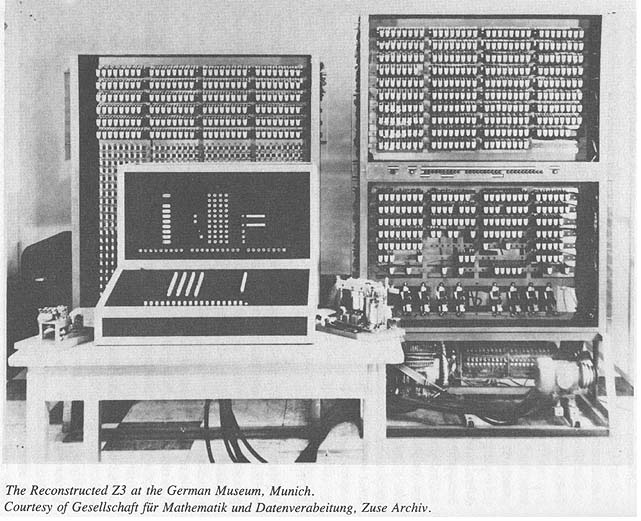
In 1961 a replica of the Z3 was reconstructed for the German Museum of Technology, in Munich,
and although it is not an exact copy, it does give a good idea of what the
original Z3 must have looked like.31
The reconstructed Z3 reveals three large units: two relay cabinets, and a
keyboard/display panel. Just to the right of the keyboard is the device
that read in programs from perforated movie film. The original had two racks of relays
for the storage of sixty-four numbers, not just one rack, as the replica has. Each memory
cabinet was six feet high and three feet wide. On the whole the Z3 was a modest machine,
nothing like some of the "giant brains" that later would be built in America.
The size of the cabinets that held the Z3's memory reveals why Zuse was
reluctant to abandon a mechanical approach. He knew that a full-scale computer having
sufficient power to do useful work would need far more than sixty-four memory cells-a
thousand was a more realistic requirement. But to store 1,024 numbers (as he planned
for his next machine) using relays would have required thirty-two cabinets like the one
used for the Z3's memory. That would have taken up a lot of room and needed a lot of power.
Zuse returned to a mechanical store for his Z4, which eventually stored 512 numbers in a
very compact and reliable unit. He never seriously considered building a computer on the
huge scale of the ENIAC or the Harvard Mark I.
All computing and storage in the Z3 was done with ordinary telephone
relays, although their contacts were carefully adjusted so that their opening and closing
times were all within a specific range. This was necessary to synchronize the running of
the whole system.
These telephone relays are two-position switches, open or closed. Telephone
networks also use other relays, which have more than two positions. (In all but the
newest telephone networks, rotary-dial phones make a connection by activating such
multi-position relay switches.) The Z3 also used eight of these "uniselectors," as the
telephone company called them; they were mounted in the enclosed area at the bottom of the
right-hand relay cabinet. These switches controlled some of the detailed sub-operations of
multiplication, division, and taking the square root; addition and subtraction were handled
entirely by binary relays.
The Z3 had a total of about 2,600 relays: 1,800 for the memory, 600 for the
arithmetic, and 200 for the film reader, keyboard, and display. Assuming that the
relays cost about two dollars apiece, then Zuse must have spent about fifty-two hundred
dollars for relays alone. Other materials costs may have added another thousand dollars. There
were also labor costs, although Zuse and his friends donated hours and hours of their
time. Considering the materials alone the Z3 probably cost between six and seven
thousand dollars, a figure that agrees with estimates Zuse gave to the DVL. (He said
that he had spent around twenty-five thousand Reich Marks for the
machine.)32 That is a lot less than the cost of any other comparable device built in those
years.
| Reckoners, Germany, page 0031
|
The relays were purchased second-hand, cleaned, and synchronized with one
another. They required 60 volts DC, supplied synchronously to all parts of
the computer by a rotating drum mounted below the arithmetic cabinet. Each
rotation of the drum directed one full operation of the computer, such as the
storage of a number into a memory cell.
The drum could be spun at varying speeds, up to a limit of five cycles per
second (300 RPM). It could be slowed down to a single step at a time,
useful if someone wanted to trace a computation step by step.33
The drum controlling the flow of current through the machine was set up so
that current was sent to the relays only after they had switched. This
so-called current-free (stromlos) method of switching prevented arcing at the relay
contacts, and so made the machine more reliable. (When any large currents are
switched, arcing can occur at the moment of switching, when the connection
is only partially made. By having all current switched at the rotating drum,
any contact wear is now shifted to the carbon brushes on the drum, and these are
inexpensive and easy to replace.)
That principle made the Zuse computers extraordinarily reliable-they could
run for months without needing repairs. Telephone relays are simple devices
not prone to failure, but to use them in a computer requires more reliability
than a telephone system needs. Unlike in a telephone system, the relays in a
computer must work every time; furthermore those relays go through more cycles in
just one hour of computing than they might in a week of telephone use.34
A DETAILED LOOK AT THE Z3
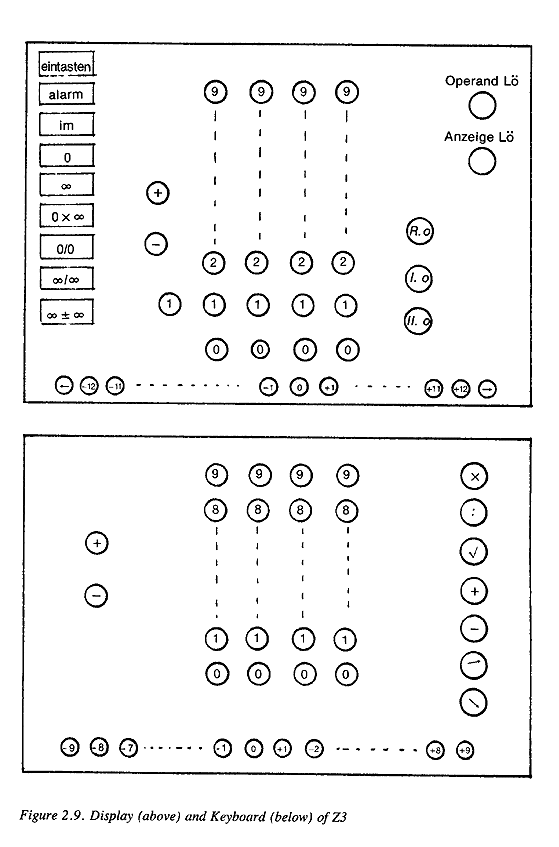
Figure 2.9 shows the calculator-style keyboard and display panel of the Z3
replica. Numbers were keyed in by pressing the appropriate buttons on the
lower panel; results were read from the upper panel, which contained small
incandescent light bulbs for each decimal digit. In both input and output the
numbers were represented in their floating-point, decimal form, with the decimal point
assumed to be after the first digit in the first column, and the power of ten
indicated by a row of buttons or lamps along the bottom of each panel. The Z3 had a decimal
accuracy of four decimal places, with a range of 10±9 (answers could range
farther, to 10±12).
The keyboard also had buttons for the four ordinary operations of
arithmetic, plus square root, divide or multiply by ten, divide or multiply by two, and
multiply by -1. (Some of these functions were not built into the replica.)
When a number was keyed into the machine, it was converted into its
floating-point, binary form before being stored or used for a calculation. On the
replica this binary number was indicated by a set of twenty-two lights on the
arithmetic relay rack.
| Reckoners, Germany, page 0032
|
| Reckoners, Germany, page 0033
|
| Reckoners, Germany, page 0034
|
Additional lights on the display panel were for special results. Lights at
either end of the exponent field indicated when the results overflowed or
underflowed the machine's capacity. If the machine was told to take the square root of a
negative number, the display "im" for "imaginary" would light up. (The Z3
did not automatically handle complex numbers, although of course one could write a
program to do that. Since the analysis of the flutter problem involves matrices that
have one or more complex elements, it was likely that Zuse eventually wanted his computers
to handle those numbers).
There was also a special light for true zero, since in floating-point
arithmetic, true zero cannot otherwise be represented (0.000 x 10° may mean a number as large as
0.0005).
If division by zero occurred during a computation, a special display for
"infinity" would light up. Similar displays indicated indeterminate results such
as "infinity" x
0, 0 / 0, or "infinity" / "infinity". In certain cases these quantities would factor
out of a computation, so their
presence would not necessarily mean a wrong answer. This feature has been implemented in
several modern computers, including the CDC 6600, but it has not become universally
adopted.35
Programs were read into the Z3 by a simple device that sensed the presence
of holes in a strip of film. A hole stood for the binary value "1" or "+"; no hole for
"0" or "-." The film was prepared by a simple manual punch having eight buttons, one for each
channel of the filmstrip. The holes were staggered slightly to prevent tearing. For
example, the number LOOLLLLO would be punched into the film as follows:
L O O L
L L L O
The film sensing device was built in Darmstadt with the help of Alwin
Walther and W. de Beauclair, two of continental Europe's other computer pioneers.
Table 2.1 summarizes the specifications of the Z3.
Table 2.1. THE Z3
Technology: electromagnetic relays: 2600 binary: memory 1400
arithmetic 600
misc. 600
20 step switches
Number System: floating-point binary
word length: 22 binary digits: sign 1 bit
exponent 7 bits
mantissa 14 bits
Memory Capacity: 64 numbers
random access
Input/Output: push-button keyboard, display by incandescent bulbs,
one for each decimal digit
Programming: eight-channel perforated filmstrip, basic commands of + , - ,
x , - , square root, shift binary or decimal point
"zero-addressing" (see text)
| Reckoners, Germany, page 0035 |
Dates: completed 1941, destroyed 1945;
replica built after original plans, 1963,
now in German Museum, Munich
Place: Berlin, Methfesselstrasse 7 (near Tempelhof Airport)
Cost: 25,000 RM, or about $6,500
Speed: 3-5 seconds/multiplication
clock frequency: 4-5 cycles/second
A person keyed floating-point decimal numbers into the Z3. It converted
them into floating-point binary. The twenty-two relays that held a number were
divided as follows:
the first seven relays held the power of two,
the next relay the algebraic sign of the number,
and the remaining fourteen relays the mantissa of the number.
In floating-point binary the first digit of the mantissa is always "1" (just as in
floating-point decimal the first digit is never zero), so that "1" was not stored.
The decimal number 398, for example, would be stored as:
398 = 110,001,110 in binary
= 1.1000111 x 101000 in floating-point binary
or, using Zuse's notation:
000L000 L L000LLL0000000
------- ^ -----------------
exponent | mantissa (with leading L dropped)
sign digit (+ )
Representing numbers by floating-point binary in the Z3 was its most
interesting feature; it was something no other functional computer would have for
years. As an engineer, Konrad Zuse recognized from the start that such a representation
was better suited to the kinds of problems he faced, but to get a machine to handle
numbers that way was not a simple task. Floating-point arithmetic has an additional effect
of making the operation of addition slower (since the exponent has to be adjusted before
the mantissae can be added to each other), while it makes multiplication a little faster
(since one obtains the exponent of a product simply by adding the exponents of the two
operands). In engineering calculations, multiplication occurs more frequently than it
does in business or accounting work, so on the whole the Z3 was a more balanced machine given
the kind of work it was designed to do.
Zuse called his representation "semi-logarithmic form," since the exponent
may be thought of as the characteristic of the logarithm of the number.
PROGRAMMING THE Z3
Programming the Z3 is best illustrated by looking at the problems it was
designed to solve, namely the evaluation of the determinant of a matrix. For the matrix
| Reckoners, Germany, page 0036
|
| a b c |
| d e f |
| g h i |
the determinant is given by the following formula:
Det = (aei + bfg + cdh) - (ceg + bdi + afh)
To evaluate that expression using only pencil, paper, and slide rule, a
person would perform the multiplications, additions, and subtractions as they appear in
the formula above, writing down intermediate results along the way. (It is also
possible to rearrange the expression slightly to minimize the number of intermediate results that has
to be recorded.)
Programming the Z3 to compute the determinant was similar. A film strip
having the same sequence of operations coded into it would be fed into the machine.
The initial values would be placed manually into memory cells, and other memory cells would be
used to store intermediate results for later use. The program would connect the
calculating unit of the machine to the correct memory cells for each step of the problem.
The calculating unit did all the arithmetic; the memory unit only stored
numbers. If the result of one calculation was needed for the very next calculation, there
was no need to store it in the memory only to retrieve it immediately. In that case the
number remained in the register of the calculating unit where it was needed anyway. Only
numbers needed more than once or needed at some later step had to be stored in memory.
For an operation like multiplying two numbers together, the program would
recall both numbers from memory and place them into registers in the calculating unit
before it gave the command to multiply. Today this is known as "postfix" notation, in
contrast to the more familiar "infix" notation of placing the operation between the two
operands. Postfix notation is also found today in some pocket calculators, where it goes by
the name of "reverse Polish" notation (after a Polish logician named Jan Lukasiewiecz,
who first proposed it for writing logical expressions in the 1920's). Zuse's machine
was probably the first to employ postfix notation-his Z3 not only specified operations after
the operands, it also contained circuits in its calculating unit that ensured that the
operands were in the proper order for division and subtraction.36
The D3's arithmetic instruction set assumed
that the operands were already in place in the calculating unit. In modern
terms the Z3 had a "zero-address" coding scheme, since no memory address needed to be
specified for an operation. (A sample Z3 program-and the same program for a modern
calculator that uses postfix notation-is found in the Appendix, in section 1.)
| Reckoners, Germany, page 0037
|
It was not difficult to produce a coded filmstrip for a problem once the
mathematical expression was given. So while only Zuse himself could service
the machine, he hired others to program it. Because of the manpower shortages during the
war, he wrote to an institute for the blind in Marburg and requested a list of blind
people who were gifted in mathematics. From this list he hired August Fast to produce
programs. Fast learned the job easily and so became one of Europe's first computer
programmers.37
The Z3 was designed to test the feasibility of a machine that would solve
the flutter problem for the Henschel Company. It passed that test. But it was also a
general-purpose machine that could be programmed to solve other problems just as well,
since the solution of the flutter problem was similar to the solutions of many other similar
ones.
In Germany during the 1930's, H. G. Kussner had worked out a mathematical
analysis of the wing-flutter problem by developing an iterative procedure whereby
the determinant of a matrix (whose elements were complex numbers) was computed for
successive values of approximate forces on a wing. When the determinant becomes zero, Kussner
showed that the elements of the matrix equalled the actual forces on the wing.
This method computed those forces without having to build a wing and test it in a
wind-tunnel, which was the only other way to get that information.38
So the method required computing determinants, each time with slightly
different matrix elements. In a 1941 report, Alfred Teichmann (who had seen Zuse's V2),
compared the numerical method with the wind-tunnel method, saying, "A disadvantage of
carrying out the flutter calculations is the huge expenditure of effort which it
requires: 100-400 man-hours to calculate a simplified system."39
Teichmann did not mention computers in that
report, but he obviously saw the advantages of having a machine take over the job.
The Z3 was never put into routine use for that or any other problem. But it
did run a number of test programs and did so reliably and without error. Several
people visited Zuse in his home workshop and observed it in operation. Dr. Alwin Walther, H. J.
Dreyer, and W. de Beauclair of the Institute for Applied Mathematics in Darmstadt saw
it during a visit to Berlin, and of that visit de Beauclair has said: "On the ground
floor of the house we saw it. It demonstrated for us the solution of a determinant. We were very
much impressed; we probably never had even thought of this approach-binary,
relays, punched tape control."40 Dreyer remembers the machine as a series of racks on
which the relays were mounted, there being a clear separation of units for memory,
arithmetic, control, input, and output. He says further:
The Z3 was fully functional. For a series of different calculations there
were program tapes available, for example for systems of linear equations. One could key
in the coefficients, and the results were displayed. From my recollection it ran
without error.41
| Reckoners, Germany, page 0038
|
That it was never put into routine use was due to its limited memory, which
meant that it could not compute the determinant of large matrices where manual methods
were impractical.
Such is the story of the Z3. It lived for about four years and never
performed routine useful work, but it stood at the gateway to the computer age nonetheless.
How significant was it? The modern computer owes far more to the American and British
wartime machines than it does to the Z3. Indeed, its very existence was hardly
known to historians or computer scientists until the 1960's.
None of that detracts from what the Z3 was: possibly the first machine to be
programmable in a general way, to use the binary system, to use floating-point arithmetic,
and to have an elegant logical design.
Actually the Z3 was only one part of the German contribution to computing;
besides the prototype electronic circuits that Helmut Schreyer built during the
war, there were several other relay machines that Zuse constructed which are also part of
the story.
The Z3 was only a test machine, but Konrad Zuse also built a relay device
that was put to practical use by the Henschel Company during the war. That was the
so-called Sl; a machine that carried out a fixed sequence of operations that Zuse
permanently wired into its circuits.
The S1 was smaller than the Z3, using about 800 binary and 30
multi-position relays. It too worked in the binary system (fixed point), and had a memory of six
cells. The fixed program it carried out was a sequence of sums of products. The computation
aided the production of the Henschel HS-293, an unmanned flying bomb that was carried
aloft by a bomber and then released and guided remotely to its target. 42
In normal aircraft production, the wing and rudder surfaces must be machined
accurately. But for an unmanned flying bomb that would have been too expensive. Instead,
the wings were fabricated cheaply, with the understanding that there would
be inaccuracies.
These inaccuracies would be measured, and then the S 1 would calculate how
far the bomb would deviate from a straight path because of them. The wings and rudder
could then be adjusted along a movable axis to compensate for the error, but no expensive
refabrication would be necessary. The S1 took a set of about 100 measurements of the
wing and calculated the resulting aerodynamic performance. When it was put into
service at Henschel, it replaced a team of thirty to thirty-five women who worked with
desk calculators. Human "computers" were a dying breed.
The flying bomb was successfully produced and deployed in large numbers
toward the end of the war, especially against Allied shipping in the Mediterranean
after August, 1943. It was also used in the German retreat from Poland in 1945. It made a
modest contribution to the German war effort.43
Zuse built one other computing machine during the war that ranks with the
Z3 as a pioneering computing device. That was the Z4, a full-scale relay machine
that he started to build as soon as the Z3 demonstrated the feasibility of the overall design.
| Reckoners, Germany, page 0039
|
The Z4 (or V4, as it was known then) was to have been the full-scale
general purpose computer the DVL wanted for aircraft design. Its construction was begun in
1942, and it used the same design as the Z3, with a few differences.
One difference was that it was to have a longer word length-thirty-two
binary digits instead of the Z3's twenty-two. This gave it an equivalent of seven decimal
places, with a range of 1020 for both input and output.
But the main difference was its much larger memory: Zuse planned a capacity
of up to 1,024 numbers, although that was not achieved. For that memory Zuse
returned to a mechanical memory device, like the one he first built for his "V1" four
years before. So the Z4 would have a memory unit that was about a third the size of one of
the Z3's relay memory racks, yet it would have many times the memory. (Eventually a
512-cell store was built, having eight times the capacity of the Z3.) That capacity was
far greater than anything being designed in America or England at the time.
Designing the Z4 was straightforward, but its construction was severely
hampered by Allied bombing raids on Berlin after 1944. Zuse had to move it three times
to different parts of Berlin; at least once he was moving it even as the building was
being hit. (In one of those raids, on April 6, 1945, the Z3 was completely
destroyed.)44
The Z4 was finally moved out of Berlin in early 1945, first to Gottingen
(where it performed test computations), then to an underground fortification in the
Harz Mountains, then to a village in the Bavarian Alps. There it stayed during
the chaotic postwar years, until it was finally refurbished and put to work at the
Federal Technical Institute in Zurich in 1950.45 For a few years it was the
only functional
computer, electromechanical or otherwise, in continental Europe, and it initiated
much of Europe's postwar activity in computing thereafter.
So despite incredible hardships and hard luck, the work of Konrad Zuse,
Helmut Schreyer, and their co-workers was not totally lost. The Z4's influence was
modest, but the machine worked well and was heavily used at Zurich, even after the
computing world had turned from relay machines to the faster electronic technology. During
his stay in Hinterstein, the Alpine village where the Z4 rested from 1945 to 1949,
Konrad Zuse did not abandon work on computing. Work on the Z4 itself was impossible: even
getting enough to eat was difficult in those years, and Zuse lacked the tools and
manpower to do much more than just try and save what he had. He turned his attention to
the problem of programming computers-pencil-and-paper work that few at the time thought
was crucial to making use of a computer's power. Today the cost of writing programs for
computers far exceeds the cost of the machinery itself. Now that the computing world
faces this "software crisis," it should be remembered that here, too, Konrad Zuse made
original contributions. His work on a "Plan calculus," begun in 1945, was one of the
first attempts to design a programming language for a computer.46
| Reckoners, Germany, page 0040
|
After the Z4 was installed in Zurich in 1950, Zuse founded a private firm
that made and sold relay machines to industrial and educational customers. For the Leitz
Optical works he built a relay machine that he called the Z5, and after that he built a
series of other relay computers, the last being the Z11, built in the mid-1950's. His company
also built electronic computers, and for a while it
prospered. In the 1960's it had trouble raising capital and was absorbed
into the Siemens company. That left Konrad Zuse free once again to pursue the theoretical
side of computing. He is still active, a remarkable feat in a field that is so
volatile and fast-developing.47
So what do we have in the story of the first computers in Germany? They are
not the ancestors of the modern computer; that honor goes elsewhere. But their
overall design and their use of binary numbers and floating-point arithmetic make them
resemble the modern computer far more than an ancestor like the ENIAC does. The German story is
a fascinating one, and it has a lesson for us as well. The key concepts of
computing were discovered independently in different places by different persons. That the
present computer world bears the imprint of the American projects was not
inevitable; things could have turned out very differently.
NOTES
- Konrad Zuse, Der Computer, Mein Lebenswerk (Munich: Verlag Moderne
Industrie, 1970) p. 68.
- Zuse, Der Computer, pp. 15-16; C. Evans, interview with Zuse, "Pioneers
of Computing Series" (London: Science Museum, 1976).
- Notebook 17, Zuse Archives, Gesellschaft fur Mathematik and Datenverarbeitung,
Bonn.
- Konrad Zuse, interview with the author, April, 1978.
- Wilfred de Beauclair, Rechnen mit Maschinen (Braunschweig: Vieweg,
1968), p. 2.
- For a discussion of the symbolic analysis of Zuse's graphical scheme,
see F. L. Bauer, Between Zuse and Rutishauser-the Early Development of Digital
Computing in Central Europe, Technical University, Munich, Department of Informatics,
Report 7629 (Munich, 1976).
- Zuse, Der Computer, pp. 36-39.
- Charles Babbage, "Passages from the Life of a Philosopher," in Charles
Babbage and His Calculating Machines, ed. Philip and Emily Morrison (New York:
Dover, 1961), p. 55.
- N. Metropolis and J. Worlton, "A Trilogy on Errors in the History of Computing,"
Annals of the History of Computing, 2 (1980): 49-59.
- De Beauclair, Rechnen mit Maschinen, pp. 11-15; W. Meyer zur Capellan,
Mathematische Instrumente, 2nd ed. (Leipzig, 1949), pp. 53-55; Friedrich A.
Willars, Mathematische Instrumente (Berlin, 1926), pp. 28, 48-51.
- Anton Glaser, History of Binary and Other Nondecimal Numeration
(Southhampton, Pa., 1971); Hans J. Zacher, Die Hauptschriften der Dyadik
von G. W. Leibniz, ein Beitrag zur Geschichte des Binaeren Zahlensystems (Frankfurt
am Main, 1973), pp. 18-34; "Hewn von Leibniz' Rechnung mit Null and Eins,"
transcription of MS, 1679 (Munich: Siemens A. G., 1966).
- Quoted in Karl-Heinz Czauderna, "Konrad Zuse-der Weg zu seinem Computer Z3
and dessen Verwircklichung," Report 120, Gesellschaft fur Mathematik and
Datenverarbeitung (Bonn, 1979), pp. 88-89.
| Reckoners, Germany, page 0041
|
- Konrad Zuse, "Method for Automatic Execution of Calculations with the Aid of
Computers," German Patent Application Z 23 139 IX/42m, April 11, 1936,
reprinted in Brian Randell, ed., The Origins of Digital Computers: Selected Papers,
2nd ed. (New York: Springer Verlag, 1973), pp. 159-166.
- Czaudema, "Konrad Zuse," pp. 85-89.
- Ibid., pp. 31-40.
- Ibid., p. 89.
- E. Jessen, "Konrad Zuse-Konstructeur der ersten programmgesteuerten Rechenanlage,"
paper presented at the Advanced Course on General Net Theory of Processes
and Systems, Hamburg, Oct. 10, 1979.
- Zuse, Der Computer, pp. 75-76; also Zuse Archiv, Bonn, # 009/002.
- Zuse, Der Computer, pp. 53, 64.
- F. L. Bauer, Between Zuse and Rutishauser, p. 36; see also the discussion by Bauer on
the history of ALGOL, Association for Computing Machinery (ACM) SIGPLAN
Notices 13, no. 8 (August, 1978), p. 40.
- Morris Kline, Mathematical Thought from Ancient to Modern Times (New York:
Oxford, 1972), chapter 51; Jean van Heijenoort, From Frege to Godel: A
Source Book in Mathematical Logic (Cambridge, Mass.: Harvard, 1967), introduction.
- Zuse, interview with the author, April, 1978.
- Konrad Zuse, "Ober Programmgesteuerte Rechenanlage fur industrielle Verwendung,"
Probleme der Entwicklung programmgesteuerte Rechengerdte and Integrieranlage, ed. H.
Cremer (Aachen, 1953), p. 74; Konrad Zuse, "Die ersten programmgesteuerten
Relaisrechenmaschine," 350 Jahre Rechenmaschine, ed. M. Graef (Munich, 1973), p. 55.
- Helmut Schreyer, "Die Entwicklung des Versuchsmodells einer elektronischen
Rechenmaschine," unpublished, Mosbach/Baden, Aug. 1, 1977.
- Helmut Schreyer, "Das Rohrenrelais and seine Schaltungstechnik," dissertation,
Technische Hochschule, Berlin, August, 1941.
- Ibid., p. 77.
- Records of party membership were obtained through the Berlin Document Center,
Mission of the United States.
- Schreyer's letter has been translated and published in Brian Randell,
Origins, pp. 167-169.
- Alfred Teichmann, "Das Flattern von Trag- and Leitwerken," Deutsche Akademie der
Luftfahrtforschung, Schriften 49 (1941); Zuse, interview with the author,
April, 1978.
- A letter from the DVL to Zuse, April 22, 1942, Zuse Archiv No. 014/008, states that
the "provisory" machine (that is, the Z3) was completed by December 5, 1941.
- German Patent Application Z-391, applied for in 1941, rejected May 7, 1956; letter
from de Beauclair to Czauderna, in Czaudema, "Konrad Zuse," p. 98; letter
from Dreyer to the author, July 23, 1978; letter from Zuse, Zuse Archiv, No. 014/001.
- Zuse, Der Computer, p. 82; correspondence between Zuse and DVL, Zuse
Archiv, No. 014/008; interview with Zuse by Uta Merzbach, Zuse Archiv, No. 030/002.
- Czaudema, "Konrad Zuse," pp. 70-73; Wend Goldbach and Rolf Schneider,
"Beschreibung der Rechenanlage Z3," Zuse Forum, 2 (September, 1963), 19-31.
- H. Flessner, private communication, October 10, 1979.
- See, for example, John Ball, Algorithms for RPN Calculators (New York: Wiley,
1978), p. 163; Donald E. Knuth, Seminumerical Algorithms (Reading, Mass.:
Addison Wesley, 1969), pp. 192-193, 205.
| Reckoners, Germany, page 0042
|
- Ball, Algorithms, chapter 1; John Kennedy, "RPN History," paper
presented at the Western Calculator Conference, Anaheim, Calif., Sept. 22, 1979.
- Zuse, Der Computer, pp. 83-84, 93-94; Zuse Archiv, No. 017/013.
- H. G. Kussner, "Flugelschwingungen an Flugzeugen," Zeitschrift fur Angewandte
Mathematik and Mechanik, 9 (1929), 492-493; H. G. Kussner, "Zusammenfassender Bericht
uber den instationaren Auftrieb," Luftfahrtforschung, 13 (1936), 410-429.
- Alfred Teichmann, "Das Flattern"; letter from DVL to Zuse, May 6, 1943, Zuse
Archiv, No. 028/008; Konrad Zuse, "Some Remarks on the History of Computing in
Germany," paper presented at the Conference on the History of Computing, Los Alamos,
New Mexico, 1976; C. Evans, interview with Zuse, "Pioneers of Computing" series.
- Letter from de Beauclair to Czaudema, in Czauderna, "Konrad Zuse," p. 98.
- Letter from Dreyer to the author, July 23, 1978.
- Interrogation summary of Gerhard Overhoff by U.S. Forces in Austria, Air
Interrogation Unit, 8 Nov., 1946, p. 1; correspondence in Zuse Archiv, Nos. 028/009 and
036/012.
- Rowland F. Pocock, German Guided Missiles of the Second World War (New York:
Arco, 1967), pp. 33, 44-45.
- Zuse, Der Computer, pp. 87-90, 97, 106; correspondence in the Zuse Archiv, Nos.
002/004, 014/001, 017/009.
- R. C. Lyndon, "The Zuse Computer," Mathematical Tables and Other Aids to
Computation, 2 (1947), 355-359; "Applied Mathematical Research in Germany,
with Particular Reference to Naval Applications," British Intelligence
Objectives Subcommittee (BIOS), Report No. 79, pp. 63-64; "The Development of
Theoretical and Applied Mechanics in German Institutions During the War,"
Great Britain, Field Information Agency, Technical (FIAT), Final Report No. 1167, 1947.
- F. L. Bauer and H. Wossner, "The Plankalkhl of Konrad Zuse: A Forerunner of Today's
Programming Languages," Communications ACM, 15 (1972), 678-685; Donald E. Knuth and
L. T. Pardo, "The Early Development of Programming Languages," Encyclopedia of
Computer Science and Technology, ed. Jack Belzer, vol. 7 (New York: Dekker, 1977).
- See, for example, Konrad Zuse, "The Emancipation of Data Processing," paper
presented at the Advanced Course on General Net Theory of Processes and
Systems, Hamburg, October, 1979.