| Reckoners, ASCC, page 0043 |
3
Bessie ---
The Automatic Sequence
Controlled Calculator
Bessie ---
The Automatic Sequence
Controlled Calculator
| . |
|
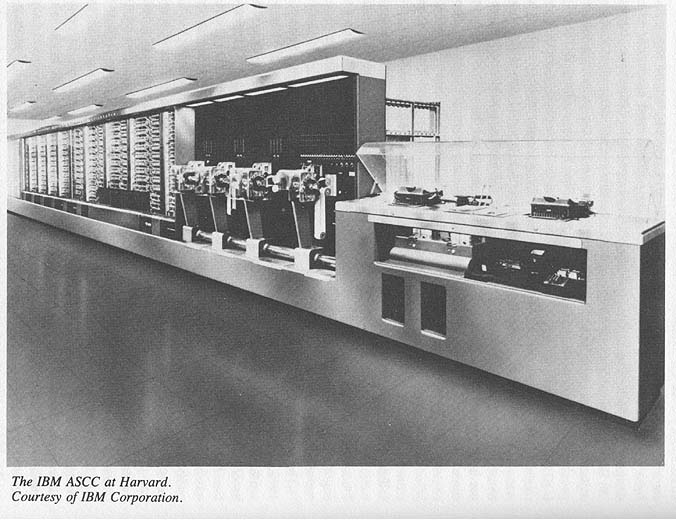
In the summer of 1944, the American press reported the waging of the war: grim news of battles in France, casualties, sacrifices and shortages at home. Among the stories on August 7 was another report that probably did not arouse much attention. On that day a large electromechanical computing machine was publicly unveiled at Harvard University, in a ceremony attended by the presidents of both Harvard and the IBM Corporation. The machine they dedicated that day was called the ASCC, short for Automatic Sequence Controlled Calculator; later it would be known as the Harvard Mark I as other similar devices appeared there. It was not really the first automatic computer. Zuse's Z3 was already in use by then, and there were other top-secret projects in America and Britain that also could have vied for that claim. But nonetheless its dedication is as good a moment as any to mark the beginning of the computer age, for it was on that summer day that the existence of the computer became public knowledge.2
| Reckoners, ASCC, page 0044 |
NUMERICAL METHODS OF SOLUTION
is given by the formula
| Reckoners, ASCC, page 0045 |
| Reckoners, ASCC, page 0046 |
| Reckoners, ASCC, page 0047 |
| Reckoners, ASCC, page 0048 |
0 000 000 000 000 . 000 000 000 00
^                 ^             ^
|                 |             |
sign	      decimal point 	two "guard digits" that would be rounded
0 = + , 9 = -                 off in the final answer
| Reckoners, ASCC, page 0049 |
| Reckoners, ASCC, page 0050 |
| Reckoners, ASCC, page 0051 |
punched into a card and computed and punched their product in the remaining columns of the card. (What was interesting about the 601 was that it computed products not by repeated addition, as most mechanical calculators did, but rather by looking up an internally stored multiplication table for the 10 x 10 decimal digits.) By the late 1940's they were working on replacing the electromechanical parts of the 601 with vacuum-tube circuits that could operate much faster. In 1942, under the direction of R. L. Palmer, they had developed a prototype "cross-footing" punch that multiplied electronically.11 Work on electronic computing circuits continued at a separate lab in New York City; after 1945, research and development of electronic devices was centered at a laboratory in Poughkeepsie, New York. (Endicott remained a center for electromechanical research and development.) When IBM unveiled their Type 603 Multiplier in 1946, it was one of the first commercial devices anywhere that calculated with electronic circuits. (The 603 could perform up to sixty multiplications per second, which was about a hundred times faster than the 601. )
| Reckoners, ASCC, page 0052 |
DESCRIPTION OF THE MARK I
The public dedication of the Mark I in 1944 brought a wide response from other mathematicians and engineers, who saw in it a way to solve problems they too were facing. So in contrast to other wartime projects that were kept strictly classified, the Harvard Computation Laboratory felt the need to provide a detailed description of the Mark I and how it was programmed. Only the specific military problems for which it was first used remained secret. Of course any publicity about the machine would also reflect upon the expertise of the IBM Corporation, even if they were not offering that kind of product to their customers.
| Reckoners, ASCC, page 0053 |
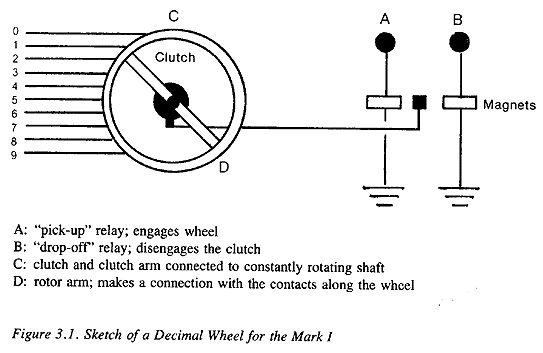
depending on their function. To add the number 6 to a register, an electrical signal would be routed through a six-lobed cam, which would pick up the clutch on the wheel for six units of time before dropping it off, while also keeping track of any carry digit produced.
| Reckoners, ASCC, page 0054 |
| Reckoners, ASCC, page 0055 |
      45793      45793
     -15342     +84657    the 9's complement of 15342
     ------     ------
      30451     130450
                   + 1    the end-around carry; the 1 at
                ------    the left-most column drops
                 30451    away
But if the result of a subtraction is a negative number, there is no
end-around carry produced at the left-most column. What happens instead is that the
digit 9 (which stood for - in the Mark 1) would appear in the sign-field, followed
by the complement of the true answer:
       5793      5793
     -15342    +84657     complement of 15342
     ------     -----
      -9549     90450     last four digits are the complement
                          of the difference = 9549

       sign digit = 9 no end-around carry
Accumulator 72 could detect when no end-around carry took place, and then it
would stop the machine. In that way, a function could be evaluated by
repeated iterations; after each cycle the value would be tested against a tolerance
value stored in cell 72. When the numerical accuracy of the Mark I exceeded that
tolerance, the machine would stop, "knowing" that further evaluation of the
function would not increase the accuracy of the result.17
| Reckoners, ASCC, page 0056 |
| Reckoners, ASCC, page 0057 |
          Decimal Digits-Up to 24 Columns
             0 1 2 3 4 5 6 7 8 9
   Line # -------------------------------
      4      0 0 0 0 1 0 0 1 0 1          v direction of tape movement [down]
      3      0 0 0 1 0 0 1 0 1 0
      2      0 0 1 0 0 1 0 0 1 1          1 = hole in tape; 0 = no hole
      1      0 1 0 0 0 1 1 1 0 0
The machine read the bottom line first, twenty-four columns across.22
| Reckoners, ASCC, page 0058 |
Table 3.1 THE IBM ASCC (HARVARD MARK I)
THE MARK I IN OPERATION
How the Mark I actually solved problems may be considered separately from
what it was physically made of; the latter is the machine's "anatomy,"
while the former is its "physiology." Although the Mark I's components were similar to
those of commercial business equipment, it obviously worked in a different
way. In fact, its physiology was remarkably similar to other contemporary
computers, even if they had completely different physical anatomies.
This so-called nested parenthetical form reduces the number of
multiplications from ten to only four, including one division. Inasmuch as multiplication is a
time-consuming operation, it is imperative that this form be used on any problem of
appreciable size.
ERROR CHECKING AND ACCURACY
Assuming the computer has successfully run through the sequence of
calculations and has printed out the successive values of x and f(x), the programmer now
faces the question of whether or not those results are accurate. The Mark I was an enormously
complicated device, containing three-quarters of a million individual parts. Even a
simple program like the one just listed would exercise many of those parts, and they all had to
function correctly if the answers were to be correct. Actually there are several
different ways that errors can occur, and for each a separate treatment may be required. In his
analysis of the reliability and accuracy of the Mark I, Aiken recognized four different
types of errors:
THE METHOD OF FINITE DIFFERENCES
Values of higher-order polynomials like the one given above may be
evaluated using only simple additions, once certain initial values have been calculated.
That was the secret of the Difference Engine: it could be mechanically simple, yet
mathematically sophisticated, by an ingenious linking of its wheels to one another.
for the integer values of x from 5 to 10:
Where n! is the product n(n-1) (n-2) (n-3). . .(1), Ax is the increment
value of x, and an is
the coefficient of the highest exponent of x. In the above example the
increment of x is 1, the coefficient is 1, and the degree is 4, so the fourth difference is 4!,
or 24.)
HOW THE MARK I WAS USED
The various magazine and newspaper articles which announced the dedication
of the Automatic Sequence Controlled Calculator in 1944 accurately described
its size, weight, storage capacity, and other physical specifications. But
they were necessarily vague as to the intended use for the computer. Most said only
that it would be used for classified problems by the Navy. Later accounts said that the Navy
used it "for ballistics and ship design. . . also... some problems in lens
design."39 No
doubt the ballistics work included the preparation of firing tables. The wartime need
for those tables was a major force behind the development of computers in the United States.
It was the sole purpose for which ENIAC was built. One other problem for which the
Mark I was used was "a highly secret, mathematical simulation of the first atomic
bomb." That calculation is still classified, but it might have been a calculation of
the bomb's blast effects.40
BESSEL FUNCTIONS
It was the desire to solve differential equations that started Howard Aiken
on his path to the design of an automatic computer. Such equations describe physical
phenomena in terms of a rate of change of a quantity that varies with time: hence the
name "differential." One particular differential equation arises frequently in the study of
vibration and periodic motion, and it involves not only rates of change but also second
derivatives, that is, rates of rates of change. This equation takes the form:
There are two families of solutions to this equation (since it contains a
second order derivative), and these are usually called solutions of the first and second
"kinds." For each kind there are many different solutions depending on the value of the
parameter n, which is usually a small positive integer but in fact may take on any positive real
value.42
POSTWAR COMPUTING AT HARVARD
The rift between Aiken and IBM that surfaced before the dedication ceremony
grew after the war. It was not just the dispute over whether the ASCC was to be
covered or not. Thomas Watson felt that Aiken was unwilling to share any credit for the
success of the project. In 1944 IBM was not the industrial giant it is today. Aiken felt
that the computer was his idea; whoever happened to build it was of little import. The
Harvard Lab continued building computers under Aiken's direction-but not with IBM's
help. (The Harvard machines took on the names "Mark I," "Mark Il," and so on.)48
Inventors: Howard Aiken, C. D. Lake, F. E. Hamilton, B. M. Durfee.
Place: Endicott, New York; moved to Cruft Laboratory, Harvard University;
then to the Harvard Computation Laboratory.
Dates: Proposed 1937; construction begun 1939; completed January, 1943;
placed in operation spring, 1944; dedicated August 7, 1944. In use until 1959.
Cost: $300,000-$500,000, exclusive of R & D.
Technology: Electromechanical, 3,000 decimal storage wheels. 1,400 rotary
dial switches, 500 miles of wire.
Size: 51' x 8' x 2'; 19 panels; weight 5 tons.
Number
Decimal system, 23 digits plus sign (0 = + , 9 = - );
provision for half- or double-precision arithmetic; subtraction by 9's
complements; parallel transfer of all numbers.
Memory: 72 accumulators; 60 constant registers (set by 10-position
switches); 3 value-tape readers.
Processor: Multiplier and divider, multiplication by table look-up; all
addition and subtraction done in accumulators; special circuits for log and
antilog (to base 10), sine, and interpolation of functions.
Programming: 1 sequence tape reader, using two-address code: out-field,
in-field, miscellaneous, other sequencing by plugboard; 1 "choice register"
and 1 "check register," allowing internal logical control.
Speed: Cycle time: 300msec. (one rotation of shaft); multiplication time
approx. 6
sec.
Input: 3 value-tape feeds, 2 card feeds, plugboard, switches.
Output: 1 card punch, 1 tape punch, 2 automatic typewriters.
Reckoners, ASCC, page 0059
      out-field      in-field      misc. or op-field

      _ _ _ _ _ 0 _ 0       _ _ _ _ _ 0 0 _      _0_ _ _ _ _ _ _
      8 7 6 5 4 3 2 1       8 7 6 5 4 3 2 1      8 7 6 5 4 3 2 1
Holes punched in columns three and one indicate the fifth accumulator; holes
punched in columns three and two indicate the sixth.26 Note how this coding
is different from the coding of the number tapes. The eight columns for the in-
and out-fields were more than enough to address the seventy-two accumulators,
sixty constant registers, and other devices.
Reckoners, ASCC, page 0060
Evaluate the polynomial
by successive multiplication, in the interval 5 <= x <= 10, with
Reckoners, ASCC, page 0061
Reckoners, ASCC, page 0062
Reckoners, ASCC, page 0063
x
F(x)
1st diff.
2nd diff.
3rd diff.
4th diff.
5th diff.
5 874.25
. . 913.75
6 .1788.00 . 540.5
. . 1454.25 . 174
7 3242.25 . 714.5 . 24
. . 2168.75 . 198 . 0
8 5411.00 . . 912.5 . 24
. . 3081.25 . 222
9 8492.25 . . 1134.5
. . 4215.75
10 12708.00
Reckoners, ASCC, page 0064
Half a century may probably elapse before any one without those aids which
I leave behind me, will attempt so unpromising a task. If, unwarned by my example,
any man shall undertake and shall succeed in really constructing an engine
embodying in itself the
whole of the executive department of mathematical analysis upon different
principles or by simpler mechanical means, I have no fear of leaving my reputation in his
charge, for he alone will be able to appreciate the nature of my efforts and the value of
their results.34
Howard Aiken chose that quotation to introduce the Manual of Operation of
the Mark I.
Reckoners, ASCC, page 0065
Reckoners, ASCC, page 0066
Reckoners, ASCC, page 0067
Reckoners, ASCC, page 0068
Reckoners, ASCC, page 0069
Reckoners, ASCC, page 0070
NOTES
Reckoners, ASCC, page 0071
Reckoners, ASCC, page 0072